


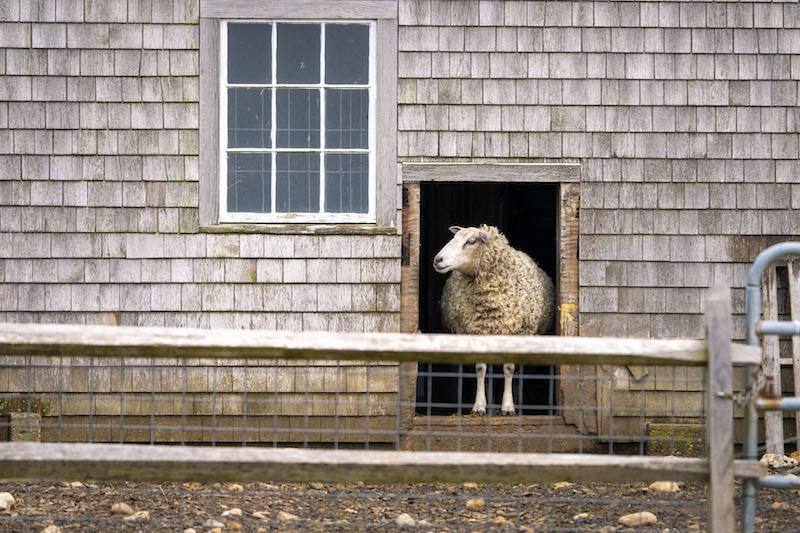
The Edgartown conservation commission is set to issue two separate requests for proposals that split the educational and agricultural uses of the historic Katama Farm.
Capping months of discussion, the Edgartown conservation commission is set to issue two separate requests for proposals that split the educational and agricultural uses of the historic Katama Farm, after the Trustees of Reservations vacate the property later this month.
The draft RFPs were drawn up by town counsel and the newly-formed Katama Farm stewardship committee, and will be likely released after approval by the full conservation commission in the coming days, according to town conservation agent Jane Varkonda.
In a press release that went out Tuesday and a follow-up interview, Ms. Varkonda said the town and stewardship committee had decided to separate leases for the use of the 180-acre farm and outbuildings early on in the long discussion process, and subsequently hammered out details regarding rent, use, utilities and other elements of the iconic farm property.
“The early discussion was whether we do two separate RFPs, or just one. And that was decided pretty quickly,” Ms. Varkonda said. “The rest of it has sort of been input from Island farmers, requesting land for start-up farming, community gardening, and how to divvy up the property.”
Situated in the heart of the Katama plains, the town-owned farm has had a series of tenants over the past half century, ranging from dairy and beef farmers to vegetable cultivators on its prime loamy topsoil. About four years ago, the Trustees took over the lease for the property after merging with former occupant The Farm Institute, taking over the farm operation as well as educational programming that included a popular summer camp.
But the town issued an eviction notice to the Trustees last summer after simmering issues over violations of the farm management plan remained unresolved. The eviction was later stayed to give the Trustees time to wrap up operations at the farm and move out by the end of this month.
Meanwhile, the conservation commission opened up a broader discussion about the property’s future, with one central issue being whether a single entity could feasibly operate both the agricultural and educational components of the property.
That question was addressed by the stewardship committee, which formed in late fall of 2020 and included a mix of conservation commission members, abutters, Island farmers and Dr. Rachel Gilker, a farming and ecological consultant. The committee met weekly, with approximately 15 to 20 people in attendance, Ms. Varkonda said.
According to copies of draft RFPs provided to the Gazette, the lease for educational use of the property covers approximately 32 acres as well as a newly-renovated building with a commercial kitchen. The lease would run for five years at a rate of $15,000 annually, and requires the tenant to operate educational programming with a focus on farming or agriculture.
The farm lease covers the rest of the property and other outbuildings, and runs for 10 years, at a rate of $3,018, or $20 per acre annually.
In November, the conservation commission issued a preliminary request for expression of interest in both uses of the property. Slough Farm and The Trustees expressed interest in the educational lease, while Grey Barn and the Athearn family, which owns Morning Glory Farm, as well as a third independent farmer, all expressed interest in the agricultural lease.
Ms. Varkonda said despite the eviction, The Trustees are welcome to apply for the educational lease. She said the conservation commission would also consider proposals from a single entity for both the educational and agricultural uses, but was unaware of any such interest yet.
“It is plausible that one or two entities could be awarded the RFP and subsequent leases for operating the farm,” the press release said. “The goal is to select operators for Katama Farm that will continue the legacy of farming at this facility, be a valuable partner within the farming community and to continue to enhance and develop the educational component of a teaching farm.”
The conservation commission hopes the next chapter will prove successful for the farm
“Right now it’s the great unknown out there,” Ms. Varkonda said. “We won’t know until we put out the RFPs.”
Comments
What’s an rfp
ItsyWhat’s an rfp
Request for Proposals. It's
Juliet Mulinare EdgartownRequest for Proposals. It's the State required procurement process to lease publicly owned property.
request for proposal: rfp
Pete G. Edgartownrequest for proposal: rfp
It would be great to see
Gabrielle west tisburyIt would be great to see something much more community minded, such as community gardens or access to the commercial kitchen. This could be a very exciting project, lets do something new! I am pretty sure the Grey Barn and Athearns are very lucky with their current operations.
Wow, if that is prime loam
Lorraine EdgartownWow, if that is prime loam farmland, that price quoted is low. Prime New England farm land lease prices can go for $300 per acre per year. Midwest and west farmland can go for much more than that. What about allotments for island families who do not have land to grow food? Allotments are popular in this country and in other countries and would be a way for people to be come more independent with their food supply. With the conversations about food insecurity, allotments would be a wonderful idea.
I don't think this is about
ECS Ft Lauderdale / EdgartownI don't think this is about making as much money as possible; its should be more about having a continuing farming operation in place with quality entity. The Vineyard location creates certain fairly obvious restriction so comparing off island rental rates seems to be an exercise of marginal value. It seems Morning Glory or any other farm operator would be a viable candidate. MG is next door which is a operational cost advantage to them. The education aspect is nice but its a farm and that should be the primary focus.
It strikes me as well that
Carol Oak BluffsIt strikes me as well that the asking price for the leases are very low - including for the 32 acres with upgraded building for $15k annually. I personally have donated thousands of dollars for the upgrading of that building and kitchen and would love to see cooking classes for any one who signs up - for a reasonable fee, and take home what you make!
Add new comment