


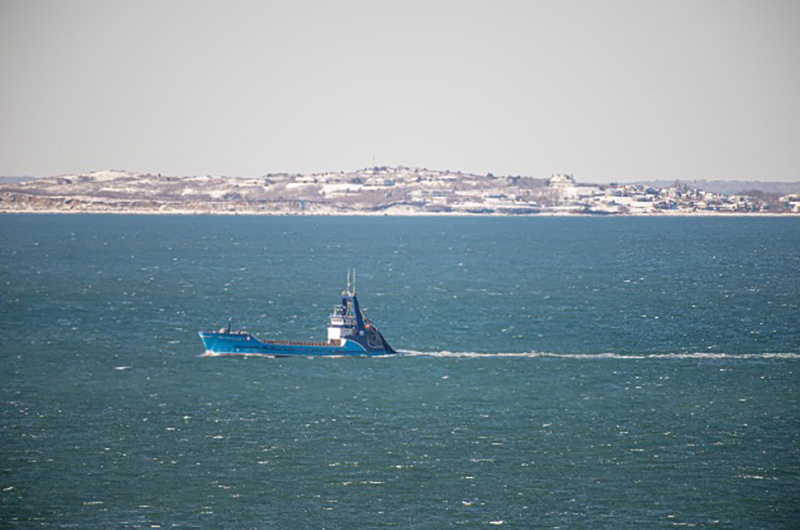
A sweeping new state report on ocean acidification recommends legislators take immediate steps to mitigate the impacts on the state aquaculture industry.
A sweeping new state report on ocean acidification in the commonwealth recommends legislators urgently update pollution regulations and take other immediate steps to mitigate the impacts of acidifying waters on the growing — but threatened — state aquaculture industry.
Led by Cape and Islands Rep. Dylan Fernandes and state Sen. Julian Cyr, an 18-member state commission compiled the report over the past year, meeting nearly 30 times with scientists from the Woods Hole Oceanographic Institution, the New England Aquarium and The Nature Conservancy.
The final 84-page report was released Tuesday morning, detailing in stark language the threats posed by a rapidly acidifying ocean and the recommended steps to combat it.
In a presentation Tuesday morning, Mr. Cyr and Mr. Fernandes, along with researchers and scientists from WHOI and the New England Aquarium, said the report lays out a 15-year plan for state efforts to fight ocean acidification.
“Our commission was not to fix the global climate crisis — I wish we could,” Mr. Fernandes said. “It was really to tackle what Massachusetts can control in our coastal waterways. And our report reflects that commitment to mitigating acidification resulting from local nutrient pollution.”
According to the report, Massachusetts waters will be disproportionately affected by ocean acidification, with acidity doubling by 2100 due to carbon emissions and septic runoff. In southeastern Massachusetts, including the Vineyard, the acidification process has been accelerated by septic systems and wastewater runoff, according to the report.
The impacts of a more acidic ocean are particularly dire for the state’s $450 million shellfishing industry, threatening the health of sea scallops, eastern oysters and other mollusks. As the pH of ocean water decreases, shellfish have a harder time surviving and form weaker shells, the report concludes.
“All models agree that shellfishing economies will suffer as a result of ocean acidification. The degree of harm that occurs will depend on the extent of mitigation efforts undertaken now,” the report says.
Recommendations in the report include immediate legislative action to establish more state grant funding for threatened coastal towns through a so-called Blue Communities Program. In the same way the state’s Green Communities Division incentivizes towns to build green infrastructure, the program would require municipalities to adopt zoning changes for future development that reduce storm water and agricultural runoff.
The report also suggests creating a real-time, statewide ocean acidity monitoring system so shellfishermen and aquaculture farmers can respond to changing pH levels in the water, as well as introducing legislation to form an ocean acidification council and trust.
“This process is very urgent,” Mr. Fernandes said. “We can’t make any process on ocean acidification if we aren’t adequately tracking it.”
Mr. Cyr emphasized the need to act fast to address the wastewater problem, saying that the Cape had been historically lackadaisical, particularly in the high development years of the 1970s and 1980s. But he pointed to new measures, like a 2.75 per cent room occupancy fee to help fund wastewater improvements, as steps in the right direction.
“Have we been too slow? Absolutely. Are we moving a heck of a lot faster now? Yes,” he said. “I think that’s really thanks to the real collaborative approach and leadership the region has taken.”
The presentation Tuesday included testimony from Seth Garfield, president of the state aquaculture association, Steve Kirk, coastal program manager for The Nature Conservancy and scientists and program directors from WHOI and the New England Aquarium.
Mr. Fernandes concluded by saying it was time to take the report to the state house floor, with the first course of action the creation of a standing fund used to mitigate ocean acidification.
“We can begin to translate these findings into action,” he said.
Comments
Is there any technology that
questionIs there any technology that exists that can de-acidify our oceans safely?
We need more alternative
Jim EdgartownWe need more alternative energy..electric cars, wind turbines, solar panels. People like John Kerry are leading the way to clean energy
Yes, that is what we need - a
Carol formerly ChilmarkYes, that is what we need - a rapid transition to zero carbon energy - the high CO2 in the atmosphere is what's acidifying the oceans. We need to move fast.
I can say from personal experience that once you get an electric car, you'll never go back to gas. Much better pickup, zero maintenance costs (tires & wiper blades, that's it), & about 1/10 the fueling costs - and no need to touch some gross public gas pump that 100 other people touched today. Just plug it in & charge at home, like a cell phone.
By flying around in a private
Bob OBBy flying around in a private jet?
Yes, wastewater treatment
Steve FalmouthYes, wastewater treatment instead of septic systems.
Wastewater has nothing to do
Dan OBWastewater has nothing to do with acidification, you are mistaking it with Nitrification.
A very serious problem and an
Frank Brunelle Vineyard HavenA very serious problem and an article about ocean acidification is appropriate mainly for how our pond shell fishing industry is impacted as we cannot on a local level make a dent in the ocean problems. But we can through our local boards do certain things like planting red cedar trees on the slope of the M.V. Museum overlooking Lagoon pond. This would be a major step as these trees are excellent absorbers of water. We could impose strict measures against cutting shade and old growth trees. Also, we could encourage in general wildflowers instead of lawns and this would reduce pollution from fertilizers, water runoff, noise pollution from equipment used to manage lawns, diesel and gas fumes from trucks used to move men and equipment and so on.
Its a huge world and we can
fact checker edgIts a huge world and we can do our part but if China India Russia and the rest of the world polluters don't do their part its pointless.
No. It’s not pointless.
Kelce OBNo. It’s not pointless. Every bit helps. You’d prefer to do nothing? Showing leadership is better.
"As the pH of ocean water
Tim Boland West Tisbury"As the pH of ocean water rises, shellfish have a harder time surviving and form weaker shells, the report concludes." This should say the pH of ocean water decreases.
Thanks Tim, the story has
EditorThanks Tim, the story has been corrected.
I bought a Telsa to do my
Jamie EdgartownI bought a Telsa to do my part. It was an upgrade to my Prius. Glad to see all cars and trucks to be Electric in the future. Next small engines lawn mowers etc.. together we can do this.
The cost of an electric car
ZephyrThe cost of an electric car is far out of my reach and that of many others, and those of us who rent and have to move (the Vineyard Shuffle) every year don't have any place to charge. Couple that with my need to drive to remote places where there is no charging--in fact no electric power--and an electric vehicle is currently hopeless. Nobody wants to buy an old electric car when the battery needs to be replaced, so that is going to make those of us who depend on old vehicles still using ICE even if we had a place to charge up, which we don't.
Actually a lot of
Tom EdgartownActually a lot of manufacturers now have warranties on their batteries that are much longer than you'd expect. Some have lifetime warranties, some are a million miles. I have some neighbors who use extension cords to charge their car. It's not a built in garage charging station, but it works. My only personal worry would be for off island use. If you want to drive a long distance...if you need to go beyond the car's range...usually 300+ miles, you need to plan your trip to charge up somewhere along the way which is kind of strange.
There are options ... public
Jim EdgartownThere are options ... public transportation..
Add new comment