

Real estate sales on Martha's Vineyard soared past the $1 billion threshold for the first time in 2020, shattering previous records as a bull market for homes shows no sign of abating
Real estate sales on Martha’s Vineyard soared past the $1 billion threshold for the first time in 2020, shattering previous records as an unprecedented bull market for homes, buoyed by the pandemic, shows no signs of abating.
According to year-end data compiled from the Dukes County Registry of Deeds, the Island finished 2020 with a total sales volume of $1.09 billion, not including the month of March. Data from LINK, the Island’s primary multiple listing service, shows that the Island also broke records in number of transactions and median selling price, as well as records regarding the price, and volume, of land sales.
The eye-popping year-end data comes despite a nearly complete freeze of the market when the pandemic hit in March and April. But the market rallied in the late summer and early fall — and barnstormed through the winter — posting the best September and December in history. The previous sales volume record was in 2017, according to LINK, when the Island tallied $670 million in real estate sales.
Sky-high sales bring even more worry about affordable housing shortage on-Island.
Sky-high sales bring even more worry about affordable housing shortage on-Island.
Passing the $1 billion mark in 2020 marks a 38 per cent increase over that all-time record.
“We’ve never approached $1 billion,” said LINK founder and president Debra Taylor. “That’s significant.”
The question now is whether the Island will ever go back.
“We kept thinking this will iron out. We thought maybe this was a deviation from the norm,” Ms. Taylor said. “And it appears, based from what I’m hearing from other agents, too, is that this could be our new normal for a while.”
Always robust, the Island’s real estate market put on rocket boosters in late summer, as the pandemic heightened the appeal of rural second homes and seasonal communities for buyers, according to brokers. The perceived safety of an Island, combined with the new business trend of working from home, prompted properties to start flying off the market at record-setting prices.
Year-end data shows that the Vineyard would have actually broken its sales volume record if only the months between August and December were counted, with $750 million in sales recorded during that quarter alone. September through December each saw more than $120 million in sales volume, driving the year-end growth.
“By September, it was really clear that this is not a one-time blip,” Ms. Taylor said. “A lot of things happened, including people realizing the benefit of traveling locally and the work-from-home trend continuing.”
And despite inventory getting hollowed out — it is currently at its lowest level since pre-2019, with only 247 listings on LINK — there are few signs that gross revenue will decline, as skyrocketing prices more than offset the lack of availability.
Ms. Taylor described the current market as “price insensitive,” inspiring long-time homeowners, otherwise uninterested in selling, to do so.
Already overheated, real estate market has exploded in recent months.
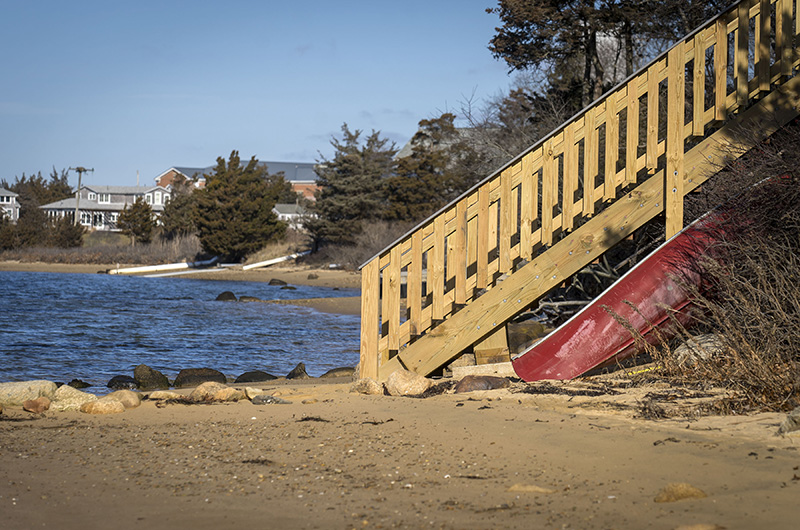
Already overheated, real estate market has exploded in recent months.
“There have been purchases of properties that were never really for sale. Homeowners got these crazy high offers and couldn’t refuse,” Ms. Taylor said. “People want what they want, and cost is not a factor.”
The Island saw a total of 542 sales in 2020, up 24 per cent from the previous 2017 record of 438. The Island also saw a record median selling price of $1.15 million, reflecting a 31 per cent increase from 2019’s previous record, according to LINK. The Island had never had a median selling price over $1 million before 2020.
All Island towns except Chilmark set records for median sale price, with Edgartown leading the pack at $1.5 million. Both Oak Bluffs and Vineyard Haven saw median sale prices rise to more than $840,000.
The rise in home sale prices came in tandem with a rise in the price of land. Ms. Taylor said the price of land is at an all-time high, adding increased pressures on a market that now has a floor where there once was a ceiling.
“A lot of these prices don’t even make sense,” Ms. Taylor said. “We saw the land transactions, and were like, wow. It changes the game if someone is paying $1 million for an acre or two in Edgartown, rather than $300,000. You aren’t going to build a $600,000 home on that property. You are going to build a multi-million dollar home.”
The high prices have also squeezed the already-scarce options for year-round housing, with almost nothing available for less than $700,000.
“It certainly crowds out the affordable housing market,” Ms. Taylor said.

Little inventory is left.
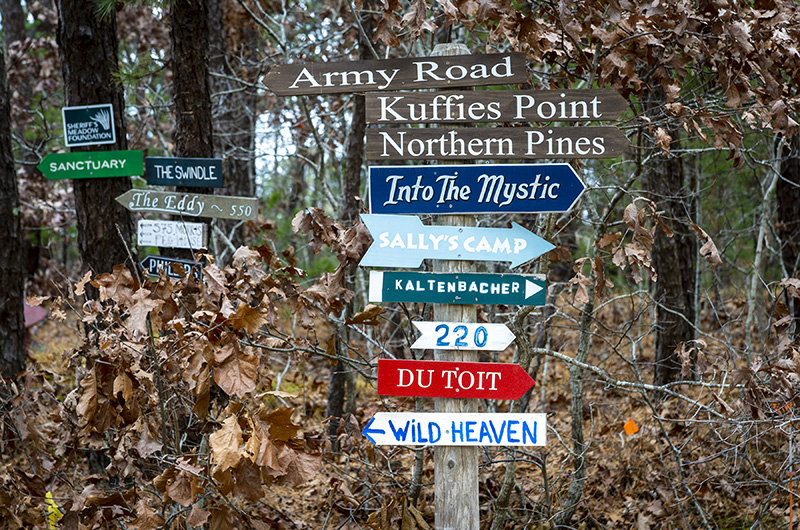
Little inventory is left.
The Vineyard’s sister island of Nantucket has seen an even more dramatic increase in its real estate market. Traditionally about twice as expensive as the Vineyard, Nantucket surpassed the $2 billion threshold for the first time in 2020, with median home prices hovering around $2 million. The previous record for total sales volume on Nantucket doubled in 2020.
“Both Islands are experiencing this frenetic, nonstop activity,” Ms. Taylor said. “Agents on both Islands have not come up for air. And the buyer behavior is the same.”
The Martha’s Vineyard Land Bank brought in record revenues during 2020 as well.
In Ms. Taylor’s view, the market has been lifted by a variety of factors that have worked in tandem with the pandemic, including an increase in Boston’s luxury home market, heightened interest in homes over $4 million, and a disinterest in flying to far-off locales, making the Vineyard — driveable from Boston and New York — more appealing.
Ms. Taylor said she was not anticipating any price-softening post-Covid, saying that people were making generational investments in the market on-Island in ways that sustain long-term growth.
“Was this just a Covid response to travel restrictions, or will this sustain in 2021 and going forward?” Ms. Taylor said. “I don’t have the crystal ball. But all I can say is that the pace has been unabated . . . and there are fundamental long-term trends that support a robust market.”
Comments
Great to see a healthy real
Mark EdgartownGreat to see a healthy real estate market. Now the towns should do the right thing and reduce property tax rates given the increasing home valuations.
Omg, are you actually
Paul EdgartownOmg, are you actually complaining about your tax rate?! What is it? $4 per $1000? You’ve got one of the cheapest tax rates around and you still want to complain? What a joke.
V.H. Is $9.45 per 1000
Maggie V.H.V.H. Is $9.45 per 1000
Good luck with that one...
Jim EdgartownGood luck with that one...
Valuations and tax rates mean
Bob EdgartownValuations and tax rates mean little they are just a product of the appetite of government spending. The only way you’re going to reduce taxes is by reducing government. Take a look at our public sector and the number of police officers, police vehicles, the size of our municipal buildings be them a Town Hall, Library, Schools and all the shiny new toys all our departments have. The increase in employment by the public sector creates long lasting tax implications. The salaries of department heads all wanting to make at least 100,000 to upwards of over $150,000 a year It’s all real money and sees no end in escalation. It is payroll and benefits to the public sector across the island that is getting unrealistic and that’s what drives up our taxes. Same is true across the country Time to end the guaranteed pension which is killing the whole country. The towns the public sector needs to be on 401(k)s like the rest of America. All new hires should be treated differently in regards to pensions. All current employees continue under the existing system. Only by the towns curbing their enthusiasm for spending money can reduce our taxes.
My math could be wrong but
Bob Vineyard HavenMy math could be wrong but assuming that everyone’s assessment goes up by the same percentage each homeowner will still pay the same property tax. Of course town budgets don’t work that way. [I’m fortunate to own my home. Yes, I know I can move away any time I want.]. In 2000: taxes $3,000. Valuation $220,000. 2020: $7,600. Valuation $800,000. Nothing has changed with the house in those 20 years.
This is heart breaking for
That’s too bad Martha’s VineyardThis is heart breaking for the hard working people on this island who are trying so desperately to just make a home here. If this continues there will be no one working on this island anymore to cater to the wealthy who have taken over. Who will teach our children? Who will run our restaurants? Who will sort our mail? Who will build, paint and repair these massive homes? These are the types of people that are being pushed out and these are the types of people we need to survive.
Sorry but it’s over. Families
Slater MVSorry but it’s over. Families that have raised generations on the island are pulling up stakes, but at least the rich and famous will have their fantasy island. Poor Martha.
I apologize for repeating
Jim feiner ChilmarkI apologize for repeating myself. But everything on Martha’s Vineyard is protected except for the people. We have done too little to support the Island community over the past 30 years as we watched the housing crisis increase exponentially. Playing catch-up is always much harder.
At this juncture, the only option I see for us to create a healthy and protected community on Martha’s Vineyard is to do everything at the same time. There is no one thing that will fix this runaway problem.
The solutions require, albeit demand the community coming together to create momentum and implement a multi faceted approach which includes a housing bank, the creation of multi family and higher density zoning in every town. We are facing the reality that some of the changes necessary may be things that we don’t love such as an apartment building or larger multi family structures However, with construction costs and land values through the roof, bigger projects have an economy of scale necessary to keep costs down. Also encouraging our sellers on the low end to work with the island buyers first could help.
I believe the island can and will come together and make these Important changes, but it takes a village! It’s time to stop waiting for people to fix the problem for us and for all of us to become part of the solution.
Well said sir! I do find it
Rebecca Oak BluffsWell said sir! I do find it interesting that our palates don’t seem to mind massive multi-million dollar homes, but an equally sized multi family residence becomes unsightly
Gross.
Prudy Burt West TisburyGross.
Took the word right out of my
Molly West TisburyTook the word right out of my mouth.
Thank you Prudy , exactly!
Linda W.T.Thank you Prudy , exactly!
I'm going to throw up.
Walter AquinnahI'm going to throw up.
While the article boasts
Depressing news Martha's VineyardWhile the article boasts celebratory pats on the backs, the rise of the monetary value attributed to land and real estate on the Island is one of the most depressing pieces of news I've heard this week. If there were a housing bank in place to capture some existing community benefit of the "$1M per 1 acre" price tags then it would be another story. However, there isn't, so a subsequent story to this article should be the effect on existing Island-born residents who are still doing the Island shuffle and have no inheritance land to speak of. The question we should be asking is not how much money did we make this year but who is building these properties? And how are they going to change the rich social and historical dynamics of the Island. This happens far too often, the rich and the wealthy take over as if money isn't a factor. We (as a society) succumb to money and give away our hand and foot in the name of an arbitrary value. What happens to the existing residents and community once the floor for buying an acre of land becomes $1M. It's about time we start considering what this will actually mean and holding them responsible for any adverse effects (social, environmental, or otherwise) they cause.
Never a clear example of "let
L Diddy Rockville, MDNever a clear example of "let them eat cake" or "fiddling while Rome Burns." In one of the worst periods in American history, somehow the luxury real estate seems to be thriving. A sad commentary on America.
...and then there are those
skip OB...and then there are those historically low mortgage rates hovering in the 3 - 4% range
How many island families
B WTHow many island families could have been housed if just a single percent of the qualifying real estate transactions had been reallocated from land bank fees to an affordable housing fee? Based on the nearly $20 million in land bank revenues for 2020, it would have been about $5 mill. In a single year. How many families could be permanently housed on MV with $5 million?
We vote and the tax base does
Islander Up IslandWe vote and the tax base does not. We can set policy in ways that makes it advantageous/attractive for islanders to own. The island was once owned by our ancestors and the tribe. They all choose to sell at some point in the past and reaped the benefit for themselves leaving their descendants with not much.
Please allow me to give you
Dana Nunes ChilmarkPlease allow me to give you an example from a little island on the other side of the world. Waiheke Island is as similarly distanced from the coast of Auckland, New Zealand, as we are from Woods Hole. For many years it was a haven for artists and musicians and others who were quite comfortable without all of the amenities. Hippies, if you will. When a regular ferry system arrived, of course things changed. The island was now accessible to any who desired. Waiheke is a stunning place, with much grander topography than Martha’s Vineyard: soaring green hills, deep valleys, spectacular water views, beaches all accessible to the public, and, as it turns out, perfect soil and climate for growing wine grapes. When we first visited seven years ago, the island was already quite built up, with what looks like 5 foot setbacks. Once beautiful hills rising from the beach are now completely covered with houses, and the many vineyards on the island have taken large swaths of land, and entice the super wealthy with wine festival’s, etc. We hear a familiar plaint from the remaining locals: it’s getting harder and harder to stay as the wealthy move in and can afford much more then they can even dream. Because the vineyards provide limited housing for their staff, many of the workers sleep rough wherever they can. That means camping out in cars, tents or, if they’re lucky enough, camper vans. We were told early on that if they find a quiet, out-of-the-way place to sleep, no one cares. The local council turns a blind eye to this because so much money is involved. The wealthy arrivals want their houses cleaned, their wine poured, their grapes picked but they don’t really want to consider those who are going to be doing this work. Sounds familiar, except that their workers get paid the national minimum-wage of $15 an hour.
Here on MV, when I look across Menemsha Pond from my one-room cottage at night, the low hills on the other side are dotted with increasingly more lights than I could have imagined possible, and I think of Waiheke; how very much we (sadly) have in common.
Add new comment