

A months-long surge in coronavirus cases has hit record highs on the Vineyard in the past week, stretching the Island’s public health infrastructure.
A months-long surge in coronavirus cases has hit record highs on the Vineyard in the past week, stretching the Island’s public health infrastructure as officials scramble to contact-trace, treat and manage the unceasing caseload.
The Island recorded its highest running 14-day total number of cases on Monday at 168, and likely has the highest number of currently active cases, hospitalized cases and symptomatic cases since the pandemic began, with 94 active cases reported last Friday. State Department of Public Health data also shows that Dukes and Nantucket counties, once the best in the state with regard to Covid-19 spread, now have the third-highest incident rate in the commonwealth and an 8.5 per cent positivity rate.
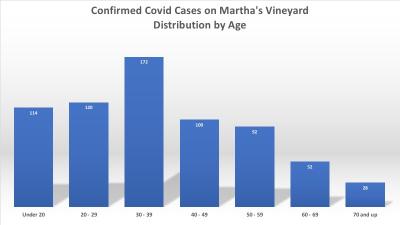
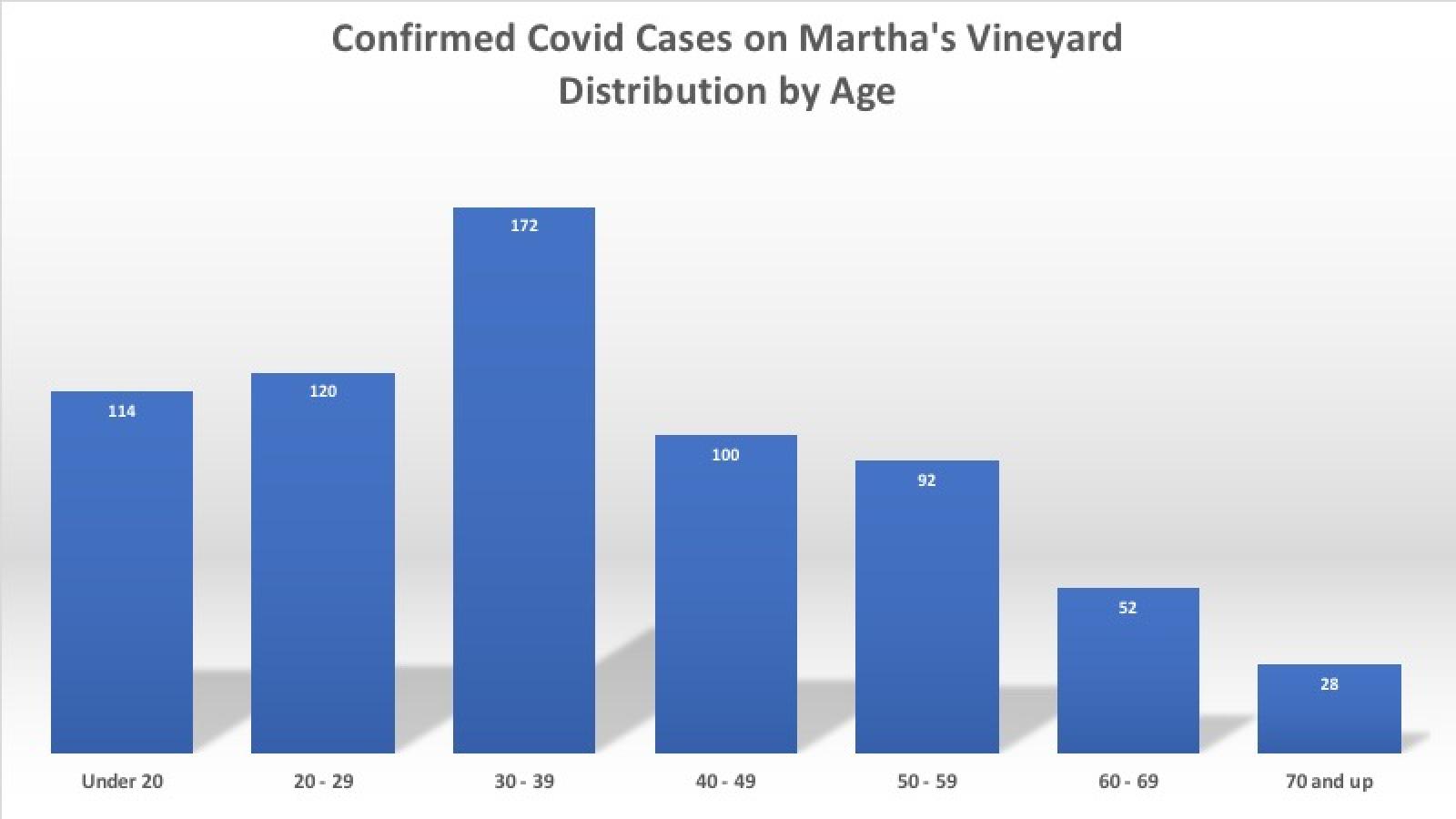
Age distribution of all those who have tested positive on the Island for Covid-19 since March 2020.
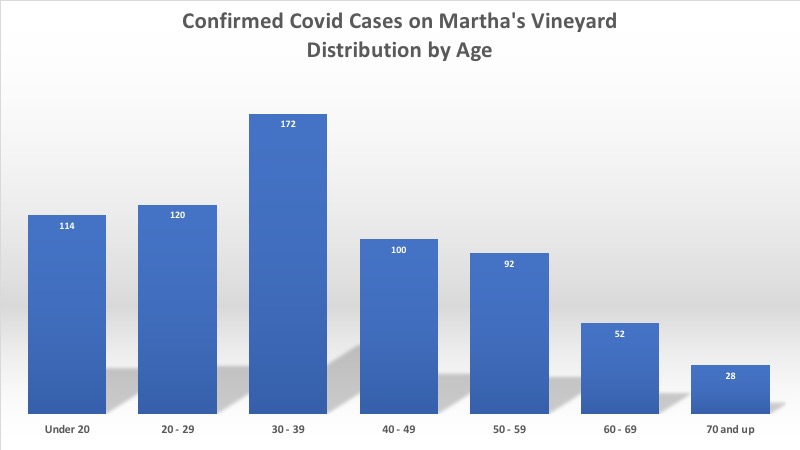
Age distribution of all those who have tested positive on the Island for Covid-19 since March 2020.
Health agents have had to hire new contact tracers to keep up with the caseload or even refer patients to the state. They also said that transmission is no longer contained to specific industries, as it was back during the Vineyard’s initial spike in October and November, but is occurring across all sectors of the Island.
“Spread is happening everywhere,” Tisbury health agent Maura Valley said.
The deluge of cases comes just as health officials are simultaneously ramping up a still-early vaccination program on the Island and preparing for the future. All of the Windemere long-term care and nursing facility residents received the first dose of vaccine on Tuesday, and the Martha’s Vineyard Hospital plans to hold its first vaccine clinic for 250 public safety officials and first responders on Friday.
More than 400 hospital and Island Health Care staff have been vaccinated, and 100 have received their second dose.
But in interviews this week, public health and hospital officials cautioned that with vaccinations for the general public not expected until the spring, there could be long, cold months ahead as the Island tries to hunker down and cope with unprecedented viral transmission. There are currently two patients hospitalized with the virus, both in fair condition, and one patient in serious condition who was emergency airlifted to Boston on Tuesday evening.
“These numbers are absolutely numbing,” hospital president and CEO Denise Schepici said at a press briefing Wednesday morning.
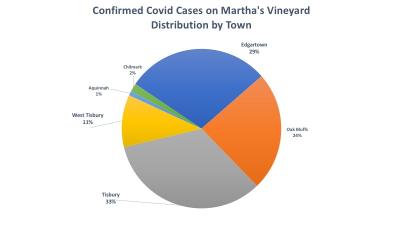
Home towns of the 680 people who have tested positive for Covid-19 on the Island since March 2020.

Home towns of the 680 people who have tested positive for Covid-19 on the Island since March 2020.
Describing the spread, Chilmark health agent and contact-tracer Marina Lent said in an interview that it has become extremely difficult to trace the root of virus cases on the Island, with a large number stemming from travel and even more from household spread — but by no means all.
“The obvious standout is households, because it is exposure over time, and it’s indoor exposure,” Ms. Lent said. “So household transmission is the most common direct link that we can make, and we’ve seen an increase.”
Approximately 40 per cent of all 680 Island cases have been linked to a family, household or close social group member, according to data provided by Island health agents. But that still leaves approximately 60 per cent of Island cases of unknow origin.
Tisbury health agent Maura Valley described the mystery.
“A lot of people say they are being very careful, conscious of what they are doing, and have no idea where they got it,” Ms. Valley said. “It’s spreading in family groups, or smaller social groups, and that makes sense. It’s easy to say these kids got it from mom or dad. But where did mom or dad get it? I have no clue. It’s community spread, and it’s very hard to pinpoint where the contact happened.”
When cases first started to surge in October, many were contact-traced back to construction and trades. Officials said that’s no longer the case.
“It’s not just the trades,” Ms. Lent said. “It’s diffuse by now.”
A portion of the recent spike over the past few weeks has been connected to specific families and case groupings that resulted from holiday travel.
“The holiday has been palpable,” Ms. Lent said. “There was a certain Christmas effect.”
There have also been a few incidents of specific social gatherings leading to cases, such as an 11-case cluster connected to a Bible study group, but Ms. Lent said those incidents have been rare — even as cases reached a record peak on Monday.
“Very little spread has been through frivolous risk,” Ms. Lent said. “The measures we have put in place dramatically reduce the risk, but they do not eliminate the risk. You can have been doing everything right, and get the disease.”
Island Health Care and the five health agents have collaborated on contact-tracing since early on in the pandemic. But when case numbers spiked in the fall, health agents quickly realized they needed more manpower than IHC’s two dogged, but only human, public health nurses.
Expecting a surge in the summer and not seeing one, the fall case spike took health agents by surprise.
“We were not expecting what hit us in October,” Ms. Lent said. “We were shocked.”
The vast majority — more than 80 per cent — of the Island's cases have come in the recent three months.
“The big surprise was how long it took for our case numbers to start rising,” Ms. Lent said. “We are by no means the hardest hit community. But we are by no means exempt.”
Since then, officials have made at least five new hires, Ms. Lent said, helping them navigate a complicated tracing process that involves calling patients repeatedly and coordinating with their schools and employers, which are required to share close contacts.
“The style of contact tracing on Martha’s Vineyard is different than some places off-Island,” Ms. Lent said. “We are very hands-on, and willing to talk about various aspects of the person’s immediate experience and engage with all kinds of questions they may have. Other places are more impersonal.”
But in recent weeks caseloads have piled up, prompting health agents to schedule a structured, daily routine and develop a texting system to contact patients. This weekend, they had to refer patients to the state’s contact tracing collaborative in order to keep up with the constant drumbeat of new cases, Ms. Valley said.
“We have definitely had to adjust,” Ms. Lent said. “When we had a low caseload, it was possible for us all to be involved, and to communicate freely about each and every case in detail, and to glean good advice from everybody. And now we have had to really systematize, and draw in more contact tracers, and come up with a routine.”
Ms. Lent didn’t expect the case numbers to abate any time soon, even as the vaccine becomes more widespread. Vaccinated patients can still transmit the virus, and Ms. Lent said that she hoped a shot in the arm wouldn’t make people feel invincible, with mask-wearing and social distancing still crucial, and case counts worse than ever.
“The vaccine is not immediate release,” Ms. Lent said. “We’re all so eager to get the vaccine and see the light at the end of the tunnel. Not yet."
Comments
“Very little spread has been
Rita Edgartown“Very little spread has been through frivolous risk.”
How can that be known, since approximately 60% of island cases have unknown sources of infection?
This statement seems to conflict with the rest of the article and with other statements made by MV public health representatives. I’m glad they’re being creative & established a process of using text messages,
I can already hear the justifications from folks who’ve been taking those frivolous risks. “It’s ok for me to do this. The health department said it’s had little consequence.”
Contact tracing: it was very nice that our contact tracers were able to spend more time speaking with folks, helping them feel like they weren’t alone.
The Island was packed with
John Cape CodThe Island was packed with off people from many states during the summer month's yet positive cases were low and no deaths resulted. So why isn't there an explanation as to why there was no surge in the summer month's yet with a low year round population the case's are surging every day since Mid October ?
Great question!
Just Curious West TisburyGreat question!
What does the science say...?
There is an explanation -
SamThere is an explanation - people were distanced outside in the summer, making it less likely for Covid to spread. We had a super spreader event in October that started the cases on the Island and they haven't stopped. As people go indoors, the transmission capability increases and more people are spreading it between households and within the work force. Our year-round population is definitely higher than normal as well. People moved here last winter/spring and never left.
My family is one who moved
KM OBMy family is one who moved here in the late spring and never left. We came from NYC, which was then a global epicenter. It was horrifying - anybody who lived with that experience knows how to behave.
I suspect most of it comes from pandemic fatigue and more indoor gatherings as the weather has cooled.
As it was in NYC early on when we had no real idea of how covid spread and what surfaces the virus survived on, we need to remain extremely careful. We all know by now what we have to do. Thank god there are better treatments now. Please take care.
Sorry but I disagree as
John Cape CodSorry but I disagree as crowds of people were everywhere on the Island & the ferries this past summer with most not following the guidelines and being in close distance to each other. Also Islanders & workers travel back and forth to the mainland daily year round as well but yet cases remained low until October. If you go back and read all the MV Gazette letters from March through the late summer it clearly shows what was happening Island wide in regards to people not following mask guidelines and distancing, so there has to be a better explanation than what you stated.
I bet if an island outdoor
Local MVYI bet if an island outdoor temperature chart was overlaid on this story’s chart along with a vertical line marking the holidays, there is a high correlation.
Does humidity play a role in
Jake AquinnahDoes humidity play a role in this? This virus is airborne and with high humidity in the Summer the virus does not linger in the air and travels less distance. The fall and winter season has low humidity and the virus seems to last longer and travel greater distance. Are there any studies on this? I'm surprised that humidifiers are not recommended to combat indoor spread. I could be wrong, but it seems to make sense. What do you think?
Jake, this article from WAPO
Mr. B ChilmarkJake, this article from WAPO in mid-November speaks to and confirms your suspicions regarding humidity.
https://www.washingtonpost.com/opinions/2020/11/18/winter-covid-19-humi…
Good point Jake as Arizona
Mike Lower CapeGood point Jake as Arizona with its super dry weather is the epicenter in the US now
Add new comment