


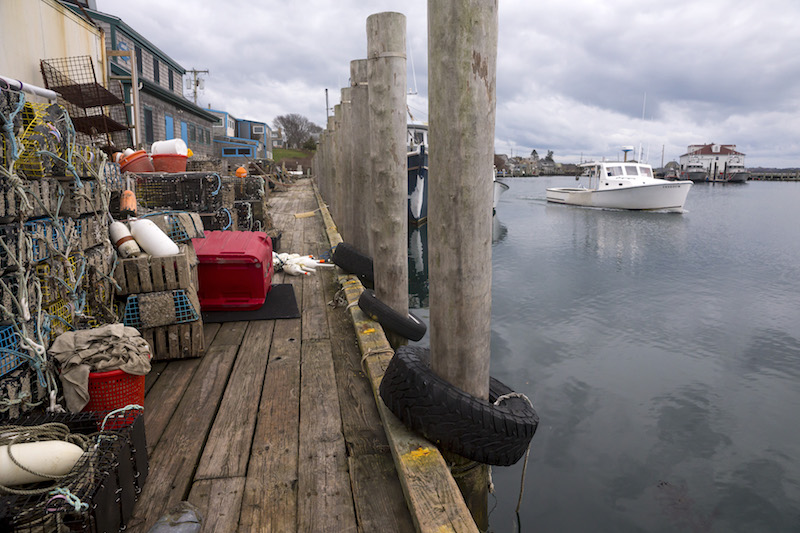
With the North Atlantic right whale population at a dangerously low ebb, the state Division of Marine Fisheries is proposing a statewide seasonal ban on lobstering.
With the North Atlantic right whale population at a dangerously low ebb, the state Division of Marine Fisheries is proposing a statewide seasonal ban on lobstering in a last-chance effort to save the critically endangered species from extinction.
Floated by the DMF during public hearings on Dec. 8 and 9, the proposed regulations come in the wake of a report that estimated right whale populations at only 366 marine mammals — down from the 481 estimated in 2011 — and a continued “unusual mortality event” that has seen more than 30 right whale deaths in the past three years.
The dramatic rule changes propose extending the state’s existing Feb. 1 through April 30 lobster trap closure in Cape Cod Bay to all waters under the jurisdiction of the commonwealth, including the Vineyard and Nantucket Sound. Buoyed recreational lobster and crab trap fishing would also be closed. The recreational closure would run from the Tuesday after Columbus Day through the Friday preceding Memorial Day.
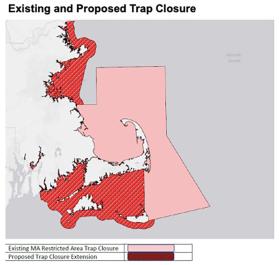
Map shows existing and proposed areas for closures.
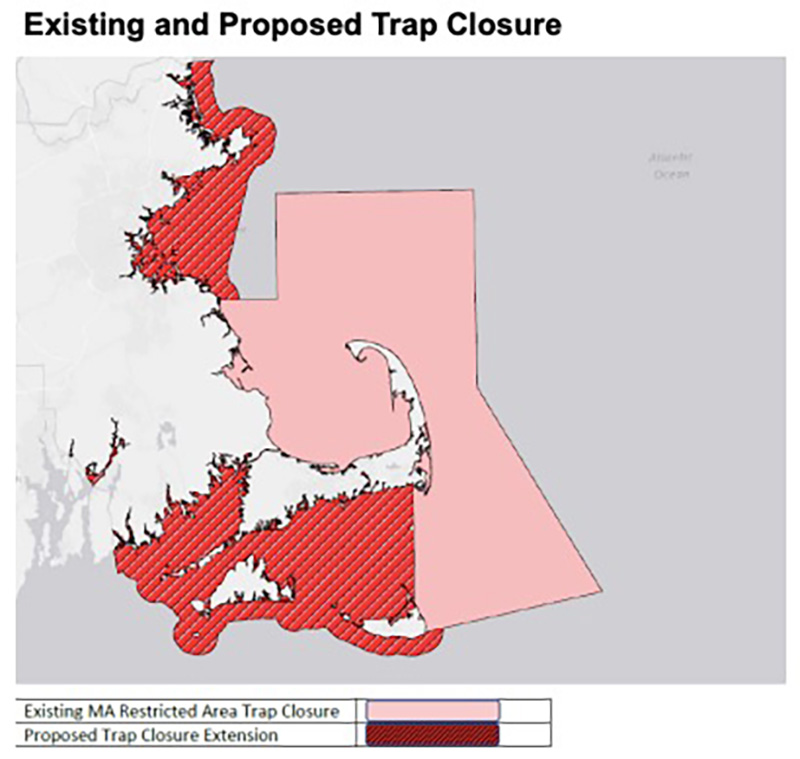
Map shows existing and proposed areas for closures.
The proposed regulations include gear modifications requiring that vertical buoys break with 1,700 pounds of tension and lower diameter limits on rope. Lobster vessels greater than 29 feet would be banned from using single-trap lines. Large boats would have to configure their pots as multi-trap trawls.
Regulations would also cap the number of student lobster permits issued annually at 150.
In a pair of public hearings posted to Youtube early this month, DMF director Dan McKiernan pitched the proposed rule changes as an unfortunate but necessary step in order to address increasing numbers of right whale entanglements, which he said often show scars from fishing rope. He added that the seasonal closure was also an attempt to release the state from liability for right whale deaths, after a U.S. District Court ruled in April that the state would have to apply for an Incidental Take Permit from the National Marine Fisheries Service (NMFS) to cover unauthorized right whale takes by the fishing industry.
A statewide seasonal closure would make NMFS more likely to issue the permit to the state’s fisheries, Mr. McKiernan said.
“Tonight’s proposal attempts to address these issues by reducing the risk of entanglement, reducing the severity of the injury, and . . . possibly exonerate the state waters’ fishery through direct and indirect evidence about the source of the rope,” Mr. McKiernan said in the public hearing.
But the proposed rule changes would deal a hard blow to the state lobster industry, which includes approximately 800 commercial fishermen and thousands more recreational lobstermen around the Cape, south coast and two Islands. According to data from NOAA Fisheries, state lobster fishermen brought in 16.9 million pounds and $94 million in catch in 2019.
While the numbers pale in comparison to more lucrative fisheries, like the $400 million sea scallop industry, they remain a crucial source of year-round income for fishermen across the commonwealth, including approximately 10 full-time lobstermen based on the Vineyard. Hundreds more recreational lobstermen on the Island also would be affected by the seasonal recreational closure.
Right whales are often sighted south of Nantucket, including two spotted last week, leading to mandatory vessel speed limits in the region. Although rarer in Vineyard waters, severely decomposed right whales have been found dead on or near Chappaquiddick — one in 2017 and 2018. The current three-month Cape Cod closure is a federal regulation that went into effect earlier this decade to protect the endangered whales, which have historically gathered by the hundreds to feed in the bay.
During the hearings, Mr. McKiernan said that whales had often been spotted elsewhere throughout the state, which has one of the highest densities of right whale sightings in the country. He said a statewide closure would be the most effective way to reduce the right whale take by 60 per cent — a number that the recently-convened federal Atlantic Large Whale Take Reduction Team determined was necessary to save the species.
“While it is true that the most likely location to see right whales is the current closure around Cape Cod, we have seen right whales in Mass Bay and East Boston and off Cape Ann,” Mr. McKiernan said. “The rationale of this is to reduce the potential of any entanglement in waters under the jurisdiction of the Commonwealth.”
Mr. McKiernan said during the hearings that the regulations would be formally proposed to the state’s Marine Fisheries Advisory Commission at their scheduled meeting on Jan. 7, 2021. The regulations require a majority vote from the nine-member commission, which includes a recent Vineyard appointment — Shelley Edmundson, who is executive director of the Martha’s Vineyard Fishermen’s Preservation Trust. Ms. Edmundson is the first Vineyard representative to serve on the on the commission in the past three decades.
She was not immediately available for comment Friday.
If approved, the regulations would likely go into effect in February 2021, with the large vessel restrictions beginning in 2022.
Comments
Heck yes, and it's about dang
Carol formerly ChilmarkHeck yes, and it's about dang time!! Please, let's safeguard the remaining right whales. Who are a key piece of the healthy ecosystem that produces lobster and fish, BTW.
How much lobster is caught
curious Craig MVHow much lobster is caught between Feb. 1 through April 30 compared to May. 1 through January 30? Is this the high season or the low season?
I'd be really interested in
Liz AquinnahI'd be really interested in knowing the answer to this question, too. I think it's helpful to break it down by region. Cape Cod Bay is already closed to fixed gear between Feb 1 and the beginning of May because of the presence of a large number of right whales in the bay. In ME, they fish for lobster year round but most of their take comes between June and December.
What a joke. Whales are
Jon Oak bluffsWhat a joke. Whales are killed by boats or trash in the water they are eaten in China. People getting paid to make decisions that they have no idea what they are talking about and destroying peoples lives.
Well Said !!! You have Harbor
Richard Hertz The CrickWell Said !!! You have Harbor master's Doubling fees (it won't be a hardship on people) and now they want to take our livelihoods and our fishing grounds away. Sounds like our Harbors will be full of Yachts and not real fishermen .... Their actions prove that is what they want snd actions speak LOUDER then words!
North Atlantic right whales'
Liz AquinnahNorth Atlantic right whales' primary habitat is the East Coast of the US. They are not hunted and have been protected since the 1930s. There are about 360 whales remaining. Primary threats to the species are ship strikes and entanglement in fishing gear. Nobody is being paid to make these decisions - these decisions are made by a panel of stakeholders at the behest of the by the Federal Govt. This panel, called the Large Whale Take Reduction Team includes representatives of lobster and pot fisheries from all regions of the coastal eastern US including MA and ME. This panel also includes scientists who have tracked and studied these whales for 4 decades. The panel meets for 4 days annually and comes to a consensus about what actions must be taken to save the species from extinction. All parties agreed there must be a 60% reduction in whale death in order to save the species.
The Chinese don’t eat whales.
Izzy WTThe Chinese don’t eat whales...especially not whales that have been run over by boats or eaten trash...try again
This article doesn't address
John Cape CodThis article doesn't address the main issue being reported which is what are the detailed reasons the right whale population is decreasing. There are no details as to the causes and numbers of this issue, such as how many are related to ship strikes, entanglements, disease, and any other causes. Just going out and adding more regulations based on estimated general information is just poor decision making. You need to know the details of the issue before making new regulations which may or may not make a difference.
It maybe a win for the
Bob EdgartownIt maybe a win for the lobster industry as well. I have read the lobster industry in the local waters has been declining for years. There are many ideas on why it is and this may help.
1. The key could be setting
Mike Somewhere1. The key could be setting the lobster traps closer to shore in areas where Whales would not go. These areas could be identified and lobstering inside them strictly enforced. Just like hunting. This would almost eliminate entanglement issues.
2. The water is getting warmer - too warm for the lobsters - they like cooler water, like up in Maine, where the water temp is a few degrees lower than Vineyard and Cape waters, this was written about in several articles.
Also, the hatchery needs to open again - full on. Putting thousands of lobster hatchlings into the population yearly. This may help. We have two species on the brink. Some responsible stewardship could be a win win for both.
Let’s not loose sight of the
David Scituate maLet’s not loose sight of the fact that for years conservation actions by trap fishermen have gone on for years and the expense to do this has been born by them.Entanglements use to be the “issue” and now that has been reduced to nearly nothing “encounters” and “scaring “ is the focus It appears that with the lack of confirmed deaths this year with the obvious reduced shipping and cruise ship activity “they” have decided to figure out a different way to assess the population and came up with fewer whales that had been thought. Most disturbing is there is no sunset clause in any of these proposed regulations so as the food source changes as does the population these regulations will stay in effect in perpetuity with or with out the whales. And let’s not overlook that the renewal cost of a commercial license will not be reduced with the effective 5 month closure to the fishery. Until the conservation groups involved get a 100% shut down of an industry nothing will be good enough for them.
A commentor said the lobsters
Charlie Callahan So Boston/EdgartownA commentor said the lobsters are declining and they are,but not from overfishing. They are declining because there are 100,000 seals around Chatham and the rest of the cape,and unless someone is stupid,that translates into TWENTY MILLION pounds of lobsters eaten DAILY from spring to fall. These seals weigh around 200 pounds each and they eat their weight PER day in lobsters,stripers and other game fish per day.White sharks with about 1000 of them here at about 1000 pounds each eat their weight per day on the same species. You don't have to be a Rhoades scholar to see why the lobsters are on the decline.Why not kill off the seals and the sharks, or is that mean. Seems like people around here pick and choose where to lay blame. And most whales are killed by props from giant ships. Maybe the whale lovers will get ships banned too.They really want to put the lobster guys out of business. They already have to use connectors on their lines that will break if placed under excess strain such as a whale entangled in them.
Add new comment