


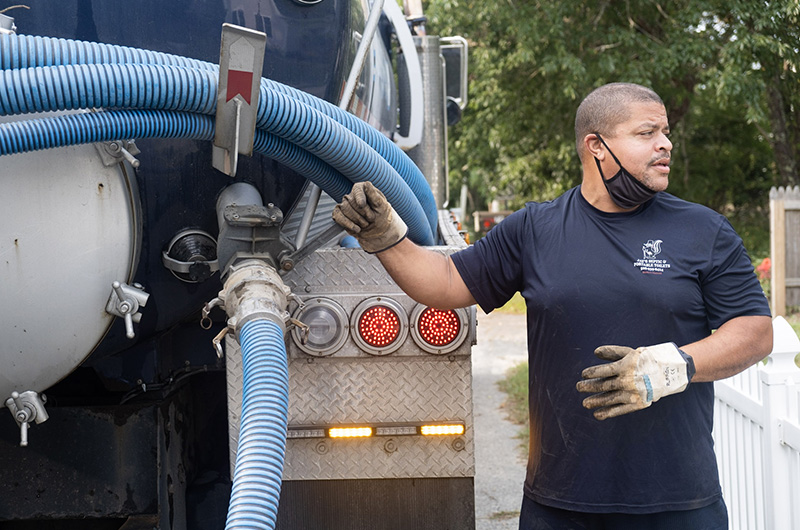
The Edgartown wastewater treatment facility has dramatically curtailed its capacity for taking pumpouts from septic systems in recent months, forcing septic haulers to scramble.
The Edgartown wastewater treatment facility has dramatically curtailed its capacity for taking pumpouts from septic systems in recent months, forcing septic haulers to scramble and potentially reordering the Island’s patchworked wastewater treatment system.
Town officials described the change in policy as a necessary shift for the overburdened Edgartown treatment plant, which is by far the largest on the Island and for the past decade has informally accepted almost an entire Island’s worth of septic system pumpouts.
The town recently retained an engineering firm to conduct a cost-benefit analysis on capacity at the treatment facility before making any further, permanent policy changes.
But the current change — which severely limits what the facility will accept from outside haulers to emergency pumpouts from failed septic systems, tight tanks and porta-toilets — has already caused reverberations throughout the Island.
Septic haulers — their pumpout trucks known colloquially as honey wagons — say they have had to cut their business approximately in half, forcing them to make plans to either temporarily store excess septage in new holding tanks or transfer the waste to off-Island facilities.
The Oak Bluffs treatment plant does not accept septage pumpouts, and the Tisbury plant only accepts a small daily amount.
Only the three down-Island towns have municipal sewer systems; approximately 90 per cent of the Vineyard’s built environment relies on individual on-site septic systems for human waste disposal.

So-called honey wagons are a quiet but necessary part of life on the Island.
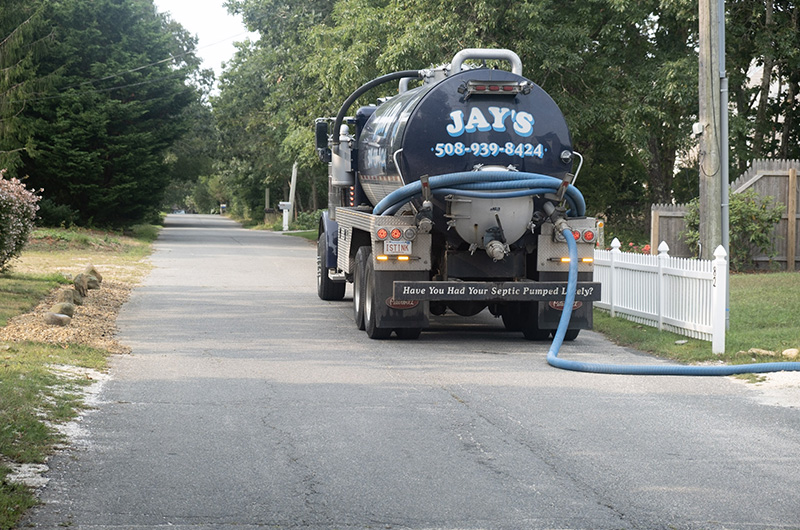
So-called honey wagons are a quiet but necessary part of life on the Island.
The changes at the Edgartown plant mean non-emergency septic system pumpouts for residences and restaurants are mostly on hold. Although on-site septic systems provide an efficient filtering and treatment process, routine maintenance through pumpouts is recommended every three to five years, with the material transferred to a treatment facility for processing.
Restaurant grease traps, which need to be serviced at least semi-annually, have not been able to get pumped either.
“It’s been very difficult,” said Jay Araujo, who owns Jay’s Septic Service in Edgartown. “A septic system is supposed to be maintained; you don’t want to wait until you need it to be pumped. But right now, that’s all we are allowed to do.”
The problem began during the start of the pandemic, according to Edgartown wastewater facility manager Bill Burke. Sewage treatment facilities must maintain a careful balance between wastewater flow — which comes from residences and buildings hooked up to the town sewer — and septage, which is material from septic pumpouts. Because septage can be 40 to 50 times as concentrated as wastewater, the facility can only accept a small amount of it relative to flow during specific hours of the day, Mr. Burke explained.
When the pandemic started, a confluence of factors disturbed that careful calculus. With restaurants and other businesses on the town sewer shuttered, wasterwater flow plummeted at the plant, preventing the facility from accepting large amounts of septage — even as seasonal homeowners arrived on the Island in higher numbers and stayed for longer, causing an increase in the need for septic pumpouts. Combined with Covid-related restrictions for septic haulers and facility staff, it spelled trouble for the already-overburdened treatment facility.
Only around 1,450 of the approximately 17,000 buildings on the Island are connected to a town sewer, according to Mr. Burke.
“It became apparent during the first quarantine that the septage haulers wanted to bring in more septage,” he said. “Looking at the historical amount of septage that had come to the plant, myself, in conjunction with our engineer, we believed it to be too much.”
In response, the Edgartown wastewater commission decided to retain the engineering firm Tighe and Bond at a cost of $8,100 to conduct a cost-benefit evaluation on the facility’s septage intake. The study was initially delayed by the pandemic but got underway this summer, and is expected to finish within the next month. Possible future outcomes include prioritizing Edgartown residents for septic pumpouts at the facility, or installing a large septic holding tank at the site.
Either way, capacity is likely to be limited in the future, Mr. Burke said.
“We’re definitely scaling back,” he said. “We have a groundwater discharge permit by the state that we have to meet and it regulates how much nitrogen can leave the plant. My primary concern is to meet the wastewater flow. To violate the permit is never a pleasant thing.”
Edgartown town administrator James Hagerty said the facility brings in about $600,000 per year in revenue for the town from septic pumpouts. But flow numbers, as well as the health of “the bug,” a vernacular term for the naturally occurring bacteria used to break down waste as part of the facility’s biological filtering process, indicated future problems.
“If you looked at the bug . . . it wasn’t the healthiest looking,” Mr. Burke said. “There needs to be a balance.”
Mr. Hagerty and Mr. Burke, who began as facility manager in February and has nearly 30 years of experience, said revenue from septic pumpouts may pale compared with the long-term cost of overworking the facility. Meanwhile, the decision to limit septic capacity was temporary, Mr. Hagerty said, while the town evaluated its next steps and waited on results from the study.
“The conditions are not bad currently, but we’re taking a precautionary approach,” Mr. Hagerty said. “The problem financially is that we either pay a little now, or pay a lot more later. If we’re constantly accelerating the depreciation of the wastewater plant by taking in high volumes of septic, then I would rather lose $250,000 [in revenue] now, than have to pay $25 million later.”
The Island’s six septic haulers understand the dilemma but nonetheless find themselves in a temporary bind. With the future of the Edgartown plant unclear, they are scrambling to make plans to accommodate ever-increasing septic demand. Mr. Araujo has requested a temporary lease at the airport business park to install two 10,000-gallon, above-ground tanks for septic storage. Airport commissioners postponed the request until their next meeting after mulling questions about safety and ventilation.
“In principle they are sympathetic, and want to help out the Island,” airport director Geoff Freeman said. “They wanted more verification on containment of any potential rupture of a tank or hose line.”
Haulers are also exploring plans to take septic pumpouts off-Island as a long-term solution. Although mainland treatment facilities generally cost much less for dropoff than Edgartown, meaning prices might remain comparable, the logistics of procuring ferry reservations and staffing have been challenging, Mr. Araujo said. He is also concerned that come winter, when wastewater flows decrease, the town may not even be able to handle the emergency pumps.
“It’s all new for me,” Mr. Araujo said.
He calculated that of the 2.4 million gallons of septic waste brought to the Edgartown facility in 2019, his company was responsible for about 989,000 gallons. The company currently has 100 people on a waiting list for maintenance pumpouts.
“There are a lot of marginal septic systems on the Island, and with people being home more with Covid, the failing septic systems have reared their ugly head,” Mr. Araujo said. “My hope was that when summer was in full swing, their flows would be high enough that we could go back to operation as normal, but I just don’t think operation as normal before Covid is ever going happen again, because the plant can’t handle it.”
Mr. Burke also thought a reversion to pre-pandemic policy was unlikely, and said the town was doing its best to balance the needs of the plant with the needs of the Island while it awaited the results of the study.
“The intent of what we’re doing is that the Island has come to rely upon Edgartown for its wastewater needs,” Mr. Burke said. “So we’re taking the tight tanks, we’re taking the porta-toilets, we’re taking the failed systems, we’re taking the emergencies. We thought that was equitable.”
Comments
As always the other towns get
fact checker edgAs always the other towns get a free ride in Edgartown, as they have paid the same per gallon as those of us Edgartown taxpayers who pay for the plant. Its interesting to hear opposition to a local development but the same folks turn a blind eye to the concentrated septage from other towns polluting the Great pond with the plume from the sewer plant.
What about the ferries in OB
BS Oak BluffsWhat about the ferries in OB and VH? Surely not every edgartown resident arrives via yacht. We’re all in this together, my friend.
Properly run The Edgartown
JAH DukesProperly run The Edgartown "sewer plant" should not consume any tax dollars. It should be funded by user fees.
No matter where on the Island the septage is dealt with it will create a plume.
Im on the list in Edgartown.
Ken Edg.Im on the list in Edgartown. Someone should have told me this would happen, I wouldnt have waited so long. No more construction in Edgartown please until we get a handle on this.
They allow building to
Charlie Callahan So Boston/EdgartownThey allow building to continue and don't prepare for what is needed.Some fools are giving the septic haulers a hard time,as though it was their fault. Let some of those clowns try doing that job. Raise taxes and build one big treatment plant for all the down island towns,it's not brain surgery
Prioritization of Edgartown
Mark EdgartownPrioritization of Edgartown residents should happen regardless of what form the long term solution ends up being.
This should have happened
martha edgartownThis should have happened right from the start. Why has Edgartown been handling the sewerage from all over the Island to the detriment of Great Pond and the surrounding areas. Thank you for finally closing that door. We have enough sewerage in Edgartown alone for that one plant to attempt to processs.
Agreed. And no more
Bob VHAgreed. And no more Edgartown residents or edgartown bound trucks and cars allowed on VH ssa vessels until the bridge into chappy is built. And no more edgartown trash hauled through VH to ssa. And... Sheesh.
I would point out that
Bob EdgartownI would point out that Edgartown residents all ready pay to use the OB & VH terminals. Is it still 50 cents per trip? What Edgartown needs to do is figure out the actual costs and pass them on which we are not doing right now. Edgartown all ready pays the most to the schools, MVC and any other regional bills the towns have. Edgartown's tax payers backs are getting sore.
The towns that prohibit us
TAD ChappyThe towns that prohibit us from using their libraries and beaches should be the first taken off the Edgartown wastewater list.
The subhead and lede
Nelson Sigelman Vineyard HavenThe subhead and lede paragraph in a story the Gazette published February, 1993: Wastewater System in Tisbury Places Limits on Town Growth; The day Tisbury's new wastewater system goes online next year, it will be running at its full capacity. That's right: No headroom or provision for growth has been designed into the municipal system now under construction in the Island's main port town.
From a May 2010 MVC report, “Martha’s Vineyard Wastewater Study: ... The Towns should work with the Commission to establish rational bases for sharing the cost of facilities that serve more than one town in a single watershed. ...Given the magnitude of wastewater management costs and the likely scarcity of suitable effluent disposal sites, each town should thoroughly address all possible needs for wastewater management (including water supply protection, sanitary needs, controlled growth, and cost and convenience issues), and then prioritize these needs.
This problem has been a long time coming. Surely this crisis calls for a regional solution and not town by town sniping.
This is a terrific, detailed,
Terry EdgartownThis is a terrific, detailed, very informative article. It shows, among other things, that housing and commercial buildings already on the system are small part of the problem, and that wells and other users of the system create a bigger issue. One conclusion might be to convince well owners to spend the extra dollars to connect to the system for the good of everyone in Edgartown.
Every town should have there
Ned ChillmarkEvery town should have there own waste water plant...
You mean “regionalize”?
DownislanderYou mean “regionalize”? *gasps and clutches pearls*
Overpopulation, pure and
Lorraine EdgartownOverpopulation, pure and simple. Islands are fragile; we have superseded our natural resources and in a free society people may move and live where they choose. So: no solution. We must soldier on putting bandaids on our problems. Confronting them is not politically correct. So, we stumble into the future. That is not negativism; it is realism and pragmatism.
On a lighter note: I remember
Jimmy Burgoff BelchertownOn a lighter note:
I remember, in the 1980's when an Araujo Brothers honey wagon had a hand painted sign on the back that read,
"Your S--T Is Our Bread and Butter!" with a picture of a smiling skunk. Probably painted by Maynard Silva (RIP).
The only short term solution
John Cape CodThe only short term solution is to have Septic haulers transport waste to the mainland by individual pump truck via the SSA or on a large scale basis hire a tank barge to fill and transport it to a mainland pump out facility. Obviously sewerage treatment / septic disposal hasn't been thought out for the future while Island development has continued to rapidly grow over the decades.
I have thought for a long
Bob EdgartownI have thought for a long time that we were not charging enough for septic from the other towns. As we know these plants are very expensive to build and operate. That is why both OB and VH did not add that ability to their systems. Edgartown should double the rate the other towns pay and if that is not enough triple it.
Maybe some better technology
Zeke MarylandMaybe some better technology for new buildings? If some places in California can go from "toilet to tap", and African villages can use recycling technologies (funded by Gates' foundation), there should be a better way to deal with this problem.
Add new comment