

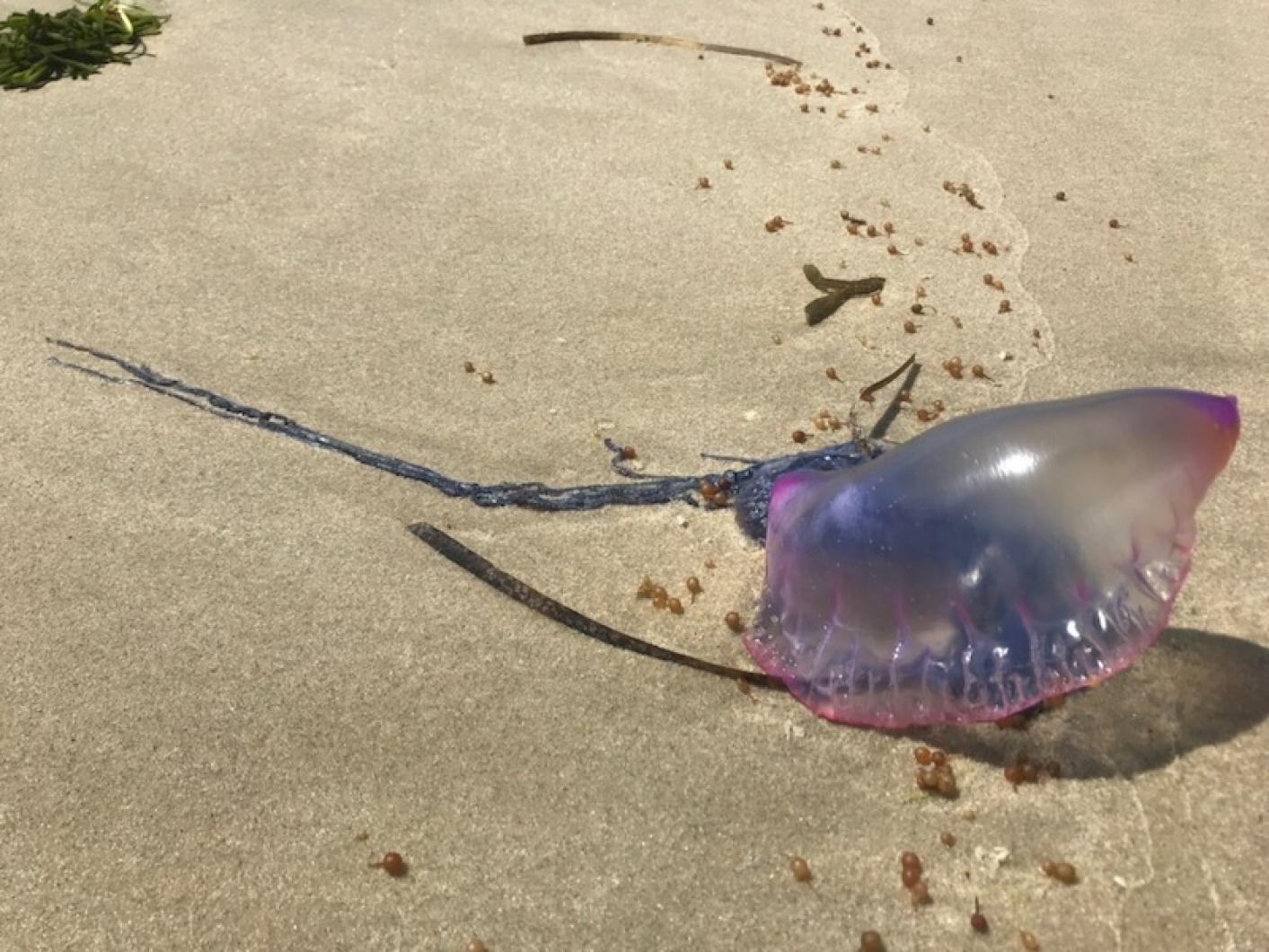
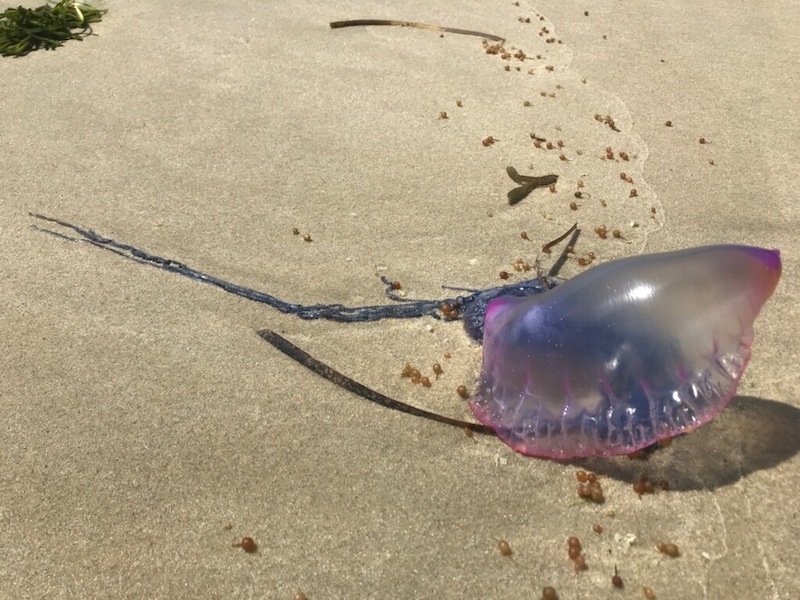
Large swarms of Portuguese man o’ war jellyfish, a highly dangerous variety, have been discovered on the south shore of Chilmark this week, raising concerns over swimming safety.
Large swarms of Portuguese man o’ war jellyfish, a highly dangerous variety, have been discovered on the south shore of Chilmark this week, a late in the season surprise raising concerns over swimming safety at up-Island beaches.
No one was stung and no beaches were closed as a result of the sighting, Chilmark beach officials said
The first round of jellyfish were discovered washed ashore on Sqiubnocket and Lucy Vincent beaches by town lifeguards at around 11 a.m. Tuesday, longtime superintendent of the Chilmark beach committee Martina Mastromonaco told the Gazette by phone.
At the time of discovery, the guards reported five jellyfish at Squibnocket and eight at Lucy Vincent, but by the end of the day, the total had swelled to 10 and 12 jellyfish at the beaches respectively, she said. By Wednesday morning, heavy surf on the south shore brought an additional 50 jellyfish to the shore of Squibnocket and 30 to a small stretch of beach at Lucy Vincent.

Signs posted at Squibnocket and Lucy Vincent warning swimmers and beach-goers.

Signs posted at Squibnocket and Lucy Vincent warning swimmers and beach-goers.
The jellyfish, sometimes called the floating terror, belongs to a particularly dangerous class of hydrozoan. Known for its vibrant blue and pink color, the animal has tentacles that can extend up to 30 feet in length and encircle its victims, increasing both the surface area of its sting and its general lethality to swimmers, said Ms. Mastromonaco.
If stung, a swimmer must remove the tentacles immediately and treat the sting with salt water and heat, she said.
“We had some jellyfish in August, but this is much worse,” said Ms. Mastromonaco. “Those are very dangerous jellyfish.”
The fish are not uncommon in the Cape and Islands region, but their arrival on the Island, normally early to mid-August, is unusually late in the season, said Ms. Mastomonaco.
The animals generally congregate in Aquinnah and migrate down-island toward Edgartown during the summer, occasionally washing up on shore during the journey, she said.
“We don’t have them every year, but we had one in August and we thought that was it,” said Ms. Mastromonaco. Because the jellyfish typically swim in swarms, Ms. Mastromonaco expects to see high numbers washing up on the south shore in the coming days.
According to beach safety protocol, lifeguards at Squibnocket and Lucy Vincent were instructed to remove the jellyfish from the shore and bury them in the dunes, to ensure beachgoers do not injure themselves by stepping on the tentacles.
No jellyfish-related injuries have been reported to date and neither beach was closed since the sighting, Ms. Mastromonaco said. Purple flags signaling the presence of jellyfish were raised on both beaches and signs cautioning swimmers about the animal were posted as well. With the recent surge in sightings, however, Ms. Mastromonaco is considering formally recommending no swimming on the two beaches, pending approval from the town selectmen.
“If anyone is swimming in the south shore area, they should bring first aid,” Ms. Mastromonaco said.
Comments
Saw one at Norton Point on
G KatamaSaw one at Norton Point on Friday and when we alerted the guard attendant, he said they have seen several
Found one on Norton on Sunday
J OBFound one on Norton on Sunday washed ashore...
Tentacles can extend 10-30
ZephyrTentacles can extend 10-30 feet or more in length! I was stung by one in the Caribbean and never saw the actual sail anywhere near me. Pain was severe too.
The Portuguese man o war is
645 Guy ChilmarkThe Portuguese man o war is not a jellyfish. It is a siphonophore that is unrelated to true jellyfish.
https://www.treehugger.com/portuguese-man-war-facts-4864196
They're also abundant in
Barry Stringfellow EdgartownThey're also abundant in Chappy/Norton Point waters. TTOR rangers have been treating an increasing number of stung bathers.
My wife and I went to the
Thomas Hodgson West TisburyMy wife and I went to the south shore on Wednesday evening. Aa we walked along a thousand or so feet of the Black Point Beach area, we saw hundreds of man o' wars. We've never before seen so many washed up at the same time.
These have been offshore up
Emily SbragiaThese have been offshore up island for the last month or so - we saw them by boat & at first thought they were plastic bags then slowed down to look & realized they were man-o-war
What is the plural of
Lorraine EdgartownWhat is the plural of Portuguese Man O War?
Men O War?
Molly AquinnahMen O War?
My daughter was grazed by a
Amy ChilmarkMy daughter was grazed by a long clear tentacle. The lifeguards helped us with rinsing her off and she was better quickly. I can only imagine how much it would have hurt if she had more than a passing sting.
Saw a couple down island as
Esther West TisburySaw a couple down island as well, over the past two weeks, washed up on shore at State and in water, amongst moons and other types of jelly fish /species, even a lions mane, which was pretty cool. Scooped them up with a long net, as we found them, buried them in the dunes , luckily no one was stung, noticed when water is cooler no jelly fish or man o war, whatsoever, however, when you know it's possible you always keep your eyes peeled and are mindful. Hope they leave soon so we can swim freely again without worry. Many warm days ahead still! Great learning opportunity for the kids, the jelly fish and man o wars come in many colors, shapes and sizes ...so it's pretty neat for everyone to learn a little more about the ocean and life in the ocean. How the storms impact water temperature (gulf stream)and motivate ocean life one way or the other, We also noticed that certain parts of the beach had more than others more consistently, we wondered why that might be? Last year,they showed up as well, but this year there are way, way more!
Enough with the misogyny! Why
Lito ChillmarkEnough with the misogyny! Why do you assume they’re gender? Are we not beyond this?
Add new comment