

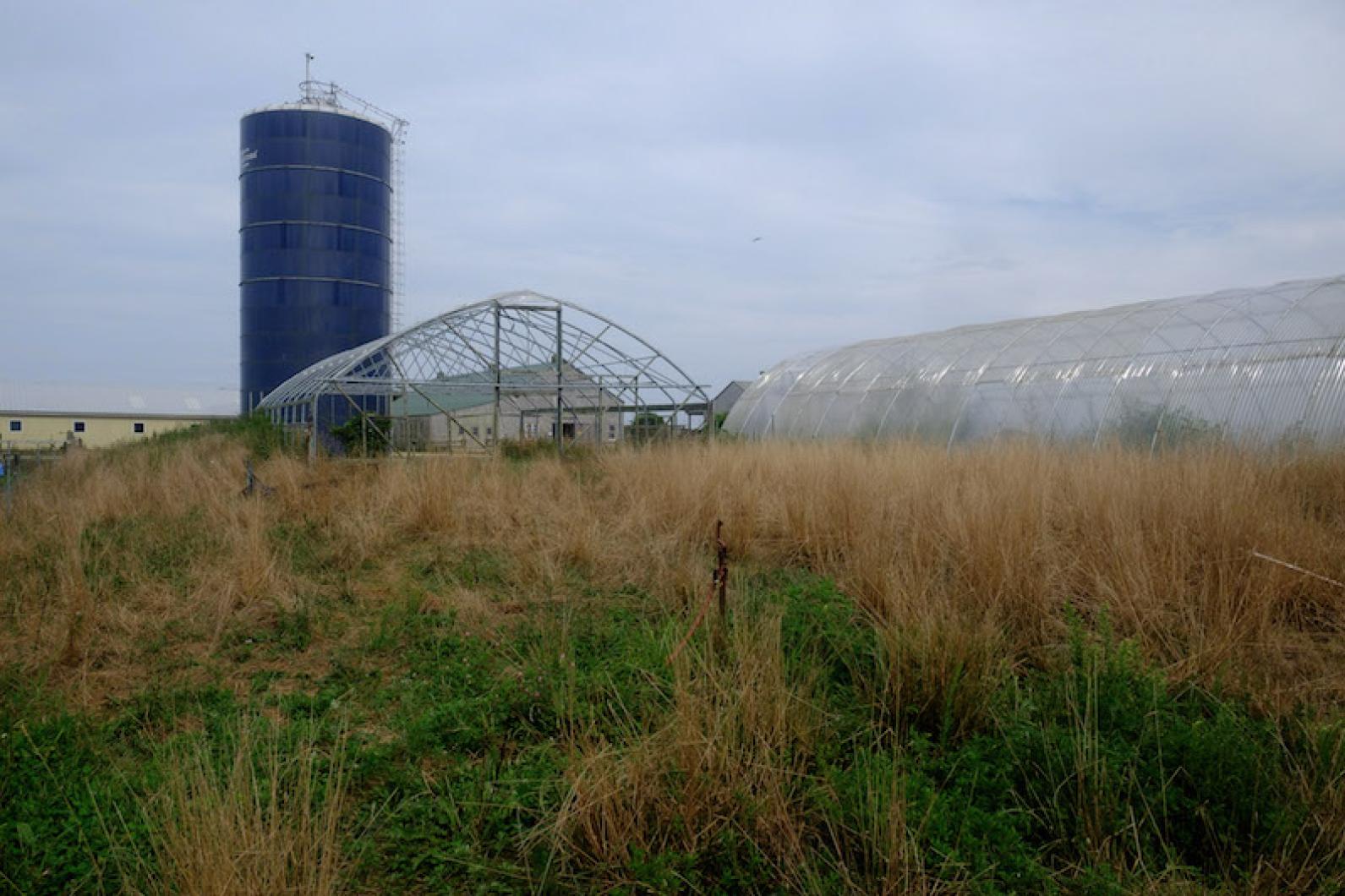
The Edgartown conservation commission formally terminated its lease this week with The Trustees of Reservations at the historic Katama Farm.
After months of alleged noncompliance, the Edgartown conservation commission has formally terminated its lease with The Trustees of Reservations at the historic Katama Farm, evicting the venerable land trust from the globally-rare, 180-acre property only four years into its tenancy.
In stern language, chairman of the town conservation commission Edward (Peter) Vincent informed the Trustees of the conservation commission’s decision in a letter sent to Islands director Sam Hart Monday.
The Trustees must vacate all livestock and equipment from the farm and leave it in “broom clean” condition by Sept. 15, the letter states — capping a rapid deterioration in relationship between the town and the Trustees that began with promise when the Trustees took over stewardship of the farm in 2016.
“It serves no useful purpose to continue to recite our strong disappointment with the Trustees’ management of the Katama Farm,” Mr. Vincent wrote in part to Mr. Hart. “At this point, we have no choice but to deliver the letter of termination to you, which we are doing today.”
The Trustees, a Massachusetts land conservancy with seven properties on Martha’s Vineyard from Menemsha to Cape Pogue, took over the nonprofit Farm Institute and lease for the 182-acre farm in 2016. The lease runs for 30 years at a rate of $12,500 per year. The conservation commission is the landlord for the property, whose history as a working farm dates to a previous century.
In a statement released late Monday afternoon, Mr. Hart expressed surprise and disappointment at the letters, calling the matter a “misalignment” with the town.
“At the core of the misalignment . . . is the balance of managing both a high-production livestock operation and an educational farm on the same site,” Mr. Hart wrote.
Issues regarding the use of the farm by the Trustees have been bubbling for the past two years, and the removal of animals and the presence of sickly livestock proved to be the final straw for the conservation commission, according to the letter sent Monday. The lease and use plan governing the property has strict requirements that it remain a working farm and maintain certain numbers of livestock, including 65 head of cattle.
“Without elaborating further, we are particularly troubled that there are not only nine cattle remaining at the Katama Farm, despite the requirement in the governing use plan that there are to be 65 cattle, and that the sick goats have not been promptly removed from the Katama Farm by the Trustees,” Mr. Vincent wrote.
The statement from Mr. Hart claimed that there are currently 23 cows on the property, with 20 more due to arrive at month’s end. The sick goats on the property were due for a final round of “deworming treatment” before their removal, the statement also said.
Reached by the Gazette later Monday, town conservation agent Jane Varkonda clarified that the goats arrived at the farm with tetanus, among other issues. But the broader problem, she added, was that they were not supposed to be at the farm anyway. They were slated for an ecological restoration project at Long Point, a different Trustees property, she said.
“That was our question, why were they there?” Ms. Varkonda said. “A couple of them died. It wasn’t a good thing.”
The vote by the conservation commission to terminate the lease occurred on July 30, according to the letter, and included Mr. Vincent, Ms. Varkonda, selectman Michael Donaroma and town counsel Ron Rappaport.
In an earlier letter dated July 30, Mr. Vincent elaborated further on the reason for the eviction, saying that recent problems with The Trustees included the winnowing of full-time farm staff and animals, the presence of sickly livestock, late rent payments, and the use of the property for fundraising and other non-farming purposes.
Most grievously, the town concluded that the Trustees had abandoned the mission to maintain the property as a working farm — a problem that had been brought up previously but was never fully addressed, according to the letters — irreconcilably violating the spirit and letter of the lease, and the Trustees’ relationship with the town.
“The fundamental difference in vision between the town and the Trustees for Katama Farm is one that does not seem reconcilable,” Mr. Vincent wrote in part. “The town acknowledges that the recent state of emergency due to Covid-19 has complicated operations, including delaying the return of some animals to the premises; this does not, however, justify the ongoing lack of farming activity at Katama Farm.”
The town bought Katama Farm in the late 1970s amidst threats from developers to turn the globally-rare remnant of the Great Plains with its rich loamy topsoil into a 700-lot subdivision. Over the years, the farm has had an eclectic assortment of tenants, including dairy and beef operations.
Originally established as an educational nonprofit dedicated to livestock farming and teaching, the Farm Institute began leasing Katama Farm from the town in 2003. The Trustees merged with the institute in 2016 and subsequently took over the lease with the town.
Along with its farming operation, the Trustees use the property for fundraising and summer camps, and recently installed a kitchen.
Mr. Hart said the Trustees have invested nearly $2 million in the farm and hosted thousands of students and families for educational programs.
He also said the Farm Institute merger came with problems.
“In 2016, we inherited a financially non-viable agricultural model and had hoped to find middle ground with the town on the number of animals in production while also providing more educational opportunities for the public and visitors in farm-based experiences,” he wrote.
Speaking to the Gazette by phone Monday, Mr. Hart acknowledged that the Trustees and town had communication issues, and that the late rent payment was an error, but said that he felt the Trustees had always worked “in good faith” to update the use plan for the farm.
“That’s something we should have had a voice in — to really revise a use plan that we felt was outdated,” Mr. Hart said “And we just never got that opportunity.”
Ms. Varkonda confirmed Monday that the town had issues with previous tenants farming at the site, but that did not mean the Trustees could violate the use plan.
“It’s never been easy out there,” she said. “But farming isn’t easy.”
Mr. Hart said he did not know whether the Trustees would fight the eviction. There are five employees who work at the farm, he said.
“We just learned about this today . . . and are still digesting the information,” Mr. Hart said. “We are weighing all of our options right now.”
Back in February, the town and Trustees clashed during a series of conservation commission committee meetings regarding the Trustees’ maintenance of the property as a working farm. At that point, the Trustees had cut farming staff, removed dozens of livestock and proposed “production scale changes” at the site due to the presence of grasshopper sparrows, causing town officials to bristle.
Although the Trustees attempted to cool the heat in later meetings, presenting a new use plan and promising that the farm animals would be returned to the property, the changes did not prove adequate for the conservation commission, who felt their lease — and trust — had been permanently violated.
Mr. Vincent articulated disappointment in the letter Monday, saying that the two sides, among other things, could not even negotiate a graceful exit after the July 30 decision to terminate the lease.
“At that meeting, we discussed the reasons for our vote of termination, and wanted to provide the Trustees to negotiate a ‘friendly’ departure from the Katama Farm,” the letter on Monday reads. “Since that time, several emails have been exchanged in an attempt to reach an accommodation. Unfortunately, those efforts have been unsuccessful. While we appreciate the statement about how badly the Trustees’ staff feel about the current state of affairs, and their acknowledgment of past mistakes, the fact remains that the reasons which led the conservation commission to vote to terminate the lease have not been meaningfully addressed.”
“We look forward to working with you to facilitate your departure,” Mr. Vincent concluded.
Comments
Good idea, the co-op form of
Lorraine EdgartownGood idea, the co-op form of structure is used successfully in the Midwest, for example, for flora and fauna. Insofar as the Farm Institute having 65 head of cattle, that is a difficult program. Generally, 1.5 to 3 or more acres for one head of cattle, depending on feed type, is the norm. Now, that is important, the feed type. Farming is difficult, takes unceasing labor and a lot of knowledge. And experience. It seems to me that this entire program was spreading itself too thin; but, if the farm was not adhering to the signed lease regulations, they were in default. Confusing the issue with feel good initiatives is not a solution to what now is a problem.
If only there were another on
Jane Norton ChilmarkIf only there were another on-island group with a track record of creating more locally grown food. One with an interest in food equity, that supports local farmers and cares for the land we all live on and the water we share. Hmmm....
Island Grown Initiative IGI
James Cisek EdgartownIsland Grown Initiative IGI has been doing a great job with the former Thimble Farm providing food for the needy its a working farm that works would they be interesjted.
Yup, that’s what I was
Jane Norton ChilmarkYup, that’s what I was thinking of. The humorous tone didn’t quite translate!
Our family and our neighbors
Adam Brown KatamaOur family and our neighbors and fellow members of the Katama Association. We were deeply involved in the preservation of this parcel and helped provide the down payment for the purchase. I don't know where the 65-head concept came from but we were not the slightest bit sentimental about its use as a dairy farm. Our primary concern was to prevent the re-subdivision of the site and wholesale development. I am not aware of any Katama neighbors remaining from those years, but it seems to me that those who gave the spark to the farm initiative would have been perfectly satisfied with the passive educational use apparently envisioned by the Trustees of Reservation, and rather than blasting off to some pie in the sky initiative, they would recommend both sides sit down and come up with a workable plan. Dont know where the dairy concept came from, but locals 40 years ago told me that the place was a simple sheep pasture as far back as they could remember.
The dairy concept is because
Liza VHThe dairy concept is because Elisha Smith farmed it as a dairy for many years. (search internet "Elisha Smith Katama") Apparently he was able to have 125 dairy cows on it at one point. (but I don't know how much hay and silage he brought from offsite). Though part of the pasture -perhaps some of the best pasture- is now under a large solar array. Why the solar array couldn't have been put in on higher posts so that animals could graze underneath them, I can't understand.
One of the great comments on
CharlIe Ward Los Angeles / EdgartownThanks for one of the great comments on this topic. The Edgartown Commission allowed an unsustainable model to be renewed when transitioning from the Institute to the Trustees. On top of that the Commission, with its expertise, clearly knew that the math wouldn’t work. And now is shocked it didn’t. Why would you lease into an uneconomic model for a 30 year term? Surely not conservation because the damage/cost to the land of yet another transition is more than the lease costs. Pearl clutchers all.
As a retired educator I too
Philip Cordelka Oak BluffsAs a retired educator I too am appalled by the fact that the Trustees are being criticized because too much teaching was going on. Come on, get with it Edgartown. Are you blind to the fact there currently is a crisis in education? Do you support the fact that the Land Bank policy also prohibits educational programing as well? Seems like the
Island's great conservationists are missing the point.
For about six years I have
Susan Johnson Vineyard HavenFor about six years I have had a couple plots in the community garden on the Farm Institute- not this year due to COVID but was planning to return. For ffs Edg: How can you not grasp the importance of “SUSTAINABILITY EDUCATION”. So incredibly important- plus ever more relevant- in all kinds of ways here on the island in this current environment. Edg is crazily oblivious to the critical, social agency potential of the farm under the Trustees. I am sorry, but I’ll say it — they are short sighted if not out-right stupid. Keeping a random max amount of cows for local beef is not nearly as relevant as sustainability farming and education. Sustainability farming IS the historic island farm practice PLUS the path to our future survival. ffs. #farminstituteevictedfornothavingenoughmestcows
I have chosen not to consume
Jane Norton ChilmarkI have chosen not to consume meat or poultry for over half of my 50+ years on this planet. Having said that, a critical missing link to sustainable agriculture on this island is the lack of a slaughterhouse and processing facility. How many of the Katama Farm’s neighbors would be willing to allow that? If you’re serious about sustainability, you have to follow through the entire cycle.
It’s great that kids get to help out with farm “chores”, but a working farm is not a petting zoo. The added burden - for the animals and the farmers - of off-island processing
Without knowing all the facts
Jon Hines KatamaWithout knowing all the facts / circumstances (just what I've read here in the article and comments), my strong instinct is tha two sides should sit down again together and try best to work this out so that the Trustees maintains the lease. We've been here for 45 years, and recall all too well the succession of n'er-do-well farm tenants over the past few decades. I doubt any possible new tenant could / would manage the property better / more usefully to the community than the Trustees to.
How many times now, since the
BFHow many times now, since the beginning, have there been terminations and turnovers due to poor management?
Perhaps we need new people making those decisions?!
Lisha Smith ran a fine farm there for many years! Let’s get a farmer in on these decisions. ( a real farmer)!
What was the original intent? To make money? To teach kids Mickey Mouse farming? To give someone a job?
Or, to keep the land open, and to maintain agricultural use?
Farming doesn’t make money, so aim at sustaining, and get someone else making those decisions!
My farming ancestors would be horrified at what has been presented out there as farming!
Add new comment