

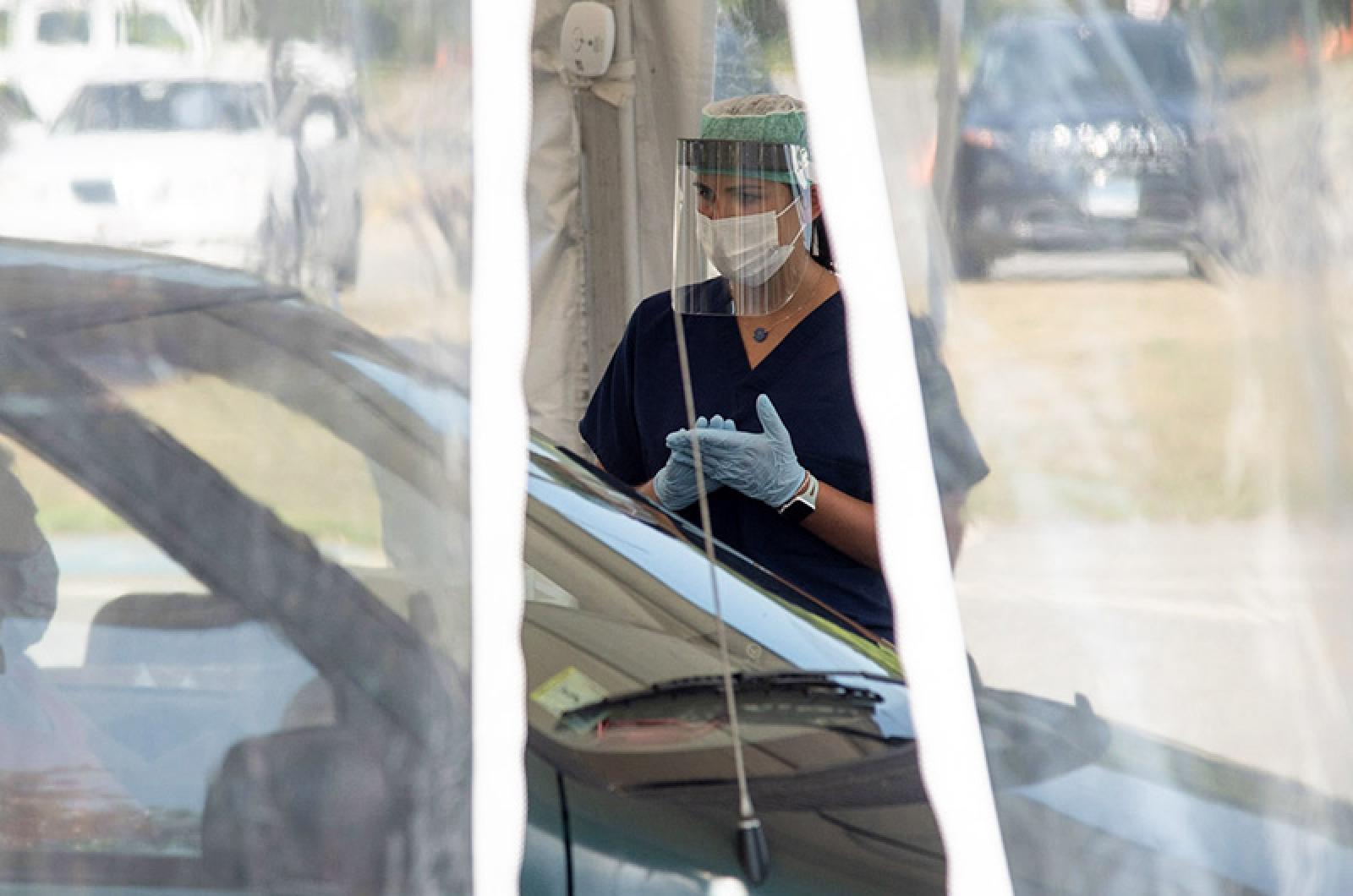
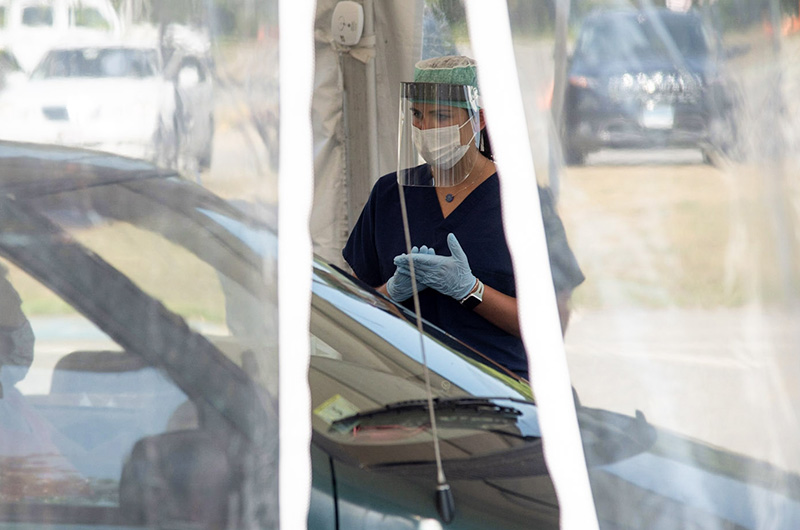
More than 70 residents have tested positive for the coronavirus. Even more striking is how the virus has in five short months has changed nearly every aspect of life on Martha’s Vineyard.
It was 3 p.m. on Friday, March 13, and Steve Bernier — the longtime owner of Cronig’s Markets on Martha’s Vineyard — had a decision to make.
News outlets across the country were starting to report outbreaks in most major American cities of a novel coronavirus called SARS-CoV-2 — more familiarly known as Covid-19 — that had spread from mainland China to Europe and now to the United States. Two days earlier, the World Health Organization had officially declared the respiratory illness a pandemic. Three hours earlier, President Trump had declared a national emergency.

Dr. Karen Casper heads the emergency room at the Martha’s Vineyard Hospital.
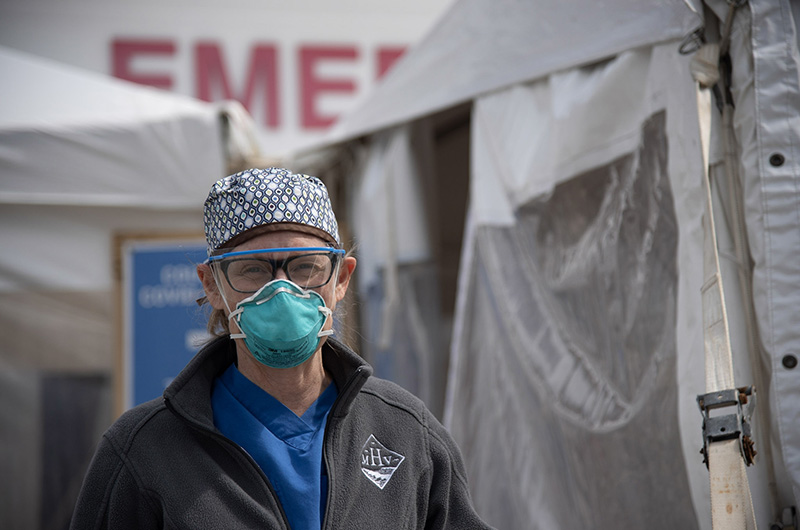
Dr. Karen Casper heads the emergency room at the Martha’s Vineyard Hospital.
That of course was the real world. The Island’s closest brush with the coronavirus had come in February, when an Edgartown couple — Tom and Dianne Durawa — arrived home after being marooned on a cruise ship for weeks in Southeast Asia.
But now the Durawas were safe and healthy. Grocery stores still had toilet paper. Offshore Ale had changed its peanuts-on-the-floor policy, but not much else. Cape Cod still hadn’t reported its first case of the virus. Everything on Martha’s Vineyard — surrounded by seven miles of water and deep in the final doldrums of its winter season — seemed relatively normal.
And then three o’clock hit.
“Everything just came right off the shelves,” Mr. Bernier recalled in an interview this week. “If it was on the shelves, it came off. And it came off in a crazy, hyper state. It was the energy. It was the fear. It was the, oh my god, what’s going on? And then the snowball effect of one person’s energy to the next. And all of a sudden, we had panic buying. And that all happened literally within a few hours.”
Mr. Bernier said the frenzy was worse than his traditionally busiest day of the year — July 3.
“We felt the store getting away from us,” he said. “We were so damn busy and we were chasing it, and I didn’t even have time to think, and I was trying to think about how to hang on to the business and keep everybody safe . . . it was a day where . . . . we got truly, down in our guts, scared.”
He immediately contacted the manager at his West Tisbury store.
“I said, as soon as you can, lock the end door. And we’ll get together in the morning,” Mr. Bernier recalled.
Nearly five months later, the doors at Up-Island Cronig’s are still locked.
“It was the gateway to the new tomorrow,” Mr. Bernier said. “And it all happened in one day.”
•
Exactly one week after that fateful Friday, Tisbury health agent Maura Valley would report the Island’s first case of Covid-19. Another case would follow two days later in West Tisbury, and five more the next weekend.
By April, 10 residents had tested positive and two had been hospitalized. By May, the number was up to 20, with four people hospitalized, including a maternity patient. Three had been transferred off-Island to hospitals in Boston. One didn’t come home.

From right, Deb O’Hara Ruskowski, Cynthia Mitchell of Island Health Care and James Anthony of Martha’s Vineyard Bank cut the ribbon at new drive-through test site.

From right, Deb O’Hara Ruskowski, Cynthia Mitchell of Island Health Care and James Anthony of Martha’s Vineyard Bank cut the ribbon at new drive-through test site.
Halfway through summer, more than 70 residents in all Island towns have now either tested positive for the virus or its antibodies. But even more striking than the case count is how the arrival of the novel coronavirus has in five short months changed nearly every aspect of daily life on Martha’s Vineyard.
In conversations with a half-dozen officials and Islanders deeply involved in the pandemic who looked back at the past half year, nearly all agreed that the Vineyard has managed to avoid the worst, keeping case counts low and averting a surge that would have stretched a rural public health infrastructure to the breaking point. But it came at great risk and great sacrifice for almost everyone involved, tearing at the fabric of an Island that had been woven over centuries.
And it’s not over.
“The only difference between that day six months ago and now,” Mr. Bernier said, “is that we started getting used to it.”
•
In mid-March at the Martha’s Vineyard Hospital, the situation on the ground was developing daily, even hourly. The building was closed to the public and transformed into an incident command center. A triage tent to segregate patients went up outside the hospital’s front entrance.
Hospital president and chief executive officer Denise Schepici had just returned with her husband from a holiday in the Caribbean. School vacation week had just ended. Families were returning from far-flung places, including Italy.
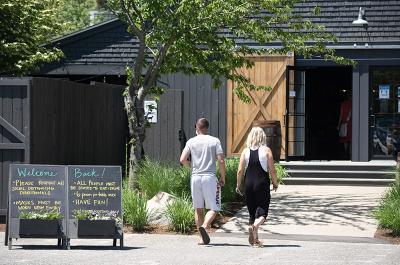
Restaurants reopened in June for outdoor dining, marking a new phase in the pandemic.
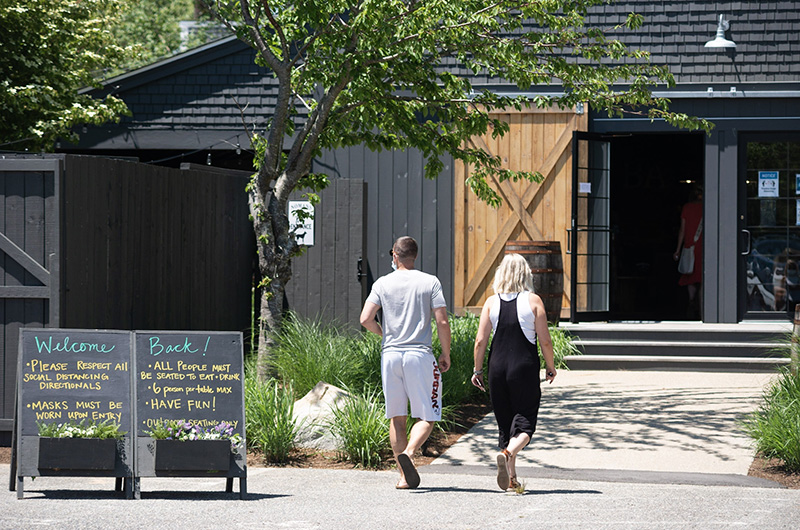
Restaurants reopened in June for outdoor dining, marking a new phase in the pandemic.
“At that point, we had to get ready,” Ms. Schepici recalled. “Our number one concern was the safety, the preparedness, the science — and so much information was coming at us every minute of the day from all different sources. So we were trying to synthesize what was real, what wasn’t real. What steps we could take to be prepared. We were just on call 24/7. And we were calmly preparing for something we were really dreading and fearing.”
On March 17, Gov. Charlie Baker instituted a statewide stay-at-home order. An Island accustomed to open doors was forced to shut them.
Schools closed for two weeks (amended soon after to run for the rest of the school year). Town governments went into lockdown, shifting public meetings to teleconference and closing libraries and other public buildings that had been open for centuries. The Steamship Authority cut its route numbers in half and saw traffic plummet — although an unusual influx of people arrived on the Island in the last two weeks of March.
Emergency orders went into effect, with broad powers handed to town administrators previously only imagined in training seminars. They all had to use them.
“We put as many plans in place as we possibly could. But how quickly the situation evolved was traumatic,” recalled Edgartown town administrator James Hagerty, who is a former marine. “The changing nature of this. The fear of the unknown. The fluidity. The rules coming down from the state . . . We were wondering what was going to happen next.” Islanders wondered too. Businesses due to reopen after a winter hiatus had to stay closed. Restaurants, retailers and other establishments that were still open had to shut their doors as well. Lines swelled at food pantries. Workers were furloughed or laid off. Islanders, used to quiet springs, hunkered down. The normally hushed streets of March turned ghostly.
•
A surge in case numbers seemed not only possible but imminent.
“We always felt there was going to be a surge here,” Ms. Schepici said. “There was a potential for one. And then we had an initial case, an early spreader. Those were breath-holding moments. Is this thing going to hit us with a vengeance?”
The hospital — limited to three ICU beds and only a handful of ventilators — overhauled its layout to prepare for an influx, creating a second emergency room, adding annex bed capacity and coordinating with its parent network in Boston for patients to receive priority if they were transferred off-Island.

Island Food Pantry went into overdrive as community need skyrocketed during lockdown in March and April.
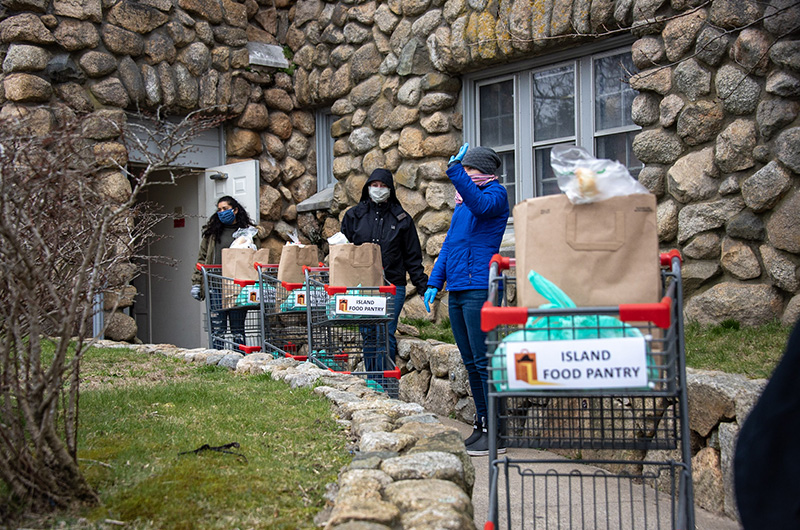
Island Food Pantry went into overdrive as community need skyrocketed during lockdown in March and April.
As March turned to April, Ms. Schepici was forced to confront more gut-wrenching possibilities. She made personal calls in the community looking for volunteers for the hospital’s ethics committee.
“If we had to institute those crisis standards of care with a surge, and knowing our capacity, that was a somber turning point for me,” Ms. Schepici said. “Never in my career — and most of everybody’s career that I have talked to here — nobody had lived through a moment where we would actually have to rationalize care. That was a somber moment for everybody.”
Public officials were engaging in similar discussions. Towns dusted off pandemic and disaster emergency plans that had been written after 9/11, including one that would use the ice arena as a temporary morgue.
“It was very serious,” said Edgartown health agent Matt Poole. “We were trying to defend against something that was unknown . . . and was really hard to control . . . there was discussion about temporary morgues, and secondary hospital sites. It was not an unfamiliar topic to us. But it was pretty astonishing that we were considering it beyond an academic level.”
•
In late April as the pandemic reached its peak in Boston and New York, it appeared that disaster plans would remain exactly that — plans. Case numbers rose, but never stretched the hospital’s ICU capacity. A construction ban was slowly lifted. New cases subsided. The hospital went the entire month of June without reporting a positive Covid-19 test.
“If we hadn’t taken those strong measures in the spring, would things have turned out differently?” Mr. Poole reflected. “Maybe we could have been a little bit more relaxed and carefree and we could have gotten lucky. But I don’t think we could have done any more than we did.”
Vineyard Haven fashion designer Stina Sayre helped lead community mask making effort.
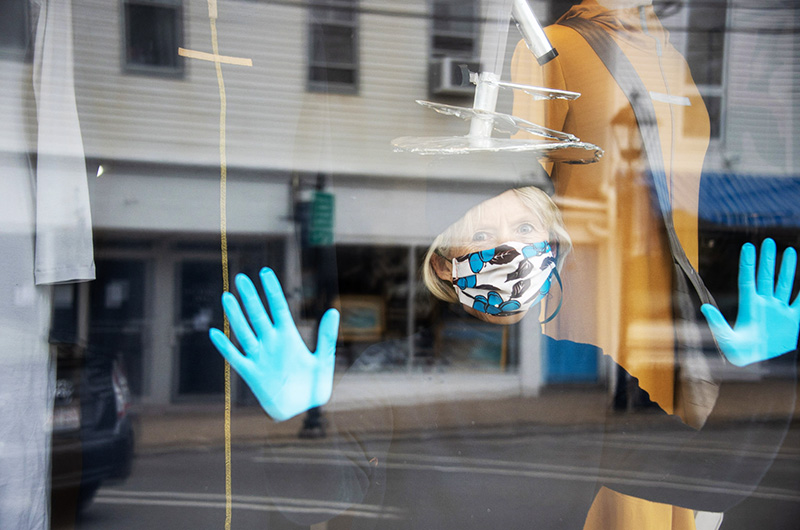
Vineyard Haven fashion designer Stina Sayre helped lead community mask making effort.
Then as the first hints of summer appeared, another remarkable and unprecedented Islandwide initiative took root.
It began as a casual backyard conversation between seasonal resident Steve Rusckowski and his landscaper, Edgartown selectman Michael Donaroma. Mr. Donaroma mentioned the limited availability of testing on the Island.
Mr. Rusckowski is chief executive officer of Quest Diagnostics, the largest testing company in the country.
Things went into motion from there. By late May, a comprehensive, free coronavirus testing site for asymptomatic Islanders was up and running at the regional high school, a coordinated effort among Quest, the six Island boards of health and Island Health Care, a federally qualified community health center. To date, more than 6,000 people have been tested at the site. Only 15 have come back positive.
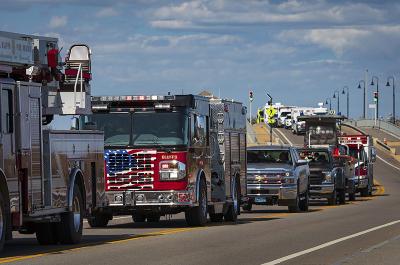
Parade of thanks for front line workers in late May.

Parade of thanks for front line workers in late May.
“I think it’s given a lot of peace of mind,” said Deb O’Hara Rusckowski, a nurse who was instrumental in the site’s organization and continues to work there as a volunteer. “We have identified over a dozen people as positive. And that alone could have been outbreaks upon outbreaks. And that, we believe, has saved lives. It has unequivocally saved lives.”
Mr. Poole, Ms. Schepici, Mr. Hagerty and others also attributed the avoidance of a surge to the tireless efforts of health agents Maura Valley, Omar Johnson, Meegan Lancaster, Marina Lent and public health nurses Lori Perry and Lila Fischer, to closely contact trace the first cases on the Island, as well as the sacrifices of everyone on Island who stayed home and quarantined, often at the expense of their livelihoods.
They also said it was part luck — accompanied by 80-hour work weeks and no days off.
“It was really an intense drill,” Ms. Schepici said. “And fortunately the drill paid off. You can’t say that unless you look back in retrospect, and see that we have the lowest number of positive cases per 100,000 in the state.”
•
The crisis has not ended. Nearly six months after Mr. Bernier closed up-Island Cronig’s, the “new tomorrow” he described is a daily norm. Case numbers have spiked throughout many parts of the country, and the arrival of summer has brought a rise in Covid-19 cases on the Island as well.
“It’s very hot. We’re very busy. We’re very tired,” Mr. Bernier said. “We’re still dealing with a shortage of help, a shortage of product, a shortage of patience, and a shortage of strength.”
He is not alone.
The business landscape remains precarious. The Steamship Authority needed a bailout. Food pantries have had to raise their capacity, and federal loan programs have kept thousands of Islanders afloat. Masks and mask bylaws are ubiquitous. Dining has shifted mainly to takeout. Going to meetings means hours online. Going to post offices means hours in line.
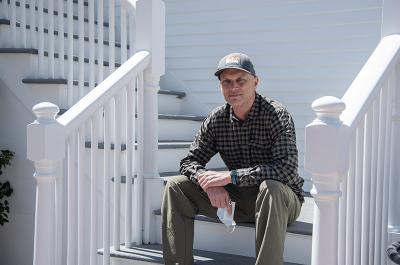
Edgartown health agent Matt Poole.
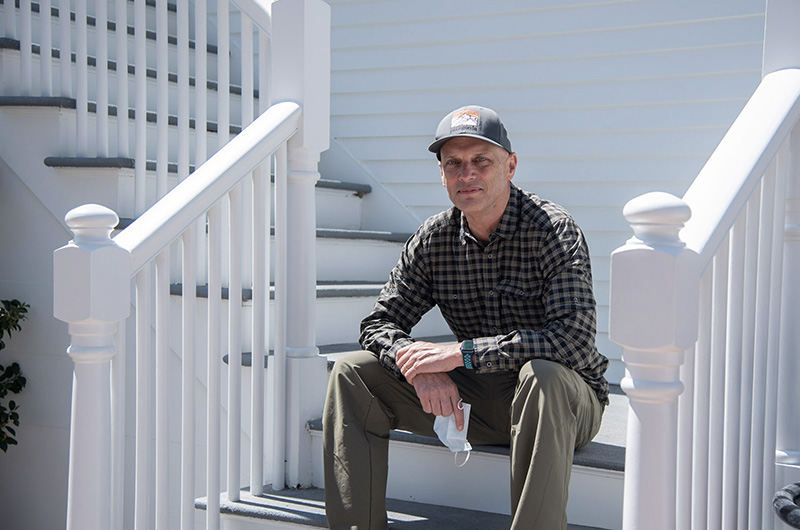
Edgartown health agent Matt Poole.
The traditions and rites of a Vineyard summer have all been cancelled, some for the first time in their century-long history.
“If you wanted to schedule a calamitous event that would underscore all the changes that the Vineyard has undergone in say the last century, say 1920 to 2020, you could not have picked a better combination of event, of timing, of geography,” said Bow Van Riper, reference librarian at the Martha’s Vineyard Museum.
More broadly, the crisis has shifted the landscape of summer — literally and figuratively — forcing the Island to finally weigh the cost of its dependence on a seasonal economy.
“The Vineyard has spent 80 years since World War II intensively and enthusiastically embracing tourism as an economic driver . . . and the summer of 2020 was the year that we went okay, yes, but if you do that, you create vulnerabilities to certain kinds of situations. And, boy howdy we are living in one now,” Mr. Van Riper said. “2020 was the year you find out how exactly in the margins you are, or not.”
The impacts of the pandemic have stretched far beyond the economic and experiential and torn at the soul of the Vineyard, laying bare age-old divides between seasonal and year-round residents.
License plates have turned into dog tags, social media forums into dog fights.
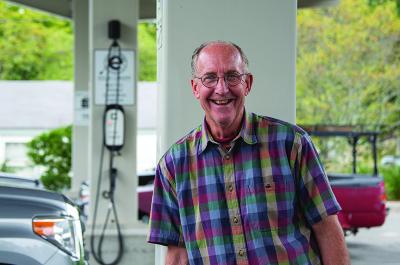
Steve Bernier, owner of Cronig’s Markets.
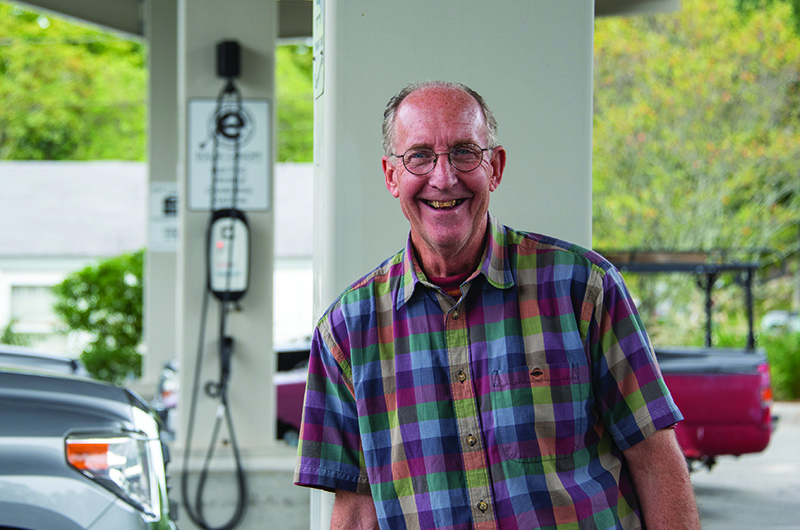
Steve Bernier, owner of Cronig’s Markets.
“What I’m seeing — for the absolutely the first time in my memory — is people saying the quiet part out loud,” Mr. Van Riper said. “And I was seeing it almost as soon as the epidemic broke here.”
But if the pandemic has shaken the Vineyard’s soul, its spirit remains intact. Mr. Van Riper said the biggest surprise to him about this summer is how similar everything feels.
A $70 million pleasure yacht was tied up in the Vineyard Haven harbor last Saturday, a stone’s throw away from the launch of a historic wooden, 1932 Alden gaff cutter at the Gannon and Benjamin boatyard.
Summer is still here. August begins tomorrow. And Vineyarders — like always — are counting the days to September. The only difference this year is that their survival may depend on it.
“We’re wrestling with an octopus right now,” Mr. Poole said. “I’m really, really just looking to get to Labor Day.”
Comments
Steve Bernier saw it coming,
W.S.M. West TisburySteve Bernier saw it coming, many of us saw it coming and the only island town that saw it coming and began to take immediate steps was Edgartown!
The entire rest if our island's towns leadership as well as our county commissioners ran around totally confused.
A couple towns and the County Commissioners as well as most of the islands BOH still have no serious ENFORCEMENT and August is a few days away -- Oh My!
One major error in this reporting is that "Edgartown town administrator James Hagerty, who is a former marine". Well, There are no former Marines! "Once a Marine Always a Marine" and believe me James with that background in that leadership position at this time in our history made Edgartown the model other towns would follow.
GOD help us all who have taken this very serious from the get go and those now who do also until a true vaccine is found and politics will temporally end!
In closing thank very much Noah Asimow for such a well written and informative article, hopefully the Gazette will keep you on for a while!
I completely disagree about
Islander MVI completely disagree about only Edgartown taking action. All the boards of health and health agents were in lockstep in the first months including the construction ban. Selectmen were on different pages and got many headlines but they didn’t have the authority. Coordination between the towns was extraordinary. Meanwhile, Edgartown comes in far from first place in terms of messaging (signage especially) and enforcement.
You people are jerks -
Jonathan EdgartownYou people are jerks - "counting the days till September", public officials saying out loud they are just "looking to get to Labor Day", and of course, the scorn of people who can afford a "pleasure" yacht.
Stop patting yourselves on
Paul Oak BluffsStop patting yourselves on the back. The Island did little to no enforcement and allowed many unsafe conditions to still exist. We might dodge a bullet but more luck then a plan.
The problem with the
Islander MVThe problem with the enforcement, and what most people mean is mask wearing, is that order from the state is essentially unenforcible. Nobody can be compelled to provide ID because there is no probably cause of a crime, and anybody can say they have a medical condition and they cannot be compelled to prove it. Add to that the sheer numbers of people not in compliance and you would need national guard troops to make a dent. Instead the enforcement has been at the commercial level, where it is less visible and more effective. Even then, paltry resources come into play. And messaging, particularly in your home town, has been strong, again considering how little the island tax payers have invested in their police and health departments. The proof is in the numbers and that isn’t luck. It is mostly due to community buy in and some very strict rules early on. Mask compliance is up hugely but it is a new crowd of visitors every week so let’s hope the signage works. The 14 day quarantine order will be interesting.
Paul, you are so sadly very
Jennifer - Mother MVPaul, you are so sadly very right we haven't dodge a bullet yet! I do not believe the numbers are truthful and accurate! August starts tomorrow and there will be more kids partying and visitors here from Hot CV-virus states laughing at the 14 day self quarantine orders! They are also all here to hid out and party as they have done in their home states! I do believe their news and numbers.
Plus we have three children that have to go back to school on the island very soon and we are totally prettified as to what to do because we have no confidence in any of our leaders!
It is clearly about money and not about lives and now are children are the pawns.
I am so sorry for your
Islander MVI am so sorry for your distress and share your concerns. I agree with you and Paul that we are not nearly out the woods. The people traveling here right now who are crowding the harbors and streets drinking and maskless are an affront to humanity. I believe island selectmen and their town managers along with the governor have sold us out to a large degree. Their values and mine don’t align. Then again, this is a tourist economy and I am hardly surprised. Please don’t attack anybody stuck with enforcement when the purse strings are drawn tight and the rhetoric and politics drive the cash grab. This is like blaming teachers in a poor school district for overcrowded classrooms and lack of supplies. One wonders why they even bother. I sure wouldn’t. I am grateful for the protection that has been offered by police and health departments, nurses and indeed private citizens and just wish they would be provided the staff and legal tools they need to protect us. I wish you the best!
Having lived in Boston since
Susan VHHaving lived in Boston since college, I have been coming to the Vineyard every summer since 1986. Last year we became Florida residents since we were spending slightly more time there than in MA. As a result, the car we leave in MA has FL plates though it has never been there. We have been back in MA since early June and have not left the state. I have been concerned with the # of anti-tourist comments in the Gazette, but agree that people coming from hot spots need to quarantine. But I'm not 1 of those people. We are arriving for our yearly visit next week and I worry about harassment because of the FL plates. I never thought this could ever be a concern and it makes me sad that I have to even consider it.
I haven’t witnessed any
Islander MVI haven’t witnessed any harassment nor have I read of any. However, I have seen a dramatic reduction in the “Vineyard Stop” for those with out of state plates. Your left turns from side streets may be quite difficult but that’s probably it. I advise planning your jaunts out to maximize right turns. But then that is just good basic sense any August here.
Sounds like a global pandemic
August West EdgartownSounds like a global pandemic. Maybe the tourists should put on masks.
Add new comment