


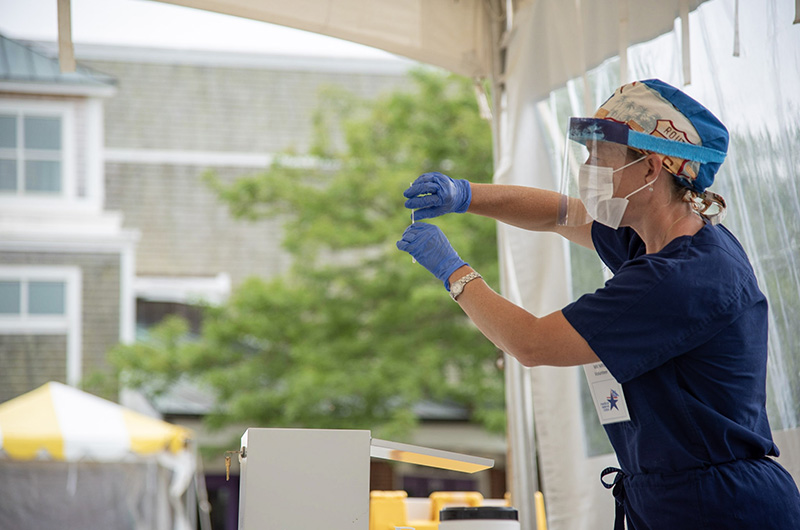
As Covid-19 testing continues to expand throughout the Island, viral serology testing — or testing for coronavirus antibodies — remains virtually non-existent.
As Covid-19 testing continues to expand throughout the Island, viral serology testing — or testing for coronavirus antibodies — remains virtually non-existent, with Island health officials expressing hesitancy about antibody testing and using it in only rare circumstances.
“We are trying to follow the science,” said Martha’s Vineyard Hospital president and chief executive officer Denise Schepici at a hospital briefing last month. “And our research is that we still don’t really know quite how to interpret what the antibody is really telling us.”
With the pandemic still in its nascency, the science and guidelines behind the two types of coronavirus testing — viral testing and antibody testing — remains complex, even as cases surge nationwide and Vineyard visitors arrive from near and far for the summer season.
Viral PCR [polymerase chain reaction] testing for the coronavirus, which is generally conducted by a nasal swab and tells patients if they currently have the virus, has become a focal point for Island health officials. Nearly 1,600 symptomatic patients have been tested over the past three months at the Vineyard hospital, while nearly 2,000 more asymptomatic patients have been tested at a comprehensive testing facility opened at the regional high school in May. The Island has had 33 residents test positive for Covid-19.
But antibody testing, which is conducted through a blood test and tells patients if they carry antibodies for Covid-19 or another related coronavirus, signaling that they may have had the disease in the past, is effectively unavailable on the Island. The Island has had 13 residents test positive for viral antibodies; all 13 of the tests took place at clinics off-Island. The closest available on-call antibody testing site is on Cape Cod at a Quest Diagnostics facility in Falmouth.
Antibodies are proteins that fight off disease and can in certain instances provide immunity to the disease in the future. The science around whether coronavirus antibodies indicate immunity to Covid-19 remains unclear, according to the Center for Disease Control.
Neither of the Island’s two coronavirus testing facilities currently offer voluntary antibody testing, citing either federal or state guidelines, unknowns associated with the science or logistical complications. Most insurance providers are required to cover antibody testing for patients at no out of pocket expense.
The Martha’s Vineyard Hospital recently announced that it would offer the Roche diagnostic antibody testing in an extremely limited capacity, using it exclusively as a second, follow-up diagnostic test for patients exhibiting symptoms of Covid-19 but who received a negative viral test. Up to that point, hospital officials had expressed strong reservations about antibody testing, saying that offering it was not a priority considering the unknowns regarding its science.
“Right now, the antibody question is in the research phase, and we are still trying to figure what it means in terms of immunity and prevalence,” Ms. Schepici said in May.
Tisbury health agent Maura Valley has previously stated that the boards of health were taking a “wait-and-see approach with regard to antibody testing” before recommending it to patients.
“They’re still kind of working things out with the antibody test,” Ms. Valley said.
In an email last week, head of hospital operations and nursing Claire Seguin explained the new guidelines around antibody testing. The hospital follows guidelines from its parent network, Partners Healthcare, which includes Massachusetts General Hospital.
“Serologic testing for antibodies against COVID 19 should not be used as first-line testing for the diagnosis of COVID 19 infection,” Ms. Seguin wrote. “Viral testing should be performed to evaluate for active infection in symptomatic individuals. At this time, it is generally unknown if the presence of antibodies confers protective immunity.”
But in a later press briefing, hospital officials further expounded on the availability and use of antibody testing at the hospital, saying that even though anitbody testing was available, patients could not simply request a test and that they would be directed to have a viral test first. Only after a negative viral test could patients, who were still showing symptoms of Covid-19, get an antibody test at the request of their physician.
“It’s two things,” Ms. Seguin said at the time. “Patients who test negative with the viral [test], which is always the first one, and have symptoms that are very suspicious for Covid-19, can have an antibody test as sort of a second-line. So that’s really where antibody testing is at the scientific community. So that is what we’re following.”
Mary Breslauer, a spokesman for TestMV, the comprehensive coronavirus testing site at the high school, said there have been limited conversations about offering antibody testing at the site but that it would be logistically complicated. Unlike the viral nasal swab test, an antibody test cannot be self-administered and would likely involve a more complex reorganization of the drive-through facility.
The Center for Disease Control’s guidelines on antibody testing state that antibody tests should not be used to diagnose a current Covid-19 infection “except in instances in which viral testing is delayed.”
According to the CDC, antibody tests might not show if patients have a current Covid-19 infection because it can take one-to-three weeks for bodies to develop antibodies. The guidelines also state that testing positive for antibodies could indicate the patients have antibodies from a different coronavirus infection, such as the common cold, and that future immunity is unknown.
“Having antibodies to the virus that causes Covid-19 might provide protection from getting infected with the virus again,” the CDC guidelines state. “If it does, we do not know how much protection the antibodies might provide or how long this protection might last.”
Comments
If you make an appointment to
Another Means to an End EdgartownIf you make an appointment to donate blood through the Red Cross, they will give you the option of also testing your blood for antibodies. There is no charge. The Red Cross will be coming to the island in July & August.
That’s great to know. Thanks
IslandMama West TisburyThat’s great to know. Thanks for sharing.
Antibody testing would
John Part-time Island residentAntibody testing would provide more peace of mind to those who have not experienced symptoms, than the viral test. Since Quest provides both types of tests, why not offer it to Islanders? I had Covid-19 in April, tested positive (viral) & followed up with another viral test weeks later which was negative. My doctor explained the immunity aspect, however felt it may be short term (6-8 months). For those without symptoms (the 2,000 Islanders tested so far), the antibody test provides future security at least for the near future. The viral test provides no security, because the next day at the crowded Granite State store, Stop & Shop, or Post Office, they could easily contract it (alot of people coming from out if State shopping). My father has friends who want him to get viral tested so they can socially gather this Summer. I reminded him they would need a test prior to every dinner for it to provide actual results. Antibody testing for people without symptoms is better use of testing.
Strikes me that once again MV
Jim NycStrikes me that once again MV Hospital goes to great lengths explaining all that they can’t and won’t do for you. The Red Cross option sounds excellent and a worthy one to rely on thank you.
Starting in mid July, then
MV Nurse Oak BluffsStarting in mid July, then August and September I have been expecting to see real spikes in confirmed cases and sicknesses here seeing all the visitors already arriving most from hot spot state and them definitely not self quarantineing for the 14 days as expected. Also seeing even in the press young people not masking up and not Social Distancing thinking they were invinceable. Seems now they are getting sick as well and the country is now seeing concerning CV-19 spiking in several states.
Hopefully the island leaders and law enforcement will abide by the Governor's orders which violations do include Fines!
We once again we are getting a definite heads up about the real seriousness of this
Virus and there is a overabundance of our elderly folks as well as many with serious compromised immune systems. Our phone calls are already ringing off the hooks!
Antibody tests provide peace
Elizabeth Vineyard HavenAntibody tests provide peace of mind. It is thought that you are protected for at least six months which would take you through the summer months, at the very least, without too much worry of contracting the virus. Of course, social distancing and masks should still be used. But, also, if you know you have had the virus and you have antibodies, you can donate your plasma which could help save a life. In this time with so much uncertainty which make us feel so helpless, this is a way to help. This is why antibody tests are important.
Add new comment