



Travel delays and bureaucratic obstacles caused by the coronavirus are disrupting the influx of seasonal workers who typically begin arriving on the Island around now.
Travel delays and bureaucratic obstacles caused by the coronavirus are disrupting the influx of seasonal workers who typically begin arriving on the Island around now with visas from many corners of the world.
The visa programs, known as J-1 and H-2B, have not been cancelled, but the pandemic has shifted priorities at the state department, impeding worker arrivals. And even if foreign workers are able to come, Island business owners are unsure whether they will have enough work this summer to keep them employed.
“I need a couple of key people and we can get through this summer, but we won’t be in the position where we need too many people.” said Mike McCourt, owner of Murdick’s Fudge, who committed to employing 14 J-1 and H-2B workers this year based on past summers.

Mike McCourt, owner of Murdick’s Fudge in Edgartown.
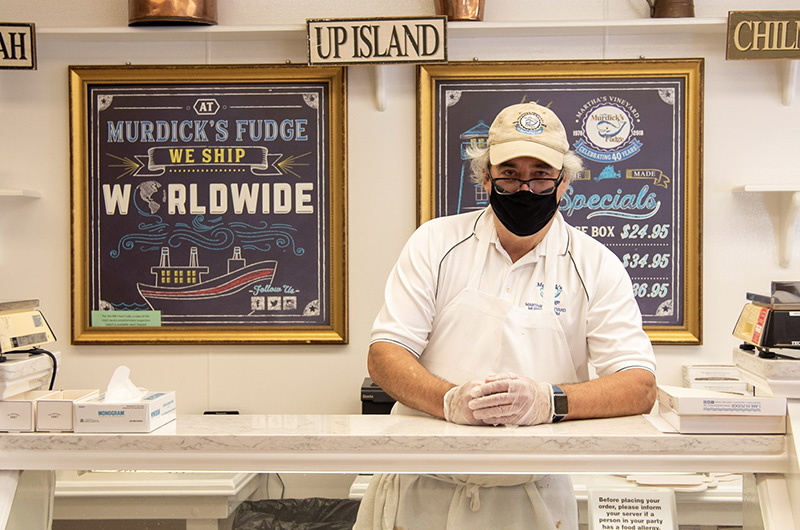
Mike McCourt, owner of Murdick’s Fudge in Edgartown.
Visa workers have been an integral part of the Vineyard seasonal economy for over two decades, offsetting what would be a significant labor shortage when the summer population typically increases five-fold beginning around Memorial Day weekend. In 2018 there were 872 J-1 visas issued to the Island. These are specific to foreign students who are only available to work for part of the season, while hundreds more H-2B visas run through the shoulder seasons.
Island businesses owners said they have become dependent on the workers, who in recent years have mostly hailed from Eastern Europe and the Caribbean, in some cases comprising over half their total staff.
Cong. Bill Keating, whose Cape and Islands district office oversees the visa programs, said workers and business owners alike were at the tail end of a months-long process to secure visas when the pandemic broke out. The disruption reshuffled priorities of U.S . embassies that handle the paperwork, he said.
“When the pandemic hit . . . The scope of the state department and their function went to repatriating U.S. citizens around the world,” Congressman Keating said. “That became the enormous focus of the state department, away from everything else.
“All across the world, embassies are on a skeletal crew. They don’t have the ability to process many workers under those conditions,” he added.
Even if the embassy problem were solved, many international flights have been canceled, making getting here difficult, said Marilyn Vukota, a lawyer who who assists more than a dozen businesses on the Island with the H-2B visa application process.
“I think they will be able to get here eventually,” she said. “But whether that is going to be the time that is beneficial for the employer, nobody knows.”
Mr. Keating said visa applications are still being processed, with a priority on those who have already worked in the United States previously and for that reason do not need in-person interviews at the short-staffed embassies. But Island business owners and visa workers said communication with the embassies have all but shut down.
“We’re just waiting. All of us are just waiting,” said Amadeo, an Albanian native, who this year graduated from the American University of Bulgaria, and has spent the last four summers working on the Island with a J-1 visa. “We have been told the program is not cancelled, but the embassy is not telling us anything,” he said, speaking to the Gazette via FaceTime from his apartment in Blagoevgrad, Bulgaria.
Business owners on the Vineyard said they are still operating on the assumption that the workers will arrive but so far none have come.
“We have to make the assumption that we are going to be open this summer,” said Mark Snider, who owns the Winnetu resort hotel in Edgartown and the Nantucket Inn on Nantucket, employing a total of 80 H-2B workers between the two, the majority of whom are returning for at least the second time. “Our H-2B employees are valued. We are going to have to bring them on board if we want to maintain any level of business.” Several business owners said they don’t expect to have enough work for the visa workers if they are able to arrive this summer, even though businesses are contractually obligated to employ them.
“If they are able to come, I can’t guarantee them work,” said Jan Burhman, who runs the catering company Kitchen Porch, which this year already signed a contract to hire 11 J-1 visa workers. “I don’t anticipate doing any catering this summer,” she said.
With the nation in the midst of the highest unemployment rate in recent history, some businesses are taking the opportunity to wean off their dependency on foreign labor.
Bernard Chiu, owner of the Harbor View Hotel in Edgartown, said that last year J-1 and H-2B workers comprised 40 of its 120-person staff. After the pandemic hit, Mr. Chiu said he severed contracts with all 40 visa workers expected to arrive this spring, hoping to shift to hiring on a local level.
“We are turning a problem into an opportunity,” he said, adding that cancellations and capacity limitations have led the hotel to expect a much slower season, reducing the required staffing levels. “We are not going to hire any [visa] workers . . . Going local is the way to go,” he said.
Acknowledging that this summer is different, Mr. Keating said he did not believe local hiring was a viable long-term option, as the often-politicized foreign workers are essential to keep businesses running through the summer season.
“U.S. jobs are caught in the balance of this,” he said. “Looking forward to a more normal period, you need these people to come. Without them, local jobs are jeopardized, because [businesses] are not going to open if they are understaffed.”
Comments
With flights cancelled from
Jack Thayer EdgartownTraditionally, working many summer jobs was a sought after rite of passage and a legacy for islander and summer kids.
I will be glad to see the
Rena Vine Oak BluffsI will be glad to see the influx of international students end as well the housing situation they find themselves in come to an end.. The J-1 visas are for summer intern jobs where a training program is required and the visa is specific to the employer - for almost all summer jobs on the island, such as a waiter, this is a misuse of the visa. Furthermore the students live in slum like conditions - houses where mattresses cover the floor of every room and the student is lucky to have their own mattress assigned to them. This summer will be an interesting experiment in having local students fill the jobs - back to the 80s for summer 2020.
Rena Vine
Colleen Oak BluffsRena Vine
Your statement about J1 visas is not accurate. There are FOURTEEN types of J1 visas that are issued, TRAINEES being one of them. Most of the Exchange Visitor/J1 students that we see on island are part of the Summer Work and Travel (SWT) program. Therefore there is NOT a "misuse of the visa."
SWT program allows for three months of work and one month of travel for the students. Most employers work hand-in-hand with visa sponsor agencies to ensure compliance with requisites of the program and safety of the students.
Are their abuses? Unfortunately, yes. But most employers do their best to do the right thing, so that they will be allowed to employ students in the future.
As for housing, not all students "live in slum like conditions." Again, many island employers spend incredible sums of money to pay for suitable employee housing. Unfortunately, the island has a history of unscrupulous landlords taking advantage of students-international and American alike.
American college students simply do not have academic and sports schedules that will allow them to work an entire summer. Labor Day 2020 is September 7th. Factoring in getting a car off island, driving home to Connecticut to see your high school friends and your grandma, doing your laundry, packing up, and then driving to college that starts on August 24th, that American student's realistic last available day to work on MV is around August 14-16.
The later school schedules of many Exchange Visitor students allows island businesses to be fully staffed until Labor Day, and many until mid-late September. Martha's Vineyard is a coveted location to many SWT participants because of its natural beauty, beaches, security and safety. The program is a win-win for many.
many of my friends used to
ECS Ft Lauderdale / Edgartownmany of my friends used to come over from the Cape for the summer jobs. Oh, for good old days, and the shared bathrooms at the Colonial.
J1 & H2B visa workers prop up
Really!! ChilmarkJ1 & H2B visa workers prop up a false economy. They allow the continuation of wages that are to low to actually live on here and substandard living conditions. Maybe all these businesses should start thinking about ways to make their jobs and this Island more attractive and financially available to American workers, instead of just lining their pockets each season and taking off for greener pastures each winter.
What’s your proposed solution
Mark EdgartownWhat’s your proposed solution for the problem that you outlined? So many of these comments are just complaining without suggesting anything helpful or being part of a solution.
I agree these programs are
John West TisburyI agree these programs are often abused by local employers (of which I am one) as a way not pay the going wage needed to live here. While there may be some employers that offer a summer work experience that these visas are intended to provide, most view it as a cheap, replaceable labor source to further line their pockets. Like many aspects of island's, and national economies, we would be better off in the long run if we paid a sustainable cost for the products and services we use. If this prices out some of the tourist traffic, so be it. It has become so crowded in summer as to mar the experience of both year 'round residents and summer visitors alike.
Add new comment