

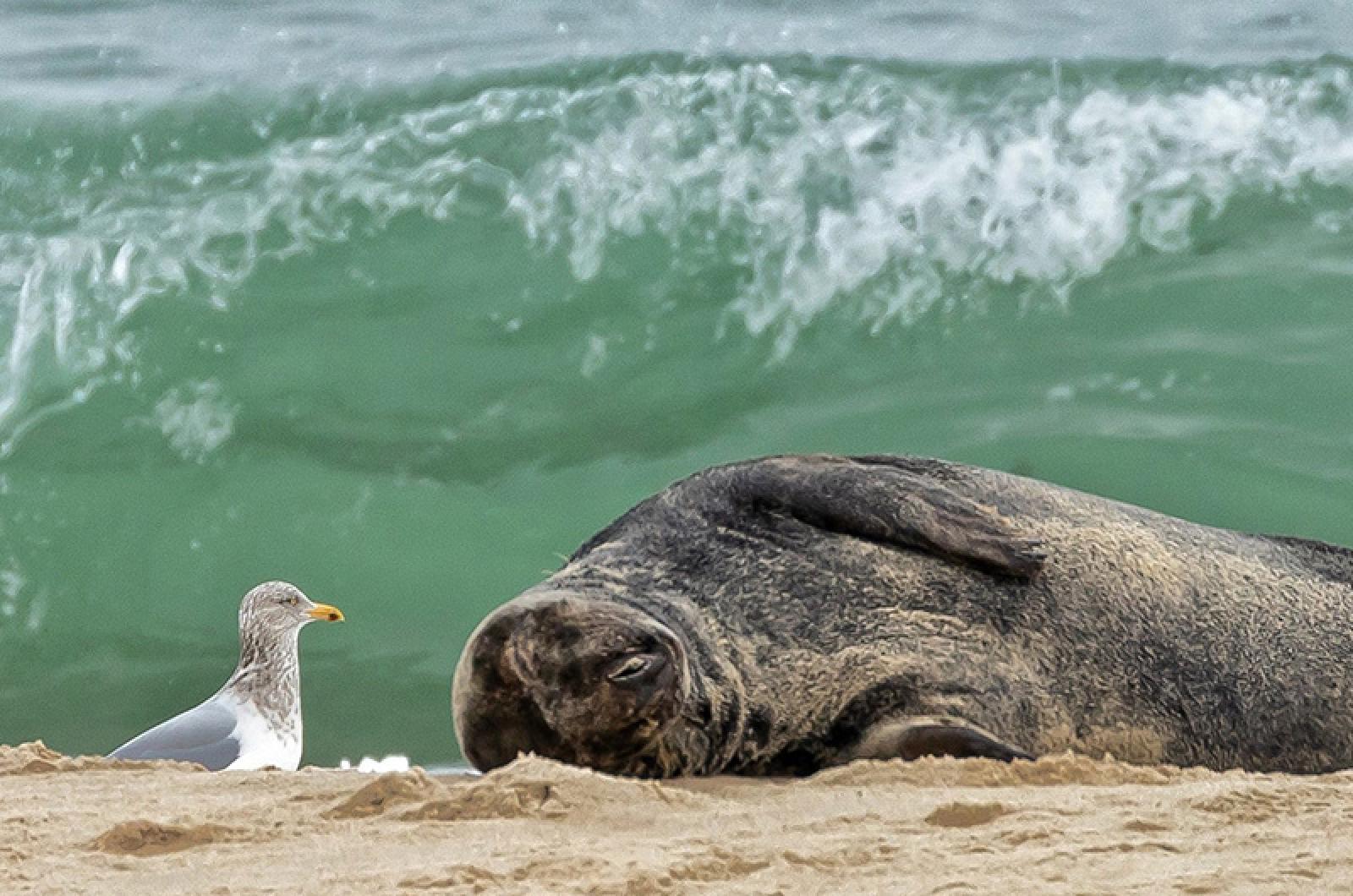
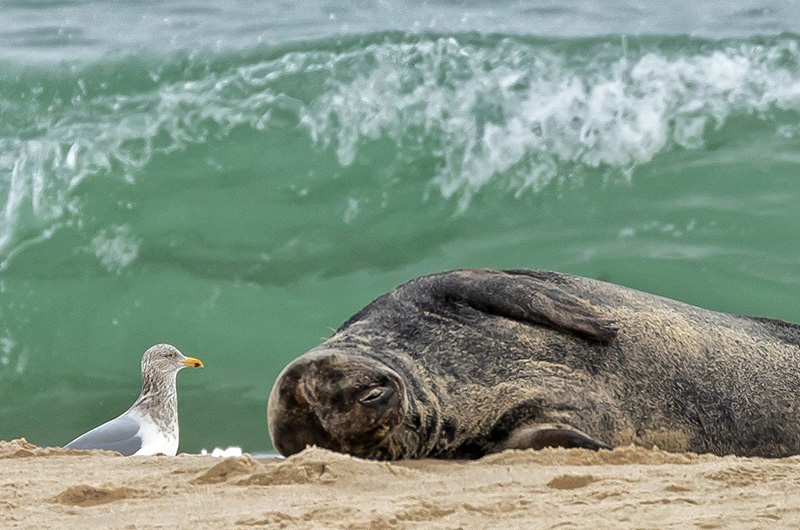
As gray seal pupping season comes to an end off the coast of Massachusetts and Maine, scientists are finishing a study.
As gray seal pupping season comes to an end off the coast of Massachusetts and Maine, a group of federal, state and local scientists are finishing a study on the health of the animals.
Gray seal pup on Monomoy island.
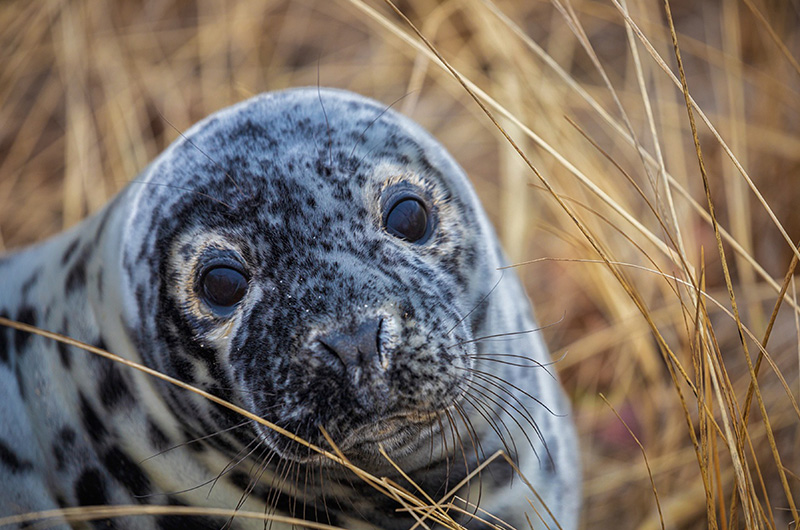
Gray seal pup on Monomoy island.
The annual study is led by the National Oceanic and Atmospheric Administration (NOAA).
One of the research teams did its work on Muskeget island, a 240-acre spit of sand west of Nantucket that hosts the largest gray seal pupping colony in the U.S.
Referred to by some as the diesel engine of the booming seal population in the region, which in the 1970s faced near extinction, Muskeget has become dominated by breeding seals during pupping season. Scientists take advantage of the abundance to study the health of the herd. As strains of influenza have been detected in the seals in recent years, the island also has become a crossroad for debate about whether seals have become overpopulated.
“We’re always trying to put the pieces together, in terms of the health of the animals,” said Kimberly Murray, a research fish biologist for NOAA who helped lead the Muskeget part of the study.
In late January, a team of six scientists and three crew anchored their 56-foot research vessel off Muskeget and used two small dinghies to reach the shore. Ms. Murray said researchers captured 27 gray seal pups, aided in part by a hefty shopping bag. Researchers measured and weighed each pup, also taking biological samples for blood, mucus, hair, feces, whiskers and skin.
The pups were born in December and by late January were just beginning to wean from their mothers, Ms. Murray said. By early March the pups will have left the island, going on to become a mid-level predators in the marine food chain, eating smaller fish and in turn being eaten by sharks in an area that runs from the Delaware Bay to Nova Scotia.
Ms. Murray tagged the seals, using satellite and acoustic technology. The tags will stay on for several months, allowing scientists to track how long the pups remain in the colony and their location later. Some tags also collect dive behavior, which can give researchers clues on feeding patterns.
“Fishermen are particularly interested, people want to know what [seals] are eating,” Ms. Murray said. “The tags can also tell us risk, if they’re caught in gill nets, for example. It is a problem not just for seals, but for fishermen. If we know more, we can mitigate that risk.”
As part of the project, the team conducted a drone survey of the island. Ms. Murray said a 2016 study found 27,000 seals in Cape and Islands waters, but a conclusive study on the Muskeget population remains incomplete.
The drone study documented the fact that on Muskeget, gray seals are pushing inland, which is not their natural habit.
“They tend to stay around the perimeter . . . around the sand. They have encroached on the center part of the Island . . . that’s not their preferred place to be,” Ms. Murray said.
The findings corroborate a trend that Crocker Snow Jr., whose family co-owns Muskeget with the town of Nantucket, has seen over the past seven decades.
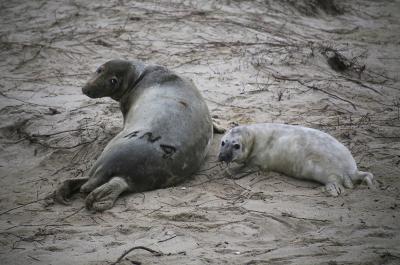
Mother and pup on Muskeget island.
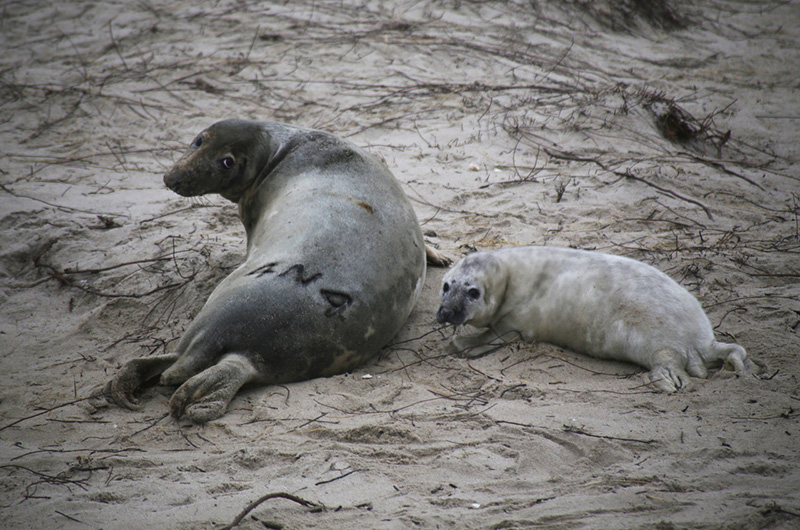
Mother and pup on Muskeget island.
“When they are birthing, they want space around them. More and more have pushed further inland, and you bump into dead pups right in the center of the island now,” Mr. Snow told the Gazette. “The mothers leave them and they are not strong enough to get all that way back to the water. That’s something you see now that you didn’t see four or five years ago.”
He added: “I saw three to four dead pups per acre. At 240 acres, you do the math.”
Mr. Snow said he believes the push inland is a sign of overpopulation, but Ms. Murray was less certain. “Overpopulation is a relative term,” she said. “In a natural population, if it’s reaching a carrying capacity, you start to see that population level off, meaning there are not enough resources to sustain the population. I don’t think they are at that point.”
The annual study of the seal population in the region began in 2013, when Tufts researchers launched a long-term study of the influenza virus in gray seals. Wendy Puryear, a research scientist at Tufts, has tracked the presence of the virus in seals since then.
She said more than 40 per cent of seals on Muskeget have antibodies linked to an avian strain of influenza, compared to a regional average of about 15 per cent. She said 11 per cent of the seal population on Muskeget had an active form of the virus, while other pupping colonies had almost none.
Ms. Puryear said the reason is likely population density. She said the problem also could be traced to an inland pond, where the seals come in contact with bird feces, creating a high risk for contracting the virus. Muskeget has the only seal pupping colony with a nearby freshwater pond, she said.
Ms. Puryear said she did not believe influenza played a role in increased seal pup mortality this year, and said her department will continue to monitor the issue.
Ms. Murray said mortality of part of the norm. “There are always dead pups out there,” she said. “They have a natural mortality . . . it can be very high in some years.”
She said she hopes the study will continue to help scientists learn more about the seal population.
“From what I’ve seen, it is still a healthy population,” she said. “The fact that it’s an increasing population suggests they are doing fine.”
Comments
At what point does herd size
Joe EdgartownAt what point does herd size get unreasonable ? With no natural predators, the only limiting factor is food supply. Time to consider culling the herd.
Joe, that argument isn't
Hannah VhJoe, that argument isn't sound. You're forgetting about sharks, boating accidents, and other natural factors like harsh winter storms. Muskeget and Tuckernuck has increased whites in the area directly related to the seal population. No culling will be necessary.
Coulda told ya that fer free.
Jim CofuitCoulda told ya that fer free....
Like the cod
Like the striped bass
Like the nose on Pinnochio’s face...
NOAA
Home of the eternal study...
Ha you are correct about NOAA
Bob EdgartownHa you are correct about NOAA, time for birth control pills for the seals. There must be something that could be put on the island to achieve that.
The science and direct
Howard NantucketThe science and direct observation prove that a healthy seal population is an indicator of a healthy ecosystem in the ocean all around us. Ignorant comments about humans controlling the ecosystem are just that. Ignorant and uninformed.
First of all, excellent
Chris Kennedy ChappaquiddickFirst of all, excellent article Will! Very thought provoking.
I recently had the opportunity to sit down with Crocker Snow to ask him about his observations on Muskeget Island which is only a hop, skip and jump away from Chappy. He told me that he never sees White sharks prowling the waters surrounding Muskeget because the water is too shallow! Think about it. The Gray seals prosper on Muskeget in part because they are protected by the surrounding shallows which Great White sharks avoid. Like having a built-in shark deterrent net around the island.
Also, in this day and age of Covid-19 virus it makes you wonder if the Gray seal susceptibility to bird influenza on Muskeget could someday mutate to a form which can make the jump to the nearby human population, much like Coronavirus Covid-19 has done? Hmmm?
Add new comment