

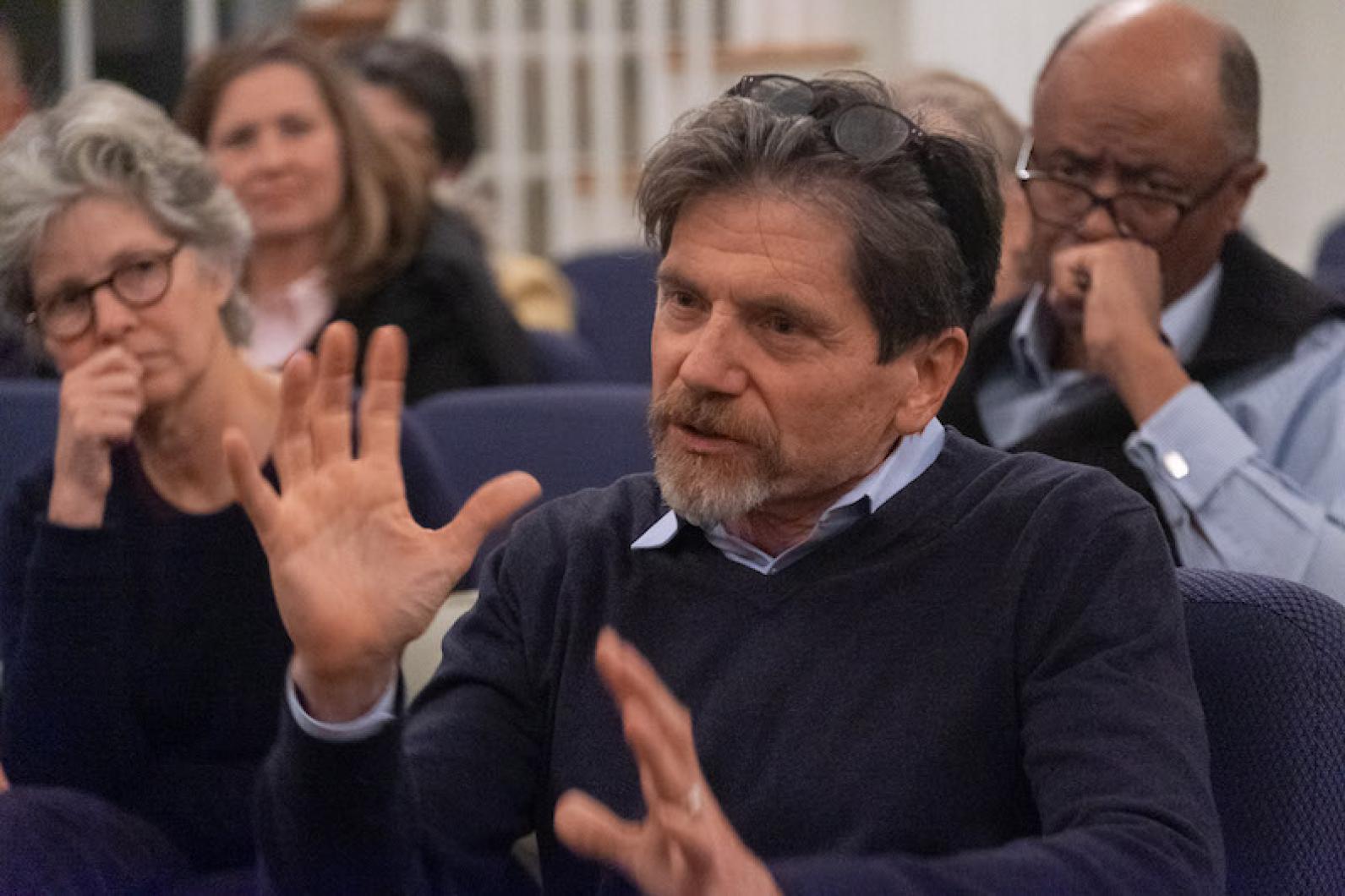
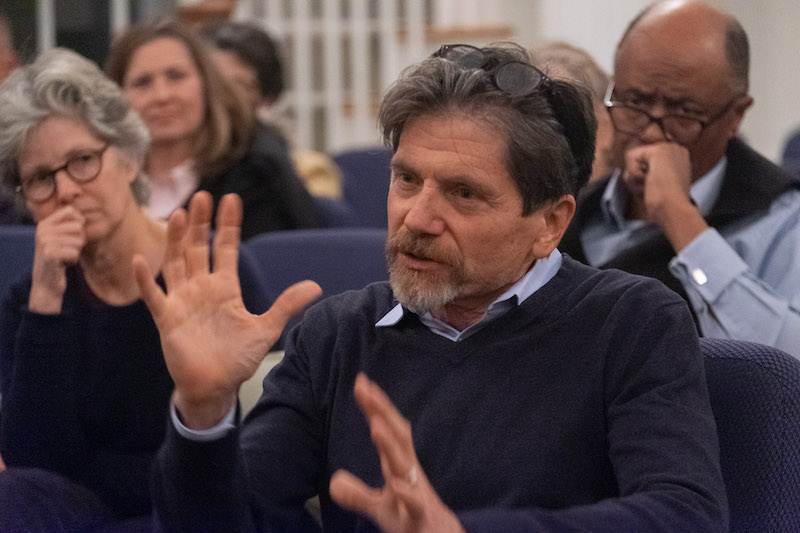
At a special presentation to the Martha’s Vineyard Commission Thursday, Dr. Phil Duffy spelled out the grave state of the global climate crisis for the planet.
Pretend the Earth’s atmosphere is a bathtub.
On one end of the bathtub is a spigot, and out of that spigot pours all of the carbon dioxide that humans put into the atmosphere, ranging from car exhaust to manufacturing to cattle ranching. On the other end of the bathtub is a drain, and out that drain pours all of the carbon dioxide that humans take out of the atmosphere.
Overflow crowd attended talk at the Katharine Cornell Theatre Thursday night.
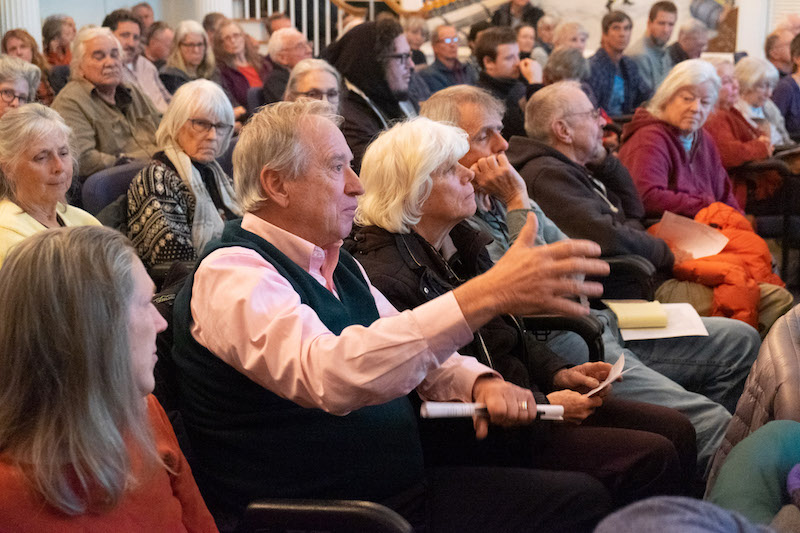
Overflow crowd attended talk at the Katharine Cornell Theatre Thursday night.
What’s wrong with this equation?
The spigot is on, but the drain is clogged. The bathtub is overflowing.
“We have procrastinated for so long about turning off the spigot, that we now have to get the roto-rooter out and unplug that drain,” renowned climate scientist Dr. Philip Duffy told the Martha’s Vineyard Commission and a packed crowd of listeners at the Katharine Cornell Theatre Thursday night.
“This is the urgency. Because it doesn’t get any better. It gets worse.”
A Harvard and Stanford-trained astrophysicist who worked in the Obama administration to pass the Paris Climate Accords, Mr. Duffy is now a researcher at the Woods Hole Research Center who has devoted himself to studying the broad-scale effects of climate change and advocating for solutions.
At the special presentation before the commission Thursday, Mr. Duffy explained the grave state of the global climate crisis, giving a dire prognosis for the planet that has ignored the consequences of its actions for far too long. Even if humans were to have completely turned off the carbon dioxide spigot in 2010, he said, the planet would continue to warm for another three centuries. To reverse the trend, humans won’t just have to become carbon neutral; they’ll have to remove carbon from the atmosphere. It’s a history lesson that goes back for nearly a million years.
“The past tells us a lot, and helps to inform us what we are going to do in the future,” Mr. Duffy said. “In the big picture, the main driver of climate change on Earth, for the past 800,000 years, has been carbon dioxide.”
Ten thousand years ago, the Earth substantially warmed and temperature stabilized, providing humans with predictable, seasonal temperatures that allowed for formalized agriculture, animal husbandry, and, in turn civilization. But over the past two hundred years, greenhouse gas emissions from the industrial revolution have gradually put those temperatures in flux, causing more extreme weather, drought, sea level rise, and the threat of mass human displacement and migration away from the equator.
On a human time scale, the temperature changes, loss of arctic ice sheets and rise in sea level and may not seem significant — less than one degree so far, leading to about 10 millimeters of sea level rise. But on a geological scale, that sort of change is supersonic.
“This is happening a lot faster than anybody expected,” Mr. Duffy said.
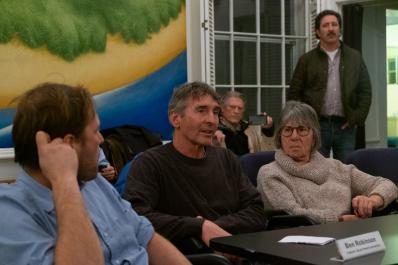
Commissioners voted 13-0 to adopt an emergency climate crisis resolution.
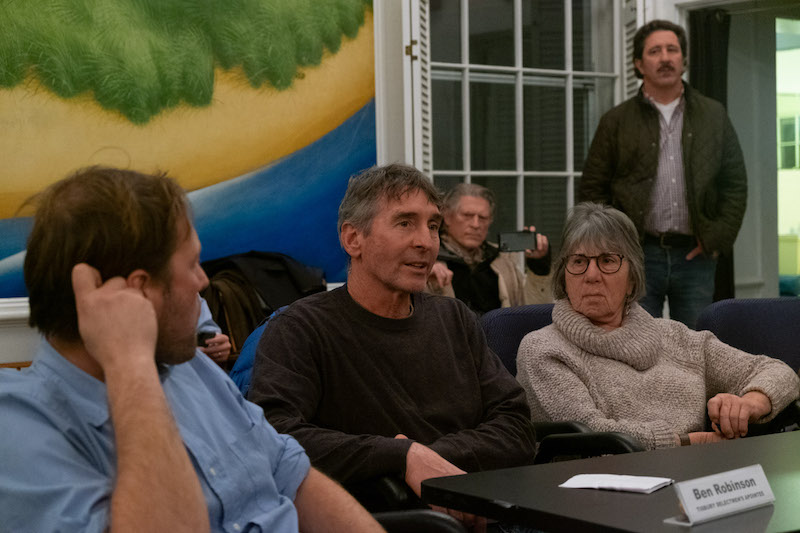
Commissioners voted 13-0 to adopt an emergency climate crisis resolution.
He said the projections of future sea level rise have been adjusted upward over time. Ancient permafrost is melting, releasing enormous quantities of methane and primordial greenhouses that were once trapped below the Earth’s crust for millenia. Ice loss is also accelerating faster than scientists predicted, meaning if the planet isn’t able to keep global temperature rise to 1.5 degrees celsius by 2040, then the entire Greenland ice sheet will irreversibly melt, leading to upwards of 20 feet of sea-level rise.
The increase in temperature will also cause increases in extreme weather, Mr. Duffy said, including more tropical hurricanes, polar vortexes and drought in traditionally water-plagued parts of the world like the southwestern United States, Mexico, sub-Saharan Africa and India. All those places, home to billions of people, would also have two more months per year where temperatures are above 95 degrees Fahrenheit. Most of India would have greater than 160 days per year with temperatures over 95 degrees. Millions of people will move, he predicted.
“The number of days where it is dangerous to be outside are increasing,” Mr. Duffy said. “This is an ominous threshold which we have crossed.”
The effects of climate change will also be felt in New England, he said. Scientists have inextricably linked climate change to an increase in instances of Lyme disease and other tick-borne illnesses. There will be more hurricanes, flash floods and coastal erosion. There has already been a 71 per cent increase in extreme rain events in the region. Parts of the Vineyard Haven Harbor could be underwater soon, maps showed.
“Increases in extreme precipitation have occurred throughout the U.S., but nowhere more than here in the northeastern United States,” Mr. Duffy said. “Climate change doesn’t fix itself. If we turn off the tap, it doesn’t get better.”
So how does the planet limit temperature rise to 1.5 degrees Celsius, roto-root the spigot, remove carbon dioxide from the atmospheric bathtub and avoid the most catastrophic effects of climate change?
“Really, we don’t know,” Mr. Duffy said. “Most of the solutions are science fiction . . . the only tech that could work for carbon dioxide removal on this scale is deliberate, large-scale land management.”
The good thing, he said, is that polling shows support for climate activism is widespread, despite a prevailing narrative that suggests otherwise. Solutions in agriculture and re-forestation are hopeful and promising, he said, with old-fashioned methods of trapping carbon dioxide in soil and trees — albeit, done on a global scale — a feasible step toward removing greenhouse gases from the atmosphere. New technology, like artificial meat, plant-based diets, recycling efforts and the sharing economy are also promising developments.
“We need action. We need it now,” Mr. Duffy said. “What’s lacking more than anything else is the will to go ahead and do it.”
The presentation was followed by a robust question-and-answer session among Mr. Duffy, commissioners and Vineyarders, all wondering how could people do their part? Discussion touched on everything from stronger land-clearing regulations, to better insurance policies, to climate equity and social justice. As an Island, Mr. Duffy said, the Vineyard has a unique opportunity to take action.
And on Thursday, the MVC did.
The commission voted 13-0 to adopt an emergency climate crisis resolution, requiring them to develop a framework for factoring climate impacts into its analysis of developments of regional impact. The resolution also supports the nonbinding resolution Island towns will present at their annual town meetings to eliminate the Island’s reliance on fossil fuels by 2040, as well as draft energy and adaptation master plans. Commissioners Clarence A. (Trip) Barnes 3rd and James Joyce abstained.
More than two hours after the presentation began, the crowd applauded the vote.
“It seems like it’s a step,” Mr. Duffy told the commission. “I’m proud of you for taking that step, and I think you should be proud of yourselves.”
Comments
If the Commission would like
thomas hodgson wtIf the Commission would like to show they're serious, they could immediately work to pull the plug on the ill-conceived and poorly considered Beach Road project, which makes no provision for rising sea level. None.
Yep, I never understood how
R Scott Patterson EdgartownYep, I never understood how they greenlighted that. All of it will be underwater in the near future. Waste of resources.
So many things, so obvious,
ECS Ft Lauderdale / EdgartownSo many things, so obvious, to those of us who are fossilized in our thinking to one degree or another.
Ridden my bike many times down that road, am aware of and in favor of the project, more or less, but the water issues, so obvious, never occurred to me.
We had a party a couple of days ago for the Xmas Boat Parade here in FLL. I was chatting with one of the millennial guests about this climate thing. He & his wife are pretty strict about vegan/no meat, certainly no beef. His point was why don’t we continue the subsidies for electric cars which for Teslas have gone from $7,500 to 0, transfer the subsidies [which are an extremely socialistic approach to capitalism] currently being paid to the oil industry, to the beef [meat] industry[s], to the milk industry-I don’t do dairy and believe no one should after childhood, etc., to the vegetable industry [an organic approach would be a further improvement]. My comment is and was that I think food advertising should be banned from TV, something I have thought for years. I imagine pesticide filled foods and junk foods and drinks, perhaps later in-life, have caused every bit as many deaths as cigarettes though obesity, heart disease, diabetes, etc.
I can’t think of an industry in this country / this world that isn’t ripe for disruption. Unfortunately the burden will fall on the millennials to actually get involved and lead the way to the future.
I am very glad to see the MVC
Carol formerly ChilmarkI am very glad to see the MVC finally - finally - taking this seriously.
I am sorry to have to raise
Frank Brunelle Vineyard HavenI am sorry to have to raise this point once again, for the thousandth time, but the Commission is responsible for the SUP project on Beach Road and it is a terrible affront to every aspect of what they should stand for. The idea that they will take down the incredible shade trees should shock everyone with any sensibility, the fact that they are replacing permeable land with growing flowers, shrubs, and grasses with concrete is the absolute height of irresponsibility and will create more flooding which is in direct violation of the mandate they just unanimously voted on. I spoke with an MIT engineer on a recent trip to Boston and this concrete bike path that they will use land taken by eminent domain for will not only add to the flooding, but also to the rate and velocity of the now increased water flow for which there are formulas that can precisely determine what the damage will be. None of this has been considered. I agree with Thomas Hodgson of course, that it should be stopped. We should all take a second look at this ill conceived and never subjected to a DRI plan.
Almost always with something
ECS Ft Lauderdale / EdgartownAlmost always with something as screwed up as Beach Rd one has to make a bigger mess before one gets to where one wants to be/should be. Everyone who has profited from Beach over the years has contributed to what it is now and they are the ones that will and should pay the largest price for its disruption and the ones who will benefit the most when the disruption is completed.
Wish we could hear other side
Tisbury voter Vineyard haven maWish we could hear other side of climate change,do we really only have 11 years left on Earth,,.and also what will MVC do with us trying to live on the Vineyard,..wish they would stop these maga homes sizes and regulate the size and square footage.Also stop the tare downs.I heard recently a well known individual bought a home up island and it wasn't big enough and tore it down,wish this would stop..maybe make the hole island a District of critical planning.
2040 is 21 years away, not 11
Math Magician Reality2040 is 21 years away, not 11.
Typical scare tactics.
AJS Westfield, NJTypical scare tactics.
Scare tactics to what end?
Jetty Yetty VA / ChilmarkScare tactics to what end?
Decades ago the government warned of declining fish stocks in the North Atlantic if extreme conservation methods were not instituted. Many regional fishermen also claimed these to be scare tactics. Well, I don’t see a lot of cod being caught anymore ... a fish, that as I recall in my lifetime, was more than plentiful.
But if you find the comments in this article scary, well you should. But burying your head in the sand isn’t going to make this problem go away.
So right on Jetty Yetty.
ECS Ft Lauderdale / EdgartownSo right on Jetty Yetty.
The 2030 "deadline" is a
John Bolduc Oak BluffsThe 2030 "deadline" is a misinterpretation of an IPCC report issued last year. The IPCC said society needs to be on a trajectory to reduce global emissions by about 45 percent if we are to get to net zero emissions by 2050 and limit warming to 1.5 degrees Celsius.If we don't reduce that much then it makes the path steeper and increasingly harder to achieve the limit in warming. Right now we are on an emissions trajectory to for about 4 degrees Celsius warming, or about 10 degrees Fahrenheit. Global warming is not like conventional air pollution. If you stop polluting, CO2 levels don't start returning to safe levels right away. CO2 is a long lived pollutant. Phil Duffy's bathtub analogy is a good way to understand the problem, or in other words it's a stocks and flows problem. Look up Climate Interactive for more info.
Where is Al Gore?
Katama Bill KatamaWhere is Al Gore?
I think he’s up island
Naomi Vineyard HavenI think he’s up island tearing down a house. /s
So when the sea level rises
Larry Priester North TisbutySo when the sea level rises and all the homes along the great ponds septic systems are intruded on my salt water are we going to let those homes be habitable?
What will happen to home values when these homes like Mr. Obama’s new residence has a front yard that is now wet lands? Critical impact zones of climate change are here. Our water front is in grave danger. Instead of building a new sea wall at the new renovation of the Edgartown yacht Club why was it not put up on poles? 18 months ago 36 inches of rain fell in the town Hawaiin town of Hanalei in 36 hours. Three old Dams on the Hanalei river burst and sent water into the bay unlike anyone has ever seen. 20 million dollar homes were destroyed. Some were rebuilt On stilts others were taken by eminent domain. More homes are for sale on the bay then any one time in the history of area. Disaster is coming it’s just a matter of time. All the homes at the waters edge or just above sea level need a plan of potential removal. It’s sad but we need to help these residents when this happens. Are we just going to let them rebuild? Some Forward thinking lawmakers better start preparing for that day and the repercussions that face our island?
There are plenty of arguments
Scott Prescott South CarolinaThere are plenty of arguments for and against the climate change issue. Most sound reasonable to sane folks. My concern is that the USA is a vert small part of the world. Look at a map of the world. China, Russia, India, the countries of both South America and Africa,The Middle East. We can do whatever this gentleman proposes and it will have no effect on the OVERALL end result. Most of the countries mentioned have no political will, or money to follow.
Global warming is the biggest
JAR NY/MVGlobal warming is the biggest problem of our time, and more so for future generations of course.
However, any discussion about it that doesn’t include reducing the human population is folly as technology and lifestyle changes alone cannot solve this.
Voluntarily having 0, 1 or 2 children with the goal of reducing the human population by 50 to 75 percent would work.
Because most humans like to consume large amounts of resources and create large amounts of waste there simply needs to be less of us.
The world was not made for 8 billion people aspiring to live high consumption lives.
Therefore regarding humans, less is more and more is death.
Add new comment