


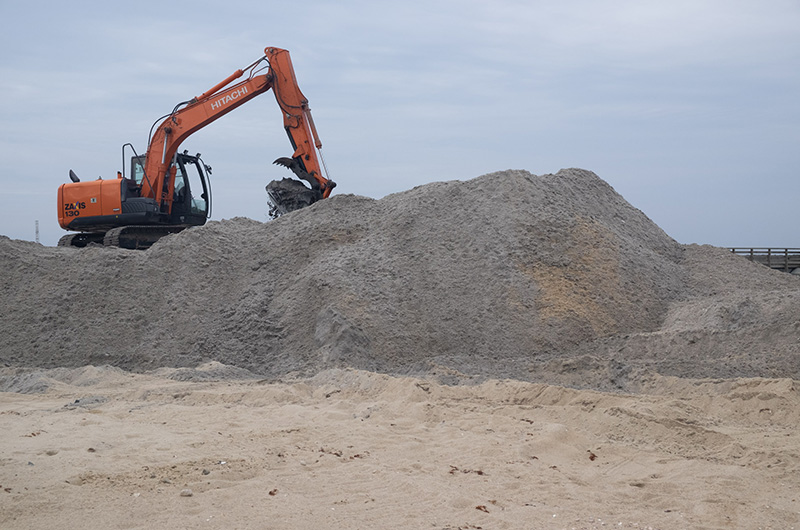
The geomorphic processes of the Vineyard’s littoral belt are among the most varied on Earth. Meaning the Edgartown dredge has a lot of work to do.
The geomorphic processes of the Vineyard’s littoral belt are among the most varied and vigorous of any on Earth, with wave-generated turbulence reforming and eroding the Island’s 126-mile intertidal zone every year.
Fuller street beach erodes every year, setting up a constant battle of town against encroaching sea.
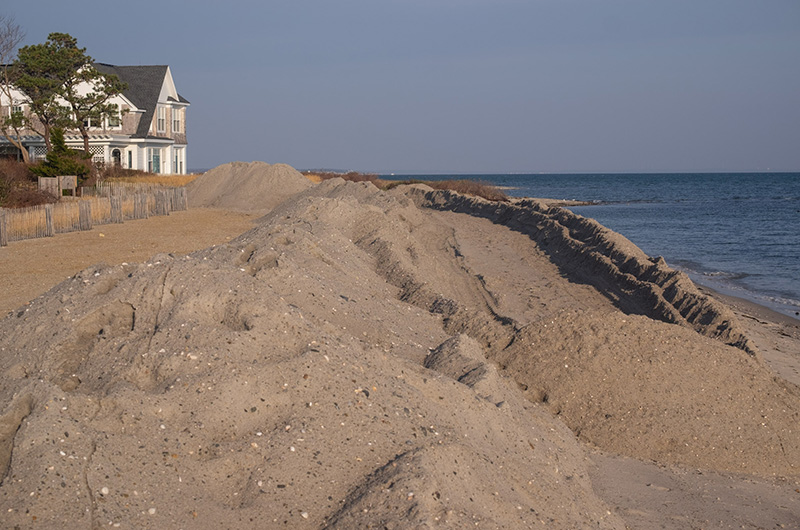
Fuller street beach erodes every year, setting up a constant battle of town against encroaching sea.
In other words, the Edgartown dredge has a lot of work to do.
This year, Edgartown plans to enter into a contract with neighboring Oak Bluffs to sell up to 16,000 cubic metres of sand dredged from Sengekontacket Pond. Oak Bluffs approved the measure at a recent special town meeting. The sand will be piled at a dewatering station by the Big Bridge along Beach Road and transported for coastal restoration to thinning public beaches on Sea View avenue and North Bluff. The work will take place this winter.
At $18 per cubic metre, that will lead to approximately $288,000 in revenue for the town of Edgartown. All for a big pile of ocean dirt.
“We prefer to call it beach nourishment,” town administrator James Hagerty laughed.
As the only Island town with its own dredge, Edgartown has created a small business digging up sand from its ponds — generally Sengekontacket — and selling it to either private landowners or other towns that want to preserve their rapidly changing coastlines. Since the town purchased the $628,000 dredge three years ago, it has nearly made its cost back in revenue.
Last year, Edgartown sold $80,000 in dredged sand to the Cow Bay homeowners association, located next to the Bend in the Road Beach, as well as to private homeowners near Fuller street. In 2017, the town entered into a contract with Vineyard Haven to dredge Tashmoo, also leading to a substantial $170,000 payout. And in the two previous winters, 2016 and 2017, the town sold approximately $50,000 in sand to other towns and private residences according to Juliet Mulinaire, who used to be the town’s chief procurement officer and now works part-time as an administrator for the dredge committee.
“That is definitely something we have been thinking more about over the past few years,” Ms. Mulinaire said. “Dredging is very much needed in a lot of places, and we can help with that.”
Work has also begun on dredging projects within town boundaries this winter, with two large piles of sand near the bridge slated to go for nourishment at Fuller street beach, a public beach by the Edgartown lighthouse. About five years ago, Fuller street beach had almost receded to the edge of the road, and erosion was beginning to undermine the roadway. Town leaders took action to preserve the beach, using sand dredged from nearby Eel Pond to nourish the eroding shoreline.
North Bluff beach in Oak Bluffs will also benefit from the spoils.
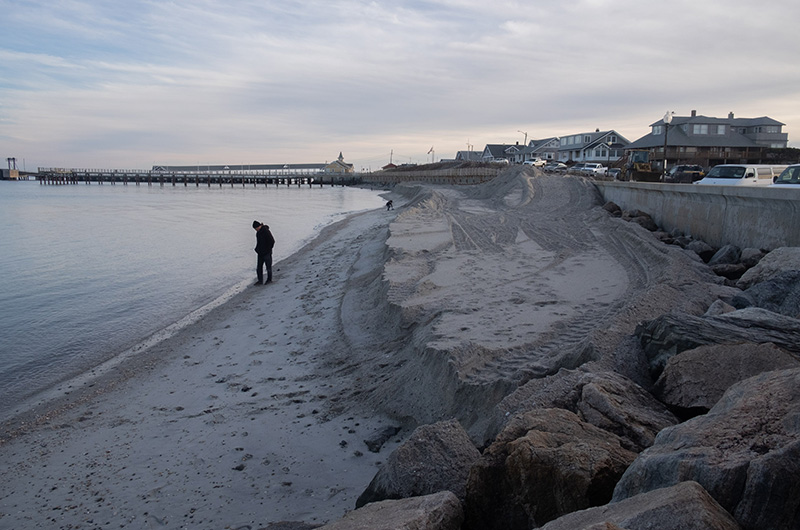
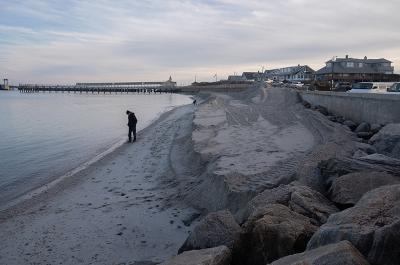
North Bluff beach in Oak Bluffs will also benefit from the spoils.
“Because of the way sand moves out there, Fuller street sort of goes away,” said Ed Handy, chairman of the town dredge committee. “The town made the decision to save it because it is one of the few public beaches that is downtown. So one of the things we do is we nourish the beach any time we can. We always nourish it a certain amount.”
In the current project, sand dredged from Sengekontacket will be trucked over to Fuller street, where it is spread along the coast. Although the sand looks black when it comes up from the bottom of the pond, the color bleaches quickly and the sand regains its normal whitish-tan hue by the time summer arrives.
Timetables for the dredging projects are always tight. Due to environmental protections for fisheries, dredging is allowed in ponds between November and Jan. 15. And due to the piping plover nesting season, no work can take place on beaches after April 15. This year Edgartown will have to dredge the sand from Sengekontacket, dewater it — a complicated process that involves separating liquid from the dredged sediment — and haul it in 16-wheelers, all within a time span of a few short months.
But the town renewed its 10-year comprehensive dredge permit in 2014, allowing it to engage in a variety of dredging projects without having to navigate a web of tangled permitting procedures. Next year, the town plans to keep the dredge in Edgartown Great Pond for work to help with aquaculture, and hopefully if there’s enough time, nourish the Bend in the Road beach.
“If you look around at all the beaches on Martha’s Vineyard, they all change radically depending on what time of year it is,” Mr. Handy said. “Now with climate change, this has turned into a never-ending project.”
Comments
As a taxpayer I'd like to
Facts not fiction edgAs a taxpayer I'd like to thank our elected officials and professional town managers for doing a good job.
I feel almost guilty about
Edgartown Taxpayer EdgartownI feel almost guilty about this. We sell OB the sand, the sea brings that same sand back to us, we dig it up and sell it right back to them. Repeat. Perhaps this should be done at cost for our neighbor? Sell at market to the private sector but cut OB a break. Regardless, well done Edgartown staff. Not often a government can turn a profit.
That’s what they get for for
Ed EdgartownThat’s what they get for for leaving in 1880. It could have been their sand if they stayed part of Edgartown!
I am glad you are not in
Bob EdgartownI am glad you are not in charge of my tax dollars. Oak Bluffs is all ready getting a better deal than they can get anywhere else. And the rest of the Island is also getting a great deal on dumping there septic waste in Edgartown's treatment plant.
You mean...rinse and repeat!
Posy Bass ChappyYou mean...rinse and repeat!
Any picture of the dredge?
truck loverAny picture of the dredge?
And, why oh why, does Oak
Ted OBAnd, why oh why, does Oak Bluffs not buy a dredge of it own? It seems there are plenty of opportunities for its use and to recoup the cost. Not to mention being dependent on another town's schedule. Just a thought....
James Hagerty, Ed Handy and
Rob EdgartownJames Hagerty, Ed Handy and the dredge crew. All good men at the helm.
Shouldn’t the sands of time
Anne EdgartownShouldn’t the sands of time be allowed to shift wherever they want. It is a natural progression of things. However, I guess if I spent millions for waterfront property and hundreds of thousands in taxes on that private property I would want my sand back for my sandbox too.
The question becomes, whose sand is it really and why should the taxpayer be subsidizing the cost of replenishing beaches that will only be washed out by the next storm.
I know this is a hot topic among all shoreline towns across the country if not the world. It affects the livelihood of many industries; tourism, housing, dredgers, to name a few. However, should it be the taxpayers via our tax and insurance premiums, who either don’t reside near the shore or reap benefits from the tourism, be asked to continually fix, repair and replenish homes, businesses and beaches that are in high risk areas? Yes, they do pay more insurance premiums for that risk, but not nearly enough to cover the full extent of the damages or erosion.
As far as our tiny island goes, I know Oak Bluffs will do anything to keep some semblance of a beach to keep the summer residents and tourists coming in order to fund its yearly budget, but when is enough, enough?
Right on Anne. When are going
ECS Ft Lauderdale / EdgartownRight on Anne. When are going to start building sea walls.
Tax payers pay for public
Jon EdgartownTax payers pay for public beaches. Houses that are private or business pay for it them selves not the tax payers. Edgartown tax payers make money selling the sand how do you not get this. Let’s just not be proactive about global warming that’s a great idea.
Does anyone know what the
Carol EdgartownDoes anyone know what the environmental impact is of the dredging of the Senge?
I hope Friends of the Senge have looked into this carefully. And I hope we are not responding to financial incentives prmarilyin our zeal for this dredging to ramp up.
They’re aren’t dredging to
Ed EdgartownThey’re aren’t dredging to sell sand. They are dredging to help the pond and the sand is a byproduct that just so happens to be able to be sold.
Senge needs the dredging to keep the pond healthy.
Anne is asking all the right
Jonathan Jupiter FLAnne is asking all the right questions. I understand tax dollars used for restoration of some public beaches - but at what cost to the dredged areas? and to the tax payer? The tax payer is still paying for the dredging equipment and its maintainance and the environmental impact even if the sand is sold to billionaires.
Well Done Edgartown Dredging
steve w miller AnnapolisWell Done Edgartown Dredging Program, Many towns wish they had such a great self managed marine dredging resource as yours.
What about the effects on the
Sara Piazza EdgartownWhat about the effects on the shellfishing beds?
The dredging improves
here we go again edgThe dredging improves circulation which contributes to the health of the shellfish beds. If the dredging was not done, it would be a swamp and a dead pond thanks to all the geese poop.
seems like there is a need
John Edgartownseems like there is a need and demand for more dredging businesses on the island!
Add new comment