

Commercial Striped Bass Season Opens, Amid Concerns About Fishery
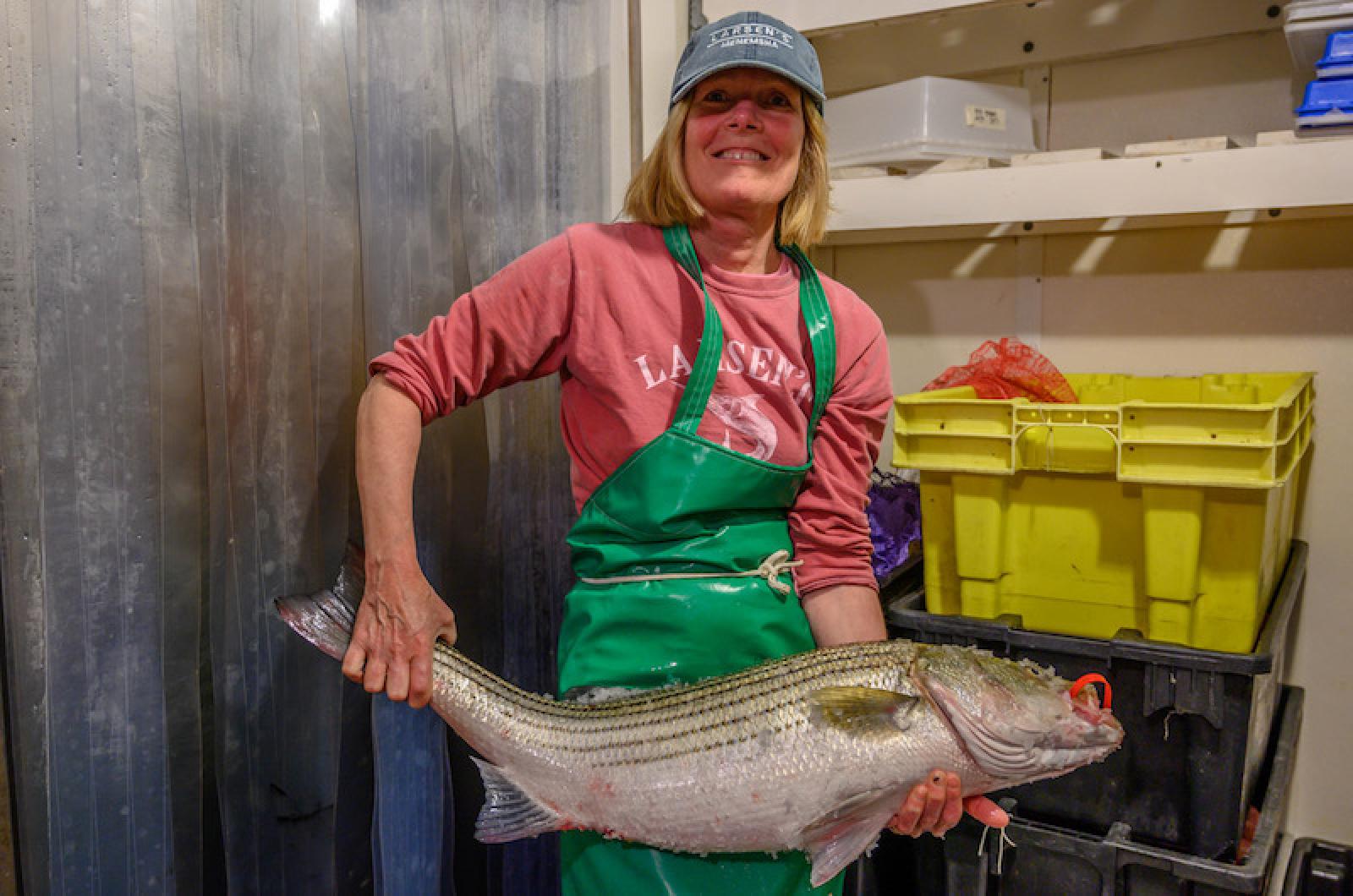
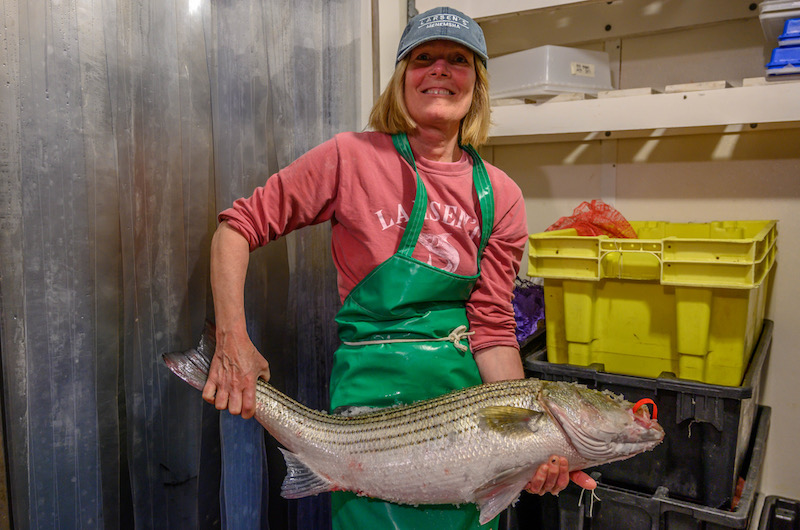
<p>By the end of the day Monday, the first day of the commercial striped bass season, the Menemsha Fish House had brought in 297 filleted pounds of the elusive — and profitable — fish.</p>
By the end of the day Monday, the first day of the commercial striped bass season, the Menemsha Fish House had brought in 297 filleted pounds of the elusive — and profitable — fish.
Otto Osmers, a commercial fisherman and fishmonger at the Fish House, said it was an about average commercial day in terms of pounds of fish landed.
And he acknowledged that the season begins amid concern among fishermen and regulators over declining stocks.
Striped bass is a highly regulated fishery, especially in the commercial market. Fishermen with a permit are allowed to catch and sell the fish on Mondays and Thursdays. They have a bag limit of 15 fish per commercial day; the minimum commercial size is 34 inches.
The only added regulation this year is that fishermen are not allowed to gaff fish that are below legal size. Story Reed, state Division of Marine Fisheries permitting manager, said most fishermen have already adopted the practice of not gaffing smaller fish, so it was a matter of “putting it down on paper.”
Fishermen and regulators are closely watching this year to see if the striped bass quota is reached.
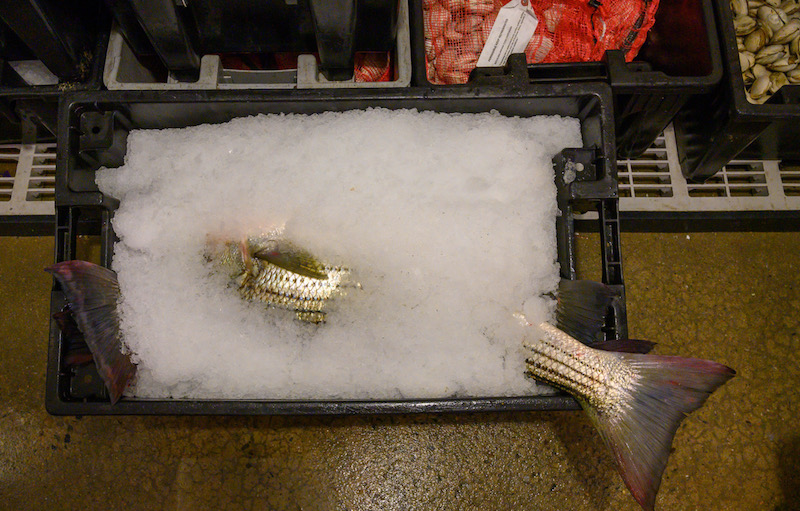
Fishermen and regulators are closely watching this year to see if the striped bass quota is reached.
In Massachusetts this year the commercial striped bass season will be capped at 869,813 pounds. The number is up from last year but represents a decrease from previous years. The season remains open until the quota is reached.
Last year the season never closed. The commercial fishery only reached 88 per cent of the 847,585 pound quota before the fish migrated south for the winter.
That result concerned many fishermen, and the concern has carried over into this commercial year. Typically the quota is reached by August or September. In 2012 the season ended a month after opening day.
Alex Friedman, a commercial fisherman out of Oak Bluffs, said environmental factors are having a clear impact on the fishery. “I believe that the problems with striped bass stocks are less due to a well regulated and limited commercial fishery than to rapidly changing environmental factors — and by that I mean climate change and an increased predation from seals,” he said.
One sign of a changing environment is the early arrival of bonito this year. The tropical fish usually arrives in late summer due to the warmer waters. This year the bonito have already arrived.
Michael Armstrong, chairman of the striped bass board for the Atlantic States Marine Fisheries Commission, cited a variety of other factors to explain why the 2018 quota was never reached.
He said the yearly haul correlates directly to the health and size of the class that spawned eight to 10 years prior. Those fish would just be coming into commercial size. According to Mr. Armstrong, there were a few weak classes in the mid-to-late 2000s.
“The biggest predictor of what’s in our waters is year class strength,” he said. “Year class strength is set by environmental conditions such as the salinity gradient . . . and rainfall in the spring.”
He said while the strength of the year classes tends to fluctuate, there are a few above average year classes from the early late 2000s and early 2010s which are just coming into maturity and should be ready to be fished this year.
“Last year was an anomaly and I think you’ll see the quota taken this year,” Mr. Armstrong said.
Nevertheless, he said the ASMFC is planning to institute new regulations for next year’s commercial season that he hopes will strengthen the 2020 year classes and beyond.
One rule will only allow circle hooks for recreational striped bass fishing. Circle hooks are more likely to hook into the lip of a fish than its gut, reducing the likelihood of the fish dying if it is released.
Mr. Armstrong said an estimated 13 million fish were released by recreational fishermen in 2018. The ASMFC estimates that nine per cent of those released fish will die.
“The mortality rate is significantly truncating the age structure,” he said. “We need to get a handle on reducing that nine per cent.”
The AMFS also hopes to pass a so-called slot policy, where fish over a certain size have to be released. The reason is that larger fish produce more eggs.
“If we don’t see the quota taken we will have to regroup and look at the reasons,” Mr. Armstrong concluded. “It’s all up in the air, and at this point we’re only speculating.”
Comments
I see people all the time
Mike Boston southI see people all the time keeping shorties and others that throw the undersized fish haphazardly into the surf barely able to swim away if at all. Until more policing is done, it will only get worse
What an absurd amount of fish
Kevin BostonWhat an absurd amount of fish to be taken commercially. When is this going to stop, when they are gone?
Commercial fishermen take
Bill FalmouthCommercial fishermen take less than 10 percent of the total catch
Who takes the other 90 per
Frank Fuller RavenaWho takes the other 90 per cent. . ?
You're chewing around the
Mark Comerford Bradenton, FloridaYou're chewing around the edges. The QUOTA needs to be reduced, foreign ships needs to be limited, and perhaps "stocking" needs to be considered.
Until the federal government faces up to climate change and changes it's ways, we are in decline.
There has not been foreign
Paul S.There has not been foreign fishing in US Waters since 1976
I have been recreational
Jerramie East hartfordI have been recreational fishing offshore since the 80s and i have seen asian ships fishing the canyons many times. Is that illegal?
I've fished for striped bass
Nostromo Beach Haven NJI've fished for striped bass for most of my life and have not kept one to put on the dinner table since 1995. Something is definitely afoot (or afin) with the stocks of these magnificent game fish. Were it up to me I'd grant these bass a five-year moratorium from being sought after whether from the surf of from vessels of any type. After SuperStorm Sandy cut the season short in 2012 there was a notable resurgence of stripers, anecdotally speaking, through 2016 but things have gone downhill since that banner year.
Stop the commercial fishing
Gerry hulsn Holbrook’ nyStop the commercial fishing of stripe bass, just give them game fish status....commercial fishing Is doing so much to our oceans!!!
if you are truly worried
Jimif you are truly worried about the preservation of striped bass, you would recognize that recreational fishermen take over 90% of the catch. there are not that many commercial fishermen, but there are hundreds of thousands of recreational fishermen
Stop killing shorts. Probably
Michael EdgartownStop killing shorts. Probably 89% of the mortality is fro. Commercial
Commercial takes only 10% ?
Michael Edgartown MACommercial takes only 10% ? And how many do they kill.off that are not big enough to keep but they net them and shorties die.
Sport fishermen are not the problem. Commercial is. And both need to work together but stop the blame game and face up to what the commercial problems are.
No need to commercial fish
Ex commercial guy BostonNo need to commercial fish them to extinction. I have to laugh at the 10% comments...why couldn't they even come close to the quota..and they added an extra day. It's all about the money...don't let them fool ya. Get rid of the commercial season and they will rebound. Also, all the states need a universal striper policy on rec harvest. Eliminate the underwater nets in the rivers down south.
Recreational fishermen take
Frank Ravena new YorkRecreational fishermen take 90 percent of them. . That's b.s. .
People people people is it
Robert Long islandPeople people people is it the commercial fishermen yes. is it the recreational fishermen yes. do all of our state's policy's suck yes unfortunately in my state most of the money for a saltwater fishing license will not be going to actually help the fishing they will probably use it to give cell phones to people on welfare. politicians also suck! we do need to have a saltwater fishing license and the money should be guaranteed to go to hatcheries along the entire seaboard. in New York where only allowed to keep 1 fish over 28 inches if we want to see success in The fishery there should be slot limits 28 in should be the biggest fish 16 or 18 inches should be the smallest let the females spawn. for some reason with most fish species you're only allowed to keep the biggest it is the stupidest idea ever not only are we taking the mothers with the most eggs we're also eating fish that have the most toxins in them what genius came up with these ideas
I agree they do that with the
Eddy Long islandI agree they do that with the red fish down south I'm sure it would work here states of just got to agree I wish people would stop playing a commercial fisherman they're not criminals and this is coming from a recreational fishermen
The sharks and the seals kill
charlie callahan so boston/edgartownThe sharks and the seals kill more than recreational and commercial combined. A seal can eat its weight in bass everyday and they can weigh two hundred pounds and they estimate there are 100,000 on the cape. Sharks probably eat more than that.Every year there are more seals and sharks and the fish populations have been going down.
I fish Commercial and us
Mike BostonI fish Commercial and us Commercial Fisherman go out catch 15 fish 2 times a week...As soon as we get our 15 fish we go home...Now go down the Cape cod Canal and on any given day there are 2000 people who claim that they are just catching stripers for recreation and releasing all of those fish...Well every day I can drive my boat on either end of the Canal and find hundreds of floating stripers dead...
I fish both commercial and
Gerry DouglasI fish both commercial and recreational off season. I can tell you that their is a problem with people who do not know how or are to impatient to properly release these fish. As stated by the marine fisheries 10% harvest from commercial and 90% recreational with more mortality from recreational newbies. I've also seen allot of these shore fisherman breaking the size and limits. The EPO's trying to get a handle on it but not enough of them. Seals are a much bigger problem then allot of people want admit. Analysis is many problems need fixing!
Mike I have to disagree with
Elaine CCCMike I have to disagree with you on the dead stripes floating at either end of the canal. I work on the patrol boats at the canal and have never seen hundreds of dead stripes floating. Maybe one or two but not hundreds.
Has anybody read the
Gourmand 2019Has anybody read the advisories about consumption of these fish? They are provided at the state level and differ in acceptable quantities (other than Mass they say don’t eat these, ever). Mercury, Dioxin, and PCBs at incredible levels. This is not a fish those who enjoy local, sustainable and healthful should be eating in any quantity, or really at all. Pregnant women, those with an aversion to mercury and PCB poisoning, children, those not naturally blessed with resistance to industrialized chemicals should not buy or consume. Look it up if you doubt it. That wholesome image of a local fishmonger holding up the hard won catch of a barely subsisting fisherman? Let’s help them find something we can all eat and profit from without eating a thermometer, herbicide byproducts, and the fillings of a transformer. Yikes!
I agree with Alex Friedman's
Albert Fischer West TisburyI agree with Alex Friedman's view in that the biggest decline factor has to do with natural predators, especially seals as well as climate change.
Make striped bass a gamefish
R Scott Patterson EdgartownMake striped bass a gamefish and buy out the commercial permits. We also need to dramatically restrict recreational limits(Derby committee are you listening?). I won't intentionally kill and a striped bass and I won't buy or eat one either. A striped bass is worth much more money in the economy alive than it is dead!
Add new comment