


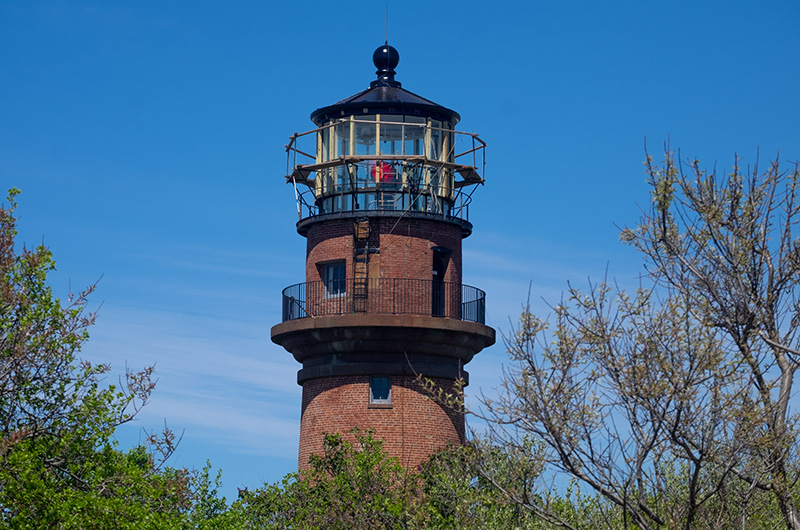
On a blustery day, Richard Skidmore, keeper of the Gay Head Light, and Len Butler, chairman of the lighthouse advisory committee, took a walk over to the clay cliffs.
On a blustery day two weekends ago, Richard Skidmore, keeper of the Gay Head Light, and Len Butler, chairman of the lighthouse advisory committee, took a walk over to the famous clay cliffs. It’s a walk they’ve made many times before. And it gets shorter every time. This time, the pair that spearheaded the historic lighthouse’s 129-foot move away from the rapidly eroding cliffs five years ago and a new round of renovations since, carried two things: the memory of 30 feet of fencing that had disappeared over the edge of the steep bluff in late April of this year, and a tape measure.
“We measured from the edge of the circle of stones, which represents where the lighthouse used to stand, to the area where the fencing fell,” Mr. Skidmore said. “Thirty-seven feet.”
“The magic number,” Mr. Butler added.
When Mr. Butler and Mr. Skidmore reached out to contractors at International Chimney Corporation five years ago, the experts said they would need a minimum of 37 feet from the lighthouse to the edge of the cliffs to have enough buffer to place heavy equipment and steel girders for the move.
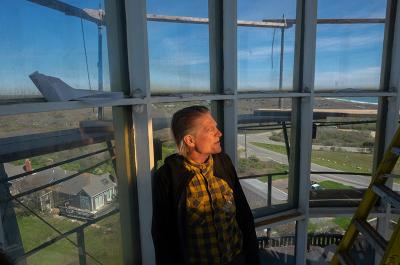
Gay Head Light keeper Richard Skidmore follows the light.
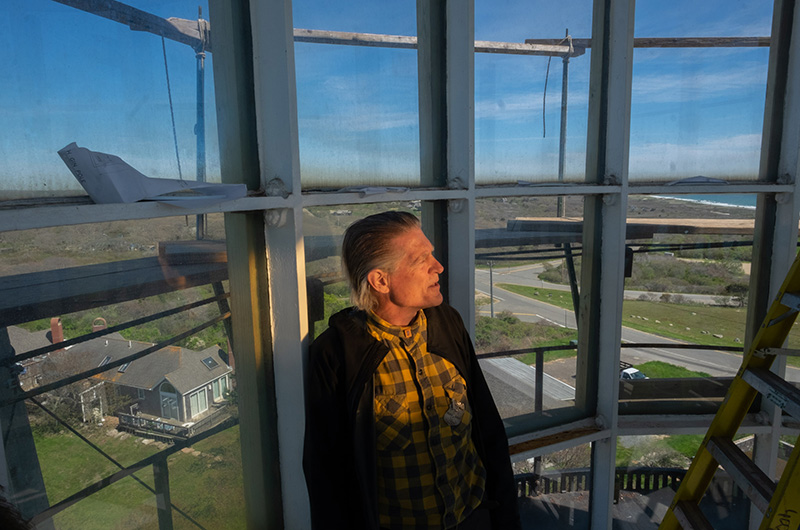
Gay Head Light keeper Richard Skidmore follows the light.
“We are now at the moment where we could not move the lighthouse,” Mr. Skidmore said. “We did it by four years, which is not much in geologic time.”
At the Gay Head Cliffs, a morainal landscape sculpted by ancient glaciers, geologic time moves fast. Or at least glacially fast. Over the past half-decade, the cliffs have lost six feet of edge and experts predict they will continue to slowly erode into the sea at a rate of one and a half to two feet per year. Meanwhile, Mr. Butler, Mr. Skidmore and International Chimney have undertaken dramatic restorations to the 170-year-old lighthouse that would not have been possible without their foresight five years ago.
The 129-foot buffer should allow visitors to see the lighthouse for another 150 years before its next move. But the Gay Head Light is more than a tourist attraction; it marks the entrance to the Vineyard Sound and the treacherous Devil’s Bridge shoals. The restoration work underway now will ensure that mariners can see the beacon for another 150 years too.
“It’s our responsibility,” Mr. Butler said. “In our agreement with the government, they said if you do all of that work, then you can have it [the lighthouse] for a buck. Let me tell you, it costs a lot more than a buck.”
Before the move, International Chimney conducted a survey of the lighthouse and found that the building would need approximately $1 million in restoration work for it to remain a safe and functional beacon. Even though the company didn’t lose one of the lighthouse’s 100,000 bricks in the move, nearly all of them still need to be re-pointed. An unattached outer protection wall, or as Mr. Skidmore calls it, a “floating veneer,” meant there was a four-inch gap between parts of the building, causing chasms in the masonry and room for moisture to enter. On the lanterntop the cast iron was rusted, the glass cracked and the roof leaky.

Len Butler, chairman of the advisory committee, surveys the world from down below.
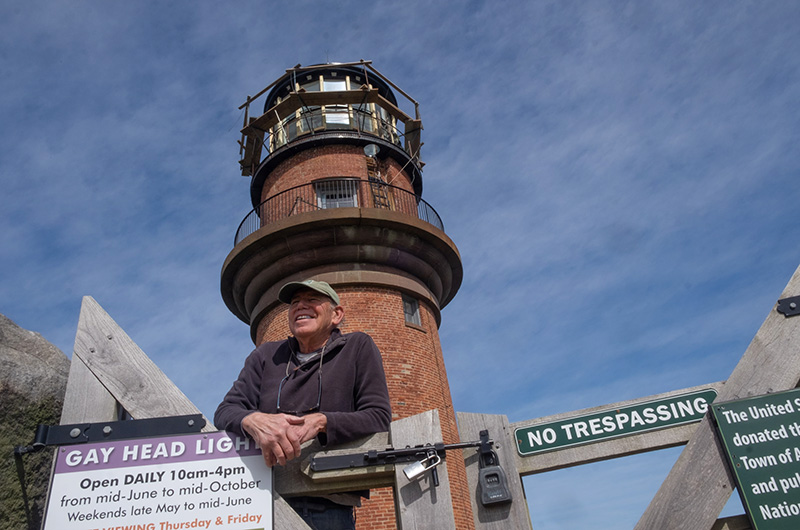
Len Butler, chairman of the advisory committee, surveys the world from down below.
And that wasn’t even the worst of it.
“We also realized there was nothing holding the lantern onto the lighthouse,” Mr. Butler said. “Just gravity.”
Today International Chimney has connected the veneer wall, repaired many of the cracked brick, and bolted stainless steel tie-down straps to the deck so that for the first time since 1849, the entire building is connected. The work has cost nearly $300,000 and was funded mainly from excess capital raised for the move, but it is by no means done. The most recent phase of restorations that have taken place over in the past three weeks involve further moisture prevention on the lighthouse roof, the cornice and a repair of Mr. Skidmore’s “30-year leak.” It also includes a much-needed paint job.
“We decided the best place to start would be at the top,” Mr. Butler said. “We found the roof itself was made of two and a half-inch thick cast iron plates, which was fortunate because it was sound structurally, but it was pitted and had little holes in it, so what they did was clean it, and filled all the holes with a metal epoxy system.”
International Chimney also added one coat of primer and two coats of urethane, weather-protected black paint to the roof.
“I don’t think that’s seen a paintbrush in 100 years,” Mr. Butler said. “Or ever.”
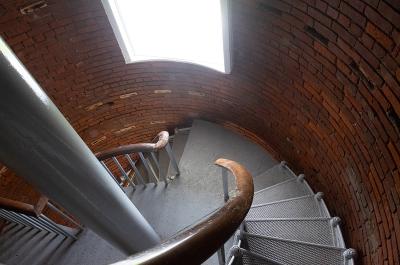
Spiral stairs lead up to the beacon.
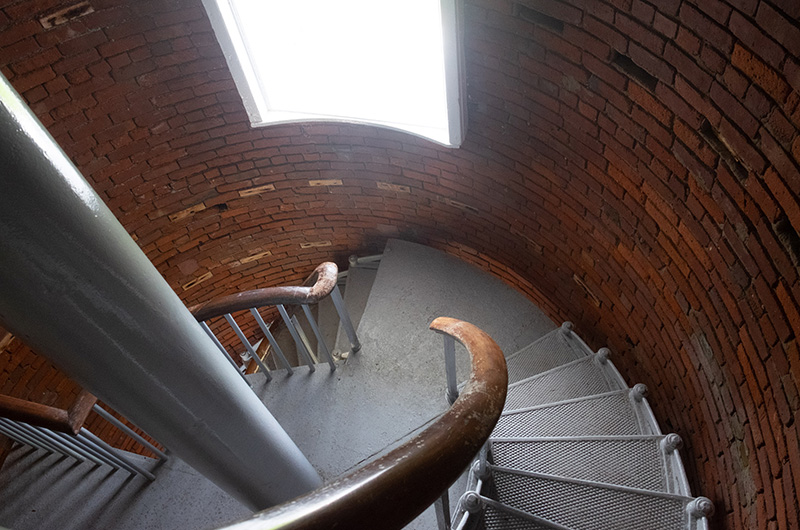
Spiral stairs lead up to the beacon.
“Now, it’s shimmering,” Mr. Skidmore added.
The Gay Head Light is 52 feet tall and 172 feet above sea level, making it the highest point on the Vineyard’s shoreline. Even for a company like International Chimney, which has repaired Tower of Babel-sized 800-foot chimneys across the globe, the view over the Elizabeth Islands, Gay Head Cliffs and Vineyard Sound from the top of the little lighthouse that moved inspires awe.
“Standing on the roof, painting the vent, the wind blowing, and you’re by the ocean, it’s not for everybody,” said Joe Scarfone, who has worked on five different restoration phases for the lighthouse and served as foreman for the move. “But I find it exhilarating and refreshing.”
To get to the top, Mr. Scarfone and his crew evaluated the condition of the lighthouse lantern and located 16 points on the window mullions for their four-by-four scaffold. They then wrapped a half-inch cable with a turnbuckle around the lantern “nice and tight,” as Mr. Scarfone described it, and connected the rigging in a circle.
“To see something that needed a lot of work and had a lot of rust on it looking beautiful and shiny, it’s pretty cool to see,” Mr. Scarfone said. “It’s a neat little lighthouse, and I’ve just become attached to it. It’s my little girl.”
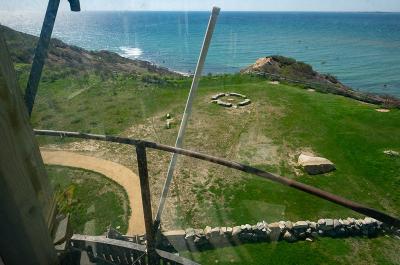
Erosion of the cliff is evident from up above.
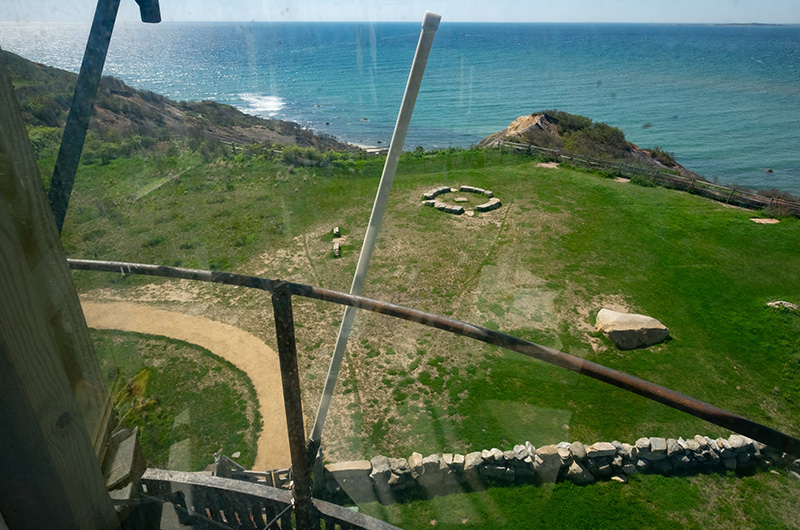
Erosion of the cliff is evident from up above.
The protective scaffolding can withstand gale-force winds. Mr. Skidmore knows. He’s tested it.
“The tension is so tight that if you hit that with a hammer it rings,” Mr. Skidmore said. “It’s a work of art.”
Mr. Butler estimated that the lighthouse still needs approximately $500,000 in further renovations, including repairs to the light drum, fixes to cracks in the lantern’s glasswork, rusting around the cast-iron floor and ceiling, and jacking all around the frame that makes the metal look like “leaves of a book.” Although a $38,000 restitution grant from Vineyard Wind, which plans to build an offshore wind farm that the Bureau of Ocean Energy Management determined would have an adverse effect on the lighthouse’s viewshed, will allow extensive brick re-pointing and passageway repaving, the lighthouse continually needs donations.
But for now, Mr. Butler and Mr. Scarfone are thankful the lighthouse is still here — less for them than for those who will rely on it 150 years in the future.
“When we moved it this time will be exactly when they will want to move it next time,” Mr. Skidmore said.
“Well, next time they’ll be able to teleport,” Mr. Butler replied.
Tax-deductible donations to the Gay Head Lighthouse gift fund can be sent to the town of Aquinnah or Permanent Endowment of Martha’s Vineyard.
Comments
How dare they call it
EmilyHow dare they call it “Vineyard” Wind when that wind farm that the majority of Vineyarders do NOT WANT ( and there should have been an island wide vote of the People by the People and for the People) will be an assault on both our beloved Gay Head Lighthouse, the sanctity of Aquinnah and her pristine views and quietude. By taking money from them, instead of protecting the island from these opportunists, the Vineyard has sold its soul to the devil. It breaks my heart.
I reject your claim that the
Hm VHI reject your claim that the majority of Vineyarders don't want the wind farm. It will be a blip on the skyline (it's 14mi offshore) and will power hundreds of thousands of homes, offsetting something like the equivalent of emissions from half a million cars.I would encourage you to go on the BOEM website for Vineyard Wind where there are publicly available simulations of the views from Aquinnah once the project is completed (as I have). In any event, you know what's a much bigger threat to the Vineyard than infinitesimally small objects way out in the ocean? Climate change.
The only thing I want to see
Island PuristThe only thing I want to see from Aquinnah is the deep blue sea.
One man’s blip is another man
EmilyOne man’s blip is another man’s eyesore.
Blip is still ugly and we don
Mark EdgartownBlip is still ugly and we don't need the eyesore.
Your claim is highly doubtful
TOM HODGSON West TisburyYour claim is highly doubtful, and you do not back it up, so it's really opinion, and you should say so, instead of making a false claim. The installation is to be what, over fourteen miles away? That is hardly an "assault". No problem with "quietude", because you won't be able to hear it. If you want to think about assaults, turn your good energy to controlling the steamship authority. They are the entity that carries the "assaulters" to our shores. There are many ways to help the Vineyard. Tilting at windmills is not one of them.
On an island known for its
Marc F VHOn an island known for its natural beauty the cliffs are probably as beautiful an area as you could find anywhere on earth
I use any excuse that I can find to visit
I am looking forward to seeing it many times more over the next 150 years!
I like your comment and
Alma Bristol RII like your comment and optimism in equal measure.
Congratulations to the
Tom Dixon Melbourne AustraliaCongratulations to the organisers of this incredible project to save such an enduring symbol of MV- it has been a truly epic adventure and it is apparent it is far from over. As advocates for historic preservation you have set a very high bar that is being recognised around the world. Well done and strength to your arms.
Actually, the project is 14
Louise ChappaquiddickActually, the project is 14 miles off Wasque and 24 miles from Gay Head.
Can't wait to visit this year
Howard J.Can't wait to visit this year!
Add new comment