


One evening nearly 50 years ago, Tom and Helen Maley were having dinner with their good friends Bob and Maggie Schwartz and the Chicago artists Max Kahn and Eleanor Coen.
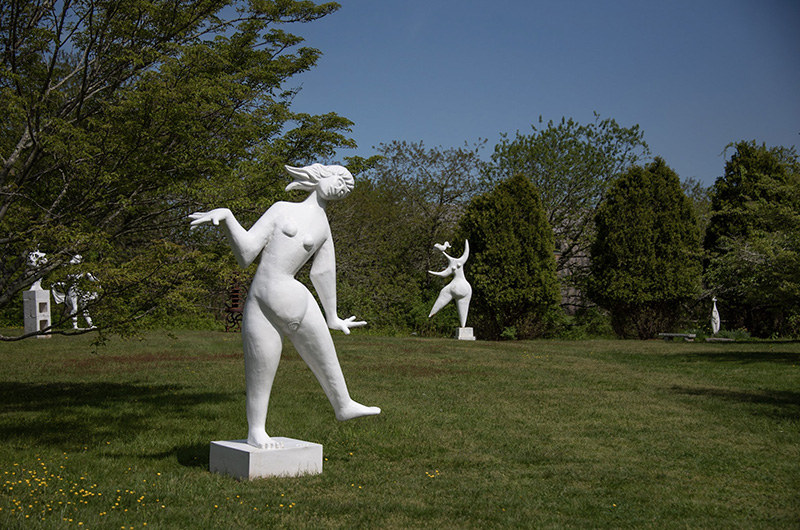
One evening nearly 50 years ago, Tom and Helen Maley were having dinner with their good friends Bob and Maggie Schwartz and the Chicago artists Max Kahn and Eleanor Coen. Tom had recently finished the first of his oversized white dancing sculptures and installed her in the field in back of their house. Its completion inspired the group of friends to imagine building an art gallery for themselves and others, there in the Maley’s extended yard, facing State Road, the town’s main and only thoroughfare. The grassy meadow had once been a cornfield where West Tisbury police chief George Manter told me that he and other kids used to go to smoke cigarettes they made from corn silk.
The late-night gallery project took form before the advent of zoning rules for the town, so Bob Schwartz, an architect as well as an artist, was in the vacant field early the next morning with a tape measure, a clipboard and a pencil, to design an art gallery. On his heels came the rest of the dinner party group, their children and their house guests. They carried hammers and saws and nail aprons, newly purchased for this fresh adventure. Among the novice builders was the aging but distinguished poet and literary force Stanley Burnshaw, who happily began pounding nails into the ascending walls and sloping roof.
Soon enough other friends joined the construction crew and sometimes strangers driving along State Road enlisted, because it looked as if fun was being had. The workers’ wives produced lunch, plenty of it, hams and turkeys, cheeses and roasts of beasts, salads and homemade bread and suitable condiments, laid out on picnic tables at the building site.
There’s a related story that goes with this project: it captures a Vineyard motif of the era. In those days, local dogs were not policed and they had their own agendas and hangout. The uptown regulars gathered daily in front of Alley’s General Store, across the street from the gallery, and howled in unison when the town clock at the top of the town church chimed the hours. This was not only a dog-meets-dog social scene; there was always a chance that some child might exit the store and drop her ice cream on the porch just as the screen door swung closed.
One noontime, the gallery wives arrived with their copious lunch components and because of a scheduling mix-up, all the humans left the picnic setting around the same time. Moments later the word or the scent had gotten out that the tables had been left unguarded, and every up-Island dog within sniffing or barking distance was helping himself to the ham, the turkey, the meat loaf, the mayhem.
The building project wasn’t completed until the following season. Over the winter, Tom wrote a letter that noted: “Work on the gallery will have to wait until all the free labor gets out of school.” The youngest of the Schwartz children, William, was 14 when he installed the electrical wiring in the building. No zoning, no inspections. The homespun plumbing, electrical work and carpentry have withstood the tests of time, and the gallery still stands upright.
In the Field Gallery’s first couple of seasons, the artists or their spouses took turns minding the shop. The gallery was open only in July and August, a nine-week season that made those summers fly by. Each Saturday night the artists and gallery staff took down the current shows and hung new ones. Two rooms were set aside for one-person exhibits by painters, photographers, sculptors and potters. The third room was filled with a selection from the gallery’s stable of artists. The four founders had first choice of dates, as well they should have. Everything was fresh and new for an opening reception the next day. I was almost always impressed with the quality of the work and how strikingly handsome it all fit together those late Saturday nights.
Every Sunday afternoon at five, for those nine Sundays, a crowd of devotees, freshly showered and tarted up in resort wear after a day at the beach, collected on the lawn for nibble snacks, punch and wine. We gallerists hoped they brought their checkbooks. With any luck at all, red dots appeared here and there and everywhere during the openings and throughout the week. Smiles were broad. Fingers were crossed. Weeks flew by.
As well as the four founders of the gallery, a number of appealing and talented young artists, including Allen Whiting, Peter Simon, Alison Shaw and Doug Kent, were among the novices who showed their work in this fledgling space. Often the sold artworks were shipped abroad to America and Alison Shaw, bless her heart, came into the gallery after hours to securely wrap and safely pack up her own sold photographs.
The gallery did not have a phone. How classy was that? We did not have a cash register or a proper booklet for receipts. I don’t know if other galleries had credit card machines; we did not. Cash and checks were kept in an unlocked metal box adrift on top of the desk. If someone bought a work of art small enough to fit inside a paper bag, it was a recycled bag from the A&P in Vineyard Haven. Nobody got rich.
As the gallery grew in prestige, the lawn became a popular site for politicians, federal and state, to host fundraisers, meet-and-greet parties, always for Democrats. Our much-loved congressman Gerry Studds came every summer to catch up with local concerns and chat with his followers. One summer, the gallery was showing reverse paintings on glass by Richard Lee while Mr. Studds’s gathering was scheduled. Mr. Lee’s paintings that season included naked leches and libertines, all prancing around, leering through the glass, fully tumescent and not a bit ambiguous. Too late, one of the gallery owners realized that the exhibit might be offensive to Mr. Studds or to some of his admirers. But it was not to worry. Mr. Studds did not go inside the building that day. What’s more, at question time, someone in the audience asked Congressman Studds what he thought of the movie Rambo, which was filling the theaters that summer. Mr. Studds responded, “To my constituents, Rambo is a French poet.”
Eileen Maley lives in West Tisbury. This essay is adapted from her memoir No Fixed Address.
Comments
The field gallery has always
Carol Klein West Tisbury Ma, Naples FlaThe field gallery has always been a "first day" visiting spot for our guests. Most of them have posed besides Tom,s sculptures. Standing in the same pose. One particular couple used the sculpture of a scantily clad man chasing a woman to announce their plans to marry. After several years of my admiring Tom's work, I was thrilled to be able to have one of them. She resides in our garden from spring to the early days of fall. I renamed her Ernestine.
.
Great tale. I wish I had
David Alger SarasotaGreat tale. I wish I had been along for the ride. My dad and his best friend, in their 60s, posed with the sculptures in similar poses, dreamy expressions and all. Still some of my favorite photographs.
Well remembered David. Am
SLB BentonvilleWell remembered David. Am hoping my slides of those moments remain intact.
I well remember those early
Carolann Clynes summitI well remember those early days of the sixties and seventies when local shops didn't open for the season until July 4th weekend and you could always find a parking space in downtown Edgartown. No one had heard of Dyke Bridge; and Chappy was wonderland in its quietness and little summer vacation one-story ranches.Those were the days before houses on Chappy had lawn sprinkler systems and central air conditioning and national chains were seen in the downtowns. I sorely miss those days but every summer we pack up the car to the hilt and head back to my beloved Chappaquiddick for renewal.
we have a desk size of "she
Alan Reed Villanova PAwe have a desk size of "she loves me" and love it. We take it with us to and from our home in Florida for the winter. It is right now on the coffee table in front of me.
My wife reminded me we no
alan l reedMy wife reminded me we no longer take our statue back and forth to Florida because we bought a duplicate, one for each home.
This is only a sample of
Cynthia Riggs West TisburyThis is only a sample of Eileen's marvelous book, NO FIXED ADDRESS. She takes us on a round the-world journey in the 1970s, sometimes hitting historic highs, sometimes scary, sometimes hilarious, always delightful reading, and a book you should race to Bunch of Grapes or Edgartown Books and buy!
Add new comment