

The fiercest, bloodiest wars are those fought not over territory or a throne, but over a way of life.
The fiercest, bloodiest wars are those fought not over territory or a throne, but over a way of life. The Civil War was one such war. The way of life at stake was slavery — lifetime, heritable, chattel slavery — and the ideology on which it rested: that men, women, and children of African blood could be property (like a cow or a horse), because (like a cow or a horse) they were not human.
The battle over slavery — what southern planters called “our peculiar institution” and northern abolitionists called an affront to God — was decades old when the first cannonballs flew at Fort Sumter. The question was put to the citizens of the Kansas Territory in 1854 — enter the Union as a free state or a slave state — and by the summer of 1856 armed guerrilla warfare had broken out. Later than summer, in a Senate debate over the Kansas situation, Sen. Charles Sumner of Massachusetts accused Sen. Preston Brooks of South Carolina of embracing “a mistress . . . who, though ugly to others, is always lovely to him; though polluted in the sight of the world, is chaste in his sight. I mean the harlot, Slavery.” Brooks, enraged, attacked Sumner at his Senate desk, beating him senseless with his walking stick.
Portrait of a chasm. Portrait of a nation, tearing itself apart.

The election of 1860 came, Lincoln won, and the Southern states bolted, convinced that upon inauguration in March he would unleash the abolitionists. They declared — one after the other — the principle for which they stood: the right to maintain, and expand, the practice of chattel slavery. We know the reason because the states, and the confederacy they formed, declared them in writing: boldly, clearly, and without equivocation. Soldiers on both sides who committed their thoughts to paper were equally clear about the causes of the war: slavery, its future in America, and the future of America.
Let me take a moment here to underscore two points:
It is frequently said that those who fought for the Confederacy committed treason, but they did not. President Lincoln took the position that — because the Constitution did not allow states to secede –—the Southern states had not, in reality, seceded. Having not seceded, they had not positioned themselves as a now-foreign enemy, and those who gave them “aid and comfort” had not committed treason against the United States. Make what you will of his legal argument, the fact remains that if the government against which you take up arms declines to indict you for treason . . . you didn’t commit it.
It is also frequently said that not all those who fought for the Confederacy enslaved people, benefited from the enslavement of others, or even supported the idea of enslavement. True as this is, at a superficial level — “not all” is a low bar to clear — it is also beside the point. Regardless of why they went, regardless of what they thought, regardless of what was “in their hearts,” those who wore the uniform of the Confederacy and took up arms on its behalf knowingly fought for a regime openly committed to the perpetuation of chattel slavery.
The war ended and the Confederacy dissolved, but ideas do not fade away so quickly. The 13th and 14th amendments outlawed slavery as an institution and explicitly extended the protections of the Constitution and Bill of Rights to all Americans. But saying it is one thing and enforcing it is another. The federal government did enforce it (after a fashion) for a decade after the war, but with the election of 1876 African Americans in the South were — like the Kurds in northern Iraq after the Gulf War — thrown to the wolves.
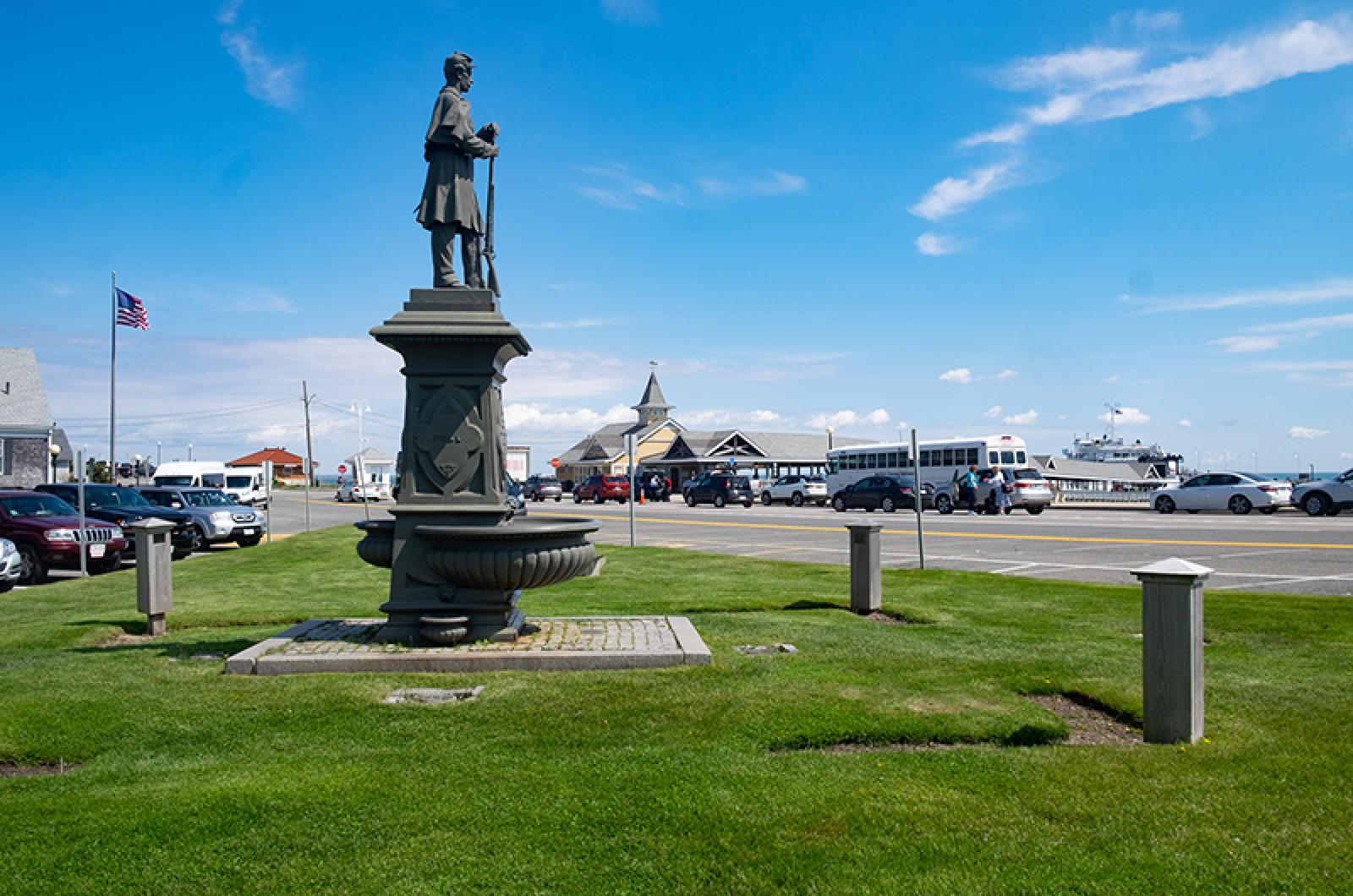
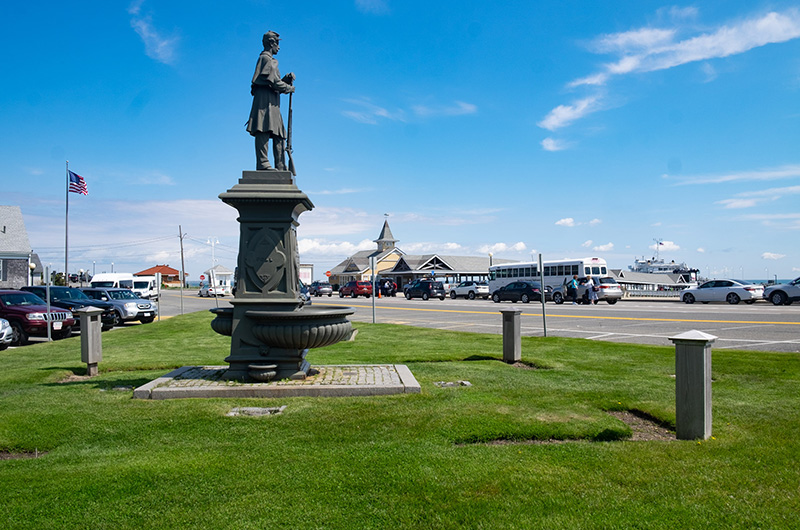
Cottage City, 1891. Charles Strahan — once a soldier in the 21st Virginia Infantry, now publisher of the Martha’s Vineyard Herald — is a stranger in a strange land: a southerner in a northern town, wash-ashore at a time when the Vineyard was far more insular. Snubbed by the local chapter of the GAR — the Grand Army of the Republic, a Union veterans’ organization — when he expresses his intention to attend their Memorial Day picnic, he launches a campaign to erect a statue in their honor.
Their honor. Not “the Union soldiers” . . . not even “the GAR” . . . but “the Henry Clay Wade Post of the GAR.” The statue, and the original three plaques, were a gesture by an individual toward a group of other, identifiable individuals. The statue went up, with a blank plaque of the fourth side of the pedestal. And speeches were made. Some day, Strahan said, perhaps the men of the GAR would see fit to return the gesture of honor, respect, and — the thing that Strahan clearly, achingly craved — acceptance.
There are African Americans in Cottage City in 1891: bellmen and cooks, laundresses and landladies. Others come each summer to worship at the Methodist Tabernacle in the Camp Ground and the Baptist Tabernacle in the Highlands. They rent rooms in boarding houses, or cottages from owners to whom the color of their money matters more than the color of their skin. The big resort hotels will not serve them.
Meanwhile, in the South, Jim Crow has solidified. Five years later, the Supreme Court will declare it legal in Plessy v. Ferguson. Poll taxes, “literacy” tests, and open intimidation make the voting “rights” of African Americans a cruel joke. Enslavement has been reestablished (in everything but name) in prisons, poorhouses, and sharecropped farms. Lynching, on imaginary charges or just for the hell of it, is epidemic.
Citizens of the “new South,” nursing wounded postwar pride and desperate for northern investment, craft a new narrative of the war known today as the “Lost Cause” myth: The antebellum South, a genteel society of gallant men and demure women (think: Gone with the Wind), war-crushed by the North in a senseless war and a brutally harsh decade of Reconstruction . . . a “quarrel between brothers” over the proper balance of State and Federal power. Can’t we all be friends again? Can’t we all just get along?
Gettysburg, 1913. Fifty years after the great battle, old men in blue and gray uniforms smelling of cedar and mothballs meet each other for what is billed as “The Last Encampment.” They sit around campfires, tell stories, and — gripping one another’s hands — declare the wounds of the war to be healed. Cameras flash, speeches are made . . . and the quarreling brothers of 1861-1865 are declared reconciled. “We are,” they declared, “all Americans again.”
African Americans might well have asked: “What do you mean ‘we?’ And what do you mean ‘again?’”
Two years later, D. W. Griffith brought the Lost Cause mythology to the screen in Birth of a Nation: a grotesquely racist cinematic caricature of the Civil War and Reconstruction. Six years later, President Woodrow Wilson purged the federal civil service of African American employees. Eight years later, a white mob attacked the Greenwood district of Tulsa — a prosperous neighborhood of African American owned homes and businesses — with small arms and improvised bombs dropped from airplanes, burning it to the ground. Nine years later, the Ku Klux Klan was re-formed at Stone Mountain, Ga. Ten years later, the predominantly black town of Rosewood, Fla., was torched by another white mob. Twelve years later, a plaque was added to the Soldiers Memorial in Oak Bluffs.
Oak Bluffs, 1925. Charles Strahan is an old man now, slowly dying. The members of the GAR — those still alive — are old, too. Prodded by Sydna Eldridge of Vineyard Haven, a member of the GAR women’s auxiliary, they decide to give Strahan what he has wanted for so long. Acknowledgment. Acceptance. A fourth plaque to replace the empty one he put on the pedestal half a lifetime ago.
There are more African Americans — “colored people,” in the language of the day, though depending on the speaker that can mean anyone (Wampanoag, Portuguese, Azorean, mixed-race) with dark skin — in Oak Bluffs now. Shearer Cottage, in its second decade, is a mecca for black intellectuals, performers and artists. The first generation of African American summer people, like the Shearers and the Wests from Boston, return each summer to homes they have purchased (mostly in the Highlands) from those — often Portuguese — willing to sell to them. New Yorkers, like Rev. Adam Clayton Powell, are beginning to hear about the place. A second generation, including a young Dorothy West, is learning what it means to grow up on the Vineyard.
Part of what it means is that the big resort hotels still have an unspoken color barrier. Part of what it means is that acting “flashy” or “uppity” is still — if you’re black — problematic. Part of what it means is knowing that there are white people who won’t eat at the homes of their friends who employ black cooks, because they don’t want to eat food that black hands have touched. Not everywhere, not always. Oak Bluffs is not Rosewood, Fla. But the invisible boundaries, and the unmarked minefields, are very much there.
And sometimes they are visible. Blackface entertainment is still considered good fun on the Vineyard in the 1920s. In 1922, the children of the West Tisbury school stage a minstrel show as a fundraiser. If you went to the Ag Fair, or the Vineyard Haven Library children’s carnival, there’d be a booth where you could put down a few coins and get a stack of balls to play “Hit the Negro” . . . except that “Negro” would not be the word that was used.
So: the plaques. One — on the front of the pedestal, replacing an existing plaque — named Strahan as the donor of the statue, and acknowledged his service in the 21st Virginia. The other — on the rear, replacing a blank plaque — began: “The Chasm is Closed.”
Here is where wording matters. The statue and the first three plaques, back in 1890, had been a gesture by one individual toward other individuals. Had Sydna Eldridge and those who made common cause with her responded in the same register, we can imagine what such a response would have looked like: “This plaque erected in honor of Charles Strahan by his brother veterans and fellow citizens of the town of Oak Bluffs.” But for reasons lost to history, they didn’t do that.
The fourth plaque, donated “by Union veterans” and “patriotic citizens of Oak Bluffs” in honor of “the Confederate soldiers” universalized the sentiment. Caught up, perhaps, in the fading echoes of the “Last Encampment” a dozen years before, they reached for a sweeping statement of healing and reconciliation at a time when — for African Americans, in Oak Bluffs and elsewhere — the chasm was far from closed, and the wounds inflicted, over centuries, by the unholy alliance of power and prejudice were far from healed.
Is the centuries-old chasm at last closed? Are the wounds inflicted over those centuries at last healed? You doubtless have your thoughts, as I have mine. I invite you to consider that, if your thoughts (or mine) are different from someone else’s, it may be because — having lived different lives, and experienced different things — we see the world through different, perhaps radically different, eyes.
Bow Van Riper is a historian and research librarian at the Martha’s Vineyard Museum. He read a version of this essay at a May 21 forum in Oak Bluffs.
Comments
Bravo.
Jim MenemshaBravo.
Such evenhanded and focused treatment of the topic as I have ever encountered.
My deepest appreciation for a smidgeon of History sans hysteria
Thank you, Bow, for this
thomas hodgson west tisburyThank you, Bow, for this excellent and thoughtful piece.
Dr. Van Riper’s comments
Harry Seymour OBDr. Van Riper’s comments during the forum debate were riveting and set the tone for an amazing and cathartic evening. His presentation and those of the brave folks who spoke in support of removing the plaques were so compelling and factual that all opposition was silenced.
A brilliant essay. Moving,
Aron WTA brilliant essay. Moving, eloquent, cutting.
Thank you for sharing this, Mr Van Riper. I only wish I had been able to hear you read it in person.
Thank you for reminding us
Appreciative Reader HarwichThank you for reminding us that we cannot progress without learning these lessons of history rather than repeating them. It is not a matter to debate. It is not a matter of “political correctness.”
Glorious essay - should be
Susan of OB WH CT and OBGlorious essay - should be mandatory reading for all students of MV -- all part of our combined legacies.
Sincere appreciation!
Bow, a wonderful piece giving
Pat Tyra Edgartown & Dania Beach, FLBow, a wonderful piece giving me new insight into our history; most appreciated. Thank you.
Bow,
William MVBow,
Your writing is incredibly inspiring. So clear and informative. Thank you for expanding our understanding.
I certainly respect Bow Van
Down IslanderI certainly respect Bow Van Riper and his rundown of the history of the runup to the Civil War and of its ripples in the twentieth century. But I don't accept his argument.
I don't know what to make of his "a genteel society of gallant men and demure women (think: Gone with the Wind)." What? The two main protagonists of Gone with the Wind are neither gallant nor demure. Rhett Butler has no loyalties; he is a war profiteer. Citing Margaret Mitchell's fiction does not support Van Riper's history lecture.
Basically Bow hangs all of the crimes of American society toward African Americans on Strahan's and Sydna's shoulders, where these individuals were so clearly driven by opposite motivations. And he seeks to expunge past (and present) injustice by the removal of a plaque containing an innocently worded positive message---not a historical explanation or analysis of current events.
IMO this lecture ill serves Strahan, Sydna, Oak Bluffs, and history. As the term "de facto segregation" made clear, segregation and bias was hardly confined to the South, before, during, or after the Civil War. Shall we remove the Liberty Bell from its location in Philadelphia because Philadelphia in fact was the banking capital of the South and continued to be a locus of racial bias far into the 20th century?
If only we could cleanse and fix the past by wiping clean tablets and plaques. We should be raising new statues and writing new plaques. Where is the energy and money for that? What would Nelson Mandela say?
Excellent writing. I learned
Margaret Vero BeachExcellent writing. I learned so much more of our history. This topic, for lack of a better word, has always caused me shame. Shame for being white. I have never been able to wrap my head around the separation of black and white. It makes no sense to me. I pray to God that we never forget what happened (just like the Holocaust). May we stop hurting each other because of our differences. Jesus said, "Love one another".
Born in Lexington, Kentucky
Susan Kaufman EdgartownBorn in Lexington, Kentucky in the 40's, I was raised with the horrible racist policies discussed in this informative article. There were white and "colored" water fountains, libraries open only one day to "colored" people, to name a very few examples that were part of the humiliation of lack of access most everywhere .Myths were commonplace that the Civil War was an attempt to eliminate the right of the South to succeed with little mention of slavery--Lee was the great general . I was raised to think the racist policies were terribly wrong. My dear Dad chose to swim at the "colored" YMCA ( he would say it was closer to his office at his lunch break) much to the concern of those who were using the pool as fear of retribution for breaking the rules was a serious problem. Still, I learned so much from the article regarding the statue in Oak Bluffs. Keep the learning coming as we all need to understand our complicated history in order to respond with knowledge when issues are raised. Honoring a man who has died is different than honoring a cause, and this article parsed out the crucial need to recognize just that.
Add new comment