

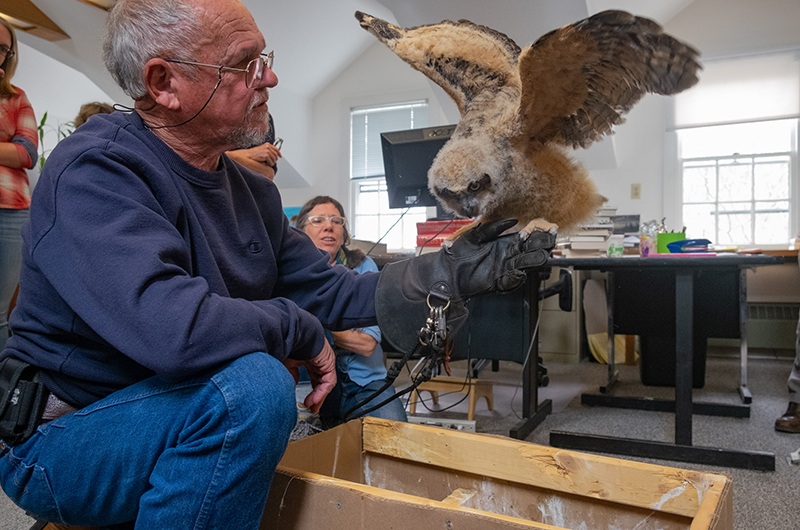
<p>Island naturalist Gus Ben David stopped by the Gazette Wednesday morning with a strigine guest in tow: a five-and-a-half-week-old great horned owl.
Island naturalist Gus Ben David stopped by the Gazette Wednesday morning with a strigine guest in tow. Peeking her fluffy head over the edge of a large cardboard box was a five-and-a-half-week-old great horned owl. Mr. Ben David, whose home is also a rehabilitation center for wild animals, acquired the nimble predator a few days ago after she was found orphaned near Milton.
The owl hopped up onto the edge of her box, displaying a formidable set of talons. Mr. Ben David scratched underneath her chin, and she nipped softly at his fingers with her beak.
“When she’s full-grown, her beak will have enough force to rip leather,” he said, noting that will be necessary when she starts hunting squirrels. Already the young owl is averaging six full-grown mice each day.
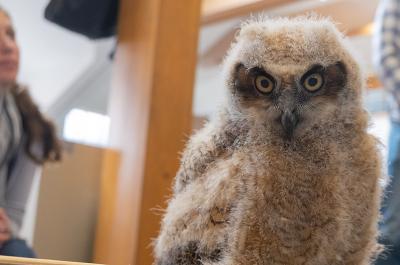
Healthy owl is five and a half weeks old. Eventually she will be released into the wild.
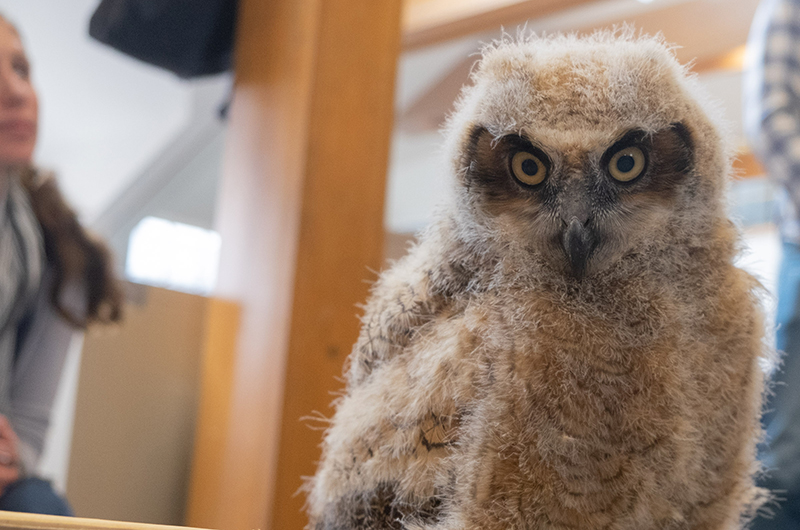
Healthy owl is five and a half weeks old. Eventually she will be released into the wild.
Mr. Ben David said his granddaughter, an aspiring falconer, plans to train the owl before they set her free on the Island. There is a small population of great horned owls currently living on the Vineyard, numbering about five breeding pairs including some at Tashmoo and in the state forest. Mr. Ben David said the owls do not make their own nests, opting instead to repurpose those of crows or hawks, and they are the earliest nesting birds living at this latitude. They can be found on their eggs while it’s snowing, as early as January.
As Mr. Ben David spoke, the owl took stock of each onlooker with huge, perfectly round, golden eyes. She bobbed her head to measure distance from each person, and occasionally panted to regulate her body temperature.
“Unlike us, those eyes are fixed in the socket,” Mr. Ben David said. He said with 14 cervical vertibrae, the owl can turn its head up to 270 degrees. While in flight, that radius gives the owl the ability to lock a steady gaze on its prey while the rest of its body rotates and adjusts to the wind.
When Mr. Ben David demonstrated the owl’s call, a deep resonant hoot, the owl turned her head completely around to see who had made the familiar sound, drawing gasps and laughs.
“Aren’t they fun?” Mr. Ben David said.
Comments
What a sincere look of
Leslie FitzsimmonsWhat a sincere look of respect for this fine, feathered friend from Mr. Ben David.
What a gift Gus is, just
Deborah (Phillips) Alves AcushnetWhat a gift Gus is, just wonderful, congratulations on the new baby...
Who is the wiser of the two?
New Englander ProvidenceWho is the wiser of the two?
Its a great looking owl. I
here we go again edgIts a great looking owl. I hope it stays. The great horned owl is the only natural predator of the skunk, most likely due to its lack of smell.
Gussie The Great! Horned Owl
Ivo MeisnerGussie The Great! Horned Owl and all
We all love you!
Well done Mr. Ben David.
Barry Stringfellow EdgartownWell done Mr. Ben David. Great horned owls are one of the few natural predators for skunks. Hopefully she'll find year-round housing
Add new comment