

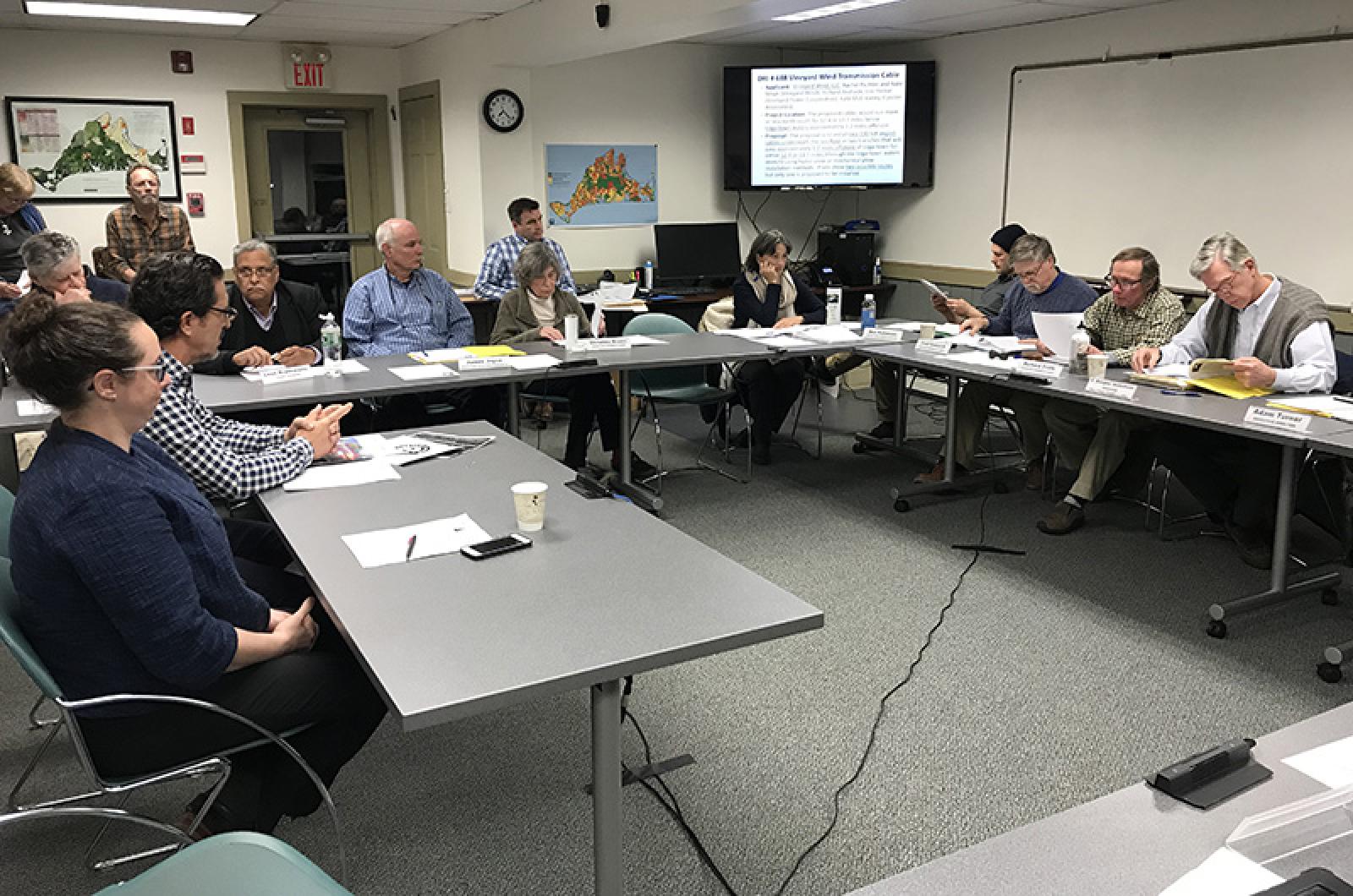
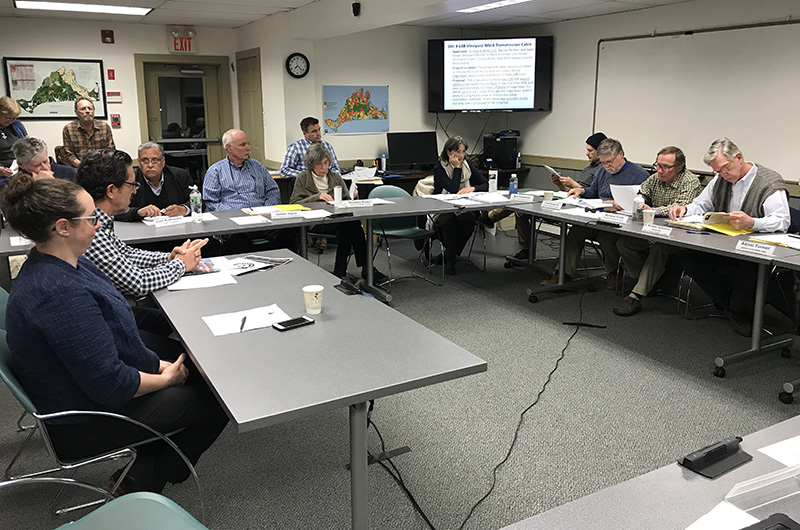
Developers who want to build the nation’s first large-scale wind farm in ocean waters south of Martha’s Vineyard saw strong support and also some criticism at a public hearing before the Martha’s Vineyard Commission Thursday night.</p>
Developers who want to build the nation’s first large-scale wind farm in ocean waters south of Martha’s Vineyard saw strong support and also some criticism at a public hearing before the Martha’s Vineyard Commission Thursday night.
Vineyard Wind plans to build 84 turbines 14 miles south of the Vineyard that would produce 800 megawatts of energy.
Most of the project is planned for federal waters. But the commission has jurisdiction over approximately 13 miles of proposed under sea cables that would pass through Edgartown waters just off the eastern shore of Chappaquiddick.
The commission is reviewing that part of the project as a development of regional impact (DRI).
Totaling some 43 to 50 miles in length depending on the route used, the cables will run from the wind farm to a switching station in Barnstable. Developers hope to obtain permits for two different routes through Muskeget Channel because of the potentially rocky sea floor.
Helen Parker read prepared statement about ill health effects from wind turbines, prompting a heated exchange with hearing chairman Richard Toole.
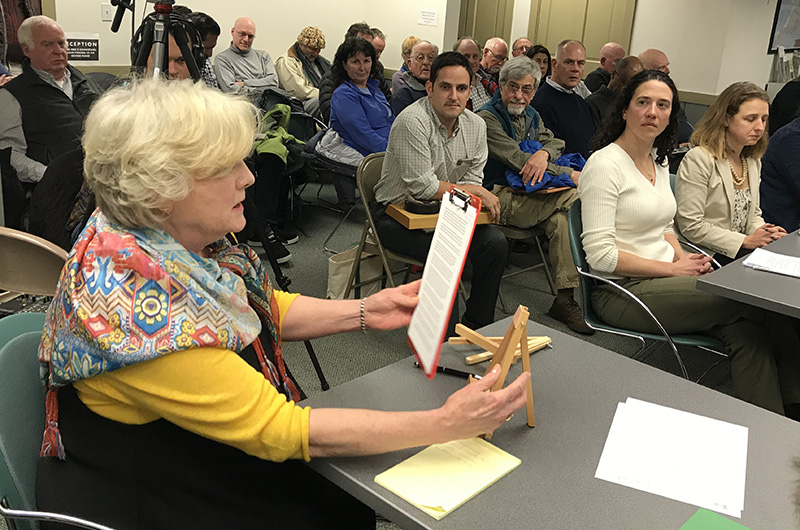
Helen Parker read prepared statement about ill health effects from wind turbines, prompting a heated exchange with hearing chairman Richard Toole.
At the outset Thursday, development of regional impact coordinator Paul Foley said the main concerns with the cables are environmental impacts on the benthic layer of the sea floor, and proximity to the North Atlantic right whale habitat in Massachusetts waters.
“It’s a bold project,” Mr. Foley said.
In their presentation, spokesmen for Vineyard Wind emphasized their commitment to the Vineyard community through their partnership with Vineyard Power, an Island-based energy cooperative founded in 2009.
“We’ve been at this for about nine years,” said Vineyard Power president Richard Andre. “We are really motivated and concerned about climate change. We as an Island community have a lot to lose, not to mention the impact on mankind,” he said in part.
He also said the project would bring about 40 to 50 wind energy technician jobs to the Vineyard, and that he hoped the majority of them would go to Vineyard residents.
MVC coastal planner Jo-Ann Taylor, who is also the liaison with the Massachusetts Environmental Policy Act, lauded a recent agreement between Vineyard Wind and a group of non-governmental conservation organizations dedicated to preserving the critically endangered right whale. Under the agreement, Vineyard Wind will restrict the speed of its transport vessels to 1o knots and use passive acoustic monitoring to check for the presence of right whales during construction.
“I am gratified to say that the main concern . . .was for the right whale, and the Vineyard Wind agreement addressed those concerns,” she said.
Dan Seidman, a member of the Tisbury planning board and also a member of Vineyard Power, echoed the praise for the right whale agreement.
“I thought that was very proactive,” he said. “This is a proven technology. We’re not trying anything experimental. To me, for lack of a better term, it’s kind of a no-brainer.”
But there were critics too.
Commissioner Clarence A. (Trip) Barnes 3rd expressed skepticism about the viability of finding employees on the Island and housing them. He also questioned developers about potential fallout from a cable malfunction.
“If it breaks underwater, what happens?” Mr. Barnes asked. “Is it like a toaster in a bathtub?”
Rachel Pachter, who’s in charge of permitting for Vineyard Wind, said because the cables will be buried beneath the sea floor, there is no risk for underwater electrification. She also said the entire wind system, including the cable, would immediately shut down if it broke.
The meeting took a turn when another critic stood to speak.
Chilmark resident Helen Parker, who is a psychologist, read a prepared statement about the negative impacts of what is termed infrasound, low-frequency sound that can emanate from wind turbines.
“I’ve worked for social justice for big wind victims with colleagues from south Australia to Denmark,” Mrs. Parker said. “Infrasound is real. It’s impact has been known and documented, and then hidden, for over 30 years.”
But commissioner Richard Toole, who chaired the hearing, called the testimony out of order.
“No, no, no,” Mr. Toole said. “We have no jurisdiction over the wind farm. You’re not talking about the cable. I’ve heard you talk about the noise from the turbines . . . This is inappropriate.”
A heated exchange followed, and Mr. Toole abruptly closed the public hearing, continuing it to an unspecified later date.
Commission chairman Doug Sederholm stepped in with a more moderate tone, asking Ms. Parker to submit her testimony in writing to the commission, which would then make it publicly available online.
“I want to preserve what you have so it is available for the public,” Mr. Sederholm said.
The date for the continued public hearing remained unclear.
In other business, a public hearing on a major expansion project planned by Martha’s Vineyard Community Services was continued to March 7 after the applicant was asked to address additional safety concerns for the entrance road.
Finally, the commission voted to go into executive session to discuss possible litigation with the Wampanoag Tribe of Gay Head (Aquinnah) over the proposed bingo hall.
Aquinnah selectmen have asked the MVC to review the bingo hall as a development of regional impact.
Comments
I appreciate the coverage of
Helen ParkerI appreciate the coverage of last night’s meeting but regret that the author missed reporting my primary point: that this initial Vineyard Wind 800MW installation, covering 252 square miles, would dwarf the current WORLD’S largest offshore wind installation, the “Walney Extension,” which is contained within 56 square miles in the Irish Sea.
While I have no doubt that the Vineyard Wind staff are experts in their field, they have no experience in running undersea cable from an 800MW offshore wind installation. No one does.
Jurisdiction over the threat of “unknowns related to the potential effects of 220 kilo-volts of electricity coursing beneath the ocean floor” 1.2 miles from Chappy is serious business for our Commissioners and should be rigorously evaluated in the context of project pros and cons.
Infrasound is serious business. It makes people sick. Most vulnerable are children, elders, and those who are especially reactive to sensation - those with autism, a prior PTSD, abuse victims, …and many of us whose souls are drawn to the Vineyard quiet.
The Vestas CEO has acknowledged that, ‘turbines send out ILFN; the bigger they are the more intense the emissions.’ It’s bad enough that the Israeli army has used low-frequency sound pulses as high-tech crowd control for decades. I reported how it travels for miles: infrasound was measured coming across the LAND 8 miles, 33 and 56 miles distant from a 96MW turbine array in central New Mexico.
If the nearby 1,400 square miles of total auctioned ocean becomes filled with its planned 7000MW array, we’ll indeed be at ground zero of some very bad vibes.
Helen you make excellent
here we go again edgHelen you make excellent points. Anyone who has ever lived near the harborfront can attest to how sound 'carries'. Music from a moored boat can be heard all through out the harbor and waterfront.When someone has a band going at night at the never ending weddings that seem to have become a cottage industry here, you can hear the music for MILES away over land!
I've been asked to cite
HelenI've been asked to cite sources re the turbines' ILFN impact on human health. Fair enough. It’s true that the extensive data on the health impacts of infrasound from IWTs doesn’t float up to pages 1 or 2 with an internet search. A good one to skim is: http://cdn.knightlab.com/libs/timeline/latest/embed/index.html?source=0…
Along with the big picture, it details the tennis match between the NASA, DOE, DOD and the BigWind industry from the get-go in 1979, presents a ‘time line’ showing the history of Wind Turbine Noise problems and BigWind’s (quite successful) maneuvering to circumvent the truth. How NREL scientists found that the disturbance from the turbines is often worse indoors than outside. “Far from becoming inured to the disturbance, people become increasingly sensitive to it over time,” they reported. How the wind industry response was immediate: Any regulatory standards will reference only A-weighted measurements, the industry insisted, which EXCLUDE the ILFN that are known to cause problems. We will measure only outside, not inside dwellings, insist that neighbors “will get used to it,” and deny that the victims’ suffering has any basis in reality, let alone science.
Another which cites many of my sources and colleagues, along with more recent investigations into the effects of infrasound on weakening cardiac tissue, for example, is the relatively new documentary film “Infrasound caused by Industrial Wind Turbines” about wind energy and infrasound by the science programme “planet e.” of the second German television ZDF — November 4, 2018
In this article, Dan Seidman,
Ocean observer MVIn this article, Dan Seidman, in response to the "right whale agreement" is quoted as saying “This is a proven technology. We’re not trying anything experimental."
However, leading North Atlantic right whale researchers have actually described this project as "an experiment" as far as its impact on marine mammals, and its potential impact on the critically endangered right whale are not known. This endangered species is here year round. The discussion has been about limiting construction times and boat speeds during construction. I have yet to learn of any discussion on the impact of the operational sound in the underwater environment.
Also please note that the CEO of Vineyard Wind has had leading roles in oil and gas companies. This is big business, no more, no less. This is an international energy company that has had prospectors as boots on the ground here for the past decade waiting to cash in. It is wise to stay aware of the consequences of this very large ocean energy development.
I would give more weight to
Carol formerly ChilmarkI would give more weight to the concern expressed in your comment, Ocean Observer, if you first addressed what is actually killing right whales now - ship strikes and entanglement with fishing gear. I don't see any passion from you on those risks. I think the 10-knot rule is great, and if ALL ships in the area used sonar and the 10-knot rule in that area, and if all fishermen used modern breakaway gear, we'd have a better chance of saving this amazing and important species.
As for your fear of "big business" - what, exactly, do you think is providing your electricity now? Here's a fact for you: climate change is real, it's here now, it's a huge threat to life on earth, and we need to change NOW. It's a bona fide emergency. You know what else kills whales? Ocean acidification, which kills small organisms in the ocean, up the food chain to (along with overfishing) reduce the food sources on which these whales feed. Ocean acidification is caused by the dramatically higher levels of CO2 in the atmosphere. So - along with lethal, enormous wildfires in the West and Australia, monster hurricanes and sea level rise that will turn Chilmark Pond (where I used to live) into a polluted indentation of a cove, the oceans will have far less life in them. Get on board with renewable energy like big wind and big solar - it's our only chance. Hope you're driving an electric car, if you're genuinely concerned about the whales.
Only 40-50 jobs? And how many
SaveOurFish ChappyOnly 40-50 jobs? And how many year round residents on the island actually have the qualifications already to be a wind technician? What programs are being put in place to train locals to be able to do these jobs? It feels more likely that none of these jobs will go to Vineyarders. And at what cost? How many jobs will the undersea cable take away, with its “moderate” impact on fish populations off of Chappy, from commercial fishing in addition to charter fishing tours, guided beach fishing tours, and the trickle down effect on the rest of our local economy? Again, there are no answers to any of these questions. Until we have these answers and we know the exact extent of the impact here (not educated guesses), the cable proposal should be rejected by MVC.
Im a recreational charter
Local fisherman TisburyIm a recreational charter fisherman and the 6 cables that already exist in Vineyard and Nantucket Sound that bring our islands power that we all use and need have had no impact on fishing. I bet most fishermen don’t even know they are there.
That’s great, but it’s also
SaveOurFish ChappyThat’s great, but it’s also just hearsay. Can you show me the facts backing that statement up? Here’s mine: the Environmental Impact Statement for this project describes a “moderate” impact on fish populations. As others have said above, the size of this project is unprecedented - no one actually knows the full extent of the impact this project will have. That’s exactly why the MVC should halt it until we have more facts and answers as to what the impact will actually be on fishing and whale populations as well as the impact of infrasound to a high degree of confidence, rather than educated guesses.
Thank you for being the voice
Bob EdgartownThank you for being the voice of reason in this unreasonable debate over a buried cable. They are not inventing the wheel here they were suppose to discuss the burial of a power line that is done all the time here and around the world. They even have a cable to Chappy and derby winning fish are caught right on top of it. The issue is the moderator let the meeting get out of hand with to many people including the applicant talking about everything but the cable until the very end. This is why Helen Parker had a right to be upset because she saw and heard many people before her talk about global warming, fossil fuel, the need for a wind farm etc..and those discussions were not on the agenda. The moderator is new to the job and hopefully he learned from his mistake and will keep future meetings focused on the agenda.
You know what’s not heresay?
Local fisherman TisburyYou know what’s not heresay? Our oceans are warming, ocean acidification, fish populations are moving north (lobsters to Maine and Black Sea bass from the south). Here is a novel thought. You’d do more to save the fish population by supporting this project than opposing it.
Typical Island reaction to
Kelce Oak BluffsTypical Island reaction to progress and improvement: throw hissy fits and toss around jarmumble. It's a wonder anything happens here.
Read the article and was more
Marie Jane Boston MARead the article and was more than amazed at how a Massachusetts resident was treated and a "local" to boot .. was it the "commission" did not want to deal with a subject they were not really familiar with, lost control of the hearing, or did want to have questions about the subject brought to the public? WHATEVER, there is so much out there about the negative impacts of the industrial wind turbine agenda both on and off shore around the globe that Massachusetts should have concerns about this very costly experiment. Those who say it must be done now to stop climate change had better rethink the urgency; industrial wind farms are not going to stop the inevitable. So, you better rethink the inherent harms .. the fears started early on in the 1980's; we knew about the negatives; but, they were conveniently "buried" while the goring and greenwashing occurred and the industrial wind turbine agenda was peddled around the world. AND IN THE BEGINNING: https://stopthesethings.files.wordpress.com/2013/07/kelley-et-al-1985.p…
I agree, Marie Jane... the
Peace and Quiet Please Vinyard guest / South ShoreI agree, Marie Jane... the "treatment" of Ms. Parker seemed so familiar, and so disturbing. My experience: any time the topic has been on an agenda, here on the mainland, there seems a concerted effort to silence any and all parties who who express legitimate concerns about industrial wind power's adverse impacts upon our environment and our health, safety and well-being. When neighbors got the chance to speak they were marginalized as NIMBY's and their concerns dismissed with NO research or due diligence applied - of course the fact of the matter IS... NO ONE should have industrial wind power plants sited in or adjacent to their backyards...we neighbors were also often told we needed to "Look to Europe and Denmark as our guide for doing wind right" WELL - yes let's DO that! Look to DENMARK and to other European countries who have blindly embraced wind power (not talking wind mills here). Europe is folding its tent on renewables for several reasons NOT the least of which is that they drive UP energy costs creating energy poverty. All in all I have to agree with this poster & ASK the question: Shouldn't we all seek out better and more responsible solutions to energy needs than what is being pushed forth by the very misleading wind industry and their shills? POST of NOTE: Green Energy: A Sound Investment ???
Rusting, fires, ice-up, infrasound, blight on pristine landscapes, raptor kills, too little wind, too much wind, power fluctuations, 100% backup required, short lifespan, unrecyclable, requiring baseload, coal to manufacture, mining to manufacture, produces less energy than manufacturing uses, lubricants pollute ground, radioactive magnet dust contamination, foundation requires large amounts of cement, habitat destruction, drives up cost of electricity... #GreenFraud #ReverseRobinHood #TaxDollarsAtWork #StopTheLies
"...We as an Island community
Sara Piazza Edgartown"...We as an Island community have a lot to lose, not to mention the impact on mankind,” he said in part.
I am leary of anyone who implies that we're all gonna die if we don't purchase his product.
The economics of this project
John Aldeborgh Edgartown, MAThe economics of this project are bad. It will increase the cost of electricity. Since the time this project was launched the supply of clean natural gas has grown to the point where there’s a virtually limitless supply, the result is a 70% drop in the cost of natural gas. This is much more economical and much lower risk. I won’t even touch on the infinitesimally small impact this may or may not have on Manmade Global Warming. The bottomline is we are penalizing the little guy to please big business and a small group of activists. It’s wrong.
Add new comment