

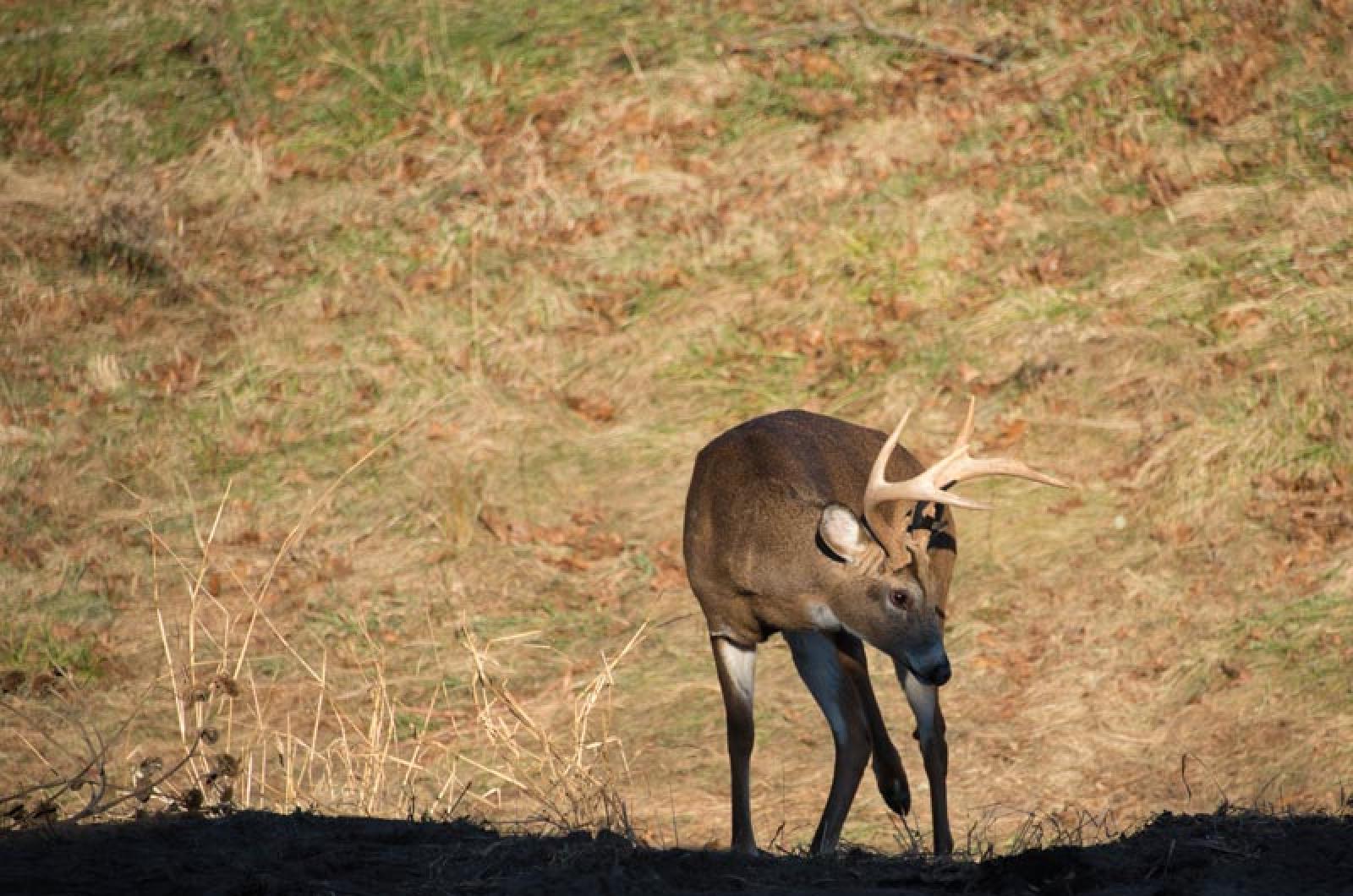
This year’s deer hunting season has begun, and many options are being considered for how to lessen the impact of the continuing infestation of deer ticks on Martha’s Vineyard.
This year’s deer hunting season has begun, and many options are being considered for how to lessen the impact of the continuing infestation of deer ticks on Martha’s Vineyard.
Deer ticks are responsible for transmission of three of the known major illnesses borne by these arachnids: Lyme disease, babesia and anaplasmosis. Recent stories in the Gazette have focused on the invasion of our Island by increasing numbers of lone star ticks, which host other equally life-threatening diseases.
The medical crisis presented by deer ticks and lone star ticks remains an important issue and one that cannot be ignored. How to best tackle the problem is being pursued and discussed in earnest. Legitimate questions often posed include why the deer? What happens if the vector then changes to ticks jumping onto turkeys, raccoons, chipmunks, or other mammalian species. Why not focus on the white-footed mouse population. Why not wait and embrace the project involving genetically modified mice bred to be immune to Lyme disease (this may happen in seven or more years time).
Other questions center on which model will be chosen to know how many additional deer need to be culled per year.
These valid questions draw attention to the fact that the actual number of cases of Lyme disease, babesia and anaplasmosis cannot be precisely ascertained. The actual size of the deer herd also cannot be accurately measured, and the extent of the spread of these tick–borne diseases via other smaller animal species can only be approximated. Lastly, it is difficult to model the actual effects of reducing the size of the deer herd on Martha’s Vineyard and how much effect this reduction will have on lowering the number of ticks carrying these potentially lethal diseases.
As has been pointed out in several articles written by Dick Johnson, the Island’s leading expert on all varieties of ticks who among other things has extensively studied the life cycle of deer ticks, we will not have the luxury of time to assemble and study the answers to these issues. I concur with this view. No matter how valid these questions are, we will never have the answers to all of them.
We must keep the focus on the current issues presented by ticks and their associated debilitating diseases. Let’s go with the best possible solution. The common sense response is to just get on with a deer herd reduction program.
Another major public health concern has also recently been identified: the transmission of babesia and anaplasmosis by blood transfusion. All blood in our neighboring state of Rhode Island, and some blood (if requested) in Massachusetts is being screened for the presence of babesia.
Important studies supporting deer herd reduction have recently been published by Dr Kirby Stafford, chief scientist and state entomologist for Connecticut. These studies show that significant reductions in the deer herd strongly correlate with a reduction in number of deer ticks and the number of recorded cases of tick-borne diseases. Thus reducing the deer herd — the larger animals that are essential in the life cycle of the deer tick and other ticks — offers the greatest chance for reducing the incidence of these diseases. There are estimates of approximately 4,000 to 5,000 deer on Martha’s Vineyard, representing a population of upwards of 40 to 50 deer per square mile of wooded habitat.
The dense population of deer also adds to the spread of Lyme disease in Island pets, farm animals and horses, and of course the number of motor vehicle accidents. All the scientific publications, including the recent paper by Dr Stafford, emphasize that to be an effective remedy, the deer population needs to be drastically reduced to between eight to 10 deer per square mile, since the effects on the number of deer ticks is not linear with the number of deer removed. As alarming and unwelcome as this target may sound, these are the facts based on the best science available.
From my perspective, the community should support a plan that has the greatest possibility of success. Waiting and thinking that there may be alternative solutions down the road is just not an option. We need to act now and offer our support to the boards of health, to Dick Johnson and others, and do what is best for our community.
The recent program by the Island Grown Initiative to accept deer from the hunters and process and distribute meat to the elderly and the Island Food Pantry is a noble cause. The plans to have an additional refrigerated storage facility, centrally located, at the Agricultural Hall will also be beneficial to the hunters.
Mr. Johnson and others are investigating making more private property available to hunters by soliciting the cooperation of property owners.
It will take some time for state and town authorities to piece together other practical solutions with the all-Island boards of health. Meanwhile, with the start of the hunting season, we should do all we can to encourage our local hunters to help solve this serious medical issue by increasing, wherever possible, the number of deer taken.
Dr. David J. Morris, is emeritus professor of pathology and laboratory medicine at Alpert Brown University School of Medicine. He is a longtime homeowner in Vineyard Haven.
Comments
It would be one of the
charlie callahan so boston /edgartownIt would be one of the smartest things that has been done on this island in a long time. The tree huggers won't like it because they think it's cruel to kill the deer as they eat a steak and sip wine at the Navigator. It will prevent Lyme disease spread and the meat can go to the senior citizens and the food pantries.
I'm a tree hugger and I don't
Geoffrey West TisburyI'm a tree hugger and I don't think it's cruel to consider culling the herd. The island's ecosystem is way out of balance - deer have no natural predators apart from hunters (and cars). The result, besides a tick infestation and a public health hazard, is that our native flora is being eaten away, all the while making room for invasive species like barberry, asian bittersweet, honeysuckle, and so on. Reducing the deer population would be asignificant step in helping to turn the tide of invasive plants, and in giving our most tasty (from the deer's perspective) native plants/trees a new lease on life.
Charlie, I agree the herd
tb MedfieldCharlie, I agree the herd needs to be culled so we are on the same page. But why the insults ("tree huggers" and "sip wine" comments) to make your point? What does it add to a legitimate debate? It seems these insults hurt the cause more than help it.
Amen
Joel KatamaAmen
Having had CNS Lyme disease
jane gilman chilmarkHaving had CNS Lyme disease in the 1990's when it took months to get a proper diagnosis with consistent spinal taps and western blots at what was considered respectable lab (Stony Brook, NIH,
Tufts), I think the deer population should be culled.
Of course, research needs to continue.
One way to move forward with
ChrisOne way to move forward with more deer taken would be to allow crossbow hunting, for anyone who wishes, during archery season. Currently a disability is required to use a crossbow. They are much more accurate and can shoot a bit farther than traditional bows thus reducing wounding shots and increasing lethal ones. Let's get some common sense legislation passed!
That was very well said Dr.
John EdgartownThat was very well said Dr. Morris. Is there anything else we can do to speed up the deer culling process? Too many of my friends and family have been affected by lyme and we need to be doing everything we can do to stop this epidemic.
I fully agree with Dr. Morris
Mr. B ChilmarkI fully agree with Dr. Morris's article and sense of urgency, but I do not feel that he supports his case with solutions to match that urgency. The gross over-population of these animals has turned them into a centerpiece of the transmission of serious diseases; the idea that we might eat our way through this issue is not worth the consideration. I continue to support and propose the reduction of the herd through placing a bounty on the animals, thus hiring hunters to kill as many as possible. In addition, I propose that the hunting season be extended until at least 1500 deer are removed from the herd.
Face it, folks: If it weren't for the "Bambi Factor," we wouldn't be thinking about "herd reduction." We'd be demanding it! Imagine if Norway rats carried the young ticks around.
I like the bounty idea.
Chris EdgartownI like the bounty idea. Another way for our hardworking residents to offset the high cost of living while eradicating disease!
i think a bounty is a great
Amy west tisburyi think a bounty is a great idea. i would happily donate to support it. maybe we need to start a gofundme campaign to get the ball rolling
I hunted the island every
Dean NarragansettI hunted the island every year with my father and many islanders. As more and more property was purchased by seasonal residents, those lands became havens for the deer population. Probably ten years or so ago we just stopped spending the deer week on the island because of the reduction in hunting areas. We used to hunt Tea Lane, down along the water front in Chilmark and other areas until we were basically pushed into the State Forest. Block Island has a program for residents that awards $100.00 per deer tail, no limit and free disposal at the town dump. This has had an impact on the deer population just as you all appear to want. Something to think about!
I would be glad to hunt any
Ned Casey EdgartownI would be glad to hunt any property for deer. Archery or gun. I am managing 2 properties now. Whats needed is permission. This morning As I was checking my Properties in Edgartown left fork. I saw and counted 12 deer. I have lived and hunted here for 45 years. Very Responsible and references on request. Contact me by email. [email protected]
I particularly like all the
David Morris vineyard havenI particularly like all the bounty suggestions.
I will be very interested to hear further thoughts as to how we might get this going--with both community input as well as fund raising support --possibly not too late for this Season
We can go about this in a few
bob west tisburyWe can go about this in a few ways but the quickest way would be to start a gofundme account or something like it. It is immediate and lots of people are then able to give small (or large) amounts of money very quickly, so the funds could be used for this year's season. For next year, we could try using an existing non-profit (like IGI or the ag society) and then trying to get grants from both on and off island charities and granting organizations.
I've been curious for a long
Mack West TisburyI've been curious for a long time about the role of raptors in controlling rodent populatons, but there's almost no talk of this.
I've read that the use of rat poison results in the unintended deaths of predator birds, which then boosts rodent numbers in the long run. I am totally in favor of a deer herd culling, but favor a multi-pronged approach: make this island a safe haven for more big birds, and it would seem they would do some of our work for us.
One issue with the idea of a
Richard Johnson Oak BluffsOne issue with the idea of a bounty is that currently 750 to 800 deer are checked in each season. With a $100 per deer bounty that is $75,000 to $80,000 for current take; would require spending $75,000 + before the first extra deer is taken.
I would love to get
Michael Gonsalves FalmouthI would love to get permission on some private parcels up island to help cull the herd. 30 years of experience but no place to hunt. If interested in giving permission please email me . [email protected]
Add new comment