

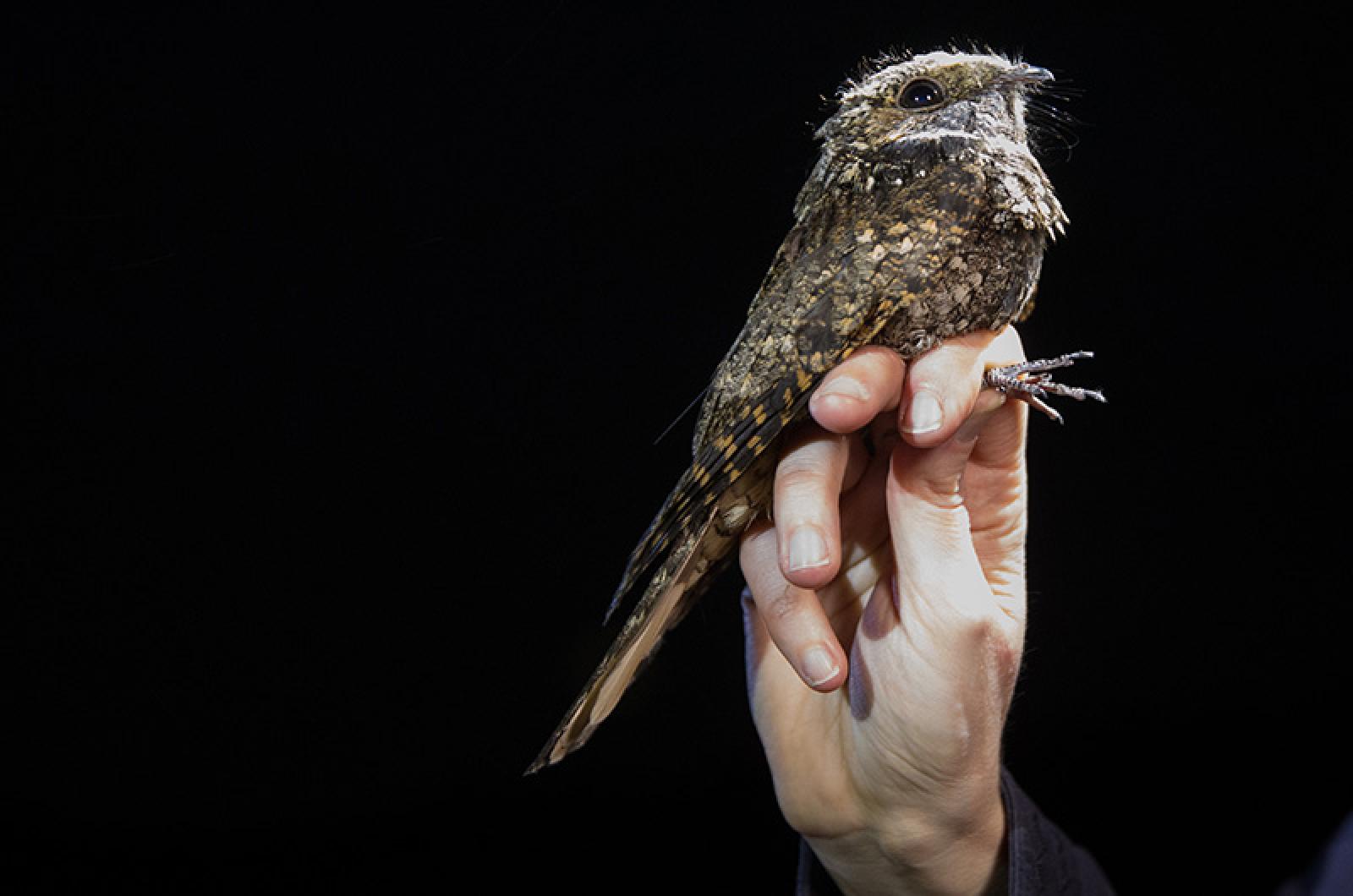
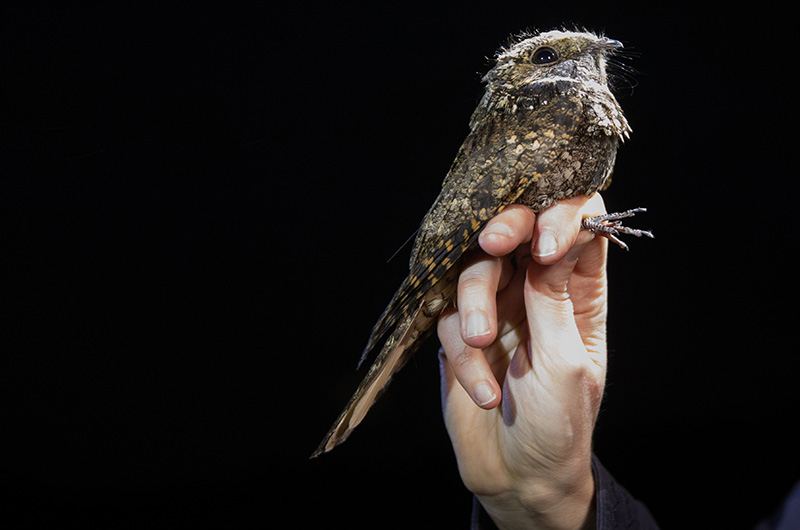
The Manuel F. Correllus State Forest on Martha’s Vineyard remains one of the six strongholds in Massachusetts for the whippoorwill.</p>
Much has changed on the Vineyard since the early 1960s. Back then Chappaquiddick was merely an island, not an incident. Jaws referred to a mandible, not a man-eating shark. And Vineyarders Islandwide went to sleep with the eponymous song of the whippoorwill chirping in the background.
Although the days of Kennedy car crashes and Spielberg adventure films on the Island are likely over, the Manuel F. Correllus State Forest on Martha’s Vineyard remains one of the six strongholds in the state for the whippoorwill, a notoriously elusive, ground nesting nocturnal songbird.
“It’s an iconic bird,” said Island ornithologist Robert Culbert who writes the weekly bird column for the Gazette. “There’s only one species of bird that yells its name incessantly.” Mr. Culbert remembers the days when he used to hear whippoorwills from his front porch in Oak Bluffs at dusk. He was close enough to the birds that he could hear the faint “chuck” note at the beginning of their quick, haunting three-note calls. Today unless he’s at the entrance to the state forest, or playing disc golf, he says he is lucky to hear them at all.
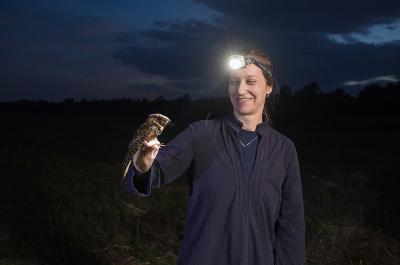
Marja Bakermans, researcher at WPI, studies whippoorwill migration patterns.
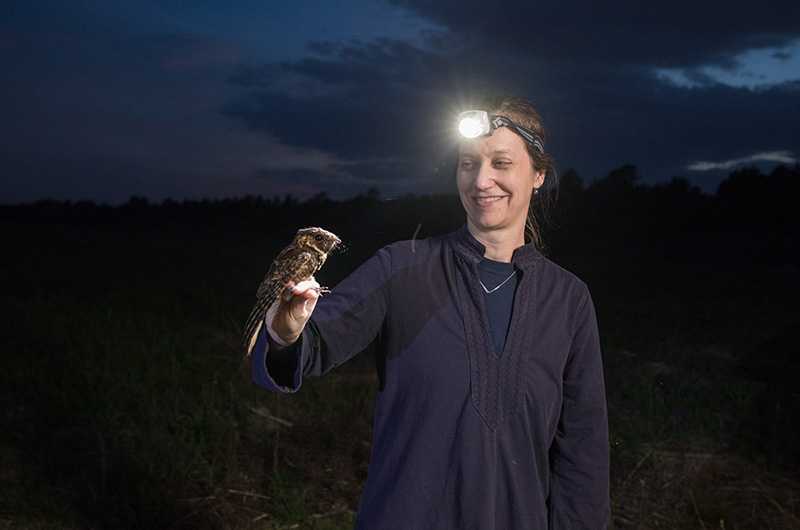
Marja Bakermans, researcher at WPI, studies whippoorwill migration patterns.
Habitat loss and the introduction of skunks and raccoons to the Island has led to a steady decline in the whippoorwill population for the past half century. The sweet spot for the bird on the Cape and Islands was during the 1950s and 1960s, when open forests, pine groves and shrublands that they like to use as breeding grounds were abundant. By the 1980s the sparsely-populated forests and shrublands began to be developed and the call of the whippoorwill, once commonplace on the Vineyard, became rare. In 2011 Massachusetts designated it as a species of special concern. Since then, biologists at the state level have enlisted local volunteers to help study and stabilize the population in the regions where it still thrives.
Vineyard residents have been central to the effort.
Beginning nearlly a decade ago Chris Buelow, a restoration ecologist with the Massachusetts Natural Heritage Program, recruited Marilyn Miller and Ron Zentner through Mass Audubon to create, track, and monitor survey routes for whippoorwills. The first route ran 10 miles through the Correllus state forest, over Barnes Road and down to Long Point, with stops at each mile where the volunteers listen for the whippoorwill’s call.
“I never heard a whippoorwill before in my life,” said Mr. Zentner, who grew up in New York and has volunteered on the route since 2008. “I’d heard the name, of course, but the first time I really heard one was looking out for it at night.” Over the years, Ms. Miller and Mr. Zentner have fine-tuned their route, ensuring optimal sound quality to listen for the calls. They often hear a dozen different whippoorwills along the state forest trail. “That doesn’t sound like a lot,” said Mr. Buelow, “but when you’re talking about a rare bird species in the state, that’s actually a good number for whips.”
“It is kind of exciting the first time you hear them. You hear it and you’re like, there you go,” Mr. Zentner added.

A delicate whippoorwill backpack tracker.
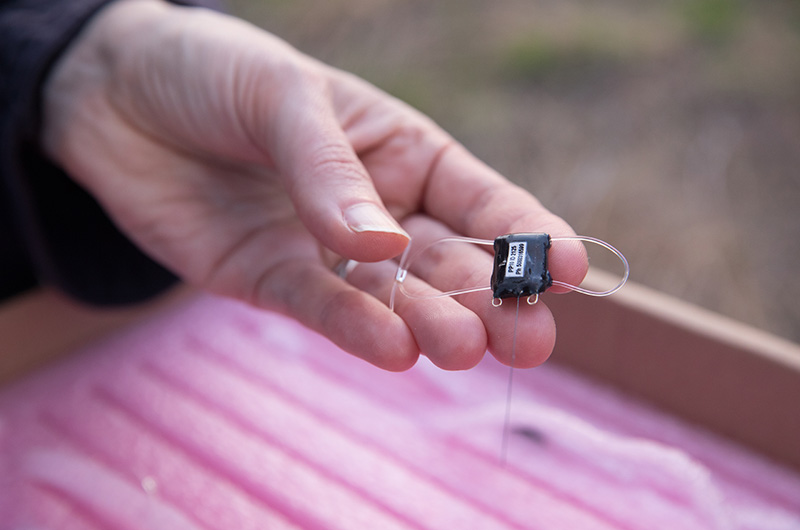
A delicate whippoorwill backpack tracker.
Mr. Buelow and his associate at Mass Audubon Suzan Bellincampi praised the work of the volunteers. “The Correllus route was one of the first that we established, and that’s one of our most productive routes in the state,” Mr. Buello said. There are now more than 40 routes that volunteers monitor, including three new ones on the Vineyard that started this year.
“More people than I ever thought were interested,” Ms. Bellincampi said. “We were able to divide and conquer, because we have such an incredible core of volunteers.” Although they haven’t registered any whippoorwills on their up-Island route, which weaves east from Menemsha Hills toward Lambert’s Cove, the crew have had surprising success with the new routes in Chappaquiddick and at Katama.
“It’s an exciting success story,” Ms. Bellincampi added, “because although the bird is still struggling, there are people watching for it, and the results of this will help the land managers protect the animal. This is the kind of work that really matters.”
Statewide, Mr. Buelow said protecting the whippoorwill is more important than simply preserving a bird. “It’s a flagship species, so we are using it as a benchmark,” he said. “When we see a positive increase in whippoorwills, that’s a proxy for everything else we are doing there.”
He said much of the species’ decline can be tracked to increased fire suppression in the mid-20th century. But in places where controlled burns take place, such as the state forest, the bird has remained.
The preservation of whippoorwill populations has also allowed scientists to study their migration patterns. Marja Bakermans, a researcher at WPI who focuses on migratory songbirds, began a study last year where she outfitted whippoorwills with geolocator backpacks to track the exact spots where the birds winter.
“This species is particularly challenging to work with because of their cryptic, well-camouflaged, crepuscular nature,” Ms. Bakermans said. She lures the birds into mist nests by playing their call, then ties on the backpacks and takes down other physical measurements, all in the dead of night. Ms. Bakermans assured that the backpacks aren’t heavy, and she uses stretchy twine so the birds can grow or shrink.

Ron Zentner and Marilyn Miller, volunteer whippoorwill trackers for a decade.
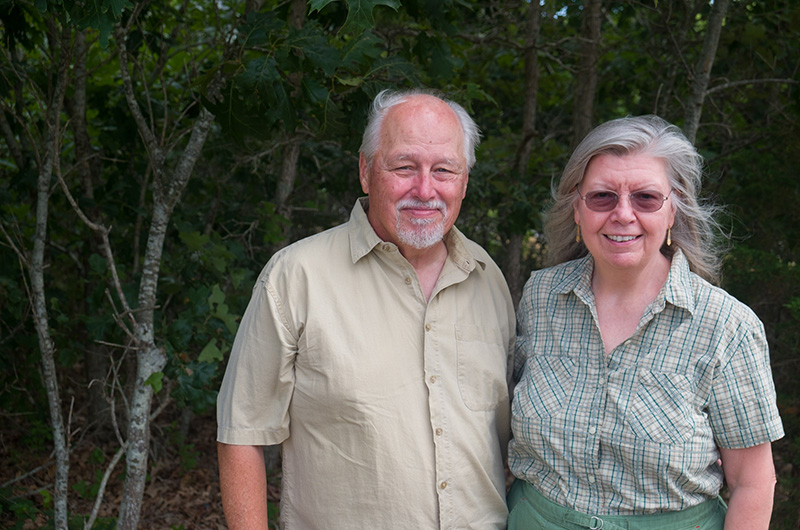
Ron Zentner and Marilyn Miller, volunteer whippoorwill trackers for a decade.
“We don’t have a lot of information about their migratory routes,” she said. “Do they travel to the same locations, or do they spread out in their winter grounds?” Although she hasn’t had the chance yet to analyze her data, she said her work wouldn’t be possible without the 10-plus years of whippoorwill numbers from volunteers like Ms. Miller and Mr. Zentner.
“Understanding where the birds are and developing local partners is so important to conservation,” Ms. Bakermans said.
This year may be Ms. Miller and Mr. Zentner’s last for tracking the Correllus route. “I’m 70, and Ron’s 72,” Ms. Miller said. “We see the writing on the wall. We really enjoy doing this because it’s such a special experience. We had mixed feelings about stopping it, but at a certain point you have to step away.” Last week, the duo did a training session with younger volunteers, and now have five people who are ready to take over.
“Hey, more people can get interested now,” Mr. Zentner said.
Comments
I hear the whippoorwills in
Christopher Mara EdgartownI hear the whippoorwills in the winter. If it's not too windy at night their calls are haunting. In some native lore the whippoorwill was allied with the Manitou. If you are walking in the forest and you hear the whippoorwill it will lead you astray.
nice
Elizabeth Bradley Edgartownnice
Yep! used to hear em all the
Margot Lane menemshaYep! used to hear em all the time in the Sixities! Now, not a peep. Keep your cats indoors, too! Red Tailed Thrashers also seem less plentiful: is this my imagination?
I also wanted to mention
Hadden Blair West TisburyI also wanted to mention domestic cats and their significant impact on ground nesting birds. At least 6 neighbors' cats hunt on my property regularly. Since one cannot "off" a neighbors' pet, I build brush piles to hopefully provide the songbirds some protection. I would welcome suggestions as to how to control hunting cats. Dogs are not free to roam anymore. Why are cats?
The Vineyard's fields
Tom Hodgson wtThe Vineyard's fields continue to disappear, under attack forest succession and the proliferation of houses and "landscaping". But....An entire article about ground nesting birds on MV without a single mention of the damage and destruction of nests by skunks and raccoons? They arrived (were brought) here in the 50's and 60's, and in my mind are one of the major reasons that ground nesting bird populations have decreased here.
In the first week of July I
Tom West TisburyIn the first week of July I heard one in the Lobsterville area. It was faint, probably in the hills overlooking the pond.
Racoons and skunks you bet,
Bob Woodruff West tisburyRacoons and skunks you bet, but let’s not forget HOUSE CATS!!!!! Both domestic AND FERAL!! At least two neighbors’ cats patrol my property DAILY, and while mousing is their beat, you can bet they are open to ANY PREY they can handle. It is irresponsible for cat owners to allow their animals to ROAM AT WILL. If you care a fig about BIRDS, somehow CONSTRAIN YOUR CATS! HATS OFF TO MARILYN AND RON AND EVERYONE INVOLVED IN THE WHIPPOORWILL SURVEYS!!
I have an exact problem here.
Papenfoth Mary Voluntown,CTI have an exact problem here. A neighbor cat is never contained and sits in wait at the bottom of my bird feeders to kill the birds. I’ve tried humane remedies to no avail and little by little my songbirds are getting more silent. Can’t understand why pet owners allow their pets to stray.
Good Morining Bob!
Patricia Carlet Vineyard HavenGood Morining Bob!
Hear a whippoorwill every so often in the woods nearby. Wonderful experience. We have a 16 year old cat, and plenty of birds at our feeders daily and year round. Frisbee - granddaughter named him - has always been quite 'restrained'. He is let out after dark at night, and sits waiting for us on the back porch to be let in around five or six am in the morning. The only bird feathers we ever see in the yard are leavings from occasional resident sharp shined and cooper hawks in the area.
Keep on writing old friend ... We love your passion for our beloved Mother Earth!
My husband and I have
Denise Monastesse Caroline Tuthill Preserve EdgartownMy husband and I have vacationed on MV for over30 years. We rent a unit within the boundaries of the preserve. In the last ten years we have observed major changes. We haven't seen a Luna Moth in over ten years. The trees are dieing in record numbers. Two years ago we were leaving to catch the ferry and a Fisher Cat ran across the road. This year the number of birds around the property seemed to increase. But it maybe due to fewer trees available in the immediate area. In the past we never heard orsaw cars traveling on Beach road. The woods were thick enough to block the neighboring home. Not any more! We love to listen to the many different bird calls that we never hear in the city. We look forward to next years vacation with new interest in the whippoorwill.
Whippoorwill are alive and
SARAH ANDRESEN Tea Lane, ChilmarkWhippoorwill are alive and well here on our property. I hear them almost every week. - Often they are sitting right on the roof peak near our bedroom. BOY, do I hear them! There is definitely more than one because they call to each other over a period of time. Also seen lots of Luna Moths, but alas, no Fisher Cat - although that's a good thing!
I hear them frequently on
Sue Nelson West TisburyI hear them frequently on Vineyard Meadow Farms Rd.
When John and I lived at the
Jane Varkonda EdgartownWhen John and I lived at the forest HQ house a whippoorwill would set up on the front step of the house, just under our bedroom window....it was there till we moved out in the mid 90's. Very cool indeed
Seems like nothing but bad
Richard V EdgartownSeems like nothing but bad news when it comes to cherished and important animals. the local skunks should literally be destroyed I really don't care what people think,if they're killing everything, else don't you understand?? As for feral cats they should be off too I'm sorry to say yes they may help with rats but they also kill a ton of birds .everyone knows it so there you go. send somebody out with a gun and let's take care of business and get our Island back . It's time now to get rid of these rampant,invasive ,destructive species.
We hear the wonderful call of
Christopher Daly AquinnahWe hear the wonderful call of the whippoorwill every June just south of Nomans Watch Road in Aquinnah. I hope we never lose them.
My grandson and I heard the
Marie foti Springvale maineMy grandson and I heard the first return call of the beautiful whippoorwill tonite
What a treat!
Why’s is it that no one
Evan ACKWhy’s is it that no one mentions the obvious? Cats are responsible for the extinction of many bird species, these birds nest on the ground. They’d be safer nesting in a cat-free wind farm - that’s not hyperbole.
Add new comment