

On Dec. 8, 2017, I was fortunate enough to be asked to join a collective of Martha’s Vineyard Public Charter School students and community members to spend 12 days exploring Cuba.
On Dec. 8, 2017, I was fortunate enough to be asked to join a collective of Martha’s Vineyard Public Charter School students and community members to spend 12 days exploring Cuba, studying sustainability, self-sufficiency and economics, and learning about the country’s rich history.
Our time in Cuba was made possible through a Martha’s Vineyard Vision Fellowship grant and the efforts of Charter School social studies teacher Jonah Maidoff, along with a supportive faculty and the Island community.
On Thursday, May 10, students will give a presentation at 5:30 p.m. at the Charter School about the trip to help raise money for Cuban NGO’s. There will be discussions on the impacts of the embargo, Cuban agriculture, the growing tourist industry, as well as pictures from the excursion.
Students visited farms outside of Havana to study sustainability practices.
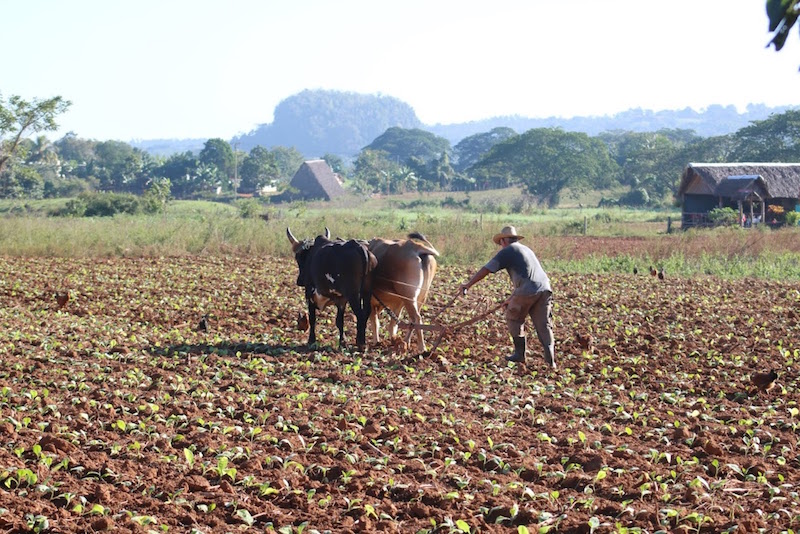
Students visited farms outside of Havana to study sustainability practices.
With the start of the 2017-18 school year Jonah introduced a new element into the curriculum, an immersive study of Cuban history and the current state of the country. Five students would ultimately be selected to participate and visit the country to expand on the research projects they had designed for Jonah’s class and bring back information to their classmates and the community. These students were Keith Chatinover, Claudia Motta, Marshall Davidson, Ruby Jephcote and Tatiana Major. The group was also joined by Sherilyn Geistfeld, an expert on Latin American and specifically Cuban history, and Mary Sage Napolitan from the Island Grown Initiative. I graduated a year earlier but was also invited to join the trip, having traveled with Jonah and our class to Alaska the prior year.
We arrived in Havana on Dec. 9 and over the course of 12 days traveled to Vinales, Cienfuegos and Trinidad with a number of stops along the way. We spoke mostly in Spanish, with the help of our tour guide Orletiz, to local farmers, business owners and professors. People on the street greeted everyone politely, and the pace didn’t feel as rushed as cities like New York or Boston. Even the street vendors seemed far less aggressive.
Visiting the slums of Casa Blanca, within the city of Havana, we received similar courtesies from everyone we encountered. With the nuns and local children as our guides we were able to explore the community in a way that might not have been available to most tourists.
As we weaved down the narrow, muddy roads I wondered how I would fare walking through there on my own, even though everywhere we went people said that Cuba is an incredibly safe place. We came up with a number of theories as to why this might be so, but I think the most accurate explanation for the safety and friendliness of the locals comes from a combination of social programs, patriotism and harsh punishment for even minor offences. With most basic needs provided by the government, there seemed to be far less desperate individuals.
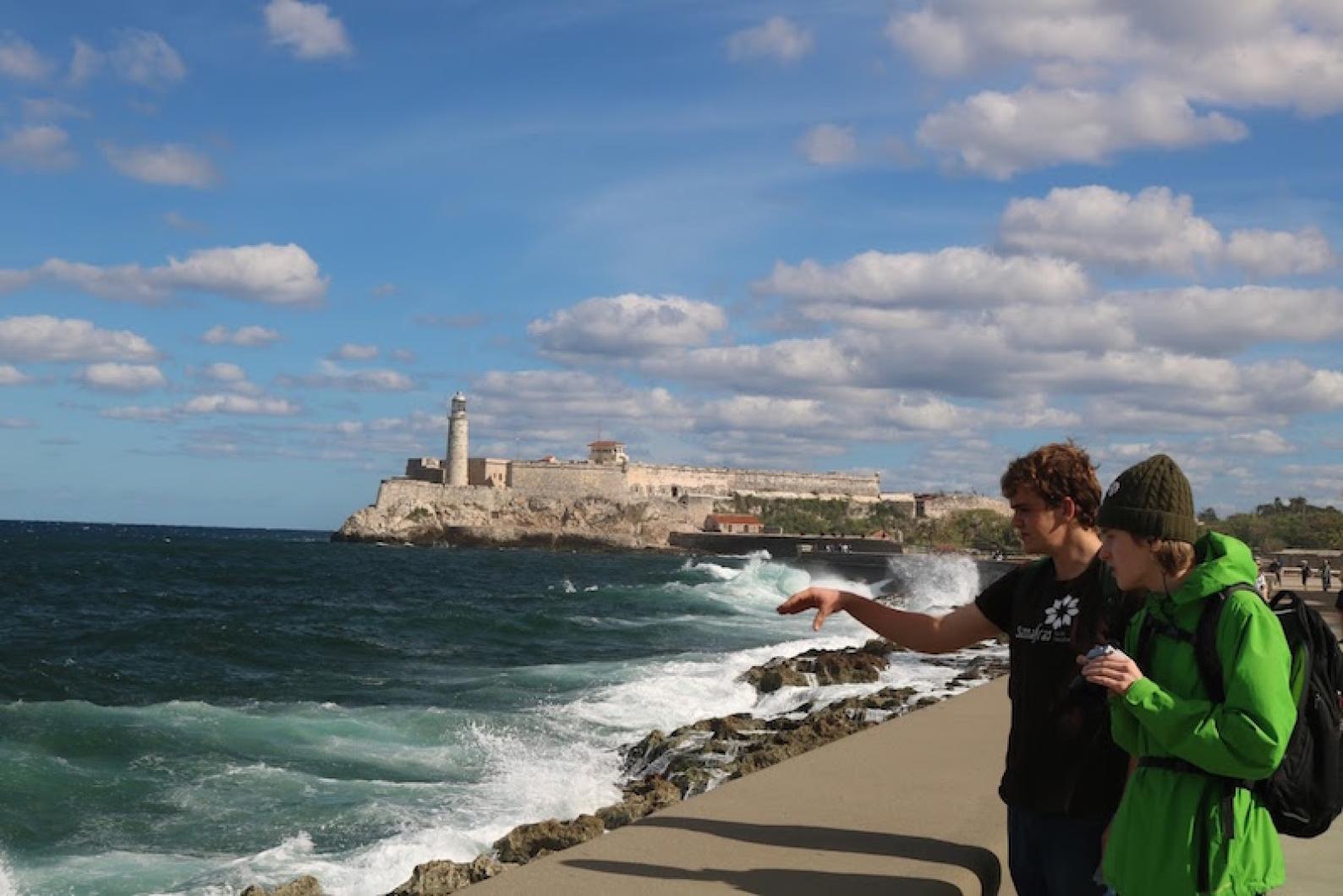
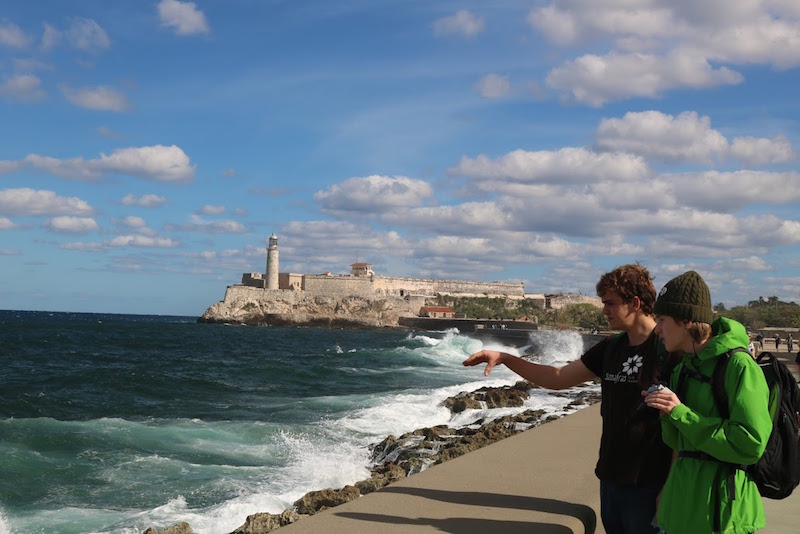
Jared Rivard, second from left, Jonah Maidoff, third from left on Charter School trip to Cuba.
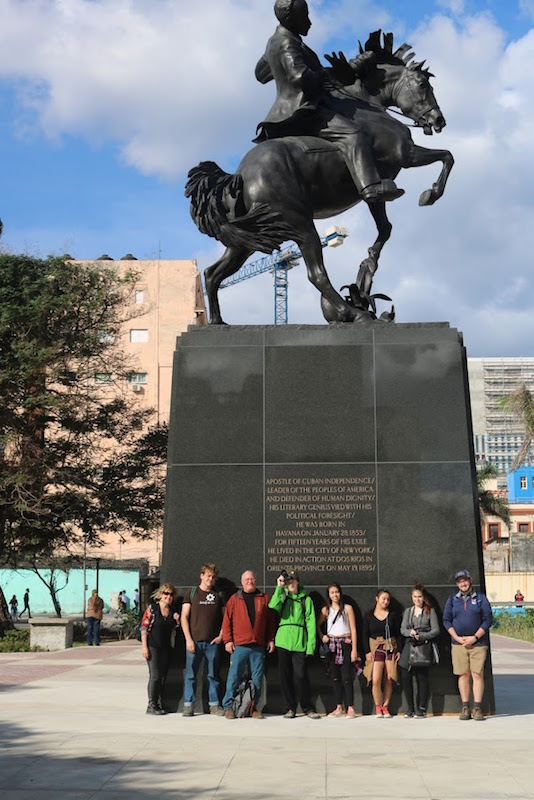
Jared Rivard, second from left, Jonah Maidoff, third from left on Charter School trip to Cuba.
Our visit to Vinales still stands out in my mind. Located on the northwestern side of the island, Vinales is one of the country’s major agricultural centers. Within the valley at the edge of one of the country’s largest national parks, the locals grow a variety of crops, particularly tobacco. We were able to witness the extent of Cuba’s self sufficiency and stewardship there. The farms were small, well maintained, and were worked without the use of fossil fuels.
When talking with the farmers, it was evident that they understood the importance of minimizing their impact in order to maintain a healthy environment and agricultural system. While many of Cuba’s agricultural practices developed due to a lack of resources during the embargo, over time the practices have been applied with an increasing emphasis on sustainability. Multiple farmers were happy to explain how they use the tobacco stems to ward off insects. Another way around insecticides was presented as the “sacrifice plant” where a farmer will place something such as a sweet corn at either end of the plant bed for the insects to feast on. Others described methods more commonly used, such as surrounding the crops with marigolds.
Looking at the Cuban countryside it would seem that these efforts to maintain the island’s natural habitats have been successful. Exploring the countryside I saw what seemed to be an incredible degree of biodiversity compared to what I see wandering New England.
What I found equally amazing during the trip was the fresh perspective on Cuban history I gained, along with the history of the Americas. Our visit to Trinidad provided a greatly expanded view of slavery in the colonial Americas, and the brutality of colonial sugar plantations.
Most interesting of all was learning about Cuba since the revolution.
Looking upon Cuban war monuments, you get a very different perspective of Castro’s revolution, the Bay of Pigs, and the Cuban Missile Crisis. Overall, the group’s exploration would offer a much broader understanding of history.
During our travels I was frequently reminded of the book Ecotopia written by Ernest Callenbach. The story takes place in a future where the majority of the American West Coast has seceded. The newly formed nation becomes a model of sustainability and environmentalism. The story is written from the perspective of an American journalist who is among the first to visit the country since its formation. He arrives with all kinds of pre-conceived ideas about how horrible life is for the people of Ecotopia, and while he finds some truth to these rumors most of them are quickly proven to be wrong.
Our time in Cuba seemed comparable to the journalist’s exploration of Ecotopia because everyday there was something new that we saw or heard that I felt was truly amazing, and often unique to Cuba, and changed my ideas about the country.
I look forward to sharing more insights, along with the rest of the group, on May 10.
Comments
We were struck by the naïveté
Kathryn Gidwitz/James Gidwitz Vineyard Have/ChicagoWe were struck by the naïveté of the author’s account of their trip to Cuba. To believe that every person their group encountered (including their guide/interpreter) was anyone but an government employee is sadly wrong. Cuba is a police state whose wretched ecomony was subsidized for decades by the USSR and more recently Venezuela. Rather than read a work of fiction I suggest the students read Against All Hope by Aramando Valladares. This well-known memoir will provide the students with facts rather than a mere novel.
Oh, my! What an inappropriate
P. Major Martha’s VineyardOh, my! What an inappropriate response to a beautiful article written by a very mature young man with a grateful heart and an open mind. And let me be clear: being open-minded does not denote naïveté, but rather strength of character.
Pardon my sensitivity Mr. and
Keith Chatinover EdgartownPardon my sensitivity Mr. and Ms. Gidwitz, but as a traveler on this trip, I can tell you that 1) we met with many non-government employees, and 2) the whole reason that their economy is "wretched," which I would push back upon in length, is that we have been blockading them from American goods and relationships for almost sixty years. To say that Cuba is a police state that only survives because of subsidies shows your total lack of knowledge about Cuba's way of living and the true value of living. Sure, there are problems with over-policing and human rights violations, but you know who is also guilty of those infractions? Not only some of our biggest trading partners, but the U.S. itself is guilty of those indiscretions! We are guilty of torturing inmates, holding prisoners without trial, trading with nations that have gross human rights violations, and voter identification laws that sometimes go so far as to lower the vitality of our democracy. Cubans value person-to-person bonds and the greater good to a far greater extent than many Americans. Our capitalist mindset that the only value in life is making more money serves only to divide us and fortunately, isn't how many non-Americans (and a growing number of Americans) choose to live their lives. We too have read quite a few pieces about Cuba and what seems obvious to us isn't your conclusion, but on the contrary it is that while Cuba is a deeply imperfect country, and I am not denying that there are huge issues in their country regarding free press and free speech, the truth is that our apparently inherent opposition to non-capitalist economic systems deprives us of being able to understand different ways of looking at the world. Please do not call my good friend Jared's work a piece of fiction. Jared is such a wonderful gentleman that he won't engage with someone with this level of dissatisfaction, but I won't let you taint the reputation of Jared, an absolute gem of an islander, and our talented and inspiring group.
I just returned from Cuba.
J C Murphy West TisburyI just returned from Cuba. You traveled to the tourist section. I traveled in the ghetto areas. I couldn't get into a hotel or anything. I wasn't able to use my debit or credit cards. The people in the ghetto areas with their bad roads, broken down houses, 3 wheel rusted cars and poor education system need the blockade to be minimalized to let the poor initiate a small profit in CUCs not the federalist currency. It wouldn't take much to turn Cuba around. They want it. Incidentally there are no drugs in Cuba. Maybe M.V. could learn something from them. Email [email protected]. He knows the truth. I was totally encrypted and couldn't get in unless I signed a document saying I was there to help the Cuban Communist people, which they, the populous, are not. You can't speak of religion and you can't talk politics. I went to a concert and they asked me to speak. No tourist of any kind were there. All I said was that Fidel did a good job until he deified himself. The revolution was great, and that was when they should have held elections, not doing as we do in Washington right now. When the greatest leader's job is done he should step aside and let the populous realize they did it and follow through with the election. We used to have a Constitution. After I danced and spoke the local cops were called. The people got me out in a rusty old car not a cab and the local cops warned them of the call by a loyal communist at the concert. Actually, the average guy with a shovel doesn't even understand atheism, nor does he ever have a martini in a high class tourist restaurant. He just shovels and smiles so nobody gives him any trouble. The local cops just try to do what is right. Their hands are tied like the man with the shovel. The Federal cops are different, and I did talk to them also. They kind of said why don't you just move along. I did. You just don't get the picture. I travel all over the world and these were the sweetest people I have met and they are oppressed and a simple letter to Larry Kudlow might enable a slight lifting of the embargo, which you didn't even really mention the harshness it causes in the ghetto areas. All they need is the ability to use an ATM which would enable people as myself to get money easily without having to go to the embassy. That would allow they the poor to rent out their flats to people as me and buy some of their local merchandise and eventually export something other than cigars, etcetera. I ended up owing a lot of money to the people in the areas you never really met. They in effect gave me shelter, rides, food and booze. they paid for my flight to Miami. I just recently returned their money at Western union and I had to say the guy I sent the money to was a distant Irish Russian cousin. I didn't edit this. I just wrote it emotionally. the average guy plays marbles and yet they love baseball. They don't have enough gloves. They also stink at basketball.
I don't know what you are
Keith Chatinover EdgartownI don't know what you are talking about. We did not travel the tourist section, did you not read the section where Jared talks about our experience in Casa Blanca, walking through slum-like neighborhoods guided by local church-attending children? There are drugs in Cuba, and in fact, they're free, because they have single-payer healthcare. You know what they also have? A lung cancer vaccine. And Americans can't be administered it unless they are comfortable committing a federal crime. I'm not sure what you are referring to when you signed a document saying that you were there to help the Cuban Communist Party. We did not sign anything like that and we were treated with nothing but respect.
This is a quick unedited
J C Murphy West TisburyThis is a quick unedited response: I was referring to Cuba. I have been to Casa Blanca and lived in the poverty stricken area of Marrakesh. Totally different than Cuba. I didn’t even need a visa in Morocco. They have a King and he runs everything and the five major roads are named Mohamed 1 through 5 and they all break the religious dogmas and have no respect for women. The average wage in Morocco is $300 per month. With regard to Cuba I am sure you used a travel agency approved by the blockade and they probably got your Visas for you from Canada or from some other country that doesn’t have a blockade. You can’t get into Cuba as a tourist. You need to commit to helping the Cuban people and you have to take out a health insurance policy payable to the Cuban Government. It would take too long to debate with you. You were in the tourist controlled zone and my humble opinion is that is only what you experienced. My humble opinion is that every person you talked to was controlled to say nice things to you and I am sure you spoke nothing about religious freedom or anything with regard to political discussions. They simply say, I am Cuban. What does that mean? I feel I know what that means to you but not to them. You would be a typical tourist with a visa probably from a foreign country other than the U.S.
P.S. The drugs I am talking
J C Murphy West TisburyP.S. The drugs I am talking about would be things like heroin, not medical drugs.
Just sifted through your
robert skydell chilmarkJust sifted through your comments and rebuttals and am a bit perplexed. The fact that local Cubans had to support you including purchasing a ticket home is simply incomprehensible to me. I suspect these were not the 'common folk' you allude to since they would be making about $15 a month. Anyone traveling to Cuba can exchange US dollars for CUC's at the CODEX branches but are penalized with a 10% surcharge. Euros or Canadian dollars (which any informed traveler comes prepared with) are not subject to this tax. In all the many trips to Cuba, I have never once had to go to the embassy to exchange money. In addition, it is common knowledge that your US credit cards are not going to be much use to you in while traveling in Cuba. While I do agree with several of your points and observations I don't see any basis for your claim that Jonah Maidoff and his student group were merely seeing the tourist hot spots and drinking the Communist 'kool-aid'. After reading the article I came away feeling feeling exactly the opposite. Their trip seemed to me a well-rounded exploration of many aspects of contemporary life in Cuba, not just a stroll around Habana Vieja with a government handler.
Thank you so much, Jared. I
Faith Ann Lubitz Northampton MAThank you so much, Jared. I have long suspected that countries we are “supposed” to hate and feel sorry for, just might be something very different. Years ago I had a vivid dream of my mother and I visiting Cuba. It was a beautiful, magical place, all lit up in neon purple and gold..Hmmm.
Faith, You're dream sounds
Scott Prescott South CarolinaFaith, You're dream sounds just like how most Cuban's think of their country and especially Mr. Castro. Thank you for your vivid insight
My daughter is a Nun with the
GratefulMy daughter is a Nun with the Missionaries of Charity in Havana and she and other Nuns there greeted and spent time with the Charter School group. I know she enjoyed meeting everyone! Her cousin is a student at the school. Thank you to the teacher and students who visited her and I know she was able to share with the students as well.
"Travel is fatal to prejudice
Yuriel Minnesota"Travel is fatal to prejudice, bigotry, and narrow mindedness." Mark Twain. Keep on traveling and thank you for sharing your experience with us.
My daughter and I are so
P. Major Martha’s VineyardMy daughter and I are so grateful to the MVP Charter School, teacher J. Maidoff and other chaperones, and to the folks at the MV Vision Fellowship whose grant made this trip possible. It was a truly educational cultural opportunity made all the more special for my daughter when she was able to visit her cousin, who has dedicated her life to serving those in need as a nun. My daughter admired the Cubans’ reuse and recycling of materials, and their dedication to organic farming. Most of all, she found- both from her cousin and from the locals- that authentic happiness does not need to depend on the attainment of material goods.
Been twice. Majority of
William EX PBA NY/Chilmark/HK and FlBeen twice. Majority of tourism industry is actually run by the military. It is a dictatorial regime and the people of Cuba have suffered under it. I actually traveled with Che Guevara's son last time there. I learned he was a mercenary for the govt, rented out by castro to African nations in the 80's. One of the largest exports of Cuba is doctors, nurses and military fighters for hire.... Sorry to burst your bubble. I do agree the people are lovely though.
What a blessing.
DanielWhat a blessing.
Understanding Cuba requires
robert skydell chilmarkUnderstanding Cuba requires an open mind and dedication. It is a complicated story and a complicated place that defies easy characterizations. During my first trip, some years ago, I was shocked, saddened and angered by what I saw. I thought I would never return. Eventually I did return several times. I read many accounts of life in Cuba both before and after the revolution and it became obvious that even Cubans living there (and abroad) don't agree on key things. I was fortunate to spend an afternoon with Mario Coyula Cowley, noted historian, author and architect, in his home in Havana. When I professed that the more I read about Cuba the more confused I became, he replied, "We Cubans don't even understand it". Mario was a member of a wealthy family and was the only family member who decided to remain in Cuba after the revolution. He was not a party member but continued to live and work in Cuba until the end of his life, shortly after we met. Eventually he was allowed to travel to the U.S. He saw his mother and sister for the first time in thirty years. He lectured at Harvard and McGill University, but sadly, I discovered that he was not allowed to open any of the attachments in the emails I sent him so our correspondence was quite lopsided.
I applaud Jonah Maidoff for leading a group of his students to Cuba. My hope is that it will spark the desire in his young students to learn more about Cuba and cast off the propaganda, easy characterizations and catch phrases that limit true understanding.
Thank you for your comment
Jonah Marthas' VineyardThank you for your comment Bob,
It was fascinating and offed us a great deal to think about. Some I spoke with in Cuba are cautious about what it might mean to open up to US. The year and half of the Obama easing had a rapid and deep impact on tourism and the choices that families made, to open their homes, set up airbnb's. New restaurants, and an great expansion of service workers. Young people are learning how to wait tables and cook because it will pay better than being a teacher or a doctor.
It is an incredible place and we met many great people. There is so much to learn and we made connections with historians, environmentalists and with the The Antonio Jimenez Foundation for Man and Nature. I want to return and spend more time learning about the way they are sharing space between agriculture and national parks and how they are engaging in conservation.
We prepared for our travels with a lot of reading and discussion, so it was really disappointing to have that first comment come in about naivete. We discussed the nature of our conversations and experiences as we traveled and after meeting people. I feel so pleased to have been able to bring students to Cuba and will do it again. Maybe for a longer stay...
Sign me up!
Roberta Marthas VineyardSign me up!
Add new comment