

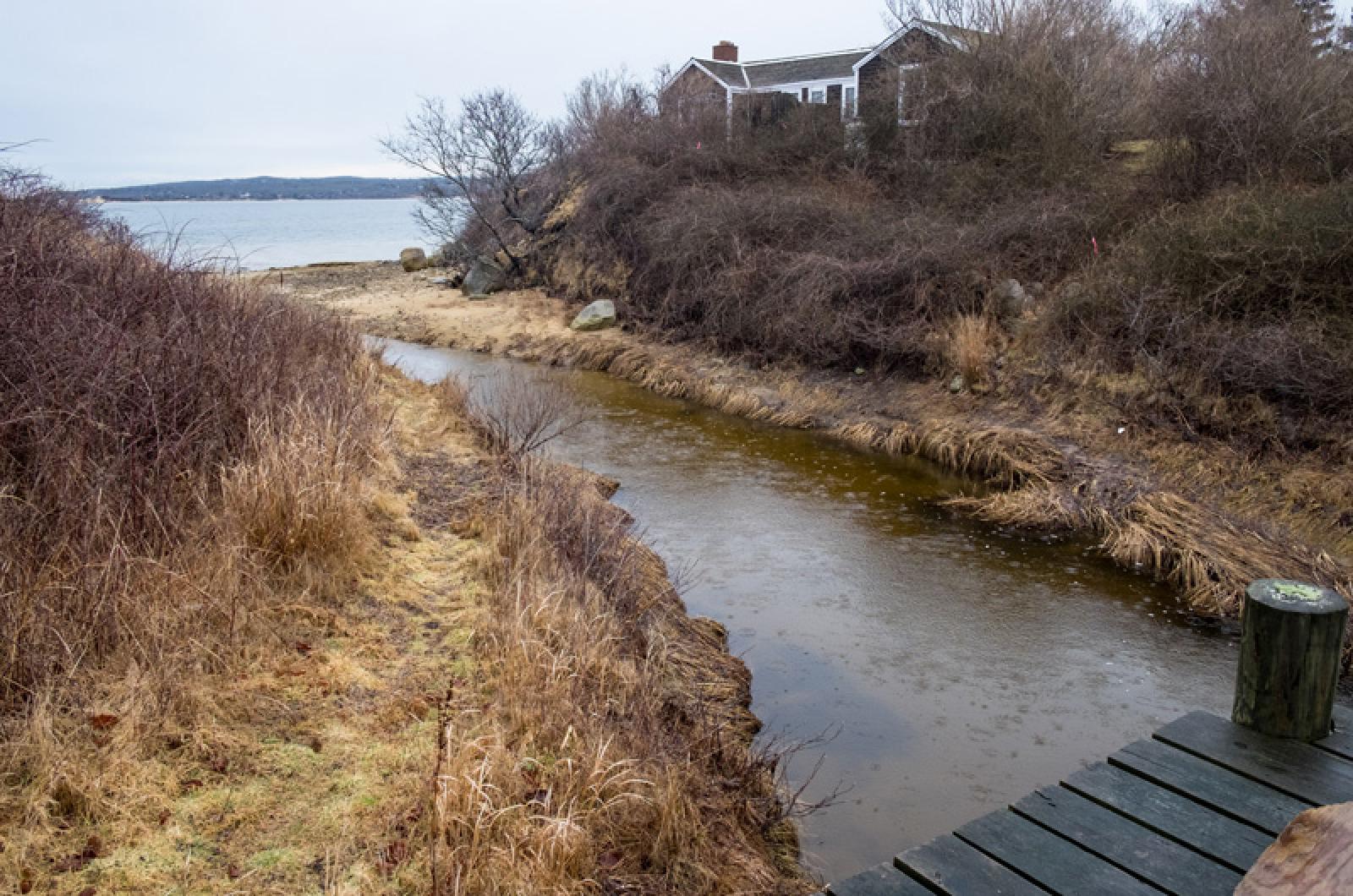
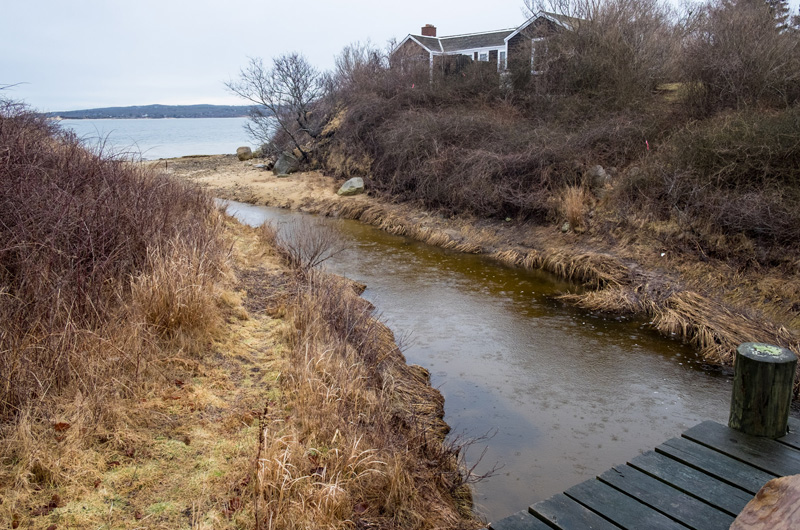
<p>Despite strict conservation measures, river herring are in deep trouble all along the Massachusetts coast including on the Vineyard.</p>
Despite strict conservation measures, river herring are in deep trouble all along the Massachusetts coast including on the Vineyard, a summit-like gathering in Aquinnah concluded early this week.
“We are absolutely at a historic low . . . There’s no question,” said Brad Chase, a senior biologist with the state Division of Marine Fisheries, speaking at a forum hosted Monday morning by the Wampanoag Tribe of Gay Head (Aquinnah).

Herring are at a historic low, a summit-like forum held in Aquinnah concluded.
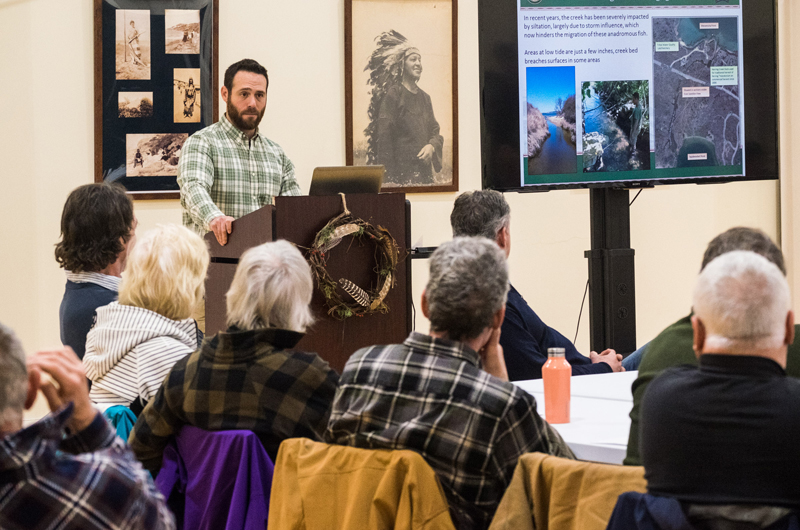
Herring are at a historic low, a summit-like forum held in Aquinnah concluded.
About 35 people attended, including federal and state regulators, harbor masters and herring wardens, town officials, and commercial and recreational fishermen. The event was held at the tribe’s newly completed community center in Aquinnah.
The news was far from upbeat. River herring, also sometimes known as alewives, are in a steep state of decline. Habitat loss, climate change and overfishing by large offshore factory ships are all factors.
Herring are anadromous fish, spending most of their lives in the ocean but swimming up into freshwater streams every three years to spawn. Historically the fish were abundant and used for both food and bait.
Herring fishing has been banned in Massachusetts since 2006 due to dwindling stocks. The exception is at the Wampanoag-owned herring running in Aquinnah, where traditional fishing is still allowed among Native Americans.
On Monday Bret Stearns, natural resources director for the tribe, described a recent project to assess the stock at the herring run located on tribal land at the head of Menemsha Pond.
Working with the state Division of Marine Fisheries, in 2016 the tribe installed an underwater video monitoring system at the herring run that gathered information by automated software.
Citing historical documentation, Mr. Stearns said 1.5 million alewives and blueback herring once passed through the herring run each year.
By the tribe’s count, fewer than 23,000 fish made the journey last year.
“That’s a startling number,” he said. “I was really shocked.”
Mr. Chase showed graph after graph of herring runs along the Massachusetts coastline, all showing striking declines over the past decade of data collection, followed by some modest gains because of community action.
He also outlined efforts the state is making to improve the fishery, including construction and repair of fish ladders and conservation of spawning areas.
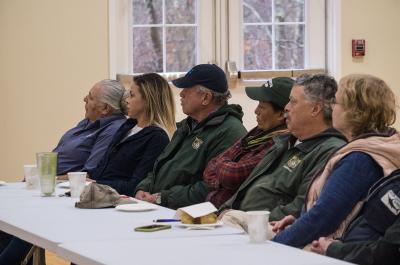
Wampanoag tribal members struck a somber note about the state of the herring fishery.
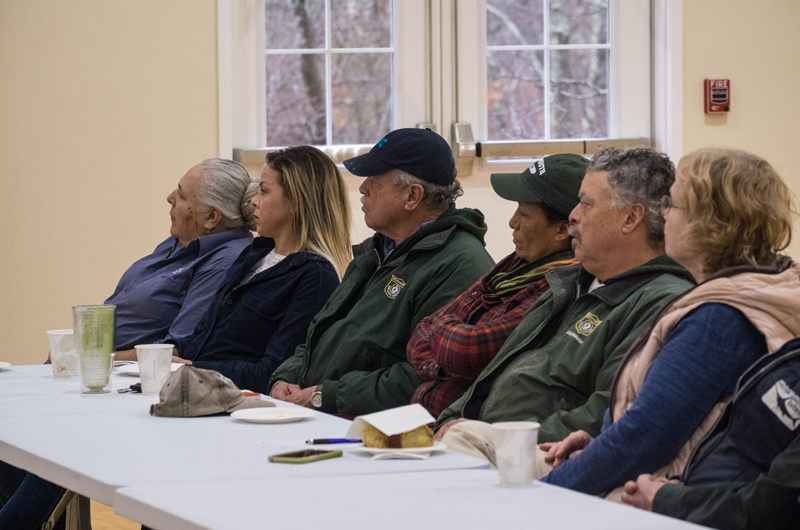
Wampanoag tribal members struck a somber note about the state of the herring fishery.
Natural mortality, habitat alteration and climate change are all factors that threaten the herring fishery, he said.
But some questioned whether community efforts can outpace overfishing.
Chris Murphy, a retired commercial fisherman from Chilmark, described how large trawlers that ply the waters off the coast of the Vineyard can gather 100,000 pounds of herring in one short sweep of the nets.
“We as a community have to decide if that’s how we want to harvest stuff, or if we want to allow it to come ashore . . . in these little towns,” Mr. Murphy said. “When you harvest it at sea, you just destroy the whole system.”
Tribal member and commercial fisherman Buddy Vanderhoop called overfishing by large trawlers in New England waters the largest factor affecting the low numbers of herring returning to Island bays and ponds to spawn.
“The trawlers are the main problem there is such a decline in the herring fishery,” he said. “If the general public knew this was happening, they would speak up. It’s just not right. This is happening off our coast.”
Tara Lake of the National Oceanographic and Atmospheric Administration (NOAA), outlined the federal government’s evaluation of alewife and blueback herring for possible protection under the Endangered Species Act. NOAA will decide whether protection is warranted, and if it is, whether the two species should be categorized as threatened or in danger of extinction.
That process is due for completion in the spring of 2019.
Comments
Back about 1998 (?) when I
Albie Newburyport, MassachusettsBack about 1998 (?) when I was tuna fishing out of Newburyport, the National Marine Fisheries Service came up with the bright idea of letting herring trawlers fish inshore waters. They even came up with a bright idea for marketing the increased bounty, namely, grinding it up into fish meal and selling it to Egypt for ten cents a pound.
I used to set a bait net before dawn, and normally I'd get about 2-3 totes of herring from an hour's soak.Enough to chum all day long. After the trawlers came inshore the herring disappeared.....pretty much immediately.
I talked to the NMFS's lady downtown about this problem, and she acknowleged that the trawlers should be moved back offshore. But that NMFS's would need to first do a study, and realistically speaking, no regulatory changes would be seen for 4-6 years.
A year later the numbers of tuna inshore (normally by the end of the season the tuna had moved in just off the beach, and I rarely had to go out more than 5 miles) had sunk dramatically, and there was nary a herring to be found.They're smart fish, the herring were gone, and they come up North to mainly gorge on herring.
That winter I sold all my rods.
So it sounds to me like the situation is the same as it was then. Government.....too often a magnet for fools, idiots, and charlatans.
It is the use of mobile net
William Burgess Leavenworth Searsmont, MaineIt is the use of mobile net gear that has reduced the fish stocks of the Gulf of Maine to about 2% of what was there when my grandparents were tykes in the 1870s and 1880s. If you read the old cod logs, fish inspectors' reports and state and federal Fish Commission reports, you can trace the impact of mobile net gear on migratory clupeids. In the 1870s there were 20 steam seiners taking menhaden IN Belfast Harbor, going up above where the two existing bridges are now, and then up the Penobscot River to Winterport. The stocks of all useful or edible fish have been overfished since the first seines were deployed, and no generation has been willing to take responsibility for it.
Let's stop commercial Striped
Bob EdgartownLet's stop commercial Striped Bass fishing as well. It is sad to see where this has end up as well. I would stop any kind of commercial activity that involved striped bass.
You have to wonder if we will
Steve FalmouthYou have to wonder if we will ever learn...
Can we breed out baby herring
Mr. Randall MVCan we breed out baby herring? How about in the tribal hatchery? (Whats going on in that building?)
We are talking about fish
Steve FalmouthWe are talking about fish that are normally present by the billions in the ocean, no stocking a little pond on Marthas vineyard with trout. So no, a hatchery will not solve the problem. I would encourage you to learn more about the fish in your local waters and do what you can to help them.
Steve- Thanks for the reply,
Mr. R MVSteve- Thanks for the reply, pardon my ignorance. I was just trying to suggest we be actively trying to help the fisheries instead of the classic blame game...
Whats the best way to learn more about the fish in my local waters? what can i do to help them, im just one guy who is not good at fishing and even worse at science. I can cook fish well tho, so i got that going for me!
SIGNED
LEON WAGNER Huntington StationSIGNED
Steve Myrick (and Gazette
Carol formerly ChilmarkSteve Myrick (and Gazette editors), I agree - these articles would be more helpful and complete if they included information on "fish in our local waters and what we can do to help them", as well as what bills, if any, have been presented in Congress to rein in factory fishing in our waters, and did our Congressional representative support/cosponsor those bills. Also, what is the state of Mass doing or not doing, and who in state gov't should be working on this? That's what we'd love to get from any media, Gazette most definitely included. Thank you.
Hatcheries have never solved
John K NBHatcheries have never solved a problem.
Eliminating or vastly
JR NY/MVEliminating or vastly reducing the out of control cormorant population would vastly help the herring as well as other species being decimated by this non-native uber predator and scourge to MV's waters. Note, Wisconsin put a bounty on the cormorant.
I agree. This summer my
Rich Atkin Somerville, MAI agree. This summer my family and I booked a charter boat and the smell of Noman's Land, you can smell it from a far, was because that place is FULL of cormorants pooping on it aka guano.
When Audubon came down east
William Burgess Leavenworth Searsmont, MaineWhen Audubon came down east in the 1820s and 30s, he saw no gulls or cormorants. Fishermen had shot them all, because they spoiled the fishing and the fish on the flakes.
It's pretty clear that when
William Burgess Leavenworth Searsmont, MaineIt's pretty clear that when alewives are taken offshore mixed with sea herring, they can't reproduce. If we want to recover the alewife population we must make it illegal to seine herring, alewives and bluebacks offshore. It might take two decades, but restricting the use of mobile net gear and returning to the use of weirs, traps and dipnets inshore will eventually allow the clupeids to recover.
good info...THANK YOU ALL,
Avis Parke ..Board Member -Red Lilly Pond CRAIGVILLE VILLAGE,IN tOWN OF CENTERVILLEgood info...THANK YOU ALL,
Note:
During Easter week, Dick Delaney (Red Lilly Pond Board) refurbished the herring run
on Lake Elizabeth..it's a model of precision on 'HOW TO DO IT'. Come see it!
Add new comment