

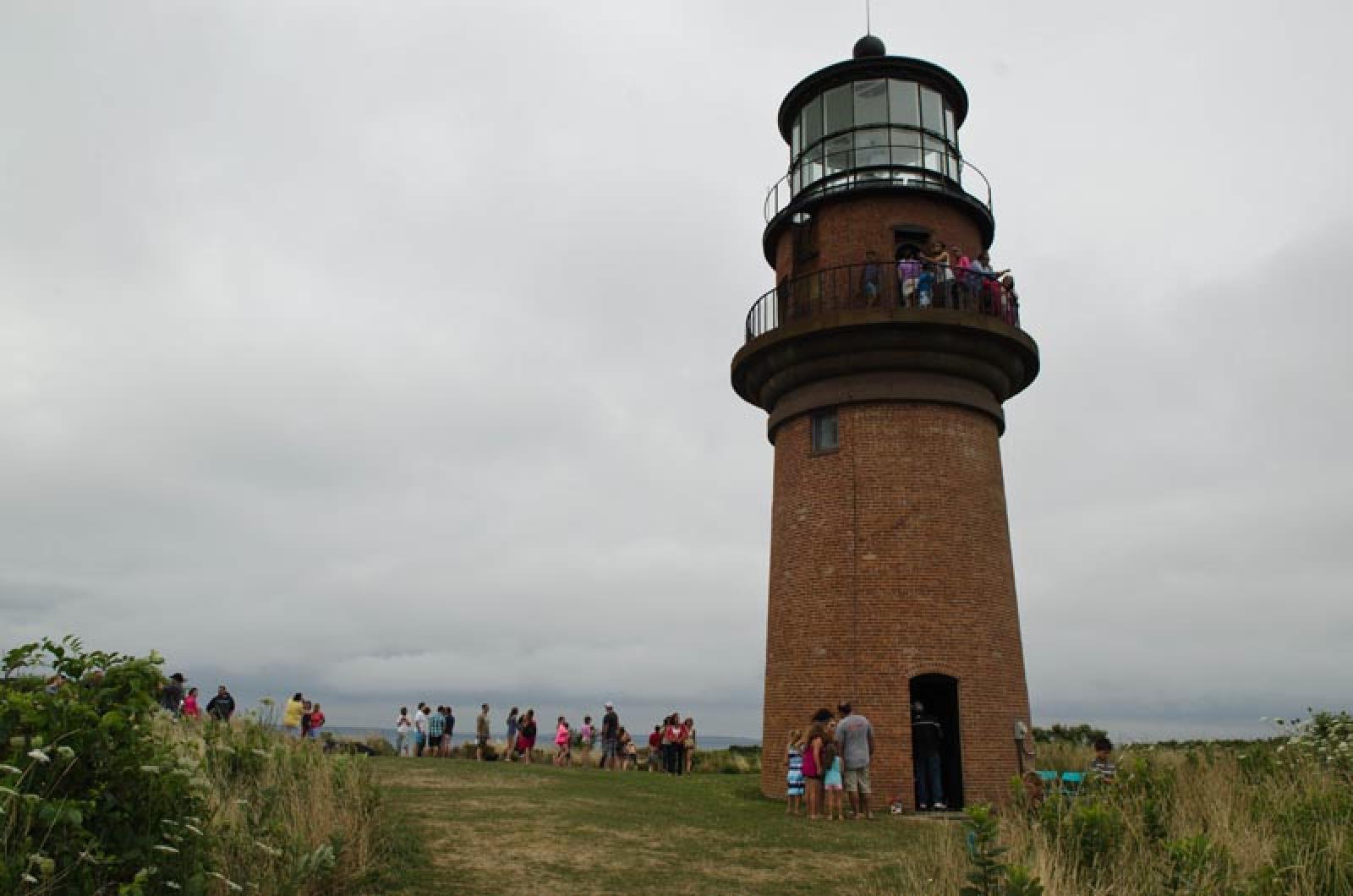
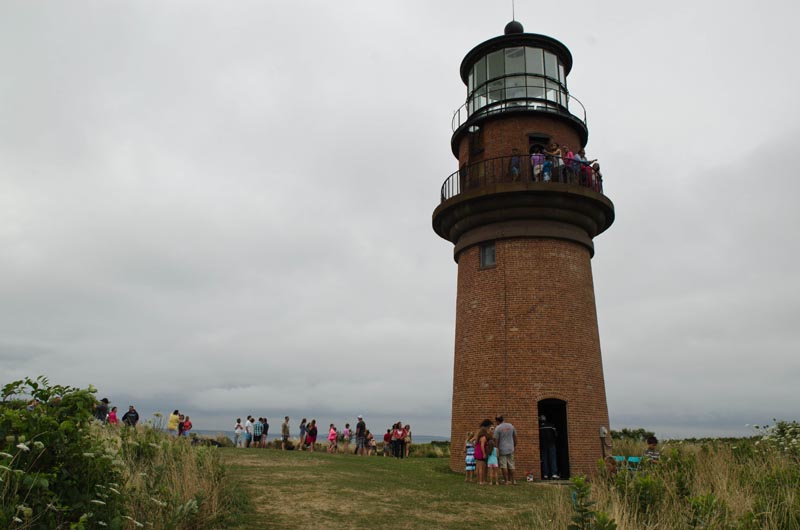
<p>Due to steady and increasing erosion at the Gay Head Cliffs, the Gay Head Light will need to be moved in the next one to three years and could cost as much as $3 million to relocate, the Aquinnah board of selectmen learned this week.</p> <p>At the board’s weekly meeting on Tuesday, Martha’s Vineyard Museum director David Nathans said the move of the historic lighthouse is only a matter of time.</p>
Due to steady and increasing erosion at the Gay Head Cliffs, the Gay Head Light will need to be moved in the next one to three years and could cost as much as $3 million to relocate, the Aquinnah board of selectmen learned this week.
At the board’s weekly meeting on Tuesday, Martha’s Vineyard Museum director David Nathans said the move of the historic lighthouse is only a matter of time.
“We’ve been watching the erosion or slumping... and it’s just a matter of time and mother nature before it will create a tremendous hazard to the continued standing of that lighthouse,” Mr. Nathans said.
The discussion of the pending move comes just two weeks after the selectmen learned the U.S. Coast Guard, which currently owns the building, would likely look for new owners sometime in the next two years. The museum has leased the lighthouse from the Coast Guard since 1994, and has said it will work with the town and interested parties to secure that the building stays within town ownership.
After the original 1799 wooden Gay Head Light fell into disrepair, a new brick structure was built in 1856 where it remains today. The light was placed on the National Register of Historic Places in 1987.
The museum consulted with International Chimney Corporation of Buffalo, New York to help in the impending move, Mr. Nathans said. The company, which was responsible for moving the Sankaty Head Light on Nantucket, visited the site this summer.
“The reason for getting International Chimney was for them to have their eyes on the site to determine if it was a feasible thing to do,” lighthouse keeper Richard Skidmore said. “In the proposal they said it’s something that has to be attended to, nothing can be waited on. There’s another 12 or 15 feet we could lose and that would get us to the limit.”
Gay Head Light at dusk.
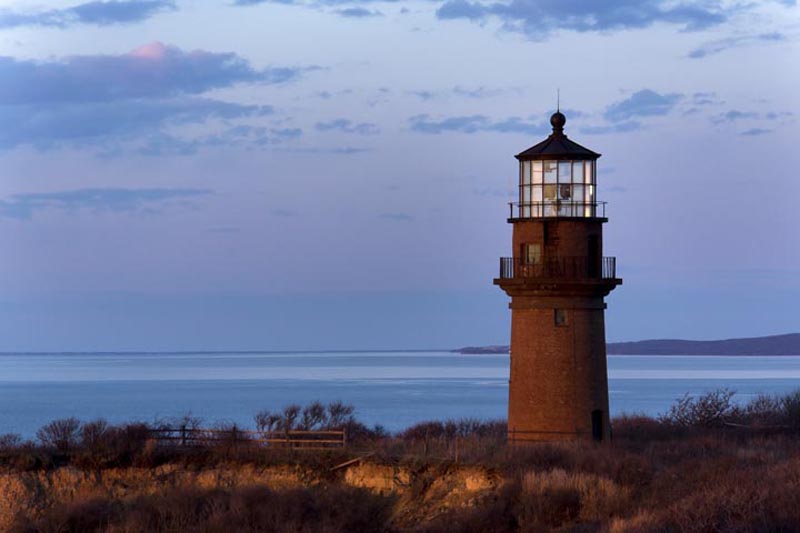
Gay Head Light at dusk.
A location is still being determined but several options are being considered in the direct vicinity. Regardless of the new location, the lighthouse will likely have to be placed on a pedestal to ensure that the light can be seen over the cliffs.
The museum is also looking into creating a barricade within the soil between the lighthouse and the cliff “that would significantly slow what’s happening,” Mr. Nathans said.
Last year voters approved monies for a three-year study to better understand the rate of erosion at the cliffs, “but we may need to take action before that is finished,” Mr. Nathans said.
The first round of results taken this past summer will not be available until next summer.
Funding sources for the move could include the federal government, state entities, foundations and private individuals, Mr. Nathans said after the meeting. “All of it should be on the table.” Mr. Nathans said he expects the Coast Guard to be “helpful in the process” but “I don’t think they have deep pockets.”
“No one is necessarily responsible for moving it,” he continued. “It is owned by the Coast Guard and under the current situation you would think the owner would have the most responsibility. I think they will be a participant but it seemed clear that the Coast Guard is happy to have local organizations who care about it to help in this process, and that’s why I think they suggested in the next year or two the ownership to transfer. It’s easier to imagine the entities that own it to take more responsibility.”
International Chimney Corporation made a report with several recommendations to the museum after their summer visit, Mr. Nathans said. A comprehensive study of the topography of the potential new locations will need to be conducted and “how they might need to prepare staging it” is needed first. The report is not being made public.
But before the lighthouse is moved, a full restoration is needed to stabilize the building.
A 2004 engineering study showed the lighthouse needed $500,000 worth of repairs. Minor work, including repairing of areas that were getting weaker, was done last year with help from community preservation act funds, “but I think it was a bandaid rather than a total repair,” Mr. Nathans said. A full restoration is needed before the relocation “so it could be moved and not crumble.”
The Aquinnah selectmen plan to advertise for a Gay Head Light committee in the coming weeks to address the ownership transfer and relocation of the lighthouse.
Comments
I believe the Gay Head light
Bruce Stone EdgartownI believe the Gay Head light as well as all the island lighthouses to be island treasures and would encourage all the towns to consider reserving current and future CPA surcharge funds for their preservation; even if there is no current application for funding pending.
Would the powers that be also
Miranda Edison MenemshaWould the powers that be also include, with this slumping and moving, a reinstallation of the 'white white white red' signal. Nothing more joyful and anticipatory as a child than watching the Menemsha sunset and waiting for that final, punctual red beam to shift around and flood the wine dark seas!
Dear Miranda - the
William Waterway EdgartownDear Miranda - the installation of 'white white white red' signal has the potential of being a reality. The organization I founded, Vineyard Environmental Research, Inst.(VERI), saved the Gay Head Light from being torn down in the 1980s. In the late 1980s the US Coast Guard, which owns and maintains the navigation signal, decided to simplify the mechanics of the signal to 'white white'. However, as president of VERI, I had the US Coast Guard transfer ownership of the old 'white white white red' signal apparatus to VERI. At the time, I was also on the board of the MV Museum, and had VERI loan the old signal to the Museum for public display. At some future date we may have the opportunity and wherewithal to install the old signal of 'white white white red'.
My father Joseph Hindley was
Betty Hindley Hatzikon Falmouth MA.My father Joseph Hindley was keeper at Gay Head during the 1950's until the light was automated & he was transferred to Nobska Pt. in Woods Hole. Gay Head Light was home to my family & I have treasured memories of our time there. Living in Falmouth I often look for 3 whites & a red as I drive be the waterfront. I sincerely hope funds will be available to safely move the light tower.
Dear Betty - I am curious as
William Waterway EdgartownDear Betty - I am curious as to what years during the 1950s your dad was Keeper at the Gay Head Light. I have a record that he was installed as Principal Keeper during the 1950s - but do not have a record as to what years he was there. Any information for the historic record will be appreciated. Thank you.
I wish the house was still
Edric Young St Petersburg, FLI wish the house was still there but would be difficult to move. I spent the first five years of my life there. My Dad was assistant keeper there with the Grieder's. I remember some of the things I did there. Hope the move works and it is not replaced by a pole stuck in the ground.
Thank you "Vineyard Gazette"
William Waterway EdgartownThank you "Vineyard Gazette" for researching and publishing this story. As many people on the island know, the organization I founded, Vineyard Environmental Research, Inst., was responsible for saving the Gay Head Light and two other island lights from being torn down in the 1980s. I personally have been involved with the Gay Head Light for 27 years.
It is my sincerest hope that this icon of America's maritime history will be preserved for future generations.
Hello Edric Young - good to
William Waterway EdgartownHello Edric Young - good to read your comment and personal affiliation with the Gay Head Light. It would be helpful for the historic record if you could inform us as to what years your dad was assistant Keeper.
Thank you
Just a thought ,To
nagel f. stone reading , mass.Just a thought ,To facillitate moving and to save $$ plus doing needed restoration work ,it could be sectioned into two pieces say :(upper, just below outer walkway) and (then, base) and moved to new location The "hughes" (spruce goose) aircraft comes to mind and the end result was excellent ! i.e. It would be a vertical instead of horizontal sectioning effort ! regards, a casual visitor
Add new comment