


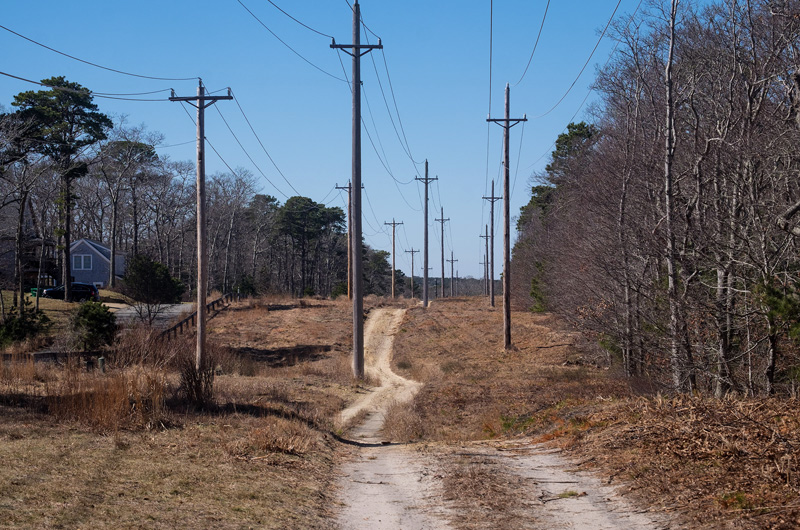
<p>Eversource will not spray herbicides around power lines on the Island this year, but debate is far from over as the utility giant files a five-year plan that would allow continued spraying.</p>
Eversource will not spray herbicides around power lines on the Island this year, but debate over the use of chemical agents is far from over as the state airs a five-year plan by the utility giant that would allow continued spraying on the Cape and Islands.
Two public hearings will be held this month by the Massachusetts Department of Agricultural Resources on the new 100-page, five-year vegetation management plan filed recently with the state by Eversource. One hearing was Thursday in the Sandwich town hall, and a second hearing will be held Tuesday morning in Chatham. Public comment will be allowed until March 16.
The plan requires state approval.
Last year, Eversource sprayed along power lines at West Chop and Edgartown-Vineyard Haven Road after a four-year moratorium ran out. Michael Durand, Eversource media relations manager for eastern Massachusetts, said this week that the purpose of the spraying is to “eliminate tall-growing, invasive species” that grow near the power lines. “We will likely not be back until 2020 or 2021 per our three to five-year cycle,” Mr. Durand told the Gazette by telephone. He the five-year plan would run through 2022 and will involve physical brush removal along with chemical treatments.
The spraying has attracted widespread opposition on Cape Cod and Martha’s Vineyard among both residents and elected officials. The chief concerns center on the unknown long-term effects of herbicides on the environment and public health in a region with a sole-source aquifer and sandy soils.
Legal attempts to block the spraying have been unsuccessful, and complaints filed by citizens and officials at the state level have fallen on mostly deaf ears. The Cape and Islands legislative delegation last year introduced a bill that would allow communities in the region to regulate their own use of pesticides. The bill was sponsored by state Rep. Dylan Fernandes, but Island legislative liaison Kaylea Moore said this week the bill remains stuck in committee. “Currently there is not a lot of traction,” Ms. Moore said. “I don’t think they’re going to go anywhere this session.”
A recommended list of chemicals in the new plan includes Rodeo, which has been controversial due to its active ingredient glyphosate, which is thought to be possibly carcinogenic although studies on the effects are contradictory.
“They are using the heaviest piece of artillery in their toolbox,” said Laura Kelley, president of Protect Our Cape Cod Aquifer, a group on the Cape that has been campaigning against the Eversource plan.
Ms. Kelley suggested that selective hand pruning or burning would be the safest and healthiest option for the environment.
The Tisbury board of health and Martha’s Vineyard Commission are opposed to the new Eversource plan and were expected to voice their concerns at the meeting in Sandwich Thursday.
The Edgartown board of health also agreed to join the fight after a presentation Tuesday evening by Lucy Morrison of the MVC who has been studying the chemicals used by Eversource. The board of health will recommend to the Edgartown selectmen at their next meeting that they send a letter to Eversource opposing the five-year plan.
“We could use much safer methods,” Ms. Morrison said at the meeting. “They are not catering to the Island the way they should.”
Whether or not Eversource gets the five-year plan approved, the spraying that has already been done, especially in Tisbury last year, is drawing the most concern.
“I haven’t seen anything adverse yet,” said Maura Valley, town health agent for Tisbury, where the majority of Island spraying took place last year. “What’s concerning is the long-term exposure in residential areas.”
Ms. Morrison agreed. “My feeling is that it’s applying chemicals,” she said. “If they don’t know long-term effects, then they shouldn’t use it.” She continued:
“The problem is there’s not many studies happening . . . The chemical companies say it’s safe, but they don’t look into long-term effects.”
Mr. Durand emphasized that the herbicides have been approved by the state pesticide advisory board and Massachusetts Department of Agriculture. He added that Eversource customers pay for the treatment, so cost is also a consideration.
“The spray has been proven time and again to be the most effective in preserving long-term sustainability of the habitat,” he said. “It’s the industry standard.”
The five-year plan can be viewed online on the state website. Public comments can be addressed to John Lebeaux at the Rights-of-Way Program, Massachusetts Department of Agricultural Resources, 251 Causeway Street, Suite 500 Boston, 02114-2151, or emailed to Mr. Lebeaux at [email protected].
Comments
Bury the power lines.
MC VHBury the power lines. I imagine people would donate $ to get rid of the eyesore.
Why doesn't the MVC, towns
Colonel Klink OB/NYCWhy doesn't the MVC, towns and public officials advocate that Eversource bury the power lines? That would eliminate the need to spray. While an upfront capital expense is needed to bury the power lines, it will save time, money and consternation regarding the ongoing use of chemicals and pruning. Has this ever been advocated?
Buried lines have been
Sue Phelan, GreenCAPE.org W. Barnstable, MABuried lines have been suggested many times but the utility refuses, based on cost--despite the fact they would def pass that cost on to customers. They would save on the annual cost of herbicides and the crews required to spray/maintain the easements. Hmmmm. So why the hard line on herbicides? Think creatively....
Is that the best the MVC has
Bob EdgartownIs that the best the MVC has is an administrative assistant to talk about this? What is her collage education experience in this field? Some would say we spend to much on the MVC and looks like we are not getting much for it. Time to get out of the MVC and save the taxpayer some money.
I imagine they are referring
Shawn Roseman VINEYARD HAVENI imagine they are referring to Japanese knotweed "the tall growing invasive species." This is a terrible weed, grows like wildfire and is very hard to get rid of. Only a very potent form of glyphosate after cutting back and then covering, over years can eradicate it. Hand pruning and digging up and burning is a safer method, could create many jobs.
Would not be cheap but is it better then poisoning our community and water or while they are burying the power lines they can dig it all up!
Add new comment