


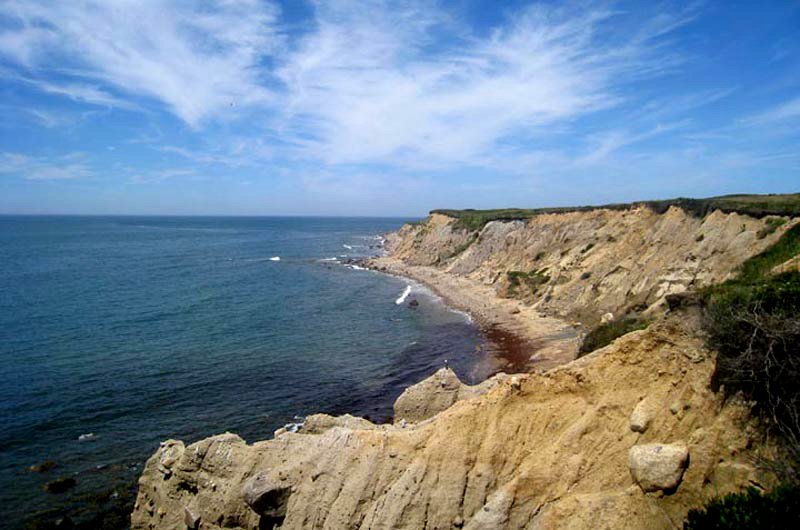
<p>The small, uninhabited island south of the Vineyard could play a key role in boosting the dwindling population of New England cottontail rabbits.</p>
Noman’s Land, the small, uninhabited island south of Martha’s Vineyard, could play a key role in boosting the dwindling population of New England cottontail rabbits.
The U.S. Fish and Wildlife Service last week unveiled a proposal to establish a population of the rabbits on the island that is now a national wildlife refuge.
A healthy population of New England cottontails has been established on Patience Island in Rhode Island.
New England cottontail.
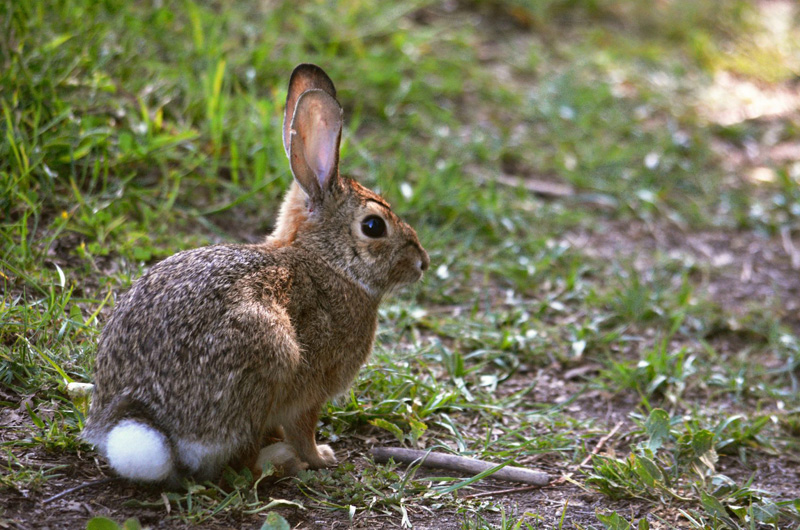
New England cottontail.
Federal officials said Noman’s offers ideal habitat for New England cottontails, which live in dense thickets found in young forests or shrubland. The rabbits are a native species and were once abundant from southeastern New York to Maine, including on the Vineyard and Noman’s, which lies three miles off Chilmark.
The species dwindled because of development and habitat loss. According to the government, the last documented sighting of a New England cottontail on the Vineyard was in 1984.
Today the rabbits are found only in small, distinct areas, including on Cape Cod.
Eastern cottontails, a nonnative species introduced to New England in the early 1900s, are now more abundant than the native New England cottontails. Rabbits seen on the Vineyard are eastern cottontails. The two species look similar; New England cottontails have slightly shorter ears and a line of black fur.
New England cottontails are being bred in captivity at Roger Williams Zoo in Providence, R.I. and Queens Zoo in New York. Some captive-bred rabbits have been released, including on Patience Island in Narragansett Bay, which is now home to more than 60 cottontails.
Fish and Wildlife officials said they believe Noman’s could support 600 or more New England cottontails. The island is more than 628 acres and was once inhabited by humans, as evidenced by Native American burial grounds, European cemeteries, and even an apocryphal Viking runestone. From the 1940s to 1976, it was used by the Navy as an aerial bombing and gunnery range. Today the island is closed to the public because of unexploded ordnance. In 1998 it became a national wildlife refuge, and is primarily a sanctuary for migrating birds.
The idea of introducing New England cottontails to the habitat has been in discussion since at least 2010.
According to a government environmental assessment, the island offers ideal, stable coastal shrubland habitat for the cottontails, along with an absence of mammalian predators and eastern cottontails.
The population would be created through the release of wild-caught rabbits or rabbits raised through one of the captive breeding programs.
The U.S. Fish and Wildlife Service is seeking public comments on the proposal, available online and at the Aquinnah public library. Comments are due by March 2.
Comments
Bunny Bunny!
Martha MageeBunny Bunny!
Please do!
MichaelPlease do!
What a wonderful wildlife
Michael MV & CTWhat a wonderful wildlife preservation idea and project! Please provide the address to submit comments to the U.S Fish & Wildlife Service.
Tick magnets? Aren’t the
Josephine daSouza OakBluffsTick magnets? Aren’t the cottontails on the Vineyard carriers of a number of tick borne diseases? What rabbits, if any, inhabit Norman’s? What mode of natural population control exists there for rabbit introduction? For that matter, what is the rabbit population on the Vineyard? I see several daily in my yard so there must be many thousands. Why then would the New England cottontail die off on the Vineyard while the other species has largely remained intact. All kinds of questions that should be answered to understand the potential impact of this experiment!
Off the top of my head, there
zenmom Salem, MAOff the top of my head, there are several reasons the imported rabbit species might gain an edge over the native New England cottontail. 1. More successful competition for resources (perhaps they are larger or more aggressive?.) 1.5. More successful competition for resources, because they are earlier "out of the gate" in foraging in the spring? (As I said, this is just off the top of my head and I'm merely speculating here.) 2. More successful competition for nesting areas. (Reasons - see #1 and #1.5) 3. Successfully bringing to term and nurturing larger litters, which over time would multiply their numbers faster than the local rabbit, thus edging them out by sheer numbers. As to your other questions (all worthy of inspection), I'm thinking either species of rabbit could be a carrier for ticks and tick-borne diseases. If so, that wouldn't affect the decision to bolster the numbers of New England cottontails, as in any event tick control and tick awareness ought to be worked on. Natural population control for rabbits on Norman's Island? Sounds like there aren't any mammal predators (foxes, coyotes, etc). But I bet hawks and other avian predators would figure out pretty quick where they could go for a snack if the introduction on Norman's Island was successful. Seems to me like the introduction of the New England cottontail to Norman's Island is a reasonable experiment to try to increase the numbers of this local species.
This is just one of the fine
brad bourque new bedford, ma 02744This is just one of the fine ideas that could come up to assist mammals in new England. This effort could be coupled with other types of rescue projects by including predators such as the Black racer (coliber constrictor) or the Timber Rattlesnake. The habitat is perfect for the Racer but not so hospitable for the Rattlesnake. I am not familiar with the Island; however, I have fished off the shores since 1979 and as a commercial fisherman, continue to fish there each summer. I favor this project and will others along this category.
We are seeing a lot less
Faith Laskaris Oak bluffsWe are seeing a lot less rabbits in Oak Bluffs and we miss them! Can any of the rabbits be brought back to the Vineyard
From Noman’s? Thanks, Faith
Add new comment