

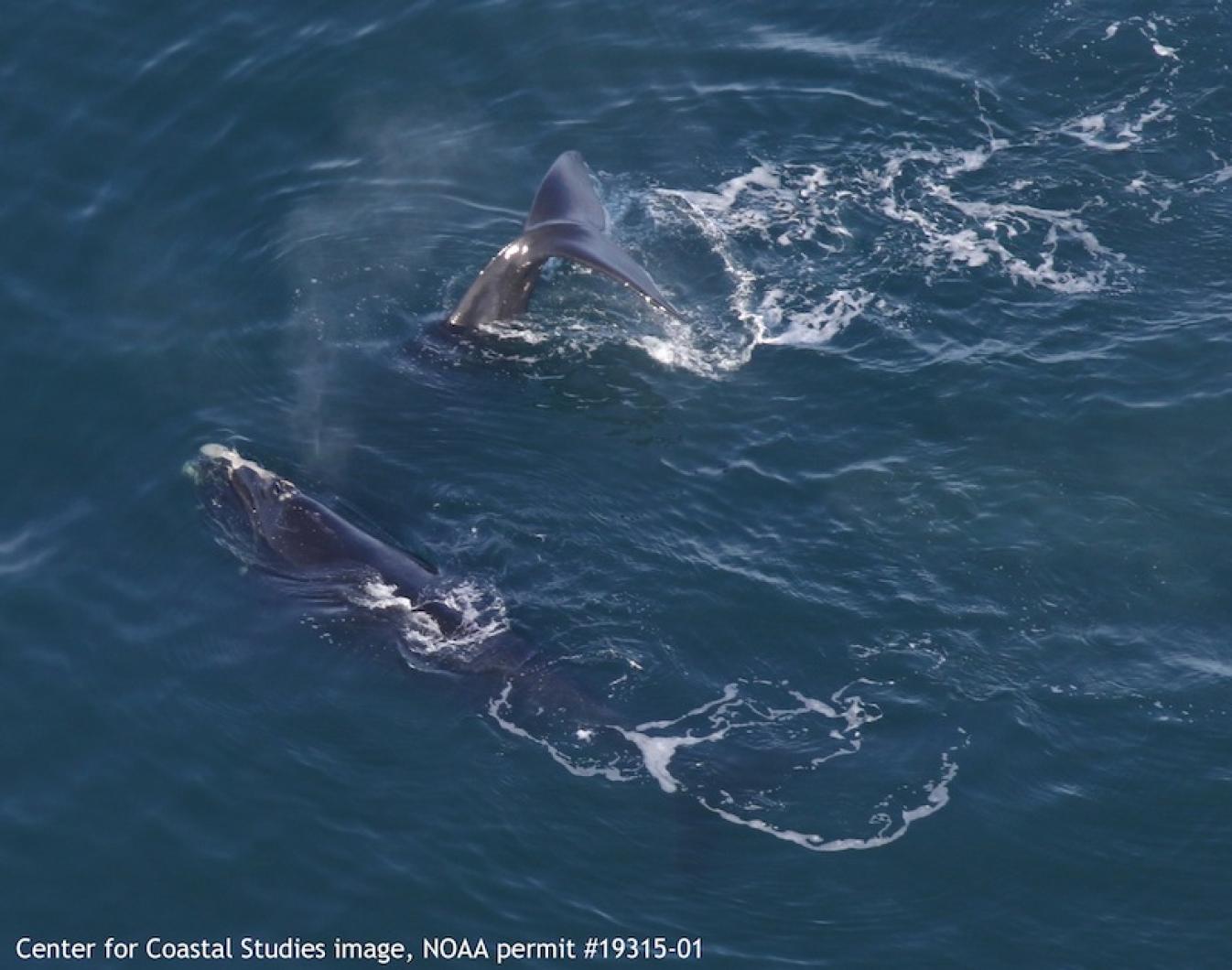

<p>About 25 North Atlantic right whales gathered south of the Vineyard last week, marking an early-season sighting.</p>
About 25 North Atlantic right whales gathered south of the Vineyard this week, marking an early-season sighting of a species that scientists warn could go extinct in the next 20 years.
The sighting belies the plight of the species, Dr. Mark Baumgartner told a crowd of about 50 people gathered in the Gazette newsroom Tuesday for a talk. There are an estimated 450 whales left.
Mr. Baumgartner, a scientist with Woods Hole Oceanographic Institution and president of the North Atlantic Right Whale Consortium, said he and other scientists have documented an alarming decline in right whale calving rates alongside a rise in deaths from fishing gear entanglement.

Dr. Mark Baumgartner spoke at recent Gazette Tuesdays in the Newsroom event.
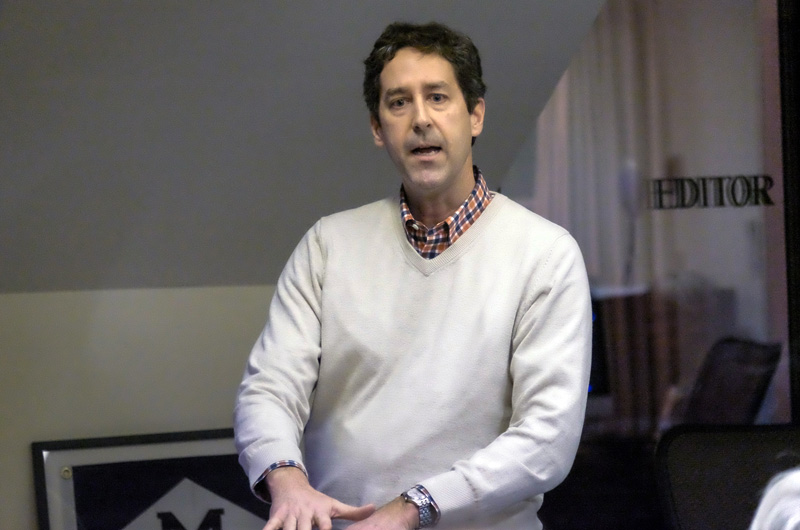
Dr. Mark Baumgartner spoke at recent Gazette Tuesdays in the Newsroom event.
“We have years, not decades to fix this problem. The longer we wait, the harder the problem gets to fix.” Mr. Baumgartner said. “We don’t need more science to be done on this species. We need to act.”
While the situation is grave, he said, solutions including weaker fishing rope and an emerging ropeless fishing technology that could reduce the number of entanglements that kill or injure the whales.
North Atlantic right whales are about the size of a city bus, and individuals can be identified by unique patterns of callosities on their heads. The whales eat copepods, tiny crustaceans, to the tune of one or two tons a day, Mr. Baumgartner said, the caloric equivalent of about 3,000 Big Macs.
Right whales got their name because they were the “right” whales to pursue during the whaling era. The whales are slow-moving, live near shore, and float after they are killed, making them easier to drag ashore.
The population was decimated beginning around the time of the Revolutionary War. “They’ve been down for along time, but not out,” Mr. Baumgartner said.
More recently, scientists have closely monitored the population from the southern Atlantic calving grounds they visit in the winter to feeding grounds off New England and Canada. Two recent trends paint a dire picture, Mr. Baumgartner said. Last winter, five right whale calves were born, the smallest number scientists have documented in 17 years. So far, he said, no calves have been seen this year. “This year I fear may be worse,” he said.

Right whale remains washed upon on Chappy in November.
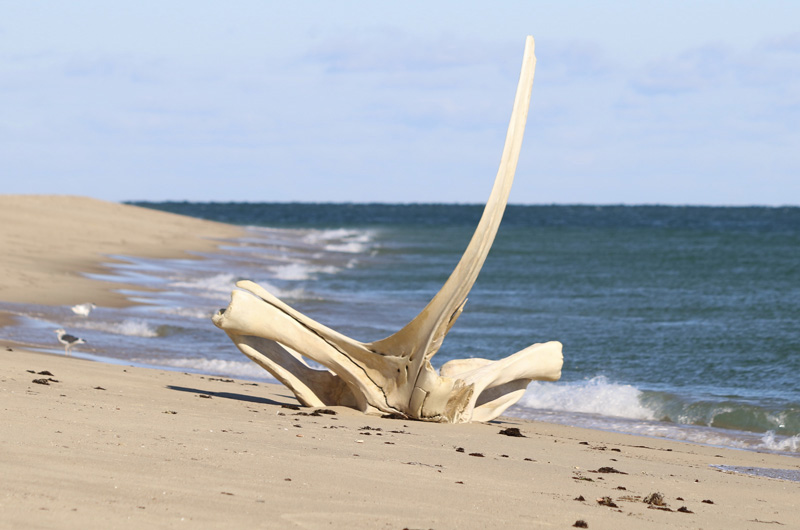
Right whale remains washed upon on Chappy in November.
Scientists have also documented increasing amounts of time between when females give birth to calves, and a decline in first-time mothers. Meanwhile, 17 right whales were found dead last year, 12 in Canada and five in the United States. Three of the whales found in the U.S. were on or near Martha’s Vineyard.
The two main causes of unnatural whale deaths are fishing gear entanglements and ship strikes. Deaths from ship strikes have declined significantly in recent years, Mr. Baumgartner said, after rules were enacted requiring ships within 20 miles of East Coast ports to reduce their speed at critical times. After the right whales were seen south of the Vineyard and Nantucket this week, the government issued a voluntarily vessel speed restriction, asking ships to reduce speed in those areas until Feb. 5.
At the same time, fishing gear entanglements have been on the rise. Rope attached to lobster pots is the culprit in entanglements, Mr. Baumgartner said. In recent decades fishermen have been using stronger rope, making it harder for whales to break free.
“It’s important to understand that entanglements are gruesome events for those animals,” Mr. Baumgartner said. One whale that was entangled in a snow crab pot in Canada dragged the gear all the way to Florida, he said. It is clear many whales suffer for some time before they die, he also said.
“I think if this was happening to a land mammal, in full view of the public . . . it wouldn’t be happening,” Mr. Baumgartner said. “Most people don’t know this is how right whales die.”
Entanglements that aren’t fatal hurt the population in other ways. Whales expend more calories and lose weight, which in turn affects reproductive rates.
The situation is clear, the WHOI scientist said. “I don’t want to research this thing to death,” he said. “We need to be doing something.”
Potential solutions range from taking steps to address fishing gear entanglement to the complete closure of the lobster fishery. The latter is not a desirable outcome, Mr. Baumgartner said. “I don’t think any sane person would really want to propose that,” he said. “Lobster fishing is as iconic in New England as right whales are.”
Ground lines are already required to be sunk in Massachusetts, Mr. Baumgartner said. “Massachusetts fishermen have done more for whale conservation than any other state,” he said, also pointing to fishing closures in Cape Cod Bay during the right whale season. These actions could be introduced in other states, like Maine, he suggested.
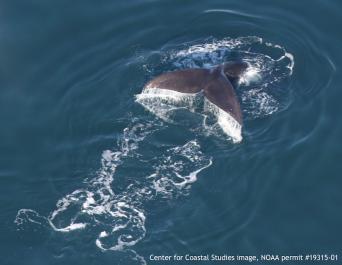
Right whales feed in waters off New England and Canada. Twenty-five whales were seen south of the Vineyard and Nantucket this week.
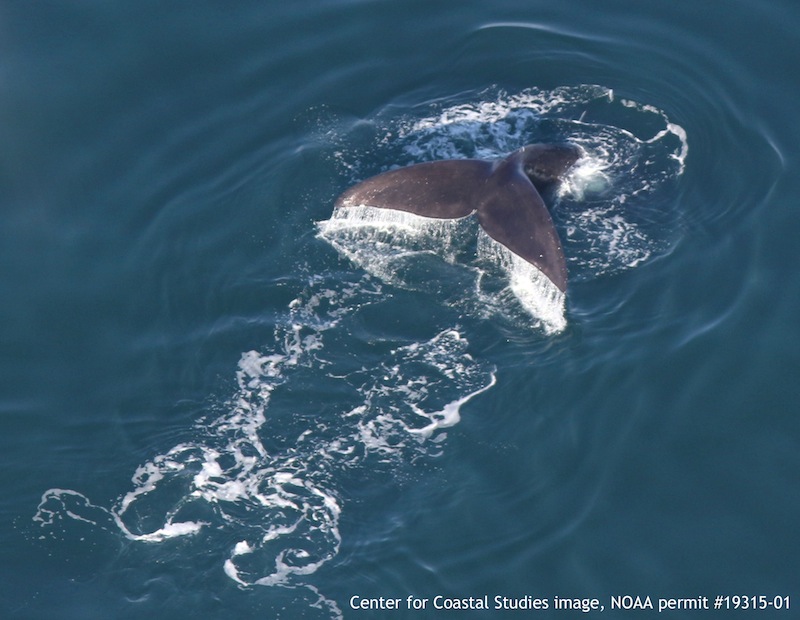
Right whales feed in waters off New England and Canada. Twenty-five whales were seen south of the Vineyard and Nantucket this week.
Mandating weaker rope, along the lines of 1,700-pound breaking strength, would be one of the quickest remedies, he said. It would not prevent entanglements, but would make it easier for the whales to break free.
The most comprehensive measure includes using ropeless technology for fishing gear, which would see fishermen using acoustic devices to raise gear from the ocean floor. Scientists have the technology ready to go, Mr. Baumgartner said. Introducing the gear would require cooperation with the fishing industry and an experimental fishery to test the equipment.
Ropeless technology would also affect other animals at risk of entanglement, including other whales, sharks and leatherback turtles.
“It’s a completely solvable problem,” Mr. Baumgartner said.
Last week three environmental and animal rights organizations filed a complaint against the federal government, claiming that the Department of Commerce and National Marine Fisheries Service failed to protect right whales by continuing to authorize the American lobster fishery despite the impact on whales.
The Center for Biological Diversity, Defenders of Wildlife and the Humane Society of the United States asks the court to require the government to put in place mitigation measures to protect whales.
Mr. Baumgartner said the lawsuit is part of a natural process of holding the government accountable. He said agencies have been slow to respond to concerns about whether whale protection regulations are being followed or are working. “So the nongovernmental organizations come in to sue the government, to come in and say speed it up,” he said.
As scientists continue to monitor the species and others press the government for action, Mr. Baumgartner disagreed with the suggestion that people stop eating lobster as a meaningful action. “Lobster fishing and whales can be completely compatible,” he said, instead encouraging people to ask fish markets where their lobsters came from and how they had been caught.
Talking to suppliers can change an entire industry he said, pointing to the movements in support of cage-free eggs and free-range chickens.
“Keep asking the government what we are doing about this,” he said. “This past year has changed the conversation completely about right whales.”
Comments
Stop blaming lobster fishing
Heather LaMarque Vineyard HavenStop blaming lobster fishing for Right Whale deaths Mr Baumgartner.
It is well documented by sources from NOAA /NMFS /WHOI 90% of Right Whale deaths are from SHIP STRIKES NOT LOBSTER GEAR!
Thanks for your comment,
Mark Baumgartner Woods Hole Oceanographic InstitutionThanks for your comment, Heather. What you have said is not true. The NOAA 2016 stock assessment report for right whales (the latest report on the status of the population) can be found here: https://www.nefsc.noaa.gov/publications/tm/tm241/8_F2016_rightwhale.pdf. At the bottom of page 12, you will find the following sentence: "For the period 2010 through 2014 [the most recent period analyzed], the minimum rate of annual human-caused mortality and serious injury to right whales averaged 5.66 per year. This is derived from two components: 1) incidental fishery entanglement records at 4.65 per year, and 2) vessel strike records at 1.01 per year." 4.65 entanglement deaths out of 5.66 total deaths = 82% of known deaths are attributable to fishing gear entanglements. Ship strikes only account for 18%. These numbers are provided by the government, but verified by non-governmental organizations. Your statement is nearly correct for the mid-2000's (when ship strike deaths were high compared to fishing gear entanglement deaths), but deaths due to fishing gear entanglements have increased significantly since then while ship strike deaths have decreased.
Thank you, Mark Baumgartner.
Carol formerly ChilmarkThank you, Mark Baumgartner. It's very helpful to have this information. Gazette, perhaps include this detailed information in the next article on these beloved, critically endangered animals. No one's "picking on" lobstermen, but we need to know facts before the risks can be addressed.
You neglected to mention, the
Bonnie Hyler TennesseeYou neglected to mention, the reason fishermen are fishing with heavier gear is because much heavier sinking groundlines have been mandated by the government, and supported by the NGOs. This was done to protect whales from becoming entangled in groundlines that arched. You make it seem easy for the lobster industry to fish without endlines, or with endlines that through technology, pop up from the ocean floor when a trawl is pulled. For at least ten years, the industry has explained why, for numerous reasons, it is impossible to fish that way. Fishermen are all for protecting whales, and have been working to do so for many years. Other research must be done on endlines that is a practical alternative to that which you describe.
Thanks for your comment,
Mark Baumgartner Woods Hole Oceanographic InstitutionThanks for your comment, Bonnie. You are correct that sinking groundlines have been mandated and are being used by the industry except in coastal Maine and all of Canada. Where sinking groundline is used, whales get entangled in endlines, and strong rope is used for endlines, too. I did not mean to imply that the transition to fishing without endlines would be easy. It will not. However, there are technologies and methods in development today that have not yet been considered by the fishing industry. There are ways, for instance, to fish without endlines and avoid gear conflicts (that is, laying gear over another fisherman's gear, or getting gear caught in a trawler's net). Its interesting to note that there are three fisheries in the U.S. that are currently fishing without endlines: the golden crab fishery off Florida, lobster fishing in the shipping lanes near Boston Harbor, and illegal sunken lobster trawls in Maine.
Heather,
Alex C FalmouthHeather,
Can you please present that documentation?
There was a study that came out in 2016 from leading North Atlantic Right Whale researchers in the US that says, "From 2010 to 2015, 15% of diagnosed right whale mortalities were due to ship kills and 85% were due to entanglements."
Also "as of 2015, 83% of all right whales display scars or carry ropes indicative of past entanglements."
- Website to article: https://doi.org/10.3389/fmars.2016.00137
Is it possible that the
David Dow East Falmouth, Ma.Is it possible that the direct and indirect effects of climate change on the distribution/abundance of North Atlantic right whales in both
their breeding areas off the southeastern US and feeding areas in New England/Canadian waters could explain the low calving rate and increased deaths from gear entanglements ? NARWs appear to track their large zooplankton prey which are linked to the Spring diatom bloom. The whales seem to locate these prey feeding areas more effectively than scientists can locate them. Warming waters off the southeast and extreme weather events could have effected the southern calving areas. Many of the deaths in the Summer occurred in the Gulf of St. Lawrence from Canadian fixed fishing gear which seems to be an unusual feeding area for NARWs. Do scientists know why this change in distribution occurred ?
Great questions, David. You
Mark Baumgartner Woods Hole Oceanographic InstitutionGreat questions, David. You are right that right whales have been changing their distribution and/or movements since 2010, and one of the hypotheses to help explain this is climate change. The Gulf of Maine is warming very fast, and this is likely to have an influence on the right whales' zooplankton prey. However, no direct research has been done on this to date. I think you are probably right that such changes are influencing increased risk of entanglement (because whales may be showing up more often in areas where there are no protections) and decreased calving rates (because females cannot feed enough to support a pregnancy). Right whales are resilient, though, and can most likely survive such environmental changes, but we are making that nearly almost impossible because of human-caused deaths and the sub-lethal effects of fishing gear entanglements on calving. With regard to the Gulf of St. Lawrence, we have known that right whales visit the Gulf of St. Lawrence for a long time - this is not an unusual feeding area for right whales. There has been very little systematic effort to study them there until the past few years. I suspect they have been there all along, and we are only recently beginning to appreciate that fact.
You also neglected to mention
Greg turner Scarborough meYou also neglected to mention that USA fisherman have been marking all end lines with red markings for a few years now,does any of them show up ?? Also 600 lb break away links
New England and especially
WVI menemshaNew England and especially Mass. has very strict rules on lobster gear to prevent entanglements. Some of these are weak links, sinking line (which is very dangerous to lobstermen and caused injuries and damage to the boat when it hangs down in the hard bottom) . The weak links break the bouy free very easily as one can see by the amount of bouys that wash up with the broken link. All the entanglements are in Canadian waters where they have no restrictions , not New England waters . A whale might tow gear down this way but its been proven that it is not our gear. Also more damage is caused by acoustical gear from survey boats and research vessels.
Thanks for your comment, WVI.
Mark Baumgartner Woods Hole Oceanographic InstitutionThanks for your comment, WVI. You are absolutely correct in saying that Massachusetts lobstermen have done a lot to reduce lethal whale entanglements. However, it is not at all true to say that all entanglements occur in Canadian waters. When gear is recovered from a whale (either a live whale or a dead whale), an effort is made to identify where the gear came from. There are many instances where gear is traceable to New England waters, and in some cases, even Massachusetts waters. We are waiting for the government to complete a formal analysis of these data for more information, but it is very clear that entanglements happen throughout the whales range, including in New England waters. As for acoustical gear harming whales, there is certainly concern over the effects of low-frequency noise from seismic exploration and commercial shipping on whales, but it is incorrect to suggest that these are causing more damage to right whales than fishing gear entanglements and ship strikes. Fishing gear entanglements and ship strikes are the *only* cause of death documented for adult right whales.
Is there any information on
George S. TorontoIs there any information on the ropeless technology? It would be great to know what it is and what fishermen think of it
It is very unfortunate that
Clark ChilmarkIt is very unfortunate that this article was written without any quotes from fisherman. Our fishermen live on the water almost every day year round. These whales are amazing creatures and are absolutely respected by fishermen. Due to regulation past down from National Marine Fisheries Service fishermen are required by law to use “whale safe breakaway links” as well as sink line so there is no slack in the water column and almost complete reduction in exposed line. Our lobstermen were forced to repurchase all of their modified line in one year, which was a huge financial sacrifice upwards of $20,000.00, but they were willing to do it for the sake of helping the safety of the whales. It is seriously unfortunate that these facts were not included in this article. Further, the fishermen have not used thicker or stronger “down lines” or “end-lines” this is just simply not true. Our lobstermen have ALWAYS used 3/8 endlines or less inside of 50 fathom depths. In addition, our lobsterman have been hit with a 50% reduction in trap allocation in the last 3 years due to conservation measures so there is factually 50% less gear/traps and therefore end lines in the waters than there have been in the last 45 years of fishing. As if these facts aren’t enough, National Marine Fisheries Service mandated that you must use trawls not singles. This reduces the endlines significantly because where you had one line/buoy to one trap you now are required to have 10 or more traps for one or two endlines, this also clearly reduces exposed lines exponentially. Our fisherman have been brought to the brink of bankruptcy trying to cooperate and mitigate entanglements and it has worked locally with these regulations. Further, please read about low frequency sonar (LFS) that they use to pulse deep into the sea bed to explore for oil deposit wells and survey bottom structure for wind farms. This technology has been know to cause massive beaching aswell as large fish die offs. I encourage Mark B. to work together with fishermen to fight the oil exploration and use of (LFS) that is about to be approved south of the Vineyard out to George’s bank and let’s save both our whales and our fishermen rather than vilify a group that has sacrificed there livelihoods to protect the ocean they survive with and hopefully will for generations to come. Shame on the unanswered rhetoric that directly leads to more public fear and therefore funding for Mark Baumgartner large salary.
thank you Mr. Clark. lots of
Roger Ferris WT/Hyannisthank you Mr. Clark. lots of parts of this issue is missing in this article. (disappointing...)
please Mr. Baumgartner, what in the world is lobster farming?
(hint: it’s not a real thing...)
That was a misquote by the
Mark Baumgartner Woods Hole Oceanographic InstitutionThat was a misquote by the paper. I did not talk about lobster farming because, as you point out, its not a real thing. I said that lobster fishing and whales can be completely compatible.
Why no mention of the
Kenneth TisburyWhy no mention of the historic whaling days?? Edgartown was built
on whale blubber. We harvested thousands and it was encouraged!
Dont get me wrong, I want the Right Whale to survive and thrive; however, no need to whitewash history and shame lobstermen / the lobster roll loving public.
Thanks, Kenneth. I wish you
Mark Baumgartner Woods Hole Oceanographic InstitutionThanks, Kenneth. I wish you could have come to the presentation I gave at the Vineyard Gazette that prompted this article. We did indeed talk about historic whaling and the 1000 years of whaling that decimated right whale numbers. Whaling for right whales finally ended in the 1930's and they have been making a comeback ever since. Just between 1990 and 2010, the population grew from 270 animals to nearly 500. But that growth has since reversed and fishing gear entanglements are playing a very large role. There are now 450 right whales left, and only 100 adult breeding females. All of those females will be gone in just 20 years if we do not reduce human-caused deaths.
Well said Mr. Clark ! Have
WVI MenemshaWell said Mr. Clark ! Have not heard anything mentioned about the US Gov't NOAA Ship that hit and killed a whale last year though.
Could you provide more
Mark Baumgartner Woods Hole Oceanographic InstitutionCould you provide more information, WVI? There is no report of a NOAA ship hitting a whale last year that I am aware of. I'd be interested to hear what you know. Is there a published article on this that you can link me to? I'd appreciate it.
Why did this conversation
A. RaymondWhy did this conversation stop? I was appreciating Mark Baumgartner taking his time to reply to the posts. This fishing stuff, it's clearly a complex issue.
Sorry for the pause in the
Mark Baumgartner Woods Hole Oceanographic InstitutionSorry for the pause in the conversation. I wasn't able to read the new posts late this week, as my colleagues and I were hosting two days of meetings at the Woods Hole Oceanographic Institution to talk with U.S. and Canadian fishermen, regulators, engineers, scientists, and conservationists about ways to reduce entanglements.
Thanks for your comment,
Mark Baumgartner Woods Hole Oceanographic InstitutionThanks for your comment, Clark. As was quoted in the article, I have often said that Massachusetts fishermen have done more for right whale conservation than any other state. Not all of the measures you mention are used throughout the whale's range (that is, in other states or in Canada). Protections are not equal everywhere, and this needs to change - both for the whales and in fairness to the fishermen. I do work with fishermen to try to solve this problem - my colleagues and I just hosted two days of meetings at the Woods Hole Oceanographic Institution with Massachusetts, Maine, and Canadian fishermen, U.S./Canadian federal/state/provincial regulators, and conservation groups to try to find ways to reduce entanglements. The entanglement problem threatens the fishing industry and it is getting worse, not better. I wholeheartedly agree that we need to work together to find a way forward, and that is what I am committed to doing.
I am a McMaster university
Lindsay OntarioI am a McMaster university undergraduate engineering student and have worked on this concept for over a year now. I have done a school project on ropeless fishing technology and have developed an idea of protecting these whales from further endangerment with a ropeless fishing gear concept. I am planning to be doing a final year 'capstone' project to design ropeless fishing gear with acoustic deployment and retrieval capabilities. My idea would have to be in coordination with the DFO, national marine fisheries services, and fishermen. It can be used in the crab and lobster fisheries to alleviate the endangerment of whales. If anyone is interested in being part of this please reply with your contact information.
Sounds amazing, Lindsay. I
Mark Baumgartner Woods Hole Oceanographic InstitutionSounds amazing, Lindsay. I would certainly be interested in hearing more. You can contact me at [email protected].
Lindsay,
Dan Ellinor Tallahassee, FlLindsay,
We are currently looking at lionfish traps. I am very interested in your research on ropeless fishing technology. Could you please contact me at [email protected] Thanks Dan
Add new comment