

<p>A decomposed whale that washed up on Chappaquiddick last month has been identified as a North Atlantic right whale, adding to the death toll.</p>
A badly decomposed whale that washed up on Chappaquiddick last month has been identified as a North Atlantic right whale, adding to the death toll of a critically endangered species that scientists say is in danger of extinction.
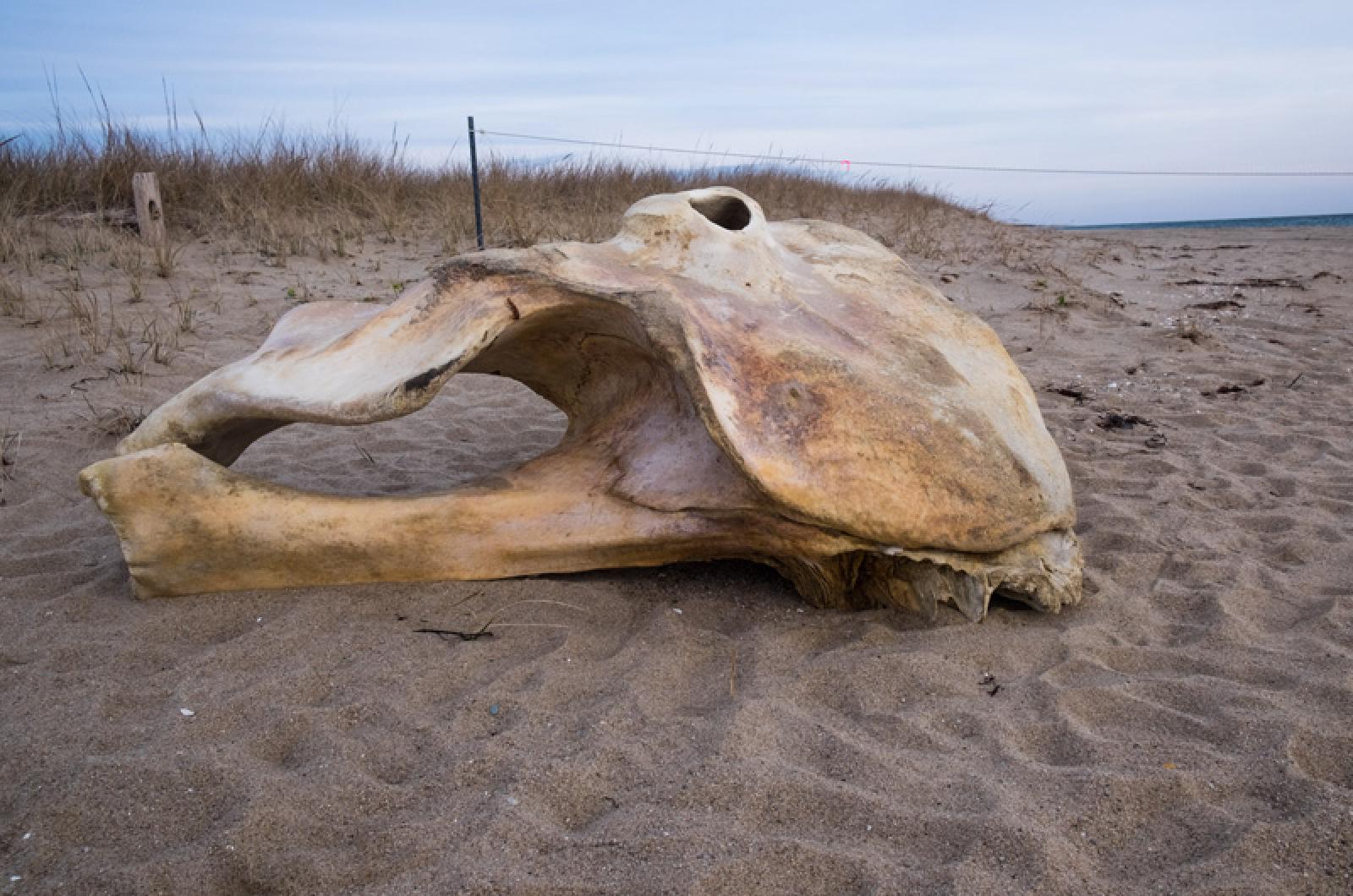
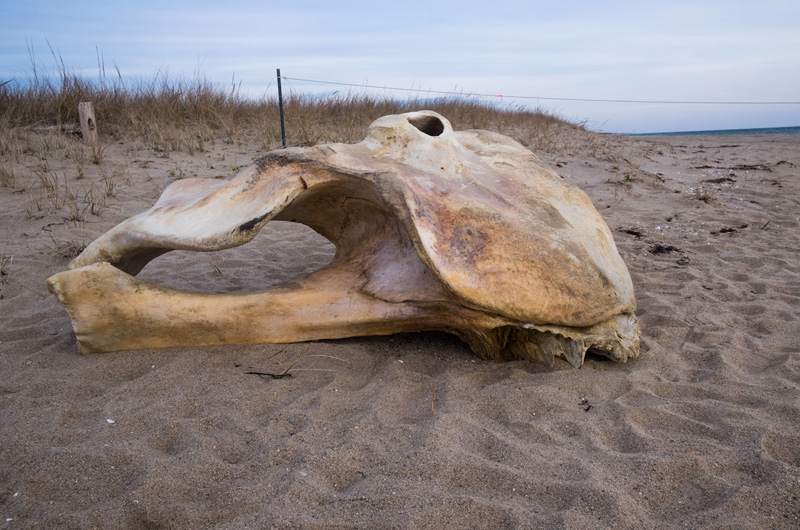
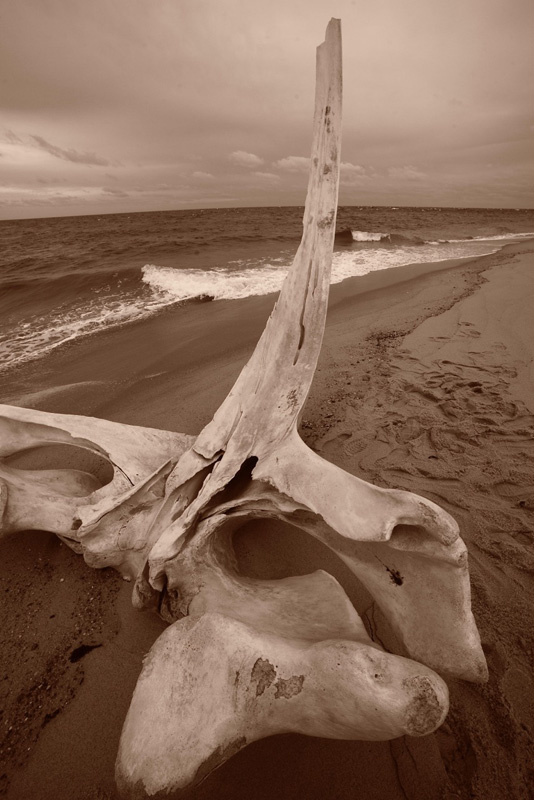
A clean white skull with labeled drill holes from examination by biologists is all that was left of the whale on the Vineyard this week. It is likely the 17th right whale found dead this year, officials said, offering more tangible evidence of an alarming story playing out far from sight beneath the ocean surface and adding urgency to the search for solutions.
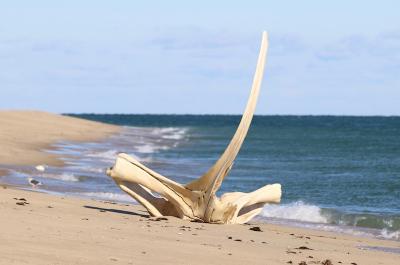
Right whale washed ashore at Norton Point earlier this month.
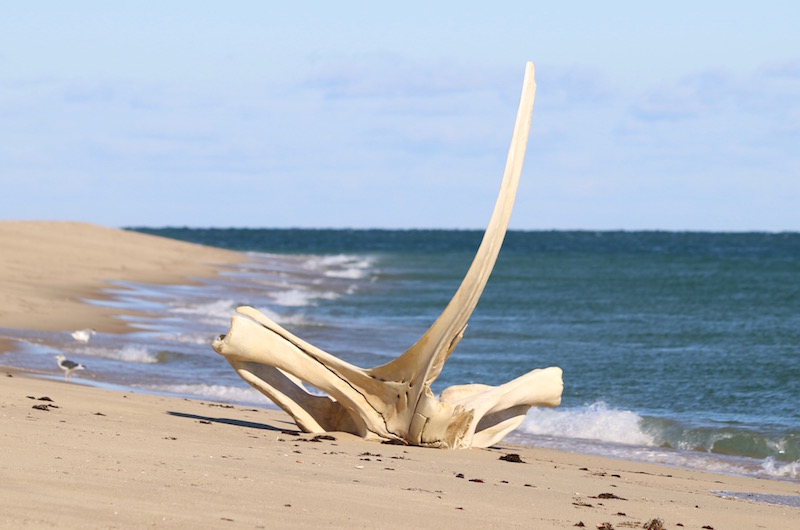
Right whale washed ashore at Norton Point earlier this month.
“At the rate right whales are dying, we could lose this species,” Mark Baumgartner, a scientist with the Woods Hole Oceanographic Institution (WHOI), said this week. He said the right whale population, which is now about 500 animals, “could reach a point at which it’s not viable to recover in just about 20 years.”
WHOI scientists came to the Island last Thursday to examine the most recently discovered right whale carcass. The whale washed ashore at Norton Point in early November and slowly migrated in the surf to East Beach.
Trustees of Reservations Martha’s Vineyard superintendent Chris Kennedy said it appeared the whale had been floating around for awhile before it washed up on the Vineyard.
“At first glance, it was really difficult to tell just what it was, other than it was a whale,” he said. “Really nothing but blubber, some bones, and primarily the skull.”
Part of a right whale washed up at Madaket Harbor on Nantucket the last weekend of November. Scientists suspect that a portion of the whale that washed up on Chappaquiddick floated over to Nantucket and the two discoveries are the same whale.

Unusually high mortality rate has triggered a federal investigation.
Unusually high mortality rate has triggered a federal investigation.
WHOI biologist Michael Moore, one of the scientists who came to the Vineyard to examine the whale, said the timing, photos, and a close look at the blubber coat indicate they are the same whale.
“One whale in two places,” he said. “I’d be very surprised that it’s not the same.”
The scientists measured the whale skull to confirm it was an adult right whale, and took skull, bone, and tissue samples. The DNA will help confirm the one whale, two places theory, and also tell scientists more about the whale, which was too decomposed for iden tification. Most of the live right whale population has been biopsied and identified.
Mr. Moore said DNA analysis takes a few months.
The whale was also too decomposed for scientists to identify why it died.
“Basically it’s confirmation of another death,” Mr. Moore said, though there is a chance the whale had already been seen and identified as it floated around the ocean. “Getting an accurate handle on the mortality rate is really important,” he said. “Diagnosis about why the animal died . . . helps to try to avoid the future mortalities.”
North Atlantic right whales are the Massachusetts state marine mammal. They spend winters in warmer water off the southeastern United States before migrating north in the spring and summer, when they feed on plankton off New England and eastern Canada. They are dark gray with no dorsal fin and distinctive callosities on their heads. They weigh up to 79 tons and measure 50 feet long.
“This is an iconic animal in our area that we could lose, not just in your kids’ lifetime, but in our lifetime,” said Mr. Baumgartner, the WHOI scientist who is also the leader of the North Atlantic Right Whale Consortium.
Mr. Baumgartner said the whales found dead this year have made clear to the public what scientists had already known about the uncertain fate of right whales. Earlier this year NOAA fisheries declared the number of deaths an unusual mortality event, triggering a formal investigation by federal scientists.
“The deaths over the last year is really just a wake-up call, not to the scientists, but to everyone else, that it’s a real problem,” Mr. Baumgartner said.
Whale skull is now secured on the beach by the Dike Bridge; the Trustees hopes to keep it for educational use.
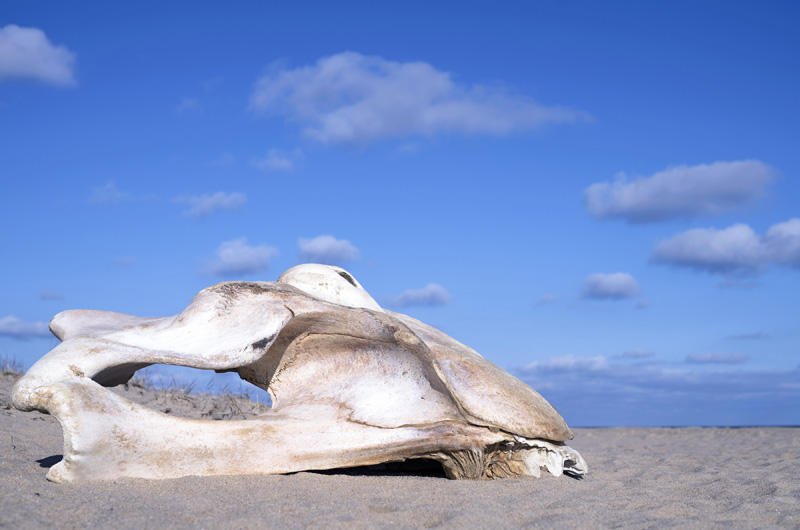
Whale skull is now secured on the beach by the Dike Bridge; the Trustees hopes to keep it for educational use.
Two other right whales were found on or near the Vineyard: one in August in the Edgartown Great Pond and another in October on Nashawena island.
Newborn or young of the year whales can die from natural causes, he said, while juvenile and adult whales found dead have been killed by humans. The two causes are ship strikes and fishing gear entanglement.
Non-lethal gear entanglements also take a toll. Dragging fishing gear around makes it harder for whales to move and feed. To conserve energy, Mr. Moore said, they are less likely to get pregnant or bring a calf to term, a grave concern for a species with an estimated 186 total females in the population, scientists said.
Mr. Baumgartner said whales that have been entangled often suffer from gruesome injuries. “It is a really difficult thing to view,” he said.
Vessel speed restrictions have been in place in areas where the whales congregate in an effort to reduce ship strikes.
Fishing gear entanglements are trickier to avoid, Mr. Baumgartner said. Scientists are looking at a range of available solutions. One is completely closing areas to fishing when right whales are present, an unpopular option that would be difficult to implement across the whales’ range.
More likely solutions focus on the primary problem, fishing rope. “Whales don’t get entangled in traps and floats.” Mr. Baumgartner said.
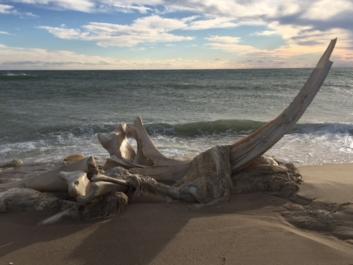
It is against the law to remove pieces of right whales, an endangered species, from the beach.
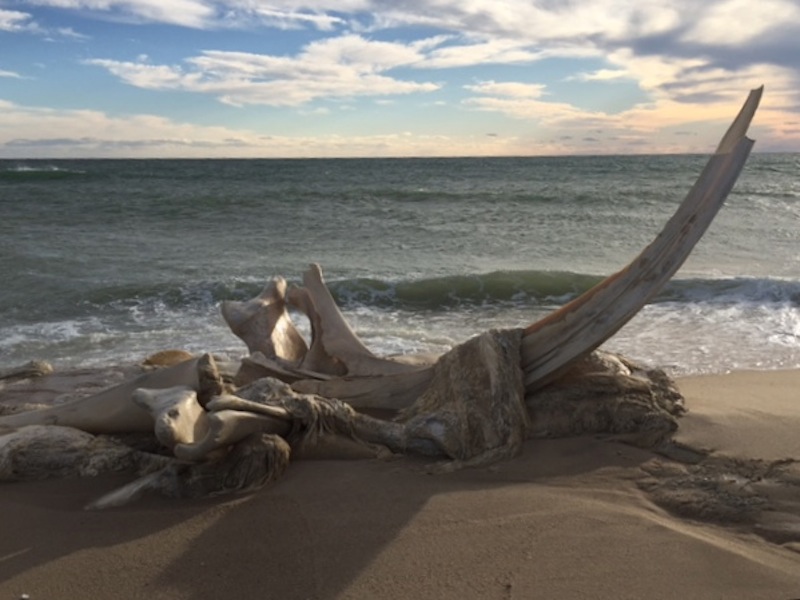
It is against the law to remove pieces of right whales, an endangered species, from the beach.
Reducing the strength of fishing rope would allow entangled whales to break free more easily. New technology adopted in the 1990s strengthened fishing rope, he said. Before then, “we didn’t see the kinds of severe entanglement that we see today that leads to death.”
“Today whales get into rope and can’t get out of it,” he added.
Mr. Baumgartner said he sees the ultimate solution as taking rope out of fishing entirely. Scientists at Woods Hole and elsewhere are working on technology that allows fishermen to put things like lobster traps on the ocean floor and get them back using acoustic devices instead of a single rope.
The next steps in this effort would include demonstrating the technology to fishermen and regulators, and then getting fishermen involved in an experimental fishery. Getting rid of ropes would also benefit other species that are often entangled, he said, like humpback, minke and sei whales, basking sharks, and leatherback turtles.
“Let fishermen do what they do best, which is to innovate how to make the equipment easier to use, cheaper to use, more effective,” Mr. Baumgartner said. If the technology is found to be viable at each step, then it would be time to look to the rest of the industry, he said.
Scientists will also look for funding, including from private foundations. A lot of the technology has already been developed, he said, but the government might be slow to jump on board because it is relatively new technology.
“I often say the time to do something about the species is now,” Mr. Baumgartner said. “We can’t wait five or 10 years to start making progress on this. This species doesn’t have that time. In 20 years time the species could be essentially gone.”
This week the right whale skull was on display on Chappy, secured with a metal chain in the sand on the beach by the Dike Bridge. Assistant stewardship manager Antone Lima said the skull has been a popular attraction. He said the Trustees have submitted a request to NOAA to keep the skull and part of the whale’s mandible (recovered by the Trustees) for display at the Mytoi garden ranger station. Mr. Lima said the whale parts would be used along for educational programs and an interpretive information panel would be on display for visitors.
Mr. Baumgartner said this whale, and others that have washed up, are a reminder of an ecological concern that is often out of sight and out of mind.
“Most people never get to see a right whale,” he said. “I think having that visual, going down and seeing that animal, is really one step closer to understanding what is going on with these species.”
“A lot of endangered species stories are very sad, and often lack viable solutions,” he added, but noted there are some options on the table for right whales. “That to me is hopeful. That gives me hope for the species.”
Comments
For about 30 years I've
Ginny WTFor about 30 years I've sported a RW license plate in the hopes that the meager fees might help bring the right whales back from the brink of extinction. Unfortunately I don't think it is going to happen. If this year's rate of deaths continues we will see Atlantic Right Whales disappear from the earth in our life time. We seem to be wiping out African and Indian elephants and other large mammals as well. What tragic scenarios.
What is the Marthas Vineyard
Leo D. Chilmark sometimesWhat is the Marthas Vineyard Fishermen Trust response to this article? They asked for support ($) in the comments last week in an article written by the gazette on fishing. I wonder what they say about this? What are our local lobstermen doing or at least thinking about doing in response to this? Are our fishermen leading on this effort or possible contributing to it? As a community we deserve answers and if they aren’t leading we should encourage and support them to take the necessary steps to help reduce any and all whale deaths.
So the question is WHY. We
Martha MageeSo the question is WHY. We saw them breaching at Narragansett Beach at Summer Solstice time. It was magical!
You didn’t see a right whale
Doug PlymouthYou didn’t see a right whale breach
So sad to read this. What can
Thomas J Bena ChilmarkSo sad to read this. What can citizens do to help?
Hold fishermen accountable.
Leo DHold fishermen accountable.
I agree - we need to hold
Carol formerly ChilmarkI agree - we need to hold fishermen accountable. The ship strikes come from not paying attention (or caring) where the whales are. The Coast Guard is supposed to be enforcing the Marine Mammal Protection Act of 1972, which requires that ships stay 500 yards away from whales. Call your state reps AND both US Senators AND Congressman Bill Keating(508) 771-0666 - tell them you want the Coast Guard to ENFORCE The MMPA of 1972!
I recall in the late eighties
RT WTI recall in the late eighties there was a salty looking guy(part of an organization) with a table set up at Fanueil Hall in Boston, looking for donations to save the Right whale. At that time he said the population cannot recover, and that there were only about 300. Not judging, but do you think his numbers were just off, or is it possible 300 was a low count, and there were actually more back then.
In the eighties, 300 was a
Jo-Ann Taylor West TisburyIn the eighties, 300 was a widely held estimate. At the time, there was concern that the chances of mating were slight, and that they were already functionally extinct. Instead, they persisted; and the population rose to about 600. Sadly, the local spike in mortality could signal decline.
With all due respect, the
Arthur Richardson New BedfordWith all due respect, the main reason the Right Whale is in such perilous shape is from the high volume whale industry harvesting that took place in New England up until the early 20th C. They called it the Right Whale because it was the right (correct) whale to hunt for its oil and other materials. They were harvested by the 1,000s a year.
The whale industry led to an economic boom on Martha's Vineyard, so it makes it a complicated issue. Edgartown would not be how it is today without whaling.
Blaming the fishermen is a bit short sighted. Admittedly, I would like to know how whale avoidance is being encouraged on fishermen.
How does pollution/warming waters effect the whales?
Do they have access to historical prey?
Thank you. This is the
Alfred MAThank you. This is the elephant (or whale) in the room everyone is missing! The world ran on whale oil! Thats where they all went. Sad but true.
Once they are known, the
EPR ChilmarkOnce they are known, the coordinates of the position of right whales are broadcast on the NOAA weather radio bands, warning mariners and fishermen where the whales are and reminding everyone of the laws. Even so, ship strikes often occur. The problems are at least two-fold. First, the whales often rest very near the surface, and because they have no dorsal fin, they are often invisible. Second, right whales travel, feed, and congregate in their "traditional waters", routes and locales imprinted in their DNA by many years of habit. Those traditional waters include Buzzards Bay, Vineyard Sound, Nantucket Sound, Cape Cod Bay, and the east side of Cape Cod. These waters are not only frequented by commercial fishing boats, they are used by all kinds of shipping companies, involving huge tankers and container ships. The whales cannot change the waters they frequent as easily as ships can alter their course.
Add new comment