


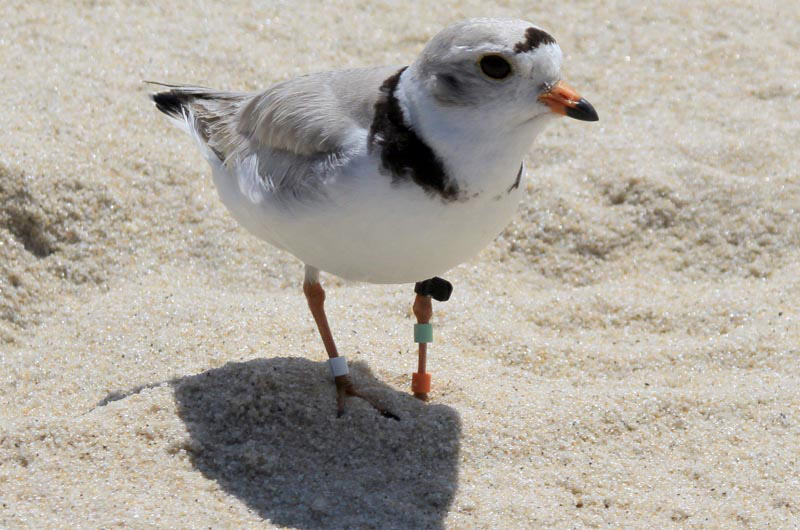
After a summer of tension over beach closures to vehicles to protect nesting shorebirds, Vineyard fishermen weighed in with concerns.
After a summer of tension over beach closures to vehicles to protect nesting shorebirds, Vineyard fishermen said this week that new measures designed to increase vehicle access did little to ease their concerns.
“There are storm clouds on the horizon, I don’t have to tell you that,” said Cooper Gilkes 3rd, longtime owner of Coop’s Bait and Tackle, at a meeting Wednesday called to discuss shorebird regulations. “People have waited 17 years [for beaches to reopen]. I remember the first meeting I attended and they told us maybe three years. That was 17 years ago.
“How much is that bird worth? Period. From Maine to Florida,” he added.
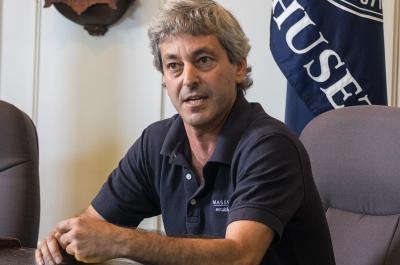
Jonathan Regosin, chief scientist of endangered species at Mass Wildlife.
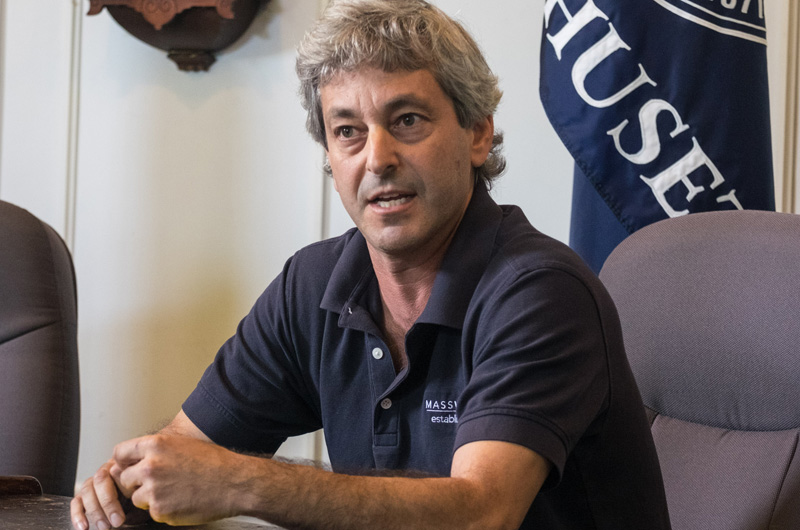
Jonathan Regosin, chief scientist of endangered species at Mass Wildlife.
The meeting was called by The Trustees of Reservations, which owns or manages most of the beaches on Chappaquiddick, including at Cape Pogue, Wasque and Norton Point. All are popular spots for fishing and recreational beachgoers. State and federal officials who attended the meeting outlined recovery goals for shorebird species that raise their young on barrier beaches, including American oystercatchers, terns and piping plovers.
Under state and federal law, many barrier beaches are closed to vehicles to protect nesting shorebirds. The closures take place from roughly late May into July, depending on when the birds nest and fledge.
This year Norton Point, which connects Chappy to Edgartown along the southern end of Katama Bay, was closed to vehicles from July 1 to July 23.
“Obviously this year in particular there have been a lot of questions raised as far as the amount of beach that’s been closed,” Trustees Vineyard superintendent Chris Kennedy told about 25 people gathered at the Edgartown town hall. “We figured this would be an ideal time for us to have a discussion with all of you to talk a little bit about what are the plans for next year.”
Susi von Oettingen, an endangered species biologist with the U.S. Fish and Wildlife Service New England office, said shorebird recovery has seen mixed success so far.
Recovery goals for piping plovers include maintaining a population of 2,000 breeding pairs for five years across the entire Atlantic range, from Canada to North Carolina, and reaching a five-year average of 1.5 fledglings per pair.
New England has been more successful than other areas with 625 breeding pairs, Ms. Oettingen said. No areas have met the productivity goal for chicks.
Trustees ecology assistant Caitlin Borck said there were 17 breeding pairs of piping plovers on Trustees properties this year with 11 fledglings, a low number. Nests were lost to predators like skunks, gulls, crows and rats, overwash from storm surges and abandonment.

Chappaquiddick resident Bob Clay (center) said people matter too.

Chappaquiddick resident Bob Clay (center) said people matter too.
Over the past five years, the average number of piping plover pairs has stayed steady at 17, Ms. Borck said, though productivity has declined. The 10-year trend is slightly better.
Jonathan Regosin, chief scientist with the endangered species program at Mass Wildlife, said beach protections have made a difference and allowed species to recover, in turn allowing him to work with other agencies on a conservation habitat plan that would relax some of the rules.
“As numbers go up, it seems like [areas are] penalized for doing a good thing,” Mr. Regosin said, noting that more nesting shorebirds often means more restrictions.
“There’s a threat of losing community support for these protections,” he said. “So we take a step back and see if we can make some changes, at least at the margins.”
New options, with permits and the right conditions, include allowing people to drive past unfledged chicks. Towns or organizations like the Trustees can apply to participate in the program.
“Our goal, believe it or not, has been to simultaneously advance piping plovers and increase recreational opportunities,” Mr. Regosin said.
Permits would allow over-sand vehicles near unfledged chicks provided an escort accompanies a vehicle or a caravan, he said. There are also self-escort options.
Allowing this kind of beach activity would require a bird monitor to watch the chicks, and driving can only take place six hours a day, officials said.
The strict requirements require money and staffing. “There are real costs involved, but real benefits,” Mr. Regosin said. “I think it’s toned down some of the rhetoric around the issue.”
Mr. Kennedy said the Trustees have received three-year permits for two areas on Chappy, one near the narrows at Cape Pogue and the other at the south end of Leland Beach. The Trustees could allow escorted beach access, he said, at a cost of about $40,000 a year for additional staff, vehicles and radio equipment.

Susi von Oettingen, biologist with U.S. Fish and Wildlife service.
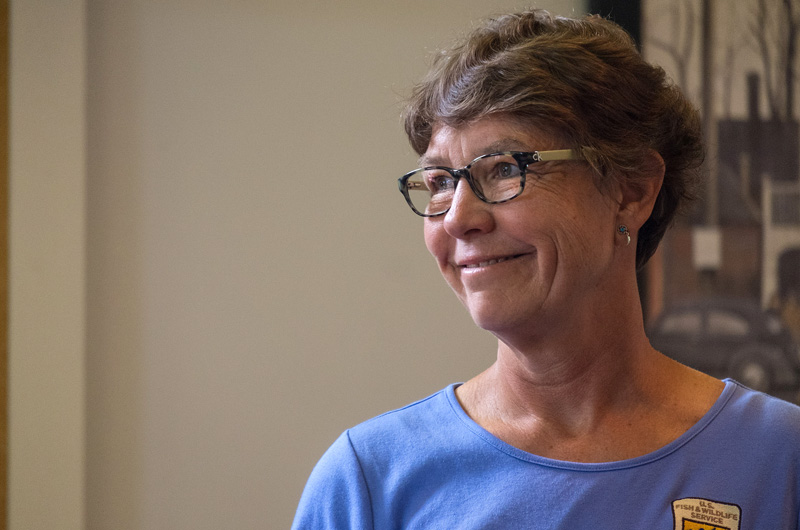
Susi von Oettingen, biologist with U.S. Fish and Wildlife service.
Meanwhile, he noted the vehicle restrictions have had an impact on Trustees revenue from the sale of over-sand vehicle permits. “We felt it. Our permit sales went from several thousand dollars a day to zippo, overnight,” Mr. Kennedy said. “We lost our revenue for the month of July.”
The Trustees must decide before next year whether to adopt the access-by-permit program because of the planning involved — although no can say for sure from year to year where the birds will nest or what the conditions will be.
“There’s no surefire plan here,” Mr. Kennedy said. “We can’t say with complete assurance that if we implement a certificate of inclusion, bump up your permit by $20, that would guarantee complete access.”
He continued: “The question today is how you feel, is this something you feel is worthwhile or not. This year . . . we chose a wait and see attitude, but we do have this option . . . it’s now September, we have plenty of time to implement this getting ready for next summer.”
Fishermen who attended the meeting were quick to say the plan was not enough.
Chappaquiddick resident Bob Clay said escorted cars or caravans wouldn’t work. “We have families that are coming here with four, five-year-old grandchildren,” he said. “The federal and state government has disregarded human beings as being an important part of the habitat,” he added. “People in this room could talk for hours about all the things that have gone wrong.”

Roseate terns in their nesting habitat.
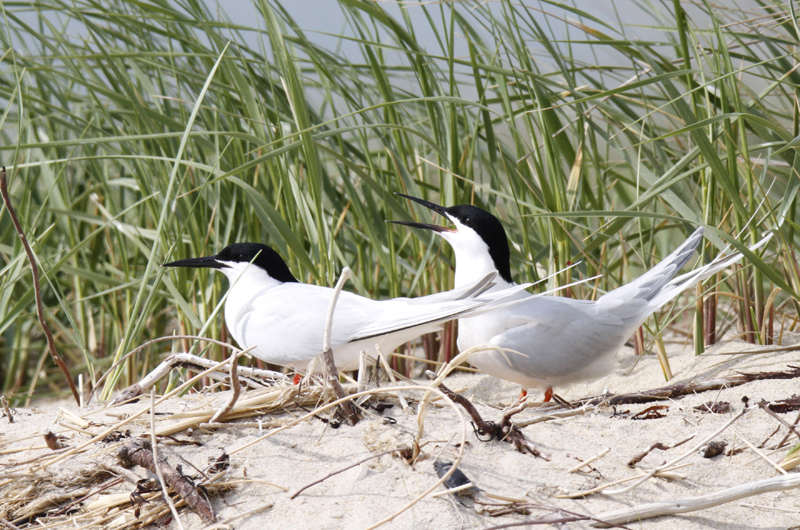
Roseate terns in their nesting habitat.
His wife Fran Clay said the situation has led to “frustrated, angry people who used to live here and left, and people who don’t rent anymore because of the months that the beaches are closed. It’s really a terrible situation that comes from the top, not from all of you. It’s so impossible.”
Martha’s Vineyard Surfcasters Association president Don Scarpone said the hours the beach would be open to escorted traffic, likely between 10 a.m. to 4 p.m., were not ideal for fishermen. “That’s not going to help us,” he said.
Others questioned the success of the program as a whole.
“How much damage is the over-sand vehicle truly going to cause,” said Maine fisherman Ron McKee, who is on the Island to fish the derby. “The economic blowback from this has been increasing coastwide, year by year.”
He added: “How about making a situation that works . . . I’m in favor of conservation, but I’m not in favor of stupid conservation.”
“We’ve heard the frustrations,” said Chappaquiddick resident Woody Filley, who moderated the meeting. He said the next steps are to follow up and suggest changes that work for everybody.
Surfcaster Ron Domurat suggested a wider survey about the new program, but felt the consensus in the room was clear. “It’s not going to do us any good at all,” he said.
Comments
Lets face it. South Beach
Long Time Resident KatamaLets face it. South Beach will be closed again because of the Plovers or worse yet another breach form a storm. Each year its getting smaller and smaller.
And keeping families in boats
Ric Smith EdgartownAnd keeping families in boats from sitting on the shore along Cape Pogue is crazy. If the birds will die due to people walking along the shore they won't survive anyway!
Balance not hyper conservation is the key.
I am so fed up with the
Edward Spalding EdgartownI am so fed up with the Trustees. I haven’t paid my annual dues and have no intention of doing so in the foreseeable future and I will still have access to the desired Trustee beaches.
I have no children and I am in the estate planning phase; I have removed the Trustees from the list of candidates.
The organization has gotten too big with too little oversite from the communities with which they are involved. Maybe it’s time to write our legislative representatives.
All they seem to be interested in is how much money they can make, vehicular traffic being a prime example. It should all be banned. South Beach is pathetic and it’s only a matter of time before trucks are parked side to side all the way to the Wasque. Maybe it should be re-named Coney Island North. The best thing that could happen would be for a new permanent breach to occur making and keeping Chappie an island.
What the Trustees don’t bother to mention that is probably the biggest inhibitor to producing PP is that a large number of the nests and no doubt hatchlings get wiped out by ‘storm’ tides; it doesn’t take much of a blow for water to wash over large portions of Pogue. The beaches are so lacking in depth that again with high tides and/or a modest blow water frequently reaches the dunes. In all probability even if all people and vehicles were prohibited on these beach areas the PP population would likely continue to fall. Certainly these beaches will never make a significant contribution to the PP recovery effort.
I have been coming here for longer than the Trustees have been in existence. This year I brought some guests to Pogue for a picnic. With an ebbing tide we set up close to the water to be out of the way of vehicles and PP. That didn’t stop the Trustees from tossing us out.
I know the chicks can be difficult to see but people on foot would have to be all but blind. It seems to me the first issue is to have two sets of rules recognizing the distinction between pedestrian traffic and over the sand vehicles. Do I really need to suggest this to the Trustees?
I have been coming to these beaches for 50 years. I was very much in support of the various conservation groups formed in the 70’s. Like one responder said, ‘I am in favor of conservation but not stupid conservation’ or ‘Balance not hyper conservation is the key’.
To Long Time Resident – The Trustees and vehicle owners don’t have the market cornered on idiots. With regards to dogs on leashes, I have pictures of trucks with dogs NOT on leashes and I could take more pictures, any day, at any time.
FYI, the root of the problem for all environmental issues is the number of people on this planet. How many have you and yours added?
Love Diane’s comment, Edgartown beaches for Edgartown, like the rest of the island. BTW when is State Beach closed? I didn’t see any enforcement there, or the beaches in front of all the waterfront homes.
Like Paul Condlin’s comment.
i am in favor of prohibiting
vincent Katama Point Edgartowni am in favor of prohibiting all vehicular traffic on Norton Point-there is almost no beach left-something no one talks about
Not mentioned in this article
William EdgNot mentioned in this article was that for the first time ever Cape Poge (The Gut) beaches were closed to boaters for almost all summer in July and August.
The rules as stated by the Trustees were bizarre. You were allowed to walk on the beach, but, not if you arrived by boat.? There were at least two patrol vehicles enforcing the rule all summer.
To be clear, boaters were not allowed to anchor a few yards off the beach in water that - the Trustees do not own or have any right to control - and heaven forbid dare to wade in to access the beach.
It is my understanding the Trustees are planning to close the Gut to boaters next year as well. It would be nice if a compromise could be found. After all a boat is not a danger to nesting birds.
Dogs are. No one ever leashes their dog on the beach. It is counter intuitive to dog owners. Prohibit dogs not people. That sounds like a pretty good compromise solution to me.
Dogs have not been permitted
Long Time Resident Vineyard HavenDogs have not been permitted on the beach without a leash. I'm not sure where you got that idea from, but the Trustees clearly stated that dogs are a threat to the birds and were not permitted on the beach without a leash. And you were allowed to walk on the beach, the problem is that too many boaters don't just want to walk on the beach. They want to sit down, put their umbrellas up, kick back in their chairs and let their dogs and children run around. The Trustees have limited resources and are doing what they can to open the beach to recreational use. This whole article was about just that; what the Trustees is trying to do to find a good compromise solution. You have to remember that access to Trustees properties is a privileged not a right. And while it sucks for everyone that the beaches are closed, The Trustees of Reservations is a wildlife refuge FIRST not a recreation center. They do their best to mitigate bird protection and public access, there's no need to make it any harder for them.
FYI- Cape Poge was closed
William Edg.FYI- Cape Poge was closed frome late June until late August the day after after two dogs were found unleashed and running through the bushes by a Trustees patrol.
The Trustees is not a
Jody Coker Vineyard HavenThe Trustees is not a wildlife preservation first. Their mission statement, from their website is "The Trustees of Reservations preserve, for public use and enjoyment, properties of exceptional scenic, historic, and ecological value in Massachusetts." Cape Poge is a wildlife refuge, Wasque is a "salt-water angler's paradise."
Let's Not kill some rare
Up Islander West tisburyLet's Not kill some rare birds, just to go kill some fish.With every species we loose,it gets closer to us.All species are important,and have a value.
It's time to think out of the
Ray Drop EdgartownIt's time to think out of the box here. First, I understand predators account for roughly 80% of fatalities. Let's start with coming up with a game plan for protection from predators more original that wire cages. Second, partner with a college to offer internships for students majoring in Marine Biology to spend 6 weeks, 24/7 getting college credit for studying/protecting Plovers in the summer. Interns plus beach equipment should cost less than 40k.
Third, open the beaches, 24/7 to vehicles for one year to assess the impact on the remaining 20% limit speed to 10 mph for vehicles. Lastly, attach an educational brochure to all permits to inform drivers of changes. Fees are high enough already. Let's get more bang for the buck not more fees.
This is an absolutely awful
Long Time Resident Vineyard HavenThis is an absolutely awful plan. First, enclosures are one of the few reasons that their are any birds AT ALL still alive. Second, the Trustees already hires interns through their CSEP program. Third, who's going to pay for $40,000 worth of equipment and what equipment would that even be? There's no save-all equipment solution that will protect these birds, it's public commitment that saves the birds. And finally, you must me out of your mind... Open the beaches to see how many birds are killed? Are you serious??? What kind of solution is that?
An educational brochure is an awesome idea, to let the public know why the beaches need to be closed during certain times of the year to protect the birds. And fees are high because you are paying for the maintenance and up-keep of the wildlife refuge that comes along with letting humans trash the beaches.
You have to remember that the Trustee's are a wildlife conservation refuge. Their organizational goal is to PROTECT wildlife. Beach access is a privileged not a right.
Well the TTOR takes over $300
Paulli D EdgartownWell the TTOR takes over $300 per car for the combined OSV passes, and we have the nice gentlemen just sitting around. Maybe they can be the escorts and do something? TTOR taking our money and then closing the beaches is not the right approach if they want to gain support. As Ms Clay states, if the beaches remain closed, MV will soon lose many visitors and renters.
Why not trap the skunks and
deshandra brown edgWhy not trap the skunks and other predators that kill these birds and eat the eggs?
Finally something you write
Island Resident On IslandFinally something you write that I agree with
Edgartown take back the beach
diane edgartownEdgartown take back the beach from the Trustees. There seems to be a lot of plovers. STOP the day passes. Tell the rest of the island to open their beaches to the public......Let's make South Beach a private Beach for Edgartown residents and their guest....There you go...less traffic....Protection for everyone...
Sadly it's not that easy. The
Long Time Resident Vineyard HavenSadly it's not that easy. The Trustees OWN the property and are doing everything in their power to mitigate access to the beaches. As I've said above, beach access is a privileged not a right. The wildlife comes FIRST.
And no, there are actually almost no plovers. The species is nearly extinct. New England is one of the few places with remaining plovers. So while it may seem like a lot, you have to remember that the 600 plover pairs in New England is an ENORMOUS portion of the global plover population.
I agree with you, opening other beaches to vehicle access would be tremendously helpful in mitigating public access to beaches and protection of the plovers. You have a right as a citizen of Edgartown to relay your concerns to the Board of Selectmen and other town officials to open South Beach to vehicle access. If there are enough people that care about driving on the beaches, and are willing to pay the increased tax for the town to maintain it, then you have the answer to your solution. That's how democracy works.
My family and I really enjoy
Frequent Visitor CentralMAMy family and I really enjoy driving our pickup on the beaches at the Vineyard. We have been driving our truck on the beach for a number of years now. This year as usual, we bought a season pass over Memorial Day weekend for both Chappy and Norton point, the total cost was close to $400. When we came back in July for a two week vacation, if we could get on the beach at all, it was restricted to a very small section of either beach. It seemed like a far larger area of the beach was restricted this year compared with the past years. My wife and I felt like we had been ripped off. When we bought the pass early in the season there was no warning by Trustee employees that the beaches would be effectively closed to traffic all of July. If its true that 80% of the bird fatalities are due to predators it seems silly to restrict traffic so, control the predators. Trustees please think outside the box here...like what if you bought another piece of land somewhere else on the island or on Nantucket or one of the Elizabeth Islands and use it to nest the birds and paid for it with increased over-sand beach permit fees.
Death to the skunks !!!
John At seaDeath to the skunks !!!
Everyone is looking for
Paul Condlin EdgartownEveryone is looking for answers in the wrong place. Just look at the current state regulations. The Feds relaxed the old standards because the target number of plovers established more than 20 years ago came to fruition. Check out how Plymouth or Orleans achieved in their Norton Point. The Trustees failed in my opinion. As well as the Town of Edgartown and the County of Dukes County. Get you heads out of the sand.
Do plovers only nest on
John Somewhere-In-The-MiddleDo plovers only nest on public beach areas? Are privately "owned" beach areas, which comprise the majority of water frontage on the island, subject to the same rules and restrictions as the public beach areas? I think not. And, since plovers can probably not read all those signs that say "Private Beach", "No Trespassing", or "Access Forbidden", my guess is that large numbers of plovers are nesting on those privately "owned" beach areas, where their nests are trampled under tires or under feet or are plundered by free-running dogs and other predators.
Perhaps it is time to extend those restrictions to all privately "owned" beaches (if they are not already). Large additional numbers of plovers would be saved, multiplying their numbers in a shorter time, and just maybe make it possible to lift restrictions in general, island-wide.....
Add new comment