


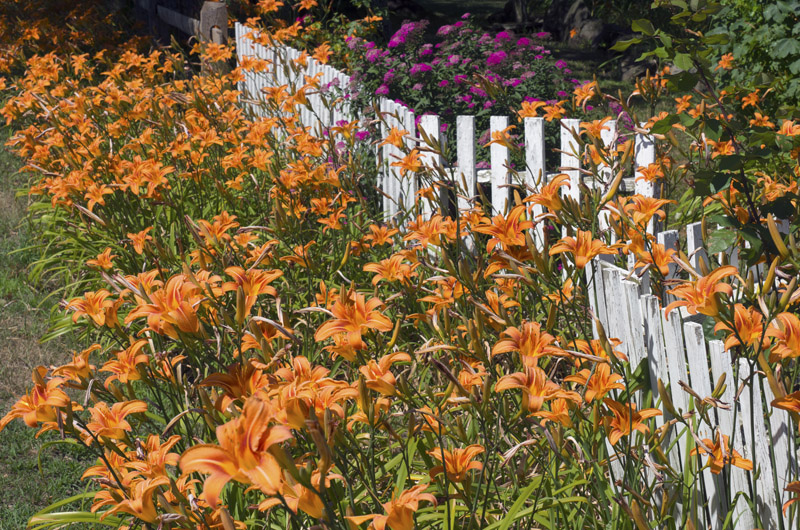
It is the season of orange lilies up-Island and down.
It is the season of orange lilies up-Island and down. Sometimes they edge gardens; sometimes they edge roadsides, but wherever they are, their bright orange lights up the landscape. Rambler roses and spotted orange tiger lilies escaped from gardens were the first flowers I took note of in my childhood.
I remember there was a valley of tiger lilies — or so it seemed to me when I was small — on the Downs that I crossed to go into Oak Bluffs from my great-grandfather’s house on Arlington avenue in the Highlands. It seems quaint to me now that eight decades ago we talked of the East Chop Highlands and the Downs that led down to Oak Bluffs in terms that described the English landscape. But all that was beyond my ken in those days. All I knew was that it was an exciting adventure to cross the Downs to reach the harbor, and en route pass by the valley of tiger lilies.
There were blueberries and huckleberries to be picked on the Downs too, but those grew elsewhere, as well. The tiger lilies were something different. They were nowhere else then. Perhaps they were up-Island, but all I knew of up-Island was that Menemsha and the Gay Head Cliffs were there (and peach ice cream to be had on the way, made from cream produced by a cow that lived under a big tree in North Tisbury).
The Downs in those days were a wooded, hilly area, unlike English Downs. I am told, however, that when the East Chop Downs were named, they were not wooded either.
The Downs extended from Arlington avenue to the harbor and were edged by Massachusetts avenue. There the fragrant pink rambler roses tumbled over the stone walls of the Seeberger property. Charles Seeberger had been important in the invention of the escalator in the 1890s. The invention allowed him to have a sprawling property with a main house and a guest house and trees that I dreamed of sitting under to read books when I grew up and had managed to become the owner of those houses and that land.
Until then, I was quite satisfied simply to walk over the Downs into town. In those days, there were no houses on the Downs — only the pine and scrub oak woods and an occasional mossy clearing that made fine picnic spots. There were one or two dirt roads and paths to follow, but that was all. At the intersection of two roads there, I remember I buried a dead bird in a cigar box. I am not sure why now the burial had to be at a crossroads, but at the time it was important to me.
Once I had passed the tiger lily valley, I was quite close to the harbor. Then there was the riprap along the harborfront where motor yachts tie up now. I would leap from rock to rock, past the Wesley House with the big W on its top. Today the W that sailors used to guide them into the harbor is gone, and the evangelist John Wesley, the founder of Methodism and the inspiration for the Camp Ground, has been mostly forgotten. The Wesley House has been renamed Summercamp.
I would make my way up Circuit avenue past Darling’s Old Popcorn Store and pause briefly to watch the taffy pulling machine, perhaps buy a pink wintergreen or a brown chocolate popcorn bar before making my way to my destination — the Oak Bluffs Public Library. There, there were wondrous books to be borrowed. I particularly liked the Little Girl of Old Provincetown series, and the Little Colonel series in pink bindings. Also there were Don Studley adventure travel stories. I have often wondered if it was Don Studley’s adventures in exotic lands that led me as an adult to extensive travels in what have sometimes been strange places. Finally, with an armload of books, I would head happily back on my harbor rock route, then over the Downs and past the tiger lily valley to Mon Repos, my great-grandfather, Jean Baptiste Meras’s house with red-shingled siding. He had built it in the 1890s when the Summer Institute on the Highlands offered courses to summer visitors with a yearning for knowledge. He had been invited to the Vineyard to teach French at the institute.
In this tiger lily season, memories of those simple Vineyard summers of long ago flood back. There’s ever so much more to do today on an Island summer vacation, but I wonder if those carefully choreographed and widely advertised events will be remembered so fondly eight decades from now as my East Chop walks across the unpeopled Downs.
Comments
This article contains many
Alma Ivor-Campbell Bristol RIThis article contains many things I like. First, it is by Phyllis Meras, who used to write for the Providence Journal, where I always read anything I saw with her name attached. Second, it is illustrated with a beautiful picture of orange day lilies (Hemerocallis} perhaps my favorite flower. And third, it is set in Martha's Vineyard. But, as often happens, she writes about tiger lilies, not day lilies. I have found that people who pick pictures of flowers to go with an article about flowers, seldom grab the correct picture!
The author's interesting
Judith Tankard BostonThe author's interesting piece confuses ordinary daylilies (Hemerocallis) with lilies (Lilium). There is no relationship between the two. The former grows on rhizomes and the latter from bulbs. Tiger lilies are pendulant and beautiful and much to be preferred over common, wild-growing orange daylilies. That said, there are hundreds of worthy varieties of daylilies available.
Oh my, I am confused. The
Kathleen Gainesville, FLOh my, I am confused. The writer's topic is a tiger lily because it is orange and is somewhat spotted. If I see this plant growing by the side of the road I think what a pretty Tiger Lily. Now the Image here on line in glorious color is just an orange plant that looks like a lily but I do not know what is underground, I think I would say, "what a lovely lily." Now, This picture, if it was indeed captured on the island and if the location in the caption was noted, I would be less confused. As I don't see spots on the orage part I guess it is not a tiger lily. Futhermore, the writer speaks of a memory and perhaps there are fewer Tiger lilies on the island today--- and the orange plant identified more percisely by a commet-tor is what one sees in abundance when visiting the island. In any event, this discussion needs intervention by the editor-- was the image published captured on MV? What kind of plant is it for sure. And Does the Tiger Lily grow on Martha's Vineyard any more? Inquiring Minds want to Know thank you.
Phyllis, Jean Baptiste Méras
Nathan Isler Azusa, CaliforniaPhyllis, Jean Baptiste Méras was my Great Great Great Grandfather. I am descended through his daughter Jeanne Méras who married Maurice Jewell. Maurice was a Principal in Queens, NYC. I did a Google search and I came upon this article. It is my hope to connect with you somehow. I would very much like to learn more about my extended family. Thanks!
I would be glad to hear from
Phyllis Meras West TisburyI would be glad to hear from you. If you would like any family information I have, my address is PO Box 215 West Tisbury, MA 02575.
Add new comment