



<p>Mill Brook has been the topic of intense study and debate in recent years, much of it focused on Mill Pond. The freshwater river system provides some of the only cool-water fish habitat on the Vineyard.
On a bright afternoon last week, Bill Wilcox stood on a dirt road in Chilmark and peered through the foliage at a shallow impoundment near the headwaters of the Mill Brook. A few frogs could be heard croaking in the muddy water, which appeared nearly motionless in the afternoon sun.

Much study has focused on the Mill Pond.

Much study has focused on the Mill Pond.
“This thing probably right now is about as flush as it ever gets,” said Mr. Wilcox, an Island geologist and former water resource planner for the Martha’s Vineyard Commission who has been studying the brook since the early 2000s. He noted an especially wet spring this year, with almost nine inches of rain in May alone, and ten inches between March and April.
On the other side of the road, water spilled out of two metal pipes a few feet down, where the brook continues its three-mile journey through woods and farmlands in Chilmark and West Tisbury, forming seven artificial ponds and finally emptying into Town Cove, at the head of Tisbury Great Pond.
As with all the impoundments on Mill Brook, the one near the headwaters has long been a feature of the Island landscape. But at times during the year it also becomes lethal for cold-water fish species such as native brook trout, which can’t survive in water warmer than 70 degrees. Its broad, shallow surface acts like a solar collector, getting as warm as 90 degrees in the summer.
“Once you hit 90, you don’t have any trout in that stretch of the stream,” Mr. Wilcox said.
Mill Brook itself resembles many freshwater streams in New England. Even its name appears about 20 times on a list of freshwater streams in the state. But it also provides some of the only cool-water fish habitat on the Vineyard.

Priester's Pond in West Tisbury.
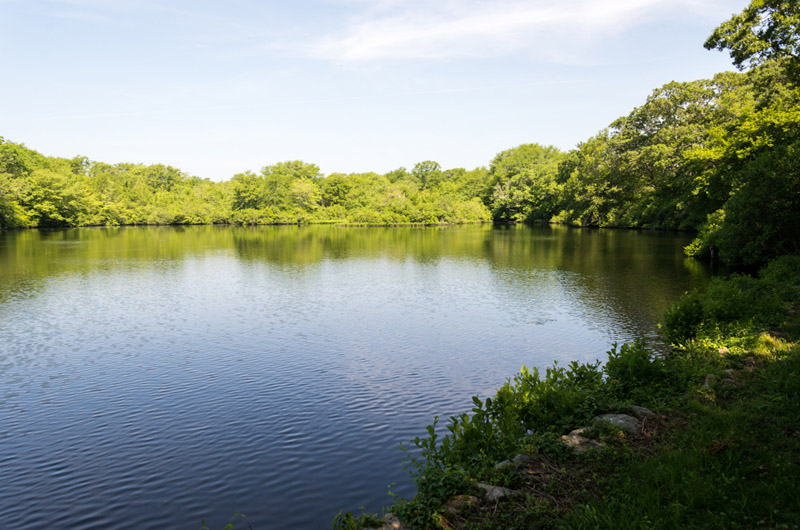
Priester's Pond in West Tisbury.
“There’s not that many sites like it that have that type of flow and that potential,” said Brad Chase, senior marine fisheries biologist at the state Division of Marine Fisheries who has been involved in Island discussions surrounding the brook for years. “It’s not a tidal-brackish situation. It’s truly a running stream that has groundwater contributions, and there’s not too many places like that on the Vineyard.”
Mill Brook has been the topic of intense study and debate in recent years, much of it focused on Mill Pond, a shallow impoundment just north of Town Cove. West Tisbury voters have twice approved funding for an extensive watershed study, but narrowly turned down a proposal in 2014 to dredge Mill Pond for the first time in more than 40 years.
More than two years in the making, the Mill Brook watershed study is now in its final stages, with a draft expected this summer. But many questions remain, including whether dredging would be the best way to manage excess vegetation and sediment in the pond.
Debate has cooled, so to speak, as the watershed study continues, but Mill Brook is as warm as ever. The average summer temperatures range from about 59 degrees above Fisher Pond on North Road, to about 75 degrees below Priester’s Pond at the intersection of North and State Roads, according to a temperature study funded by the Edey Foundation in 2014. Peak temperatures exceeded 85 degrees at Priester’s and Mill ponds, and at the small impoundment near the headwaters.
Steve Hurley, southeast fisheries manager for the state Division of Fisheries and Wildlife, has helped stock Mill Pond with up to 300 brook trout every year since 1990. The tradition began in 1968 and is a treasured part of life in West Tisbury, where families gather every spring to fish for trout in the pond. But the event also underscores the fact that Mill Brook’s trout population isn’t what it once was.
Mr. Hurley said the brook now supports perhaps a couple thousand brook trout, depending on the time of year, along with state-listed American brook Lamprey, American eels and other species. But with seven dams and a number of old road crossings to contend with, being a native trout in Mill Brook isn’t easy.
“It doesn’t take much to wipe them out,” Mr. Hurley said. “If you develop the watershed, if you cut down the trees along the stream bank, build dams and impoundments, you could easily wipe out a wild brook trout population.”
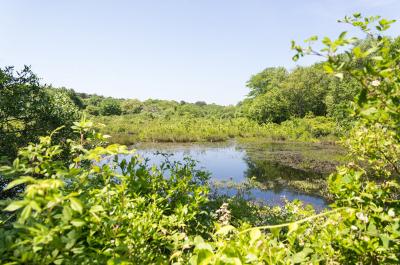
Roth Woodlands in Chilmark.
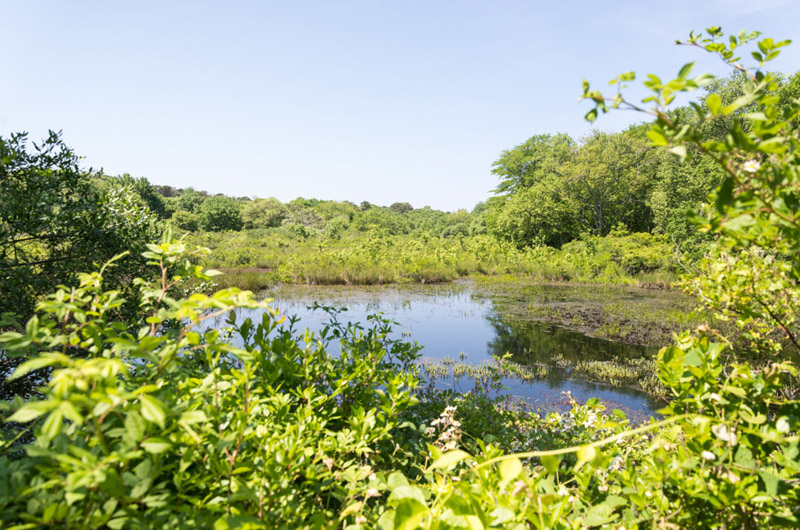
Roth Woodlands in Chilmark.
Along those lines, when the brook trout are thriving, that’s also an indication of a stream in good health, said Prudy Burt, a West Tisbury conservation commissioner who serves on the town’s Mill Brook watershed planning committee. “If conditions are good for them, it means they are good for everyone else,” she said.
Historically, Mill Brook was considered one of the better habitats for brook trout in the area. Boston Mayor Jerome Smith marveled at their abundance during a visit to the Island in the 1800s. “[C]rossing the principal brook of the island, our attention was attracted towards the agitated state of the water, and never do we recollect so fully to have realized the expression of its being ‘alive with fish’ as on this occasion,” he wrote.
But the 1850s marked a turning point for the brook, with Dr. Daniel Fisher establishing a series of dams and mills –—at Priester’s, Crocker and Fisher ponds. The Mill Pond dam, which powered a textile mill on State Road, is said to predate the 19th century.
More than 100 years after the last mill stopped running, the ponds remain, but the roiling brook trout that Jerome Smith observed in the 1800s have not returned.
Removing some of the dams could restore the brook’s original cool-water habitat (or something close to it), but that idea doesn’t sit well with everyone. Many Islanders still find value in the historic dams and ponds, and in the different mix of wildlife those environments support. (The mute swans Bob and Bobette who inhabit Mill Pond, for example, are invasive but well loved.)
But few would deny that dams and road crossings have greatly altered the brook system. Among other things they create a number of swampy areas upstream from the ponds, where habitat is generally less conducive to fish. They also prevent the passage of river herring and other sea-run fish, which if given the chance would likely move upstream to spawn or find habitat.
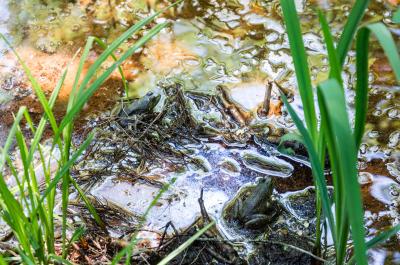
Frogs found in abundance in fresh water system.
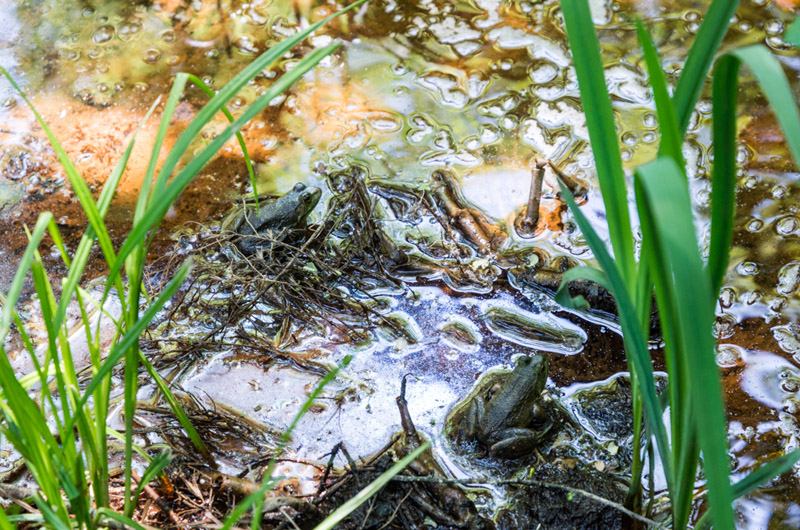
Frogs found in abundance in fresh water system.
About two years ago, the Division of Marine Fisheries installed a fish ladder to allow herring to move directly through the dam in a series of ascending channels. Ms. Burt and others say the ladder hasn’t attracted many herring, as evident in the lack of scales and other fish parts upstream. But Mr. Chase pointed out that there hasn’t been continuous monitoring, and that herring may pass through at any time of day.
West Tisbury herring warden Johnny Hoy has extended the ladder to adjust the flow, and built a rock weir downstream to help direct fish toward the entrance.
But even if the herring get up the ladder, Mill Pond promises them only a marginal habitat.
“There are no illusions about what we’re doing with the fish ladders,” Mr. Chase said, noting the shallow depth and limited volume of Mill Pond. “We understand it’s a very small area that could be used for spawning and nursery habitat.” Even removing all of the dams along the brook might not benefit herring in the end, he said, since the brook has no real headwaters, only the swampy area above the impoundment in Chilmark.
That impoundment itself may soon disappear, although some ecologists have welcomed the change. With funding from the state Department of Environmental Resources and the Daniels Wildlife Foundation, The Sheriff’s Meadow Foundation, which owns the property known as the Roth Woodlands, plans to replace the two metal pipes under the road with a box culvert that would allow brook trout and other species to move upstream.
The new culvert would eliminate the impoundment, which Mr. Wilcox said would lower average water temperatures by restoring a narrower stream channel and faster flow. But the proposal also has raised concerns about how lowering the surrounding water table would affect nearby wells. Sheriff’s Meadow executive director Adam Moore said plans are now on hold as the foundation attempts to address those concerns.
Other riparian owners in the area have also taken matters into their own hands, and apparently without much controversy.
Just south of Mill Brook, on the Tiasquam River, the owners of Grey Barn Farm in Chilmark have allowed a small impoundment known as Farm Pond to revert to marshland. Working with the Division of Marine Fisheries, the conservation commission and others two years ago, they removed the spill boards in the dam and the pond drained away. Within a year, the area reverted to native marshland, with a stream meandering through it.

Fish ladder at Mill Pond.
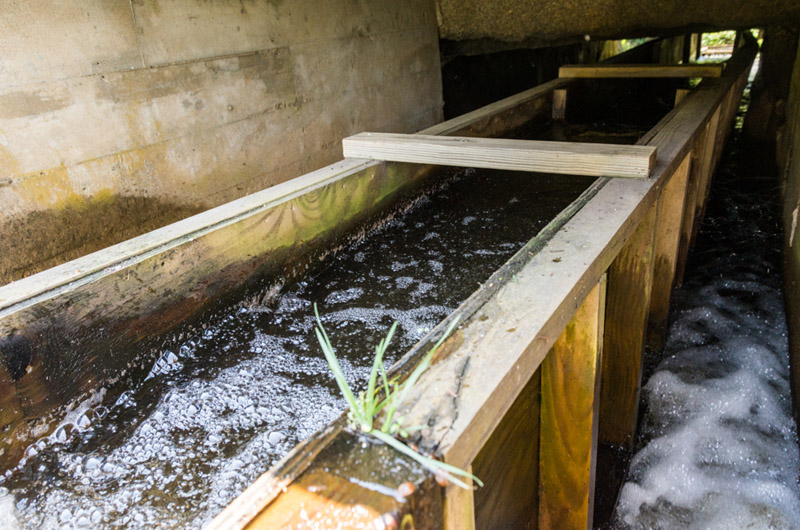
Fish ladder at Mill Pond.
“It went from being mudflat to being pretty convincing wetland in really one growing season,” said Matt Pelikan of The Nature Conservancy, who provided support for the project. That same year, herring from Tisbury Great Pond were observed blasting up the stream, but only as far as the next dam, at Look’s Pond.
“We immediately wanted to rectify that,” said Geraldine Brooks, who lives next to the pond. Working with the Division of Marine Fisheries, the town conservation commission, Mr. Hoy and others, she installed a wooden fish ladder at the pond — not the first in its 350-year history — to allow herring to continue upstream.
The results were spotty this year, she said, due largely to the timing of manmade breaches at Tisbury Great Pond. Mr. Chase, who helps coordinate the breaches, said the first one early in the season didn’t last long enough, and didn’t happen to coincide with the arrival of the herring. A later breach also didn’t appear to let the herring in.
“I always feel these things take at least three years to understand how things are working,” he said of fish ladders in general. “In this case, I think Johnny [Hoy] is really dedicated, and he’s learning from our crew. I think that he’s going to have both those ladders really tuned correctly for when the fish do arrive.”
Meanwhile, a large amount of data collected over the years has helped inform the Mill Brook watershed study, and could help West Tisbury and Chilmark decide how best to manage the system. But as of last week, questions remained. “The mysteries of this stream are pretty great,” said Mr. Wilcox, standing at the edge of Mill Pond, as cars passed over the dam and a family of geese made their way along the water’s edge. As an advisor to the Mill Brook watershed committee, Mr. Wilcox has tried to help get a handle on factors such as flow and velocity, which could be used to determine the size of the watershed.

Geologist and water quality expert Bill Wilcox.

Geologist and water quality expert Bill Wilcox.
Researchers have puzzled over an apparent loss of volume between Priester’s Pond and Scotchman’s Lane, which crosses the stream farther south. Mr. Wilcox said the difference might be a result of water flowing into the ground, or simply a miscalibration of readings along the stream. “We definitely need more work there,” he said.
Questions also remain as to what role Mill Brook plays in nutrient cycling. Mr. Wilcox said its phosphorus levels are unusually high for freshwater streams, and a 2006 report by Aquatic Control Technology Inc. noted excessive nitrogen in Mill Pond, although data at the time was inconclusive. Any discussions about removing the Mill Pond dam may need to address the possibility of increased nutrients in Tisbury Great Pond, which is already impaired by nitrogen.
Looking ahead, he believed restoration efforts along the Tiasquam River could serve as a model for Mill Brook, although the former has only about a quarter of the flow. “If the fish ladder at Look’s works, and they are starting to find migratory fish in that pond and upstream from it, that’s certainly a good indicator that the same would happen at Mill Brook,” he said.
Ms. Brooks said every case should be considered on its own merits, but she also saw the implications for stream restoration in general. “What’s happened with the Farm Pond is very beautiful,” she said, “So it’s not a scenic zero-sum game.”
“If the abutters came to me and said, let’s do the wild river thing, I would certainly consider it,” she said. “But I’m also somebody who loves history, and I love historic landscapes too. So I think that’s a value that we need to consider in the mix.”
Comments
Eons ago Mother Nature
Nelson Sigelman Vineyard HavenEons ago Mother Nature created a cold water artery in the heart of Martha’s Vineyard that nurtured brook trout, American eels, herring, white perch and numerous other native species that benefitted from the free flowing waters of Mill Brook.
The dams that now block that flow were created to benefit industry, not nature. West Tisbury, which holds itself up as a responsible steward of the environment, ought to be in the forefront of efforts to allow the stream to revert to its natural course. Communities across New England have already done so and seen the benefits.
I understand the scenic appeal of the Mill Pond. Rather than despair its loss town residents might envision how much more beautiful it would be to glance from the roadway at a natural, free flowing stream capable of supporting brook trout that still carry the genetic strains of their ancestors.
As Alex Elvin reported, the owners of the Grey Barn Farm removed the boards in a sluiceway along the lower portion of the Tiasquam. The shallow farm pond reverted to a free flowing brook visited by spawning herring, mallards, black ducks and bordered by a natural meadow. The transformation should serve as an example to anyone worried about what might replace Mill Pond.
The story quotes Dr. Jerome V.C. Smith, who described a visit to Mill Brook in his “Natural History of the Fishes of Massachusetts,” the first comprehensive study of fish in state waters. Writing about trout almost two centuries ago, Dr. Smith said, “Factories and sawmills have done their part towards the work of extermination, and the destructive net bids fair to do the rest. But though much diminished from these causes, there are more or less waters all over this state, and particularly in Plymouth county, and Barnstable county on Cape Cod, where the fish live and thrive in the undisturbed possession of their element. In no place, however, do we remember to have seen them in such abundance as in Duke's county, upon Martha's Vineyard … It was here in the month of November last, and of course in their spawning time, while returning home from a ramble among the heaths and hills of Chilmark and Tisbury, that crossing the principal brook of the island, our attention was attracted towards the agitated state of the waters, and never do we recollect so fully to have realized the expression of its being ‘alive with fish,’ as on this occasion.”
I have no doubt that if Dr. Smith were able to revisit that trout stream he would be greatly disappointed to see that the destructive dams remain, despite the fact that they no longer power anything.
I came across this old photo
David Stanwood West TisburyI came across this old photo of an empty pond by the West Tisbury mill taken sometime in the 1900's:
https://www.facebook.com/photo.php?fbid=10213369979553878&set=gm.156817…
If dams are to be removed,
Thomas Hodgson WTIf dams are to be removed, how about removing them in chronological order, with the goal being the removal of the most recent dams first? There was a spate of pond-building here in the '50s and 60's, even into the 70s. Those ponds could go first.
Great contribution from
Katherine Scott TisburyGreat contribution from Nelson on a fine story by Alex Elvin.
Maybe remove the dams by "seniority" (or juvenality?) as Tom suggests, or maybe remove them in order from downstream to upstream?
Perhaps a dam removal plan should or could be
designed to generate as much useful scientific data as possible.
As for the "history," we have archives and the MV Museum for that.
This is about natural history, "history" in the making.
From the removal process we will obtain a "backwards" view
of an earlier epoch that is also part of the Vineyard's history.
Remove the dams!
Free Mill Brook!
Among the several suggested
Dick AquinnahAmong the several suggested changes to the Mill Pond ecosystem, the first and perhaps easiest, should be to cease the stocking of non-native brook trout. These fat, pellet fed anomalies initially out compete the local fish and at some point erode the specific and successful genetic qualities of the natives evolved over thousands of years. Break down the dams if you can but please quit the stocking.
Add new comment