Mr. Keniston served 10 years. The next editor would devote his life to the paper, serving as a printer and foreman before his own editorship began in 1888 and staying on to assist a pair of youthful new publishers for 10 years after his term ended in 1920.
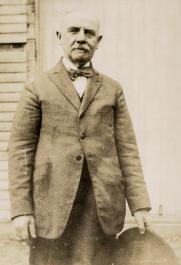
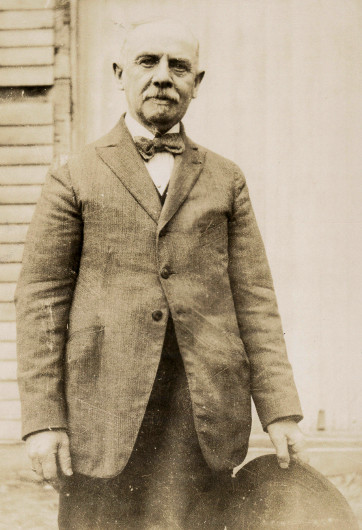
Charles H. Marchant was a grandnephew of the founder and the son of a whaling master, the demands of whose profession meant that the future editor did not meet his father until he was three. His successors, the Houghs, adored him. After the Old Editor, as Henry Beetle Hough called Mr. Marchant, had been gone from the Gazette a dozen years, “his legacy to us was still bright. Sometimes we could almost accept the illusion that we ourselves remembered the old days of which he had told us, and of which he had written. Croquet, clambakes, and bicycling triumphs; Matty Williams reciting ‘Lasca’ and Marie Burroughs doing the poison scene from Romeo and Juliet in the town hall.”
It is hard, then, to look back on so much of his editorship with disappointment.
The great problem, after a bright start, was one of stagnation. He briefly expanded the Gazette to eight pages, an amazing feat in a barebones shop. He bestowed its modern masthead, introduced the first photography and wrote with grace. But he let the editorial column disappear for a vast stretch of time. Almost to the end of his editorship he stuck to the archaic tradition of running essays and boilerplate on the front page (Ferocious Whales, Torture Machines, The Discovery of Florida) and consigned to Page Two the arson of two grand hotels in Oak Bluffs and even the monstrous Portland Gale of 1898, which drove 21 schooners ashore and killed 10 men in Vineyard Haven harbor alone. He missed stories he himself had thumped for, such as the grand opening of a first class hotel in Edgartown, the Harbor View, and he devoted only a few paragraphs to stories that deserved much more, such as the incorporation of West Tisbury in 1892. He remained depressingly Edgar-centric through most of his 32 years at the desk.
Another paper was doing better.
The Martha’s Vineyard Herald had swallowed up the Cottage City Star in September 1885 and under the leadership of a Baltimore native and former Confederate officer, Charles Strahan - who had championed the separation of Oak Bluffs in the Star and thereby won a rebellion at last - was teaching the Gazette a weekly lesson in community journalism.
Through the mid-1890s - one of the few periods from which enough Heralds still exist to make a direct comparison - the rival paper covered scores of stories, great and small, that the Gazette never mentioned: the first run of the electric railroad to Vineyard Haven; the arrival of a fireman’s band in Oak Bluffs; lawn fetes in Vineyard Haven; a bicycle race of three miles from “the stone crusher on the state highway to Waban Park and return”; the arrest by the Vineyard Grove Company of two photographers who bought tickets to the bathing beach and began to take pictures of the bathers; the retirement and towing away of the old steamer Island Home, veteran of 40 years’ service to the Vineyard and fated to become a coal barge in Boston; whist parties and shellfish suppers.
In short, a journal of Island life, and while the Herald was as much an Oak Bluffs paper as the Gazette was an Edgartown one, through these years it chronicled in depth a much wider array of subjects, both on the Island and on the mainland. Mr. Strahan devoted so much space to the debate over gold versus silver in the election of 1896 that Mr. Marchant suggested he be nominated Secretary of the Treasury if William Jennings (Cross of Gold) Bryan won.
By 1903 Mr. Marchant had improved, forced into it by the competition.
He came to see, as Mr. Hough later explained, that the best stuff in a country newspaper was often the commonplace, the typical, the event that recurred month after month or year after year. What he did not see, or at least record, even toward the end of his editorship in 1920, was that the world he had known — a world, as the Gazette later said, of “hard-fisted and determined men who saw hardships, battled adversity and winning or losing put up a fight which compels admiration” — was beginning to slip away. There were still clear memories of things the paper had never set down — what it was like to swordfish by catboat, or circle the planet in a whaling ship. How the women of Vineyard Haven did so much to fight the fire in 1883. Why so many hundreds of Island men had risked everything to travel to California to dig gold in 1849.
Mr. Marchant, who had spent almost his whole life on one Island, and virtually all of it in one office, could not see that it was all coming to an end. He did not think to get their stories before it was too late.
“We could see long ago that from one point of view we were participating in the final scene of the drama of a New England community, a community of a New England that had to die under the flood of the modern world,” wrote Mr. Hough in Once More the Thunderer, his second book about the Gazette. The Houghs began their esteemed joint editorship determined to put that final scene down on paper before it was lost.
His first editorial, the week of August 5, 1920, advised sheep farmers to hold on to their wool until prices rose. Among his last were encyclicals on time sharing, McDonald’s and the land bank. When the Houghs took over the paper it had no linotype machine; when his editorship ended it had just installed its third generation of computers. The week they first published the Gazette — June 3, 1920 — four people were needed all morning to manufacture 600 copies on a hand-cranked press. The week he died, in June 1985, one man watched a bank of four offset presses crank out 16,000 Gazettes in little more than one hour.
He was a slender man, stooped in his old age but still clear-eyed and wry, with an encyclopedic knowledge of Island genealogy, history, nature and the old place names where the new houses were going up. The man who wrote editorials about the archaic idioms and pronunciations he was still hearing on the streets of Edgartown when he was 25 dazzled people well into his 80s with his command of a new language forced upon him by the modern era — a language of developers, of planners, of economists and politicians.
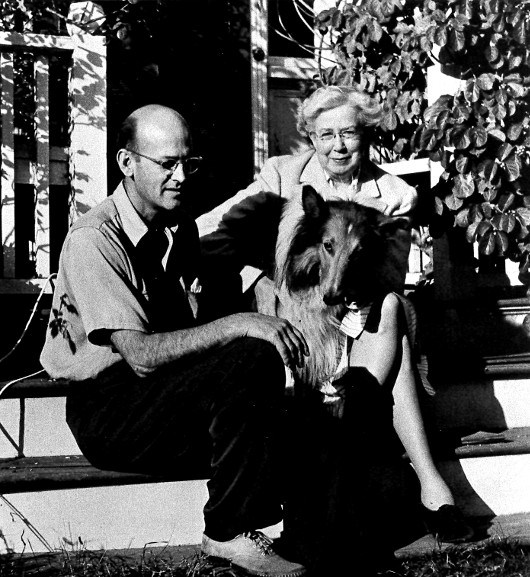
She was a white-haired woman who wore rimless spectacles, serving as editor in chief in all but name for almost 25 years after 1940, when he began to write books regularly and concentrate on editorials. “First or last,” he wrote on her death in June 1965, “she did about everything there was to be done on a weekly newspaper, running the linotype, selling ads, writing and editing, scolding and inspiring, driving young reporters to write with taste and clarity, expecting them not to do everything but to do well whatever they had instinct or talent to undertake.”
It would require a full section of this anniversary issue to spell out the significance of the 45-year editorship of Elizabeth Bowie Hough and the 65 years of Henry Beetle Hough. It began with an explosive and celebratory reinvention of the Vineyard Gazette all in the first week, a sweeping away of the crowded old boilerplate and the creation of an airy front page filled with Island news: the five remaining veterans of the Grand Army of the Republic attending the ceremonies of Memorial Day; the saving of Mrs. Ralph Emerson’s cottage from fire at West Chop; the death of Joseph T. Pine, six years old, who collapsed from heart disease when called in from play by his mother. They took a 19th-century paper and in seven days remade it entirely. That June 3, 1920, edition still looks modern today. Henry Hough was 24 years old.
They were the first editors from the mainland, and never lost the mainlander’s sense of wonder at Martha’s Vineyard. Three principles drove them throughout their stewardship: to record history before it was lost and show how tradition played an essential role in contemporary Vineyard life; to define what was extraordinary about a society and a wilderness out in the sea; and to campaign for the preservation of this apartness in all its forms - customs, commerce, wildlife.
Henry Hough was a boyhood summer resident of Indian Hill, born in New Bedford on Nov. 8, 1896, and a graduate of the Columbia School of Journalism where at the age of 22 he was awarded a Pulitzer Prize for an essay on the history of the American press. Betty Hough was raised in Pennsylvania and met her future husband at Columbia. They received the Gazette as a wedding present from his father, George A. Hough, the executive editor of the New Bedford Standard. A brother, George Jr., ran the Falmouth Enterprise.
The revolution begun that first week of June in 1920 lasted 12 years, until the Depression damped down the first wave of freshness and inspiration.
On May 8, 1925, they printed the Gazette’s first known profile of a living Islander - Capt. Isaac Norton, a coaster, fisherman and member of the former United States Life Saving Service, who dwelt happily on his memories of whaleboat racing on a two-mile course off Oak Bluffs 50 years before. They hired Joseph Chase Allen, the Gazette’s first full-time reporter, who sometimes wrote the news in rhyme and for more than 50 years quoted prices and told yarns about Island seafarers on a page called With the Fishermen. They evoked Island life with the smallest brushstrokes, creating a column of incidental quotes and overheard storefront conversation called Cutting Crosslots, another of offhand, ironic events and commentary first called Vineyardana and later Things Insular.
They created the Tuesday paper in 1929, the Invitation and Directory editions during the depths of the Depression to help inaugurate a string of precarious summer seasons and a birder’s column in December 1953 to chart the astonishing migrations that swept over the Island each spring and fall. They introduced columnists Dorothy West and Louise Aldrich Bugbee of Oak Bluffs. The Houghs opened the pages of the Gazette to the beautifully stark lithographs of Sidney N. Riggs and the more expressive cuts of Bill Abbe, and to the first in a parade of photographers — Clara F. Dinsmore and Edith Blake.
They were deeply aware of a growing summer audience.
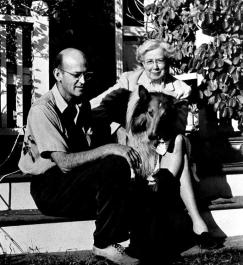
Photo by Gretchen Van Tassel
Four huge steamers, licensed to carry 2,000 passengers each, were built between 1923 and 1929. New houses were going up all across the Vineyard. “One Moment Please!” said an advertisement at the end of the season in 1927. “Before you go, don’t fail to enter a subscription to the Vineyard Gazette. It will follow you and come as a weekly visitor to your winter home with all the news of Martha’s Vineyard. Week in and week out, the newspaper prints column after column of comment and occurrences. Here is Vineyard history in the making, and if you are interested in the Island you cannot afford to be without it.”
They would soar whenever history demanded it, producing grandiose front pages and reams of news that would have challenged the city room of a mainland daily: Joe Allen writing in a garage by the headlight of a car after a hurricane carried away Menemsha; the editors improvising the first banner headline ever for an election extra, inventing lines that wouldn’t use more vowels than the few they owned; and at least one edition, in 1933, that no mainland paper ever would have dreamed of, a paper of bold upper case headlines, a photograph of a grouselike bird bordered in black and four pages devoted to its extinction. The heath hen was a cousin of the greater western prairie chicken. Its last home in the East was the vanishing Vineyard prairie.
Mr. Hough had chronicled the decline of the heath hen closely through the second half of the 1920s, seeing before most men that it was possible for living things to run out of room. Among the first and best examples of his transcendental prose on nature appeared in the paper about the extinction, April 21, 1933. The editorial was called A Bird That Man Could Kill:
“The most prosaic scientist . . . has lain among the black scrub oak in the white mists of a chill April morning and has returned to write poetry. The meticulous observations and Latin terms appear modestly, softened by a cloak of mystery. We read of the birds appearing ‘as if by magic.’ We are told that the call of the heath hen did not rise or fall, but ‘ended in the air like a Scotch ballad.
“. . . And so it is that the extinction of the heath hen has taken away part of the magic of the Vineyard. This is the added loss of the Island. There is a void in the April dawn, there is an expectancy unanswered, there is a tryst not kept. Not until the great plain has grown again a forest of tall pines and cedars, such as that which wooded the level acres a few centuries ago, will the loss of the heath hen be forgotten.”
It was the event that turned the Gazette conservationist. Henry Hough inspired the creation of Sheriff’s Meadow Foundation, the Vineyard Conservation Society and in the spring of 1970 he led the paper with a proposal by Edward Logue of West Tisbury that would take root as the Vineyard Open Land Foundation.
The regulatory hand of government clasped the Vineyard during the New Deal and tightened its grip during the war. The Arcadian world was giving way to a more complicated, political one. “A good many people, especially those at some distance from the Vineyard, may feel puzzled by the rapid sequence of events in the transportation picture,” Mr. Hough wrote of the creation of the Steamship Authority in April 1949. “[L]et no one think that what happened at the State House last week was of minor importance. It was a turning point vital to the future of the Vineyard.” Thus did the Gazette begin to play the role of interpreter and crusader, especially for its mainland audience.
Mr. Hough told his readers what they ought to watch for, what to resist, whom to write. He counted on the summer residents to insist on the preservation of what they had fallen in love with and invested in. He told them that the taxes they paid gave them an important, if indirect, say in town government, that only concerted efforts could forestall the forces that were making the Island too much like the places they had come from. Unity was the important thing. Speaking loudly and unceasingly, with one voice.
He was like the founder in this way.
Increasingly through the 1950s and 1960s the admonitory tone crept into coverage of the news itself. Television Tower Threat Looming Again on Island read a headline Jan. 22, 1960. Arguments for zoning, for planning and for the Islands Trust bill, which in the 1970s would have made the federal government a partner in the defense against rapid and thoughtless change, were read by some as attacks on Island business and progress of any sort. Critics said that the paper was written mostly for summer people, that it failed to report the views of those it disagreed with, that its editorial voice was growing nostalgic and even petulant.
Betty Hough died June 21, 1965. Henry Hough, nearing 70, was now regarded across the country as one of the preeminent American journalists of the century, certainly the most famous country editor. In his lifetime his name became synonymous with Island history, with the natural world, and with the unending campaign to save its character - by which he did not mean appearance, but way of life.
“What has preserved the Island in its natural attractiveness until recently has been the fact that for 300 years it lived in an economy of production,” he wrote near the end of his career. “A service economy, as it is called, has set in like an irresistible tide in the past few decades, culminating in the intensive enterprise of tourism which by its nature exploits rather than preserves, promotes congestion, depends more on turnover than long term advantage, grows through appeals of mass advertising, and in its worst form establishes crudely formed ‘developments’ from which the old rurality of the Island is excluded. Sophistication and conformity set the standard of new times.”
He had long contemplated retirement.
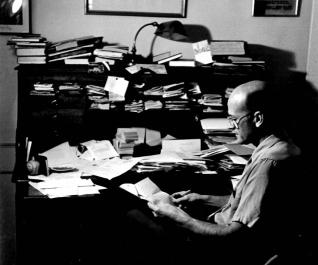
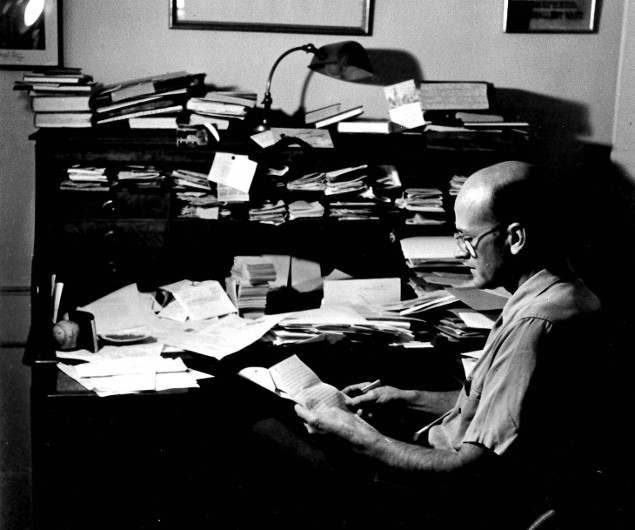
Henry Beetle Hough at his desk.
Photo by Gretchen Van Tassel
“Apparently there is no way to taper off as there is in some worldly occupations,” he wrote as far back as 1950. Country editorship, he had discovered, “is all or nothing until the end.” He would keep writing editorials for another 20 years, almost to his death on June 6, 1985, but in 1968 he found a new family to run the Vineyard Gazette. Except for the tenures of Charles Macreading Vincent and Samuel Keniston, it would be only the third family to publish the paper.
James Reston and Sally Fulton Reston
April 19, 1968 - July 5, 1988
The relevance and even the survival of the Vineyard Gazette was at stake.
The machinery by which the paper was composed and printed was 40 years old and older. The pace of change had quickened but the Gazette lacked the staff to report how all six towns were meeting the challenges of the day. The paper struggled to define itself in the new era. What sort of country journal could it be when the headlines were about Chappaquiddick and Jaws, when crises flared at the hospital and the ferries groaned with traffic, when the wells threatened to go dry and the dumps to fill? How to preserve its own character as a reflective old Island paper and yet deal deftly, thoughtfully and comprehensively with news that was beginning to sound very much like news from everywhere else?
James Reston, twice the winner of the Pulitzer Prize, had traveled the world as a correspondent, bureau chief, columnist and executive editor for The New York Times. With his wife, Sally, he was a frequent summer visitor to the Island. “In the days of my youth,” he wrote in his memoir, Deadline, “some restless reporters, usually when they were tipsy or sore at some editor for mangling their copy, would damn the big city dailies and babble about retiring to edit or even own a little country paper.” Mr. Hough proposed the sale to the Restons because, he said, “I want it to go into a newspaper family and you have writing sons.”
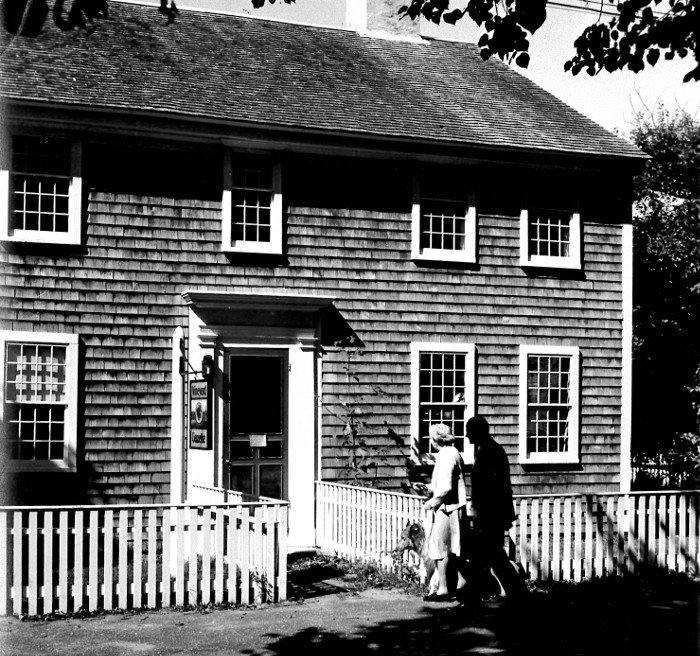
From Washington Mr. and Mrs. Reston introduced the new technology of cold type, careful to replicate as closely as possible the old fonts of the letterpress days. They invested in computers, lifted the roof of the old office — once a poorhouse — and expanded the plant on the corner of South Summer street and Davis Lane, just across the lawn of their summer home. Later, under the Restons, would come the Pulitzer Prize winning sage who had retired to Katama from New Jersey, William A. Caldwell. They hired editors Phyllis Meras and Douglas A. Cabral, who began to wrangle with the problems of the modern world, and to explore the interests of the newest generation of Vineyarders and visitors, all the while holding fast to a fixed mission of the Vineyard Gazette — "to know what went before," as Mr. Hough once explained.
In the fall of 1975, the executive editorship of the paper was transferred to their oldest son, Richard Reston, formerly a correspondent with the San Francisco Chronicle and a reporter and bureau chief in London and Moscow for the Los Angeles Times, and his wife, Mary Jo (Jody) Reston, who served as business manager. Richard and Jody Reston became publishers of the Gazette on July 8, 1988.
Island Life
We come now to our own time, to the weekly judgment of the contemporary reader, and to the question asked at the beginning of this history: Why was it so important to have a copy of the Vineyard Gazette with the storm long gone and the rebuilding so plainly evident to all?
It’s worth remembering that the founding editor may have been the first man on Martha’s Vineyard to describe publicly and quite precisely what was so appealing about this place where he and his audience lived. He told his readers what was different about it. He said that the beaches were longer than Rhode Island’s, that the fishing was better than any other place along the coast, that the riding would suit any horseman.
The differences of Vineyard life captivated the Gazette forever after. Mr. Cooms wrote about them in his midnight stroll around the tented Camp Ground, Charlie Mac in his third visit to the agricultural fair, Mr. Keniston after witnessing the Katama fox hunt. Today every story begins with the implication that nothing quite like this has ever happened anywhere else in the world.
It is true that other villages stage farmers’ markets and hold county fairs. Other towns have carousels and brass bands. Other headlands have cliffs, other harbors have ferries and schooners, and other farms have draft horses and organic crops blowing in the summer breeze. You may find boards of selectmen all across New England, barn raisings, tribal pageants and historical groups storing the logs of whaling masters or saving grand old churches and country stores. On the mainland frogs sing in the springtime, drifts of snow seal the front door and leave bare patches behind a leeward corner. The wildest storms come from nowhere to send sheets of salt water racing over the rooftops, flexing the seaward faces of the oldest houses and leaving a jungle of wood and green leaves and wire on the street corner in the sickly sweet-smelling hours of calm that follow.
The hurricane of August 19, 1991, raked the coastline from the middle of Long Island out to Chatham and Provincetown. But people hurried to buy the Gazette because they wanted a record of one important thing, the thing the paper could be counted on to ponder first and last — why it was different here.



Comments
Truly Brilliant
Andy T. VHTruly Brilliant
Add new comment