


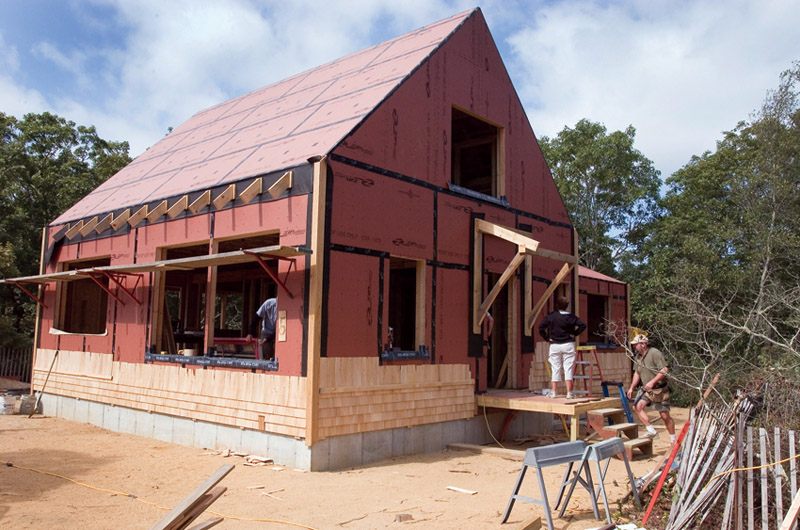
The home ownership lottery system has made a significant dent in the housing problem on the Island by allowing at least some young families to put down roots.
Surrounded by flowers at Morrice Florist on a recent afternoon, owner Emily Coulter recalled a selectmen’s meeting seven years ago that changed her life. It was July and the Tisbury town hall was unbearably hot. The families in attendance quietly braced themselves as the first name was drawn from a wooden box.
Mrs. Coulter and her husband Benton had taken part in two other housing lotteries in the past, but this time the months-long process ended in celebration. Theirs was the first name drawn from the box. The whole ceremony was over in a matter of minutes.
“It was crazy,” Mrs. Coulter said. “We actually got our picture in the paper.”
Three months later, the Coulters moved into their new home on Lambert’s Cove Road, one of four similar houses built for year-rounders who would otherwise find home ownership out of reach. The Coulters paid $258,500 for their house, which will remain affordable by Island standards for at least 99 years.
Eighty-eight similar dwellings on the Island have been built and allotted since 2005, each one with a deed restriction, ground lease or other mechanism to keep it affordable.
The home ownership lottery system, today overseen by the Dukes County Regional Housing Authority, has made a significant dent in the housing problem on the Island by allowing at least some young families to put down roots. Many other houses and apartments around the Island are kept affordable through similar long-term agreements. But for many families, it’s still a stretch.
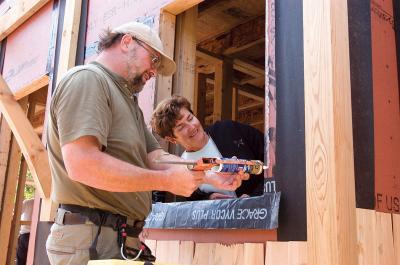
Sweat equity: volunteers work on a Habitat home.
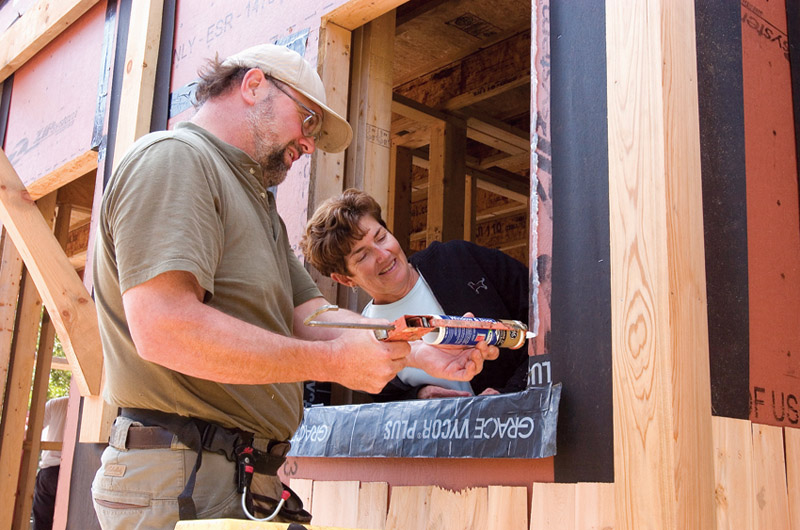
Sweat equity: volunteers work on a Habitat home.
“It’s affordable for Martha’s Vineyard, but it’s like a normal house anywhere off-Island,” Mrs. Coulter said of her 1,260-square-foot house, one of 66 new homes built by the nonprofit Island Housing Trust since 2005. “We do really well, but there is no way that we would be able to afford a regular house.”
But overall, she said, the investment has been a good one.
“The life we’ve created for ourselves with the security of having that house is everything we had dreamed of,” Mrs. Coulter said. “I was able to buy this business here. Knowing that we have such strong roots now, there is no need for us to ever leave.”
While the Coulters own their house outright, the Island Housing Trust holds a 99-year ground lease for the property. Homeowners can sell, but only for what they paid, as adjusted to keep up with changes in the area median income, about $65,500 in Dukes County. Housing trust director Philippe Jordi said that after 99 years the lease is renewed, ensuring that the houses stay affordable in perpetuity. The ground lease model has been adopted in other affordable housing projects around the country.
“The community’s interest is vested in the fact that we own the land,” Mr. Jordi said. “We want to ensure that they are successful and when they go to sell their house that it be sold to a household with the same needs,” he said.
The trust also maintains 17 rental units, most with long-term restrictions. Another 29 are in development.
The houses on Lambert’s Cove Road are limited to households earning between 80 and 100 per cent of the median income, roughly $52,400 to $65,500. Other developments have targeted lower or higher income levels. The vast majority of Island dwellings for people earning less than 60 per cent of the area median income are rentals. Habitat for Humanity, which has built 10 houses on the Island with another project coming up this year, focuses on the 60 to 80 per cent income range.
Almost every affordable housing development on the Island since around 2000 has been restricted in perpetuity, a change from 20 years ago, when restrictions of 30 years or less were more common.

Christie Phillips was awarded a home at Island Co-Housing in West Tisbury in 2000.
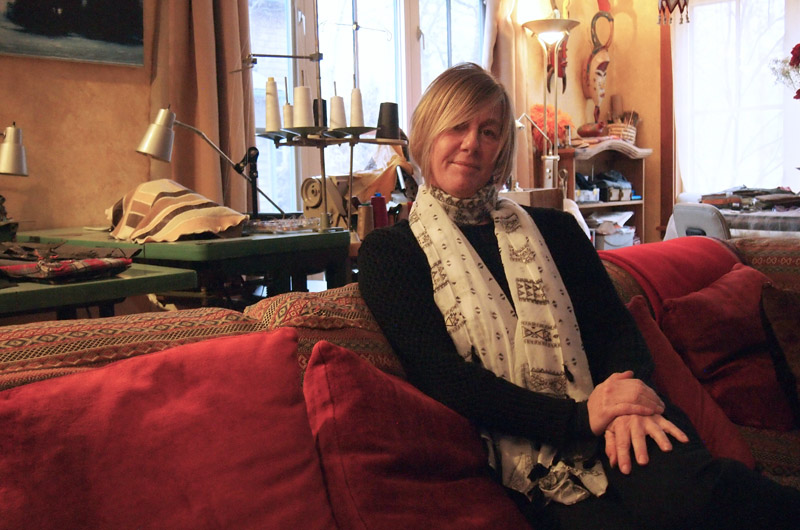
Christie Phillips was awarded a home at Island Co-Housing in West Tisbury in 2000.
“It’s the only thing that makes sense in an area where real estate values go as high as they do as quickly as they do,” said Doug Ruskin, a housing trust board member who has also served on the board of Habitat for Humanity and the Edgartown affordable housing committee. The housing trust and Habitat for Humanity separately adopted the approach more than a decade ago.
But while long-term restrictions are now the norm, a new project in Edgartown could end up bucking the trend.
A plan to make three affordable housing lots on Sixth street would carry affordability restrictions of only 10 years.
Edgartown selectman Arthur Smadbeck, who is helping organize the project, has argued that the shorter-term restriction would allow families to benefit from building home equity for the future. “The idea is that we are trying to give a leg up to the young people who are going to come to live here for a good long time,” he said. A public lottery is expected this month.
Mr. Ruskin has opposed the project, arguing that it would simply provide a windfall to future owners, who would be able to sell their homes at market rate after 10 years. Dukes County Regional Housing Authority director David Vigneault said he sees that kind of approach less as affordable housing than as a delay on market-rate housing.
“The question boils down to: Is it primarily a housing program, or a personal finance program?” Mr. Vigneault said. “At a certain point does it go from being one to the other?”
Homesite and housing lotteries may include a requirement for town residency, which disqualifies them from being counted on the state inventory of affordable housing. The inventory also excludes lottery projects where a preference for town residents is applied to more than 70 per cent of the units.
But Island officials are less interested in the state inventory than in creating more attainable housing in general. “The driving criteria is that we have hundreds of families looking for stable housing, and we have effectively zero 12-month leases available on this Island,” Mr. Ruskin said. “I haven’t seen an advertisement for one in the paper for a long time.”
He said Chapter 40B of the state general laws, which allows developers to push through some projects that include affordable housing, has little influence here, given the high cost of development and the regulatory powers of the Martha’s Vineyard Commission.
By all accounts, the home lotteries have been a godsend for year-round residents. “Their entire lives change,” Mr. Ruskin said. “They don’t have to worry anymore, stress levels go down, kids do better in school. In a number of cases, folks have been able to stabilize to the point of opening their own little businesses.”
But it has not always been smooth sailing.
Christie Phillips, a seamstress and single mother, was awarded a home at Island Co-Housing in West Tisbury in 2000.
“I couldn’t believe I got a house,” Ms. Phillips said in a recent interview, surrounded by sewing machines and spools of thread in her small two-bedroom house with a fire blazing in the wood stove. “Back then, nothing was under $500,000.” She paid about $135,000, and was among the first to move in to the 16-unit collaborative-living project in the woods off State Road. “It felt a little utopian in the beginning,” she said.
But she soon found herself struggling over monthly association fees that she said required the four affordable and 12 market-rate owners to pay the same rate. She spent years fighting to bring the fees down, noting a split within the cooperative living community.
“All the affordables were always trailing behind,” she said. “We could never make ends meet.” She pointed to a thick binder filled with legal documents and town bylaws. Affordable home owners weren’t supposed to pay anything in association fees, she said, but her efforts led nowhere. “It was so slanted against us,” she said. “It was like we were just used to make this community 40B.”
Ms. Phillips has stopped attending meetings at Co-Housing, although she still considers herself lucky to own a home. “I’ve had some problems,” she said. “But I do appreciate that I have a house for $135,000.” She also noted that while a number of households in the development have come and gone over the years, only one affordable unit has been resold, following the death of the owner.
Mrs. Coulter said if she were ever to sell her home, it would simply go back into the lottery system. Some feel the process creates an unfair burden, since the most an owner can hope for is to break even, but Mrs. Coulter sees things differently. Looking back on her years of paying $1,200 a month with her husband for an un-heatable one-bedroom apartment, she said the difference is night and day.
“The idea that we’re putting equity into something now — if we were to sell it we would make our money back — that’s an amazing investment,” she said. “I think everyone who has moved into these houses is just so thankful.”
Comments
If you can't build up equity,
Carol Lashnits VHIf you can't build up equity, how do you pay for your child's college education? How do you pay the real estate taxes and association dues? How do you re-finance when you need to? And with the IHT program, you can't leave your property to your kids, I gather. I won a lot in 1977 at Pilot Hill Farm on Lambert's Cove Rd. offered through the Vineyard Open Land Foundation's Youth Lot Program. They also sold 5 lots or so at Sweetened Water Farm in Edgartown. It's hard to make ends meet now that I'm retired BUT I do have a 1 million dollar property that my daughter someday can sell or hopefully rent to a year round Island family. We built the house with our own hands, worked to make the Island a better place. I hope that there will be some $ left in my estate to give a substantial donation to the VOLF. THEY were the visionaries when it came to this kind of program. If only people with large parcels of land could carve off a corner and let the VOLF continue to run this program. Good for Edgartown to see this clearly and not fall for the IHT line.
I'm pretty darn left-wing
Stunned leftyI'm pretty darn left-wing when it comes to wealth redistribution via gov't (especially when it is presently so insanely skewed), but the sense of entitlement embodied in the first 3 questions above is shocking. The answer is that the point of "affordable housing" efforts is to provide HOUSING at an affordable price, not hand out general wealth that can be re-purposed to buy whatever else you need later. If the community feels that it wants to use the power of taxation to fund college education, to lower property taxes for low-income people, (or buy everybody a boat and kitchen remodel since they can't re-fi their house!) let's cross that bridge when we get to it instead of muddying up the simple provision of HOUSING.
"If you can't build up equity
EH Tisbury"If you can't build up equity, how do you pay for your child's college education?"
Like everyone else who rents? Like anyone else who owns, without a huge subsidy? Like anyone who goes to UMASS or community college to save money, and/or who gets a scholarship? Like anyone else who takes out student loans? Like anyone else who is poor? Sheesh, it's one thing to want "anywhere to stay on MV," now you want a million dollar house?
Since when are our tax dollars supposed to enable those choices for a tiny set of lottery winners? If we want to use taxes for scholarships, we should just set up a town scholarship fund.
So if you can't borrow
Steve EdgSo if you can't borrow against your home how do you do major repairs? Save?
I'm a proud bleeding heart
Liberal EdgartownI'm a proud bleeding heart liberal and even I found Carols comments offensive. As long as you and yours get to cash in a lottery ticket. Forget anyone who comes after! This is an ISLAND! Which means there is limited land, you can't just keep handing out lottery tickets forever. At some point you'll have no more to give and no way to help the next generation that needs it. Comments and attitudes like yours are the reason people don't want to invest in affordable housing now. And speaking as an Edgartown resident, what they are doing with those lots is completely reprehensible!
Carol, I’d like to thank you
Doug Ruskin, for Island Housing Trust West TisburyCarol, I’d like to thank you for your non-anonymous and rational comment - and for your years of hard work creating permanently affordable elderly housing on the island. However, I would like to correct your understanding of Island Housing Trust’s approach. Please keep in mind that IHT is always focused on the community as well as individuals, with a mission to create “...affordable housing, both rental and ownership.” Our 99 year land lease is designed for perpetual affordability for a number of reasons, one of which is that town Community Preservation Act funds are utilized, and CPA legislation requires perpetual affordability for those funds to be used. With regard to inheritability, our lease does in fact permit inheritance, provided inheritors are income qualified. In addition, our homes do allow limited wealth creation based on an annual index formula. But please keep in mind that we have a long-term obligation to ensure that the community’s investment (private donations, plus CPA and state funds) is preserved and reused for future generations.
Add new comment