

<p>When I met Johnny Mayhew, my future husband, he had just returned to Brown University to finish his education after three and a half years as a World War II Navy fighter pilot in the Pacific.
When I met Johnny Mayhew, my future husband, he had just returned to Brown University to finish his education after three and a half years as a World War II Navy fighter pilot in the Pacific. He was a handsome 26-year-old veteran, and I was a 20-year-old naive college sophomore, with no clue as to what my future might hold.
After growing up all over the Orient and then fighting in a war, Johnny was eager to settle down to a more peaceful existence on the Island where nine generations of his forebears had lived. As an English major, he had no specific business skills, but his cousins Everett and John Whiting, along with their friend, Willie Huntington, were starting up an oyster company on Tisbury Great Pond. They called it the Quansoo Shellfish Farm.
Everett’s main occupation was farming, John Whiting was a professor of anthropology and Willy was an artist. They needed someone to do the actual work of gathering and marketing the oysters. My husband was only too happy to spend his days on the peaceful pond instead of in the air.
I had never tasted a lobster, let alone an oyster, until I had grown up, married and, in 1947 settled on the Vineyard. I had grown up in Westchester County, N.Y., which wasn’t too far from the water, but my mother, born and raised in the Midwest, was not a fish eater. We ate a lot of chicken and pot roast and meatloaf when I was young. And I hadn’t learned how to cook. For years when Johnny introduced me, he liked to say, “She didn’t know how to boil water when I married her.”
I did know how to boil water, but I was nonplussed when, on our first morning home after our honeymoon, he wanted scrambled eggs for breakfast. I had never scrambled an egg. And I had no idea I would be slurping down live oysters in my first year of marriage.
During my last months of college, I did some research on Ostrea virginica, the type of oyster grown on the East Coast of the United States, so I wouldn’t appear ignorant to the man I was trying to impress. I learned the meanings of the terms used by oyster farmers — spat (the newly-hatched tiny oyster that swims freely about for 10 days before attaching itself to a rock or shell where it spends the rest of its life; cultch (the material, generally oyster or scallop shells, spread by the farmer for the spat to attach to); and mollusk (an animal without a backbone but with an outer shell). A mollusk is often called a bivalve, which means it has a shell in two parts held together by a hinge. To open an oyster, that hinge must be cut. I tried to drop these tidbits into the conversation when we were out walking.
We spent the first 12 years of our married life with the Quansoo Shellfish Farm from 1947 to 1950, and then with the Vineyard Shellfish Company, a small corporation we formed in 1950, trying to support ourselves by growing oysters while we produced three children and dreamed about a house of our own.
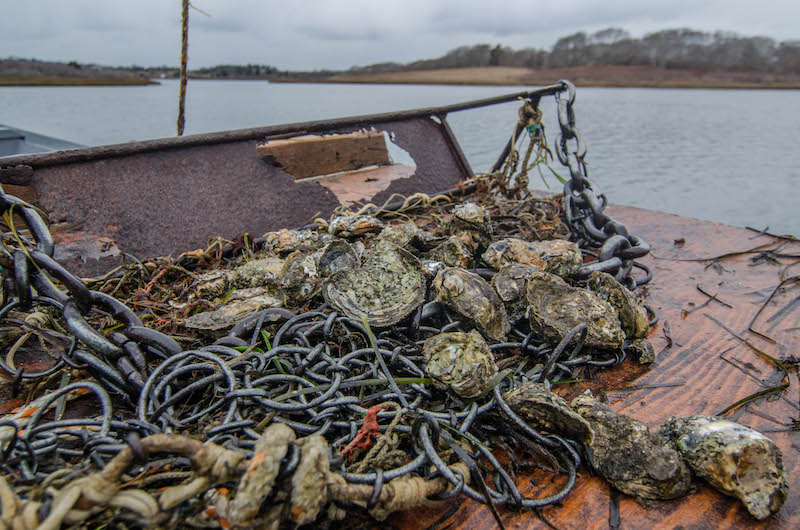
After some initial opposition from fishermen in town, we were able to lease 100 acres of Tisbury Great Pond bottom. Then we leased a parcel of land on the pond belonging to Mildred Purdom, and built a shucking shed. In 1951, we had a specialized boat made by Luther Blount of Rhode Island. It was designed to fit the needs of dredging oysters in a pond. We named it Deborah June, after our daughter born that April. Johnny hired several young men to help run the boat and dredge the oysters. Kib Bramhall, Tommy Flynn, George King, Albie Scott, Kent Healy and Roland Authier were among some of the young men who spent their first working days dredging oysters from the Deborah June nearly 60 years ago.
Farming oysters is a hard way to make a living, and that was especially true in those days. The winters were colder, and when Tisbury Great Pond froze over, the dredging — and our income — came to a halt. In early summer the oysters reproduced, and while the spat were in their free-swim phase, the weather was crucial. An early summer storm could wipe out the entire population of those free-swimming, tiny oysters. That meant, that five years hence, when they would have been mature enough to harvest, there would be no harvest.
It wasn’t easy, and we ate a lot of oysters. The year-round population of the Vineyard was only about 5,000 in those days, and not many of the Islanders ate oysters. So we shipped them to Boston to wholesale seafood dealers for $3 a bushel or $6 a gallon. Surprisingly, some of them were shipped back to the Edgartown A&P — there was no local food craze in those days.
For many years I never served an oyster dish to company. I thought of oysters as food for the poor, as we were then. It wasn’t until the early 1970s that I served an oyster stew to a few friends who dropped in on Christmas afternoon. When they were enthusiastic about it, I realized I had a good thing going. I learned how to make a delicious oyster casserole, as well as a few other oyster dishes. Johnny became known for his broiled oysters on the halfshell, and his oysters Rockefeller. Later, when he began to set a few lobster pots and go scalloping in the winter, we rarely served meatloaf or chicken to our guests.
Oyster stew on Christmas afternoon became a tradition that we carried on for almost 30 years. Our elders died, babies were born, and some years we had three generations attending our party. Johnny would dredge a bushel or two of oysters in December, when they are at their best, and then stand at the kitchen sink opening them. It is a skill that I never learned. But on the morning of Christmas Eve, I would turn eight pints of oysters into two gallons of stew, flavored with a little sherry. Over the next 24 hours, the flavor of the oysters and their oyster liquor would mingle with the milk and the cream and the butter and the paprika to produce a tasty wintertime treat for the palate. The dry sherry was the crowning touch.
As the years went by and we approached our eighties, I continued to make the stew, but the effort of getting the oysters and opening them became too much for Johnny. Our party moved around the corner to daughter Deborah’s house, and the tradition, begun in the early 1970s, goes on. Johnny died in 2012, and I moved to an apartment I built onto Deborah’s house.
An average of 50 adults and children, now mostly adults and teenagers, still congregate each year to renew love and friendship after a morning with their families, giving and receiving presents. It is a fitting way to end the Vineyard holiday season.
Shirley Mayhew lives in West Tisbury.
Comments
I would love to get some of
Islander Off IslandI would love to get some of your recipes for oysters
Yes, please share some
Dan ObYes, please share some recipes! Amazing story. Thanks for sharing.
Thanks for sharing your
Allouise MorganThanks for sharing your memories and traditions...I very much enjoyed reading them.
Enjoyed reading your article
Barbara Wilcox Surprise, AZ, Anaheim, CAEnjoyed reading your article on this Christmas morning. I just discovered I too can trace my line back to the Mayhew family through my Mother's line, Downing, Hillman, Silas Hillman married Susannah daughter of Jeremiah Mayhew, 1705, John, 1675, Rev. John, 1651, Rev. Thomas, Jr., 1618, and Gov. Thomas Mayhew, c 1593, England.
Shucking Shed on Middle Coomb
Mr. B ChilmarkShucking Shed on Middle Coomb is still there; dangerously dilapidated, but still there. Lots of memories in that place. My mother used to complain about Johnny Mayhew dive bombing the house. I used to have some shares from the Shellfish Company from my father's files. Maybe I still do.
I remember going out to the
Albie Scott Newburyport, MassachusettsI remember going out to the pond with my father. The shack, the dredge, the oyster shells. I remember it being cold. And who could forget the various ways we ate oysters during the winter. For decades I couldn't bear the thought of eating an oyster.
Thanks Shirley, I really
Jack GThanks Shirley, I really enjoyed reading about your life on the island and your holiday traditions.
Lovely story, thank you. For
Frank Partel Bryn Mawr PALovely story, thank you. For several years my grandfather had a small farm in St Michaels, MD on the Choptank River. He would have a local oysterman periodically drop a bushel of oysters off the end of his dock that would be subsequently tonged up as wanted. I do remember a few cold, gray days, a duck blind not faraway, visiting in winter and helping him with this well-treated task.
Wonderful story. Thank you.
Tom M AquinnahWonderful story. Thank you. Please share some of your wonderful recipes.
Enjoyed the article by
Sue WachenheimEnjoyed the article by Shirley Mayhew. My family spends time in Chilmark.
Love, love, love the story
Charlena Seymour Oak BluffsLove, love, love the story and the oyster stew tradition. Please share the recipe. Let's make it together. Thanks
As an oyster farmer for 35
Peter Becker Port Angeles WAAs an oyster farmer for 35 years we to did Oyster Stew fromthe recipe I jearned from my mother in Hingham. It wasa tradition to go out at midnight on the winter low tide to the beds in front of our house on Little Skookum Inlet in Shelton WA, pick the oysters and wash them in the incoming tide and take them up to the house. Shucking was newyears day.
It started the new year right. As the kids got older, they joined in.. oyster eaters from as soon as they could slurp our tiny Olympias down! We to passed the farm on to our seinor manager in 2010, I hired him just bsck from Viet Nam and trained him and now he is boss. The years go by, I now will pick oysters on a clients beds, at midnight New Years Eve, he lives nearby here, and I trained him to grow rack and bag Pacifics along with his new hanging culture system. Bless all and keep on shucking!
I would love to get your
Lynne Schwabe Morgantown, WVI would love to get your oyster stew recipe. I am Robbie Dietz's wife, and he sent me your article. It is beautifully written and I hope that I get to meet you when I come back to Martha's Vineyard.
I think this is her Oyster
Islander On IslandI think this is her Oyster Stew Recipe
It was published in one of her articles and I saved it
Oyster Stew
1 pint oysters
2-3 tbls. butter
1 ½ cups milk
Dash of paprika
½ cup light cream
Jigger of dry sherry
Put oysters, milk, and light cream into top of double boiler. Add butter and paprika and cook over medium heat until butter is melted and the oysters rise to the surface. Don't cook too hot or too fast, or stew will curdle. Add dry sherry to taste. Makes 4 cups.
That's it - and it was
Shirley WTThat's it - and it was delicious this year with Edgartown oysters!
Shirley- the Bellissimo's are
Mike Bellissimo West TisburyShirley- the Bellissimo's are honored to now be a part of your island tradition! Best of health to you in the new year!!
Add new comment