

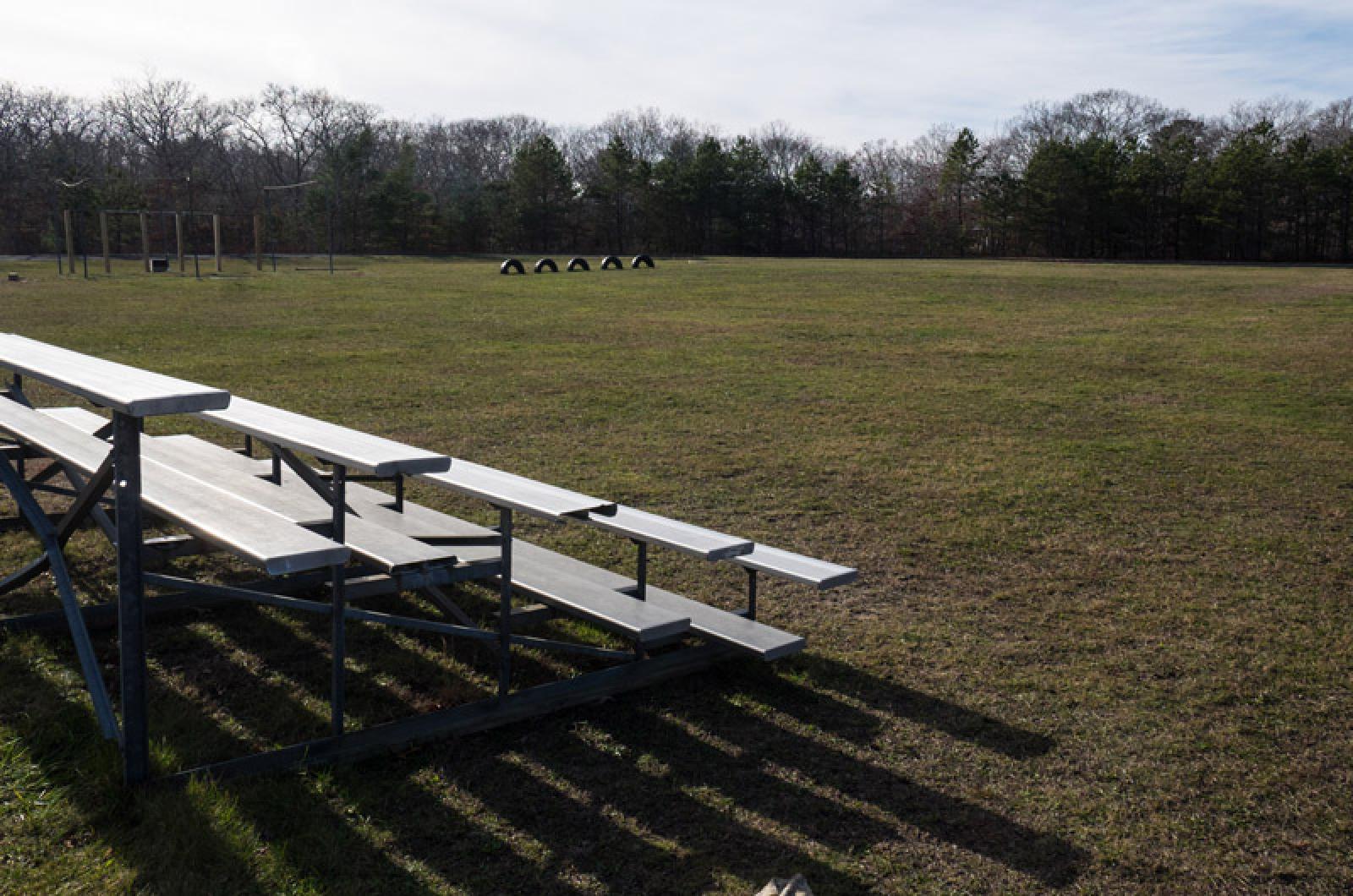
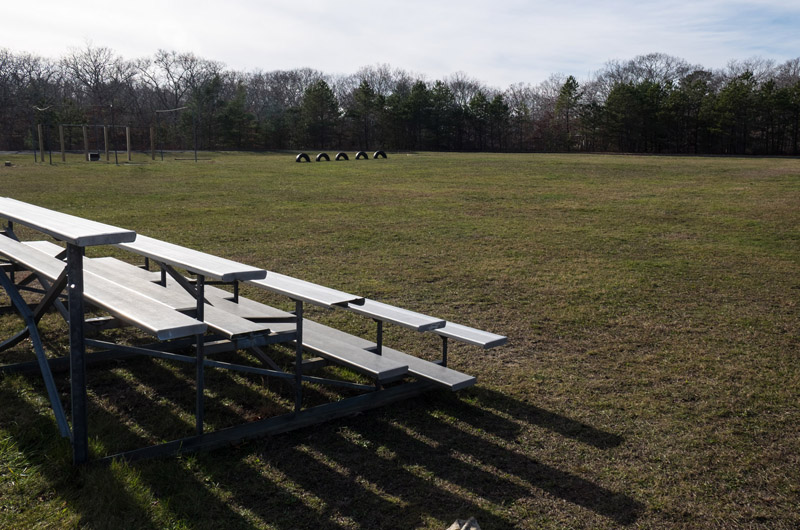
As developers of a proposed athletic complex at the high school prepare for a review, speculation continues around the effect of artificial turf.
As the developers of a proposed athletic complex at the Martha’s Vineyard Regional High School prepare for a highly anticipated public review next year, speculation continues around the effect of artificial turf playing fields on the Island.
Martha’s Vineyard Commission staff members plan to meet with attorney Sean Murphy next week to prepare for a public hearing that may begin as early as January. The Chilmark and West Tisbury selectmen, along with the community group MV@Play, which plans to develop the new complex, all referred the project to the MVC this year as a development of regional impact (DRI) amid public concerns.
Tensions have simmered in recent months, with many eager to replace the high school’s aging grass fields with artificial turf, and others just as eager to invest in natural surfaces. A three-phase project including seven new playing fields would start with an artificial field for lacrosse and field hockey and a new track.
Public concern has focused at least partly on the artificial-turf industry itself, which saw rapid growth around the turn of the millennium, but has come under increasing scrutiny in light of potential risks to human health and the environment. Some have also raised concerns about business practices in the region, where public-private partnerships such as the one between MV@Play and the high school have allowed for private bidding and may limit competition among contractors.

Project has been referred to the Martha’s Vineyard Commission as a development of regional impact.
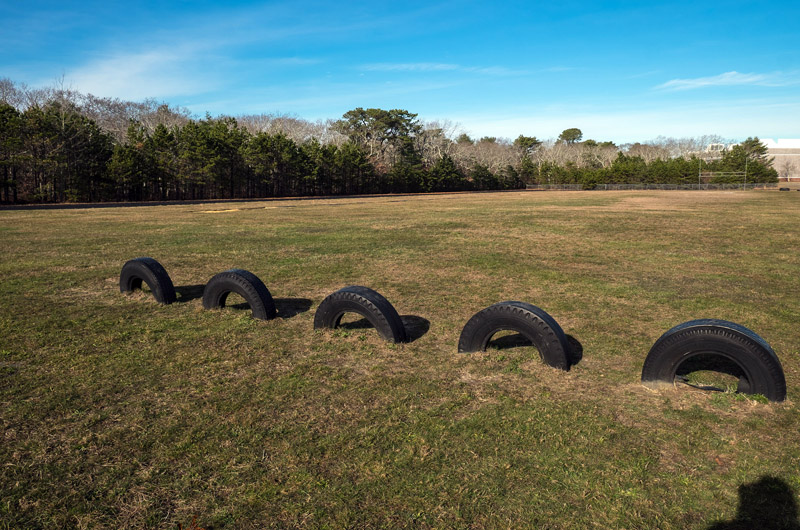
Project has been referred to the Martha’s Vineyard Commission as a development of regional impact.
More than 12,000 synthetic fields are now scattered around the country, including several hundred or more in New England, with mixed results over the years. An observed increase in sports injuries, among other things, has caused some communities and organizations to revert to natural grass, including a number of major league baseball teams. At the same time, dozens of towns and cities are voting not to make the switch in the first place.
Last week, an attorney at The Ferraro Law Firm in Miami sent a letter to Island schools superintendent Matthew D’Andrea warning of what he saw as a new wave of mass tort litigation — akin to widespread legal action against tobacco, asbestos and pharmaceutical companies — on the horizon, with Martha’s Vineyard in its path.
“The consensus within the mass tort plaintiffs’ bar is that it is not a matter of if, but when, synthetic turf litigation will commence,” attorney James Ferraro Jr., a summer Island resident, wrote in the letter. “As we have seen in asbestos litigation, massive lawsuits often drive manufacturers into bankruptcy, leaving premise owners as the only responsible party. In the case of a school, with a fundamental obligation to protect its students, and advanced notice of potential harm, the school will be held fully accountable.”
But others have their own points of view.
“I wouldn’t put too much into that letter,” MV@Play member Robert (Spike) Smith, who spearheaded the efforts at the high school more than a year ago, told the Gazette this week.
In any case, it’s unclear exactly who would be sued, since a license agreement between the high school and MV@Play would appear to free the high school of all liability related to the project. Mr. D’Andrea did not return a call this week seeking comment.
What is clear is that Mr. Ferraro’s warning reflects a growing concern surrounding artificial turf fields. (Chemicals are often present in natural grass as well, including herbicides and pes ticides.) Studies have generally found no elevated health risks associated with artificial turf, although experts have acknowledged that the data is largely incomplete. And as Mr. Ferraro points out, much of the science has been funded by the turf industry.
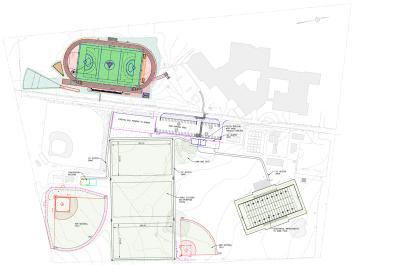
Project to roll out in three phases.
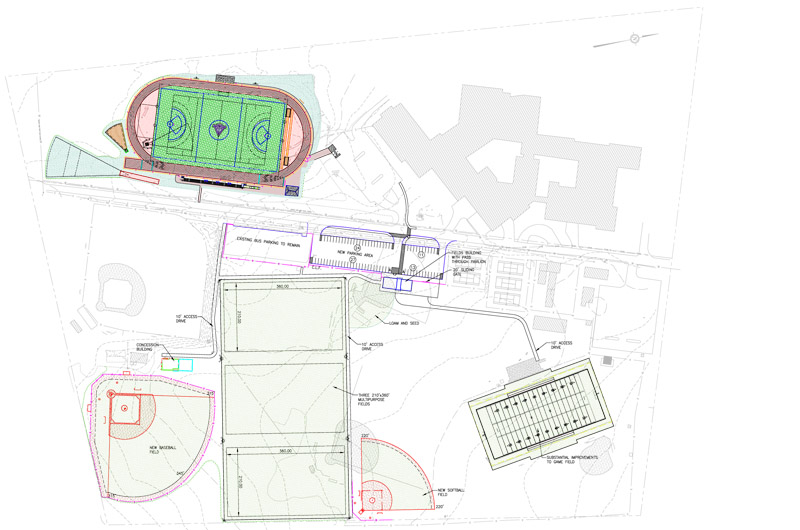
Project to roll out in three phases.
The Environmental Protection Agency, working with the Centers for Disease Control and Prevention and other agencies, launched a study this year looking at the crumb-rubber infill (made from recycled tires) used in most artificial fields. But the study stops short of investigating alternative infill materials such as the kind proposed for the Island, and the different varieties of artificial grass. A status report is expected this year.
The turf industry has voluntarily agreed to reduce the amount of lead in its products, in line with the Consumer Product Safety Improvement Act of 2008. And FieldTurf, AstroTurf and Beaulieu, three industry leaders, have all settled lawsuits in California, agreeing to much steeper reductions. But the industry remains largely unregulated, Mr. Ferraro said, with lead and other toxins still commonly used in the products.
Health risks aside, many communities have sued over breaches of contract, after their artificial turf fields failed under warranty and were not replaced. FieldTurf in particular has come under fire in recent years after installing more than 1,000 fields that contained defective monofilament fibers known as Duraspine. In 2011, FieldTurf sued manufacturer Royal Ten Cate, which has stopped producing the fibers.
Mr. Ferraro pointed out in an interview with the Gazette that FieldTurf’s parent company, the flooring manufacturer Tarkett, has been named in a number of mass tort lawsuits related to asbestos. The company has since replaced more than 240 of its defective fields.
The Vineyard proposal is perhaps among the more progressive in the state, calling for an organic infill that has been on the market only a few years. But a final plan will likely come only after the MVC review. Project manager Kathy Hervol of Gale Associates, which is designing the project, said she knew of only three other such fields in the state, all designed by Gale using an infill produced by carpet giant Shaw Industries. But according to a company document on the Gale website, the Geofill material has some drawbacks of its own, including a need for hydration, a shorter lifespan and lower stability under UV light — one defect cited in FieldTurf’s lawsuit against Ten Cate.
As with FieldTurf, Gale Associates specifies an eight-year warranty for its fields, but Ms. Hervol said it’s up to the contractor to honor the warranty. MV@Play has yet to choose a contractor for the Island project, although its agreement with the high school allows it to bypass public bidding laws and choose the company it desires. The group would essentially take ownership of the property and give it back when the project is completed. Mr. Smith said R.A.D. Sports of Rockland was the top choice, but that may not be final until after the MVC review. “They are the premier contractor in this area,” he said.
Ms. Hervol said the question of whether the project would be bid publicly or privately was out of her hands, and that most projects she has managed at Gale went the public route. But even so, she added, it’s often the same five or six companies that tend to bid, and last summer, she said, about two out of five projects that she worked on were given to R.A.D. But she maintained that the decision here was up to MV@Play.
“We probably gave them some recommendations of companies we’ve used in the past successfully,” she told the Gazette in October. “We’ve worked with several that are quite good.”
Editor's Note: This article has been updated to remove comments from a turf consultant that were later retracted.
Comments
"In any case, it’s unclear
WashAbhored Edgartown"In any case, it’s unclear exactly who would be sued, since a license agreement between the high school and MV@Play would appear to free the high school of all liability related to the project. Mr. D’Andrea did not return a call this week seeking comment."
1. All of the parties would be sued and would all potentially be liable. No license agreement can prevent someone from suing the school. =
2. Unless there's sufficient insurance any indemnification by MV@Play would be virtually worthless if they don't have money to pay for the defense or any settlement or judgment.
3. The High School has done a horrendous job of maintenance in the past. If they don't meet the exact maintenance standards required by the manufacturer then they may find themselves solely liable for the problems.
They shouldn't brag about
AnonymousThey shouldn't brag about considering Geofill, a corkonut infill. First, it's just FALSE ADVERTISING! It's only organic in the same sense as asbestos, coal, limestone, etc. Secondly, it just trades one set of carcinogens (tire crumb + silica sand dust) for another (even more silica sand dust required for corkonut). It requires between 60-90% silica sand, a known carcinogen! Even on the MSDS specifically for the infill product, it details that the silica sand comes complete with dust. AAP says silica sand is dangerous for kids to play with in a sandbox, so imagine kids rolling around, faces into it! For a picture, check out Patriots versus Seahawks game 11/13/2016. Every step, every fall, you see players kick up dust and roll in it. OSHA just lowered allowable levels of silica sand dust for workers, yet our athletes have nothing! Corkonut also requires a ton of chemicals for maintenance just like all synthetic turf, still has temps of 140 degrees and higher, you'll still get the 7x Staph/MRSA, lead exposure, 88% higher ACL injuries, abrasions where layers of skin are torn off (turf burn). I'm sorry, that's not good enough! Not to mention on average, 3.5 tons must be replaced EVERY YEAR! Where do you think that goes? The only truly safe surface is REAL GRASS - dont our kids deserve the best? Tom Brady, Ben Roethlisberger, Abby Wambach, Sydney Leroux, all MLB except 2 teams, David Beckham and a ton more NEED REAL GRASS and HATE SYNTHETIC TURF. Come on!
Why would the school system
Concerned citizen Oak BluffsWhy would the school system potentially put children and their health at risk? Why would they take such unnecessary risk with tax payer money? This is concerning at many levels, and there has to be accountability. "The juice is not worth the squeeze."
Whatever they do the game
Concerned third partyWhatever they do the game field needs to be fixed, the potholes on that field are very comparable to the ones on your route to providence while on the highway. Being a former lacrosse player I can recall many knee and ankle injuries due to the massive pot holes.
Has anyone asked the student
CuriousHas anyone asked the student athletes what they would prefer to play on? As the primary users, perhaps they should be able to participate in the selection. They are educated youth after all.
I appreciate the sentiment
Stefan Knight Vineyard HavenI appreciate the sentiment here but, what kid doesnt want a new toy? The plastic fields might look cool but not a great health choice. The kids would likely choose cool over health...if I refer back to my teenage years. I also, do not see the kids as educated on the nuances of this issue. Aside from the fact that human brains dont fully develop its center for well considered choices till age 25...again referring back to my own youth. Respectfully.
Absolutely right Stefan! Very
Anon1Absolutely right Stefan! Very good point.
Now might be the time to ask
Marty Milner Flowery Branch, Ga. 30542Now might be the time to ask Island parents if they will allow their kids to participate in sports on an artificial surface. Finding out that they won't- after the fact- seems like very poor planning and a total disconnect between spending money and getting value for the purchase. I believe that 80% of the parents whose kids will be playing on the surface, now live on the island. Ask them and their kids to make the call. If you build it they might not come.
Um, the beaches that line the
Anonymous2Um, the beaches that line the island are composed of - silica sand. The material you see kicked up in games on artificial turf is of course macroscopic - otherwise you could not see it - and is mostly composed of the tire crumb used most often in such fields. The risk of silicates is thought to be from sustained exposure to respirable silica dust - particles too small to be seen that can be inhaled and make their way to the distal lung. This dust is primarily generated in industries where sand is crushed, sprayed, blasted, tunneled, etc. - in other words, when particulate sand is ground into smaller particles and aerosolized. There are risks from synthetic fields that should be balanced against the benefits, but silicate-associated diseases are unlikely to be significant. If you are truly worried about that problem, better stay off the beaches where the waves break, crushing and grinding silica particles and aerosolizing them.
https://www.osha.gov/OshDoc/data_General_Facts/crystalline-factsheet.pdf
As I understand it, on the
Stefan Knight Vineyard HavenAs I understand it, on the beach the moisture prevents the fine particulates from becoming airborne. Im more concerned about BPA's, lead, mercury and phthalates and all of which will be airborne as the fields run 30-50 degrees hotter than the air temperature. Respectfully.
I ALWAYS prefer playing on
Former MVRHS Lacrosse Player EdgartownI ALWAYS prefer playing on natural grass to field turf. Also, you lose some element of home "field" advantage when you have a turf field that plays just like every other turf field out there. When I played at MVRHS our field wasn't in the best condition but it was OUR field and we knew its irregularities.
What a lot of fuss over a
Dissenter ChilmarkWhat a lot of fuss over a violent and dangerous game -- it's a game folks -- and it hurts the players -- just get rid of it. There is life after football.
Aside from the toxic issue
Stefan Knight Vineyard HavenAside from the toxic issue the cost of this will be a generous minimum of $200,000 per year, per field, IF there are no problems with them. That is a ton of money. I think part of the problem is that we have spent almost NO money on our grass fileds which I assume is because we didn't have the money. Where is this money coming from?
Where do you get $200,000 per
anonWhere do you get $200,000 per year?
Wow Anonymous2! What do you
Anonymous3Wow Anonymous2! What do you think students are doing on the field when they play - tiptoeing! Ha! You said yourself the risk from silica sand is when "particulate sand is ground into smaller particles." Yeah the kids are grinding in their feet, their bodies, their faces. Yeah beaches are actually made of BEACH SAND. OSHA notes that silica sand is 10x smaller than beach sand, which makes it easier to inhale! Quit downplaying the known dangers of a carcinogen and the facts! Why else would this year, 2016, OSHA lower the amount workers can be exposed to? Common sense! Come on! American Academy of Pediatrics says kids should only play with natural beach sand and natural river sand in a sandbox. They specifically call out silica sand as dangerous! Again, watch the 11/13/2016 Patriots versus Seahawks game where you can see the dust for yourself! If they can't play with silica sand in a sandbox, it's even more dangerous being ground up continually on a plastic cancer carpet!
I'm glad to see Islanders
Carol formerly ChilmarkI'm glad to see Islanders considering the risks of installing artificial turf. My little California town did it a few years ago, & now everyone hates it (especially the players!), but the cost to replace and restore grass is high, so it's being fought out. Ugh. Just maintain the grass field properly.
Having a consistency on a
George Stein EdgartownHaving a consistency on a playing field eliminates injuries and promotes fair play. All the comments using an alias eliminates actual passion or commitment to our student athletes . I am thrilled to see the issue addressed and that we have a person running the facilities there is is up to the fight of what is best long term. How many times has a person been in this role just to throw their hands up in the air and leave ?
Perhaps I missed earlier
Long time summer residentPerhaps I missed earlier articles but how about a bit more balance - i.e some discussion of the reasons why grass would be better, and perhaps some feedback from the manufacturers who were basically slammed with apparently no thought of asking their opinion of any possible benefit to turf. By just reading this article, there would be little reason for anyone to buy turf, yet clearly some organizations have and continue to do so.
Add new comment