


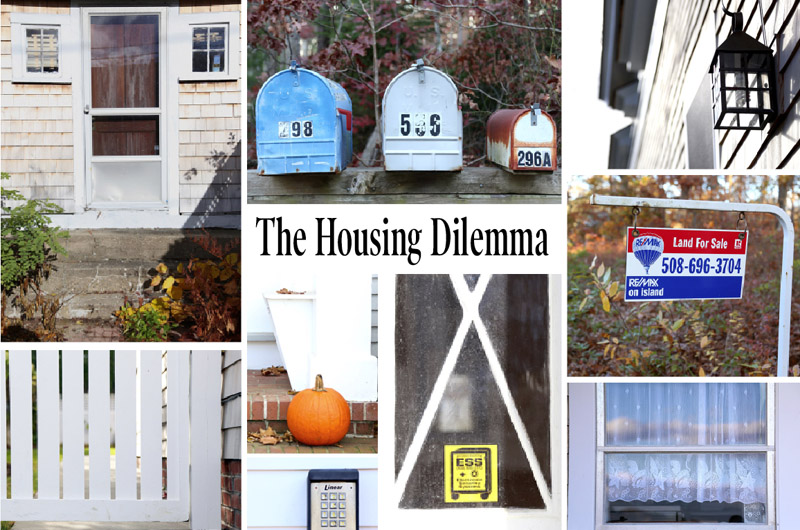
Low wages and a seasonal economy are a recipe for hardship for those looking for housing on the Vineyard and other resort communities, with high-cost second homes raising prices.
Merrily Fenner had a heavy heart the day she sold her family home in Vineyard Haven. Sentimental feelings aside, she knew that it would mean evicting her six tenants, including a young couple from Brazil she has come to know over the years.
She said the sale came quickly this summer.

Because the couple does not speak English, Mrs. Fenner got on the phone with friends and reached out through social media to help them find another home. But she said the only offers were a step down in size, with monthly rents at least twice the $800 she had charged for a separate cottage on the property. The couple eventually found a temporary arrangement in Edgartown, but the future is uncertain.
“My heart absolutely broke for these kids,” said Mrs. Fenner, a lifelong Islander who has seen as many as 100 tenants come and go over the last 20 years. “One of the hardest things that I have ever had to do was to go down there and say I’ve sold the house.” She was glad at least that it happened in the fall, rather than in the spring, when the couple would have faced a much tighter rental market. “It would have been abominable,” she said. “They may not have even been able to stay on the Island.”
Housing problems run deep on Martha’s Vineyard, where low wages and a seasonal economy can create a recipe for hardship. It’s a similar story in resort communities around the country, where high-cost second homes tilt the scales of the real estate market, raising home prices across the board and creating a burden for workers and retirees.

For many Islanders, the sting is sharpest in April and May, when rents skyrocket for the summer and tenants find themselves scrambling for housing they can afford, on or off the Island. Some turn to friends, word of mouth and social media, since landlords tend to shy away from advertising to avoid the inevitable flood of inquiries that follows. With the fall may come a sigh of relief, as crowds disperse and rents return to off-season rates. But it’s not always an easy transition.
Plans to vastly increase the Island’s year-round affordable housing stock through the development of state-certified housing production plans began this year. But whether those efforts will succeed in a community largely defined by its seasonal character and high-end real estate remains to be seen.
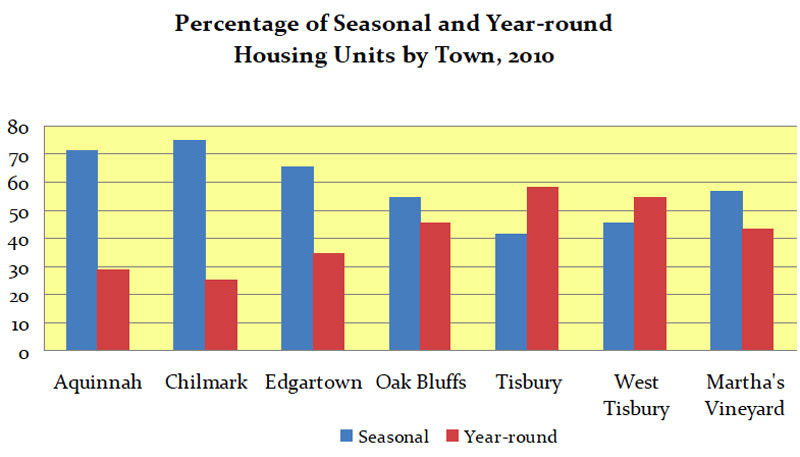
There is evidence that a booming second-home market has worsened housing insecurity on the Vineyard in recent years. According to the American Community Survey, which provides a five-year snapshot of trends, more than 65 per cent of all new homes built since 2010 are vacant in the winter. A lack of dedicated rental developments means that most year-round rentals are in private homes, which themselves may get swept up in the housing market, as Mrs. Fenner’s was this year.
The Joint Center for Housing Studies at Harvard University notes an uptick in construction nationwide since 2010, but a decline in rental affordability, with a record 11.4 million households paying more than half their incomes on housing. High-cost coastal communities such as the Vineyard are feeling especially squeezed.

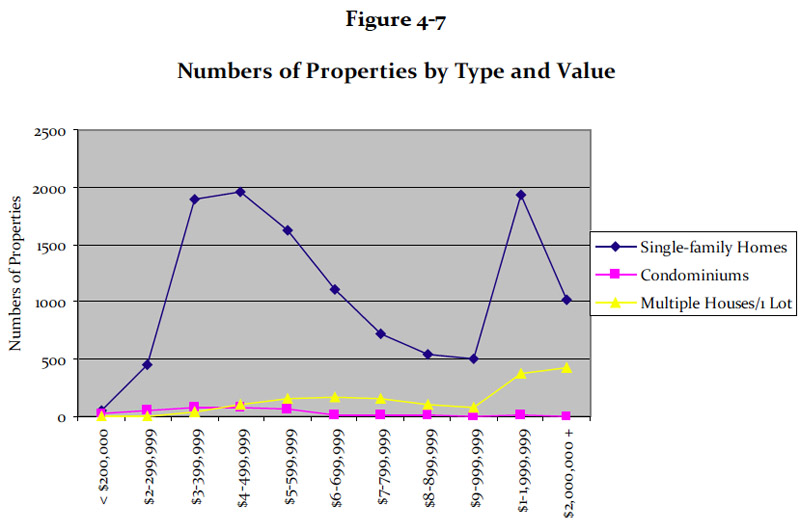
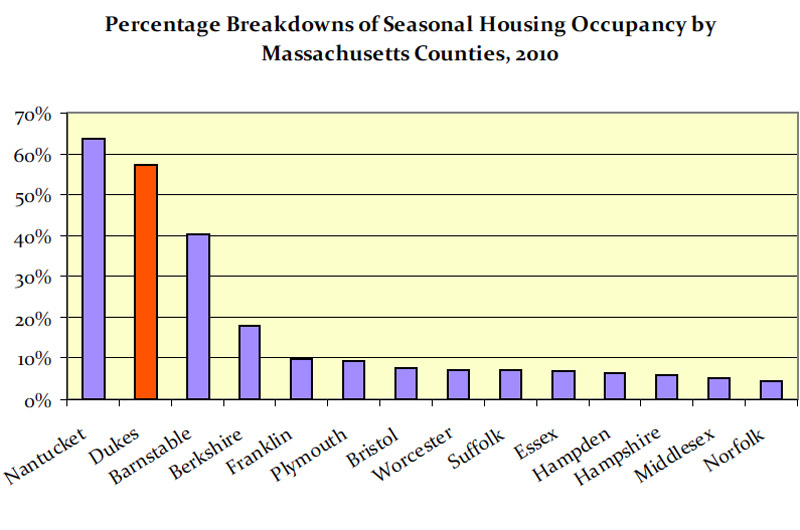
A widely accepted principle stemming from the National Housing Act of 1937 states that households should pay no more than 30 per cent of their incomes on housing. The term affordable housing also typically applies to households earning less than 80 per cent of the area median income, although different communities often set their own goals. (The median income for a family in Dukes County is about $86,000). Based on the 30 per cent rule, a two-person family earning median income would still fall about $225,000 short of being able to afford a single-family home on the Vineyard, according to a 2013 Martha’s Vineyard Commission housing needs assessment. Statewide, only Nantucket had a wider gap — around $646,000. In Barnstable County, the figure was about $31,000.
Less drastically, the average monthly rent on the Vineyard ($1,461, according to the American Community Survey) is about 30 per cent higher than on the Cape. Recent data collected for the housing production plans shows that the Vineyard has more unaffordably-housed homeowners than renters. But low wages and other factors make year-round rentals a clear priority on the Island.
According to the housing needs assessment, closing the affordability gap in all markets on the Vineyard would require annual subsidies of about $10.275 million.

The same basic factors apply to resort communities everywhere. Martha’s Vineyard, Nantucket and Block Island, for example, all experience summer and fall housing migrations, known colloquially as the Island shuffle. Even thousands of miles away, a strikingly similar situation exists.

“This is the same problem all over the country,” said Scott Loomis, director of the nonprofit Mountainlands Community Housing Trust in Park City, Utah, a small resort town made famous for hosting events in the 2002 Winter Olympics. As with the Vineyard, Park City’s seasonal economy supports a thriving second-home market where many low and moderate-income households, including year-round workers, struggle for a toehold.
“If you look at the newspaper — how many homes are over six, eight, 10 million dollars, it’s just page after page after page,” Mr. Loomis said. At the same time, he added, rents have nearly doubled in recent years, leading to an exodus of year-round workers who now commute from neighboring communities. The shifting trends culminated in 2014 with an epic traffic jam during a snowstorm that left visitors and workers stranded in their cars for hours. Dubbed Carmageddon, the event finally triggered a concerted push by the town and Summit County to develop more workforce housing.
The town and county have also been working for years to boost summertime activity such as rugby and baseball tournaments to support a more year-round economy.


With more jobs will come more housing, Mr. Loomis said, and hopefully vice versa. But as on the Vineyard, the low-paying jobs typical of resort communities are a hurdle to affordability. Even with the average hourly wage climbing from around $10 to $15 in recent years, Mr. Loomis said, every employer in Park City has trouble finding workers. “It’s a problem that isn’t going to get better until wages catch up to the real estate prices,” he said.
On the Vineyard, incomes doubled between 1990 and 2010, according to the 2013 housing needs assessment, but wages were still only 71 per cent of the state average. Likewise, employment in Dukes County has expanded dramatically since 1990, but mostly in the low-paying service industry, where many jobs disappear in the winter.
John J. Ryan, an affordable housing consultant in Amherst who has issued multiple reports for the Vineyard, most recently for the Martha’s Vineyard Commission’s 2009 Island Plan, emphasized the importance of shifting resources from seasonal to year-round economic activity to support the Island community.
“The more resort-related industries you create, the more problems you have with affordable housing, because the resort-related industries don’t pay well and they’re seasonal,” he said. “If you don’t balance the economy, you are just accepting that the problem is going to be there forever.” He estimated that seasonal residents and visitors account for up to two thirds of all spending on the Island, and agreed the shift away from a seasonal economy wouldn’t be easy.


“The issue really comes down to what is the core part of the community that you’d want to make sure is there in January and February, and how do you ensure that they can do that,” he said. “What do you want the Island to look like in the wintertime?”
Along those lines, many towns on the Cape have already developed official housing production plans, which include a goal of 10 per cent affordable housing stock in each town, as outlined in state general laws. On the Vineyard, housing production plans are now underway in all six Island towns, and for the Island as a whole. A third round of public workshops this month will contribute to the final reports expected in February.
For better or worse, the struggle for housing has long been as much a part of Island life as the changing tides — characterized by periods of greater or lesser concern, depending on the national economy, demographics and other factors.
Outgoing Cape and Islands state Rep. Timothy Madden recalled taking office seven years ago in the thick of the national recession, when a stagnant economy had made affordability slightly less of a concern on the Vineyard.
“When the recession hit, all of a sudden that freed up some housing,” Mr. Madden said. “People were leaving because they had lost their jobs or they just couldn’t make a go of it and were kind of chasing after other opportunities.”
Now nearly eight years later, the pendulum has swung again. “We are back in the middle of a boom,” Mr. Madden said. “So once again we find ourselves struggling with housing. I think that is a cycle that will be endless unless we do something about it.” He continued: “It’s not just the Islands that are struggling. It’s the Cape that’s struggling. It’s actually going on in Boston and everywhere else, where there is a lack of affordable housing. How do we keep younger workers, but also people who aren’t in the upper echelon, as far as income goes?”
On Cape Cod, Heather Harper, the incoming affordable housing and community design specialist for the Cape Cod Commission, expects housing issues to take center stage as far as planning and initiatives in the next decade, beginning with a regional market study next year.


“What levers can we push as a region — from a land-use standpoint, from a regulatory standpoint or financial incentive standpoint — that might make it feasible for developers to start rebuilding that middle market?” she said. She noted a growing awareness surrounding housing issues on the Cape, but also the complexity of finding solutions in light of the region’s dependence on tourism.
“We are really recognizing that housing to support the needs of all age groups, life stages and incomes is a huge and lofty goal, and it will remain a goal,” she said.
But the goals aren’t set in stone, perhaps especially in resort communities, where much of the need extends to higher-income earners. Anne Kuszpa, director of Housing Nantucket, which targets households earning up to 150 per cent of the area median income, pointed out that the state’s 10 per cent goal for communities relates only to households earning up to 80 per cent of the median income. Especially on Nantucket, she said, where the median home price is about $1.2 million, the state goal falls well short.
Mr. Ryan called the 10 per cent goal “ludicrous” in light of the actual housing need on the Vineyard, which spans a wide range of income levels. He also pointed out that the goal does nothing to address the longstanding absence of affordable housing in the community. But he said it was a step in the right direction.
Looking back to his first comprehensive housing assessment for the Island in 2001, he cited a long-term community vision that he said targeted a range of housing needs and was unique at the time. The report also helped set the stage for widespread fundraising and a variety of housing initiatives on the Island.
“There was buy-in to the idea that this is not just a charity,” Mr. Ryan said of the public response to the report. And despite the limitations of a seasonal economy and other obstacles, he said he believes the Island is still on the right track. “This is an effort to preserve community,” he said.
First in a series examining the housing dilemma on the Vineyard.
Comments
It's called GREED, just like
charlie callahan so boston/edgartownIt's called GREED, just like where I grew up, the locals can't afford to live there anymore,the vineyard is the same way
Housing prices are set by the
MarieHousing prices are set by the market. Supply/demand alway plays a part. How is this greed? Who are you referring to?
The Island needs a comprehensive housing plan.
Beg to differ but providing
edgartown workerBeg to differ but providing "affordable" i.e. publicly subsidized housing is exactly opposite to prices being set by the market. Please realize that business interests - the advocates you're reading about - are primarily interested in publicly subsidized housing in order to depress wages.
The 30% figure is not "widely
EhThe 30% figure is not "widely accepted as accurate." It's merely a holdover from a federal entitlement program in the New Deal, which also has the appealing characteristic of being simple to calculate. Everyone uses it because it's widely used (a circular affair) but it isn't actually a good measure.
looking at a complex housing situation should require more than oversimplified calculations.
Maybe ,it's time to rethink
Abraham Seiman Oak Bluffs, MAMaybe ,it's time to rethink priorities on M.V. Post-high school education, job training, developing small industries,
tax break incentives for the year-round population,etc., should be more important than catering to the business
interests on the Vineyard. I remember when the Vineyard was a place to live and not a summer resort.
Please clarify Business
John Randolph TisburyPlease clarify Business Interests. How do they differ from the economic initiatives you espouse?
Unaffordable housing, little
GroganUnaffordable housing, little work. Why are people choosing to live here then??? There are thousands of towns across the country where life is a million times easier. Go there.
I can't feel bad for these people when when my own family has faced the issue and headed for the mainland one-by-one over the past century. No one cared when they struggled and then eventually left.
Abraham Seiman you talk about
Not in my backyard. Martha's VineyardAbraham Seiman you talk about tax incentives for year round population and then mention it should be more important than catering to the business interest on the Vineyard. You forget to remember that they are one in the same. The people that live here year round ARE the small business owners you talk about.
The business interests are the one's that also pay a disproportionate amount of tax and fees. Be it collecting these fees or paying them outright. The businesses pay meals tax and hotel tax, a portion locally received, not all sent to the state. Those businesses you call not as important are the ones that employee people (jobs) which in turns provide wages to the those people looking for housing, those businesses you say that are less important are the ones that supply donations to organizations for their fundraising and running of island wide agencies such as Community Services, Center for Living, Island Affordable Housing Fund, Island Housing Trust, Meals on Wheels and hundreds more.
Our priorities might be skewed in the way we approach housing but they are not skewed in how we approach people.
Mr. Seiman I beg to disagree
skip obMr. Seiman I beg to disagree on one issue; The Campgrounds (420ish homes), Cottage City (350ish homes) and 2 dozen other developments--built speculatively for summer living -- all came before Oak Bluffs became a Town. The title of Henry Hough's book "Martha's Vineyard, Summer Resort 1835 - 1935" says it all.
Much of the reason housing
Stephen G Devine Oak BluffsMuch of the reason housing production does not happen is because of the bureaucracy that a developer must go through in order to build anything. All one has to do is to look at the agencies listed at the bottom of the recent ads run in the local newspaper advertising the public hearings. That made me stay away. The time & money a developer must spend to develop housing is not worth it. Meanwhile projects like the "preserve" that take up large swaths of land are very inefficient and wasteful use of land. More cluster housing is needed on the island.
And then there's the shadow
Al Seidman EdgartownAnd then there's the shadow issue nobody talks about- there are housing units intentionally left off the rental market because landlords have had enough with "anything goes", irresponsible tenants and rental laws that allow them to ruin a house and squat for months the while the creaky legal process drags its heels with evictions. It's a hard truth no body wants to hear.
And now we can cue the old
Cal Hardwick Oak BluffsAnd now we can cue the old saw about "we won't have any teachers, firemen, police officers, nurses, etc."....Yes, we will. They will simply be drawn from the existing ranks of property owners here. The laws of supply and demand take care of these things better than committees. It is truly a shame when good people get caught in the teeth of a terrible housing market, but relocation is a constant flux of humanity and the island isn't immune to it. Compassion is called for, but so is sensibility.
It's very hard to afford to
BS OBIt's very hard to afford to live here. If you're not up to the challenge that's fine. Go to where the housing prices match you're skills to make a living. This is nothing new, this is reality.
The snobs on the vineyard don
mark wyman edgartownThe snobs on the vineyard don't want working class people in their neighborhoods. If they had their way they would bring them in in the morning and ship them back to wherever at night. Not all but a lot of the phoneys on this island feel that way. The last thing many of the phoneys on this island want is affordable housing near them
Intriguing.....perhaps we can
Rex Treadwell EdgartownIntriguing.....perhaps we can look into leasing shuttle boats from the mainland. There really is no benefit in housing lesser people on the island when they can be brought in and then returned to where they belong.
Is the island obliged to find
Islander TooIs the island obliged to find or provide housing for everyone who decides this is a nice place to live and they want to stay/live here year-round and raise their families here?
Something that I wish would be factored into the housing discussion is that many of the "businesspeople" and "employers" are actually, at one or two removes, rich people who have second homes here. They are users of catering/landscaping/pool cleaning not to mention construction/architecture and other services that the members of the 1% need. They have arrived here en masse and created a demand for these types of services, businesses, and jobs. In one sense this dynamic is a market phenomenon, but in another it is not, since many of the features that draw the 1% here are either natural, are natural but strongly enhanced by nonprofits and government actions (land and farmland conservation, etc.) or have also been enhanced by nonprofits (arts, community centers, historic preservation, successful maintanance of picturesque waterfronts, etc.). So far it seems to me that this dynamic factor of market forces unleashed by the 1% that seems to increase the population in need of housing has not been part of the housing discussion. The only appearance of this dynamic in the discussion is that housing and land prices are driven up. IMO, it is not sufficient for this group of rich people who profoundly affect the economic and housing profile of the Vineyard to make donations to the IHT so that housing developments can be built far away from their compounds. Perhaps houses over a certain size should be viewed as kernels for cluster housing and permits should require that on-site housing be provided for staff and other service people, or simply a unit of affordable housing. To me this would make far more sense than killing the goose that lays the golden egg by diverting Land Bank fees to affordable housing.
Tax break for year rounders
NanTax break for year rounders is the fact that most homeowners do not live here year round. Paying for schools and programs that we will never use. The subsidy is there.
Add new comment