

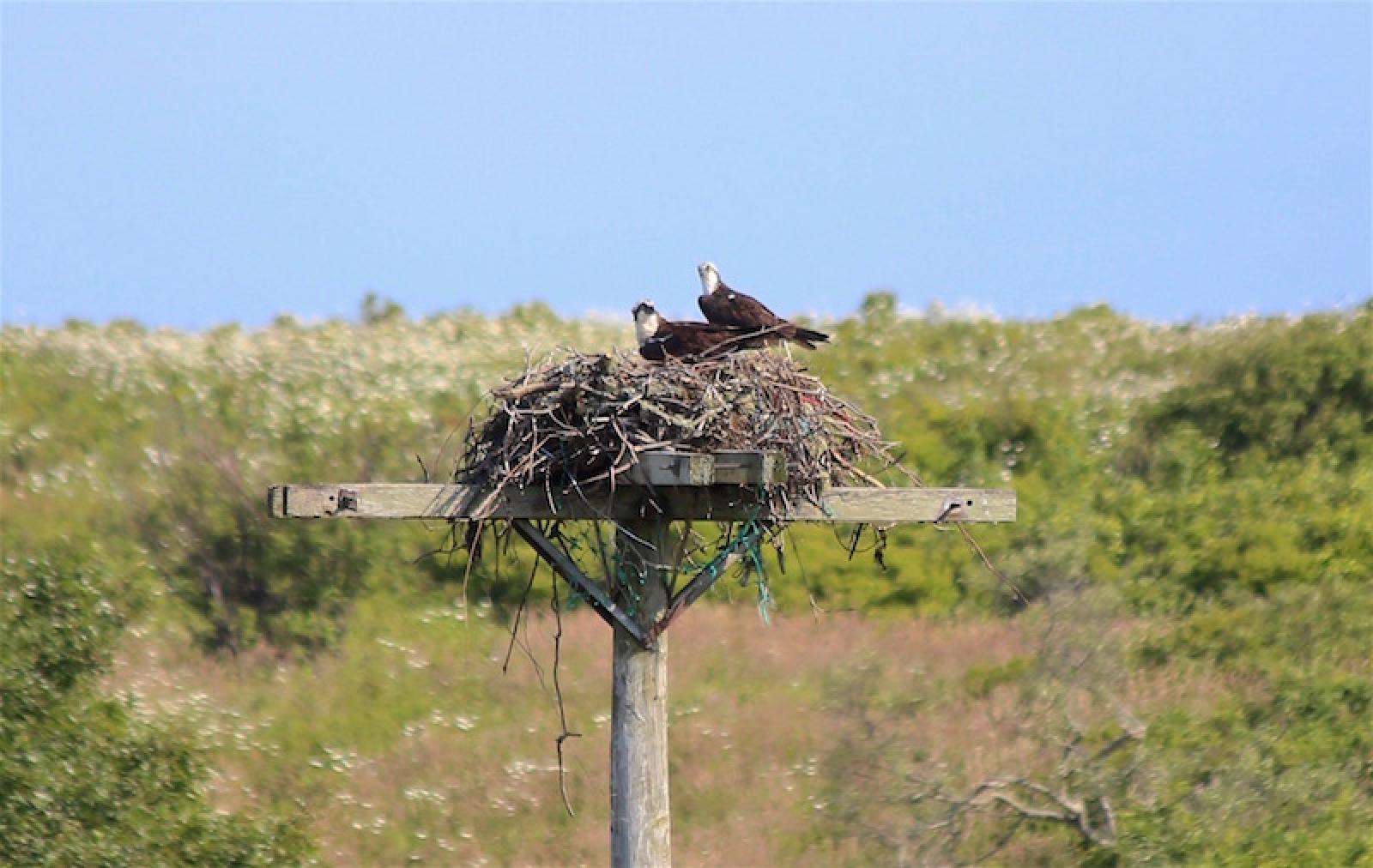
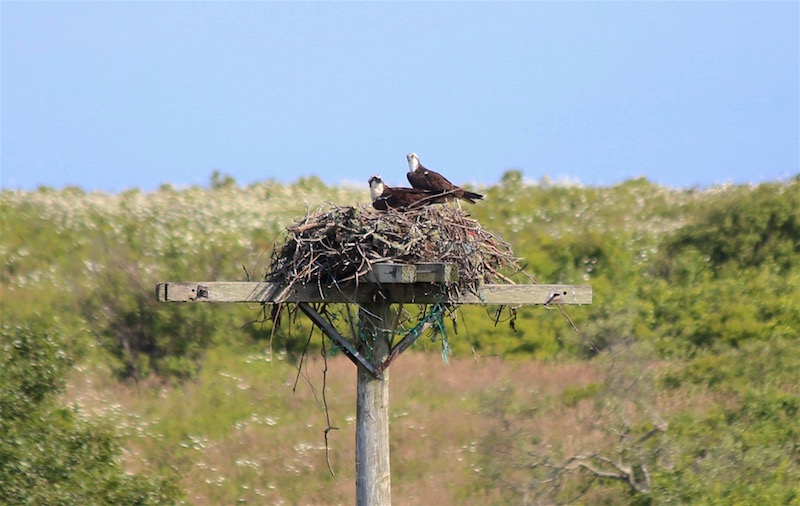
<p>With record numbers of nests and chicks successfully fledged, 2016 has been a banner year for osprey on Martha’s Vineyard.</p>
With record numbers of nests and chicks successfully fledged, 2016 has been a banner year for osprey on Martha’s Vineyard.
Ninety active osprey nests have been observed this year with 144 osprey young raised and fledged, according to a press release from Felix Neck Wildlife Sanctuary. Both are record numbers for the sea hawks, which have rebounded from just two pairs reported on the Vineyard in 1971.
More than 85 per cent of nesting osprey this year successfully raised young. There were also six “housekeeper” nests, or adult birds that nested but did not complete the nest or lay eggs. Between adults and young, there were 336 osprey on the Island this summer.
This year’s successful breeding season continues an upward trend for the majestic birds. Last year 87 breeding pairs were counted Island-wide, a record at the time, but almost 40 per cent of those nests failed to fledge any chicks.
The once-threatened sea hawks come to the Vineyard each summer to nest and raise their young. Their numbers were once reduced by use of the chemical dichlorodiphenyltrichloroethane (DDT) and their habit of nesting on (and being kicked off of) utility poles.
Local naturalist Gus Ben David led an effort to build osprey poles, creating safe nesting places for the birds. There are now 200 osprey poles around the Island.
The osprey population’s recovery has been documented by Vineyard biologists and volunteers, including osprey researcher Rob Bierregaard and lead osprey monitor Dick Jennings, who have been counting the birds and following their nesting efforts. Mr. Jennings has single-handedly run the annual osprey census for several years. This year, for the 19th annual census, he was joined by 27 volunteers who received training at Felix Neck and logged 1,800 hours working on the project.
Mr. Bierregaard’s work includes tracking the osprey through small transmitters attached to the birds as they fly south to the Caribbean and South America for the winter months.
Comments
Thank you so much for the
Karen Robeson Marysville, OhioThank you so much for the update. We are new to
osprey watching and so happy to hear this good news. Thank you for all you do!
Thanks for all the work you
Rick Hughes Dover, NHThanks for all the work you do for protecting the osprey. We humans need to take a moment now and then to marvel at many other creatures that we share the Earth with.
Our nesting pair raised three
Margot Goodwin Upper Makonikey, WTOur nesting pair raised three young this summer and we often saw (and heard) all 5 indistinguishable members of the family hanging out in the nest at once! Do you know, or is there a way to tell if it's the same pair who come back for several years to the same nest? Does the same pair mate for life? Have any of "ours" in the past near the Upper Makonikey steps ever been tagged? If not would you be able to do that some time? And how on earth do you capture one to tag it??? Thank you Gus and team for setting up our pole years ago! It's given us great pleasure over these many years. [email protected] (Louisa McCullough's great aunt Margot! Have loved her work in the Gazette!)
Dear Margot,
Dick Jennings Vineyard HavenDear Margot,
Regarding your first question; ospreys are creatures of habit and if you watch them closely and take notes, you will be able to determine when a new bird has moved in. Example : I watched a nest on Chappy for many seasons and still do. The male would always come back with a fish and half eat it on a sign post, then drop it off to the female in the nest. After several seasons, the male no longer followed the same steps, but rather went directly to the nest with the fish. No question here about a change in ospreys at a given nest.
Your second question, do they mate for life ? Ospreys fidelity is to the nest, not to one another. Once they pair up on a particular nest site whether it be natural or man made that becomes theirs as long as they survive their annual migration to S.A. When the youngsters fledge, shortly after the female leaves for her winter grounds, somewhere in S.A. and the male could stay on until late September/ early October before heading to his winter grounds. You might say that they take separate vacations.
Spring comes around and the male generally shows up first and begins his task of trimming out the nest and shortly after the female shows up and the process starts all over again with courtship.
Tagging; to the best of my recollection, there have been no ospreys tagged at your nest. As far as tagging one there, I defer to Rob Bierregaard to answer that question. He just reached a milestone in his research by tagging his 103 osprey in Newfoundland, which inccidently is the number of your pole. It certainly is worth dropping him an email and asking the question. I will tell you the transmitters that we have put on these birds are not cheap and i will leave that up to him to discuss with you and that would if he would entertain doing one more.
He's a great individual and do not hesitate one bit to contact him. [email protected]
I didn't intend on writing a novel and I hope that I have been helpful.
Dick Jennings
Typically a pair will return
Rob Bierregaard WynnewoodTypically a pair will return every year to the same nest until one doesn't make it back from migration. When that happens, the surviving member of the pair is likely to accept a replacement mate, so a nest could be occupied for years by what seems to be one pair. The Makonikey pair has not been tagged, and we're no longer tagging new birds. We catch them by placing a trap over the nest. The birds get their toes caught in small snares tied out of fishing line. One can distinguish young from adults by the speckling on the back and wings of the youngsters. All the body feathers on the young have a white edging to them, which makes them look spotted.
Thank you both so much for
Margot Goodwin Upper MakonikeyThank you both so much for responding so thoroughly! (However, "placing" a trap over the nest still intrigues me, don't they freak out and scram before the net gets there?)
First year Mahge and "T" have had 3 surfing offspring. They've had three twice before but one has usually fallen from the nest after a few weeks or whatever...so it was good to see all three made it this year (Connacaseecus, Flamingo, and Rosie this year's names by my granddaughters).
I know they all leave for SA at different times, but didn't know Mahge left first, and all alone! And that the young find their way south without ever having been there before...and then north once again in March. So unimaginable. Thank you both.
Add new comment