

Before his words haunted me, his eyes did. Maybe it was because I couldn’t really see them. They were shaded in mystery behind tinted glasses.
Before his words haunted me, his eyes did. Maybe it was because I couldn’t really see them. They were shaded in mystery behind tinted glasses. Yet they must have been dancing. He was the most animated college professor I ever had. Léo Bronstein. Even his first name flared with an accent aigu.
He taught me all about ancient art history at Brandeis. Born in 1902 in a part of Russia that today is Poland, he spoke at least nine languages, all of them no doubt with fingers flying. He spoke with passion, with an infatuation for his subject and an eagerness to explain. He reacted to every presented slide as if he had not seen it before. In a reverie, he would point out “the blueness of the blue” or “the archness of the line.”
His hair was made wavier from his hands running through it, and he usually wore a tweed jacket, pressed slacks and an ascot. But there was no ego here, just humility before the world’s art archive of nobility, beauty and design. He believed that exquisite taste spoke for itself. He was just the tour guide, not the arbiter.
At the end of this particular course, he planned an outing — a picnic on the Vineyard. It was May, 1962. We came by school bus and ferry to Oak Bluffs, wandered on foot, taking in the sights, the Flying Horses, Cottage City. Our time for touring was limited, especially without wheels. This was the first time I learned the Island was four times the size of Manhattan.
My one and only previous visit to the Vineyard was a year and a half earlier, during a cold January college break. A bunch of dorm-mates piled into a rented car and decided to explore the Island that none of us knew anything about. We tried to drink it all in on a quick day trip, which means we never left a paved road. These city boys returned to the mainland with an open-jawed appreciation and a blur of bucolic memories. We all vowed to come back.
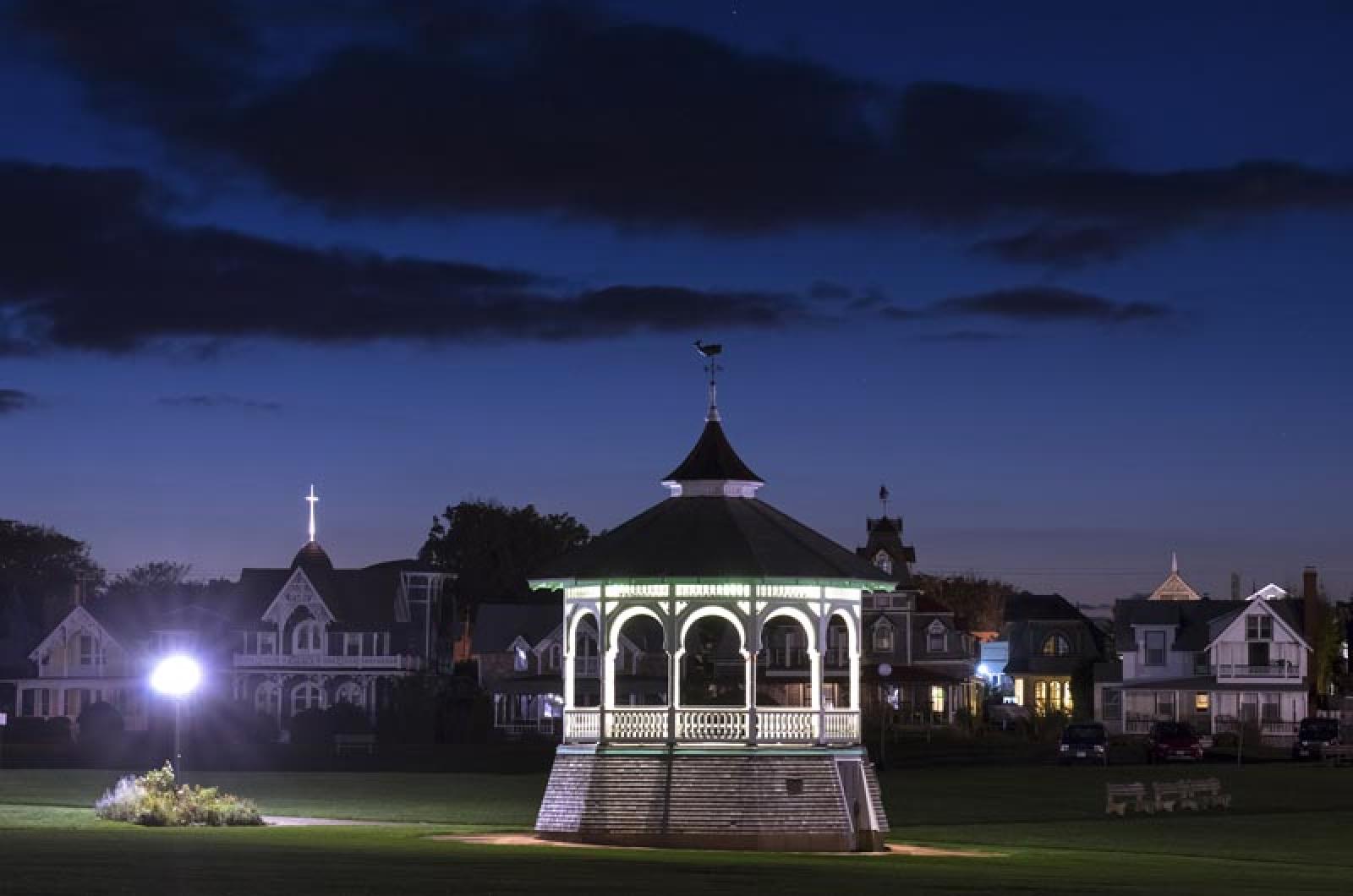
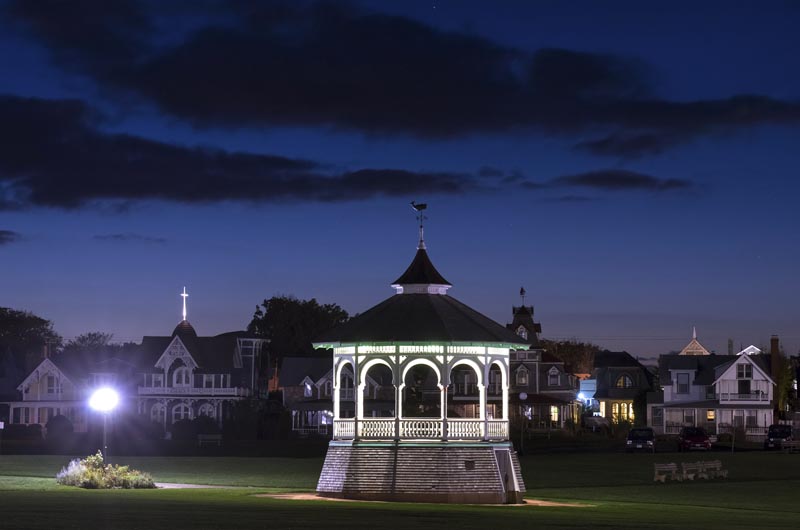
The Bronstein tour picnicked on the grass at Ocean Park. Standing in front of the gazebo and armed with framed enlargements instead of his usual slides, he did a show and tell about Roman sculpture and architecture from the fifth century, the waning days of the empire.
There we were in the spring togs of ’62 — me in my button-down pinstriped Oxford shirt, khakis, and a pair of black leather loafers. This was, after all, the pre-jean, pre-sneaker era. We all brought rolled-up blankets to sit on and brown-bag lunches with thermoses of soda.
Being sophomores, we acted the part and showed off our education by making snide references to Edouard Manet’s famous 1863 painting, Déjeuner sur l’herbe, loosely translated as Picnic on the Grass, in which fully-clothed young men lunch with naked women. A bygone era giggled about an even older era.
Although this class outing to the Vineyard was my only one and I believe Bronstein’s too, this event was the forerunner to a tradition that began in earnest when he retired in 1967. His students gave him a surprise farewell party. The celebration has taken place every year since on or near the campus. Known as Bronstein Week or Weekend, Brandeisians find a way to socialize and culturalize with performances and parties. Bronstein believed in the sanctification of life through everyday celebration. He passed this mortal coil June 1, 1976.
What I learned from his ardor-infused knowledge wasn’t so much ancient art history as ancient history through art. His lectures imparted the social and cultural lessons you needed to understand to appreciate art. At this picnic, he offered his views on why the Roman Empire came to an end. These were the words that haunted—especially today.
“Like so many other civilized societies, they did themselves in,” Bronstein said. “You know there’s a perfect Italian word for this, braggadocio, arrogant behavior!” He told us how destruction came along in many forms, but primarily through overblown egos. “They had their share of leaders toward the end who exhibited more bombast than brilliance, more hot air than cool-headedness.”
This arrogance, according to Bronstein, led to a peculiar mix of might and laziness. When the Romans weren’t out conquering, they were home being complacent.
By the end of the lecture, I wasn’t thinking much about its deeper meanings. I was too busy breathing in and memorizing the beauties of the Vineyard. I took in the panoramic view of the Painted-Lady houses on the edge of Ocean Park, having never seen anything like them before. The experience made me feel as if I had traveled back in time to a better time. I again made a note that I must return and soon. I moved here for good in 2011
And now as I breathe in the Vineyard air on a daily basis, I feel as if I’ve been transported into a comfort zone, a place about as far removed from the concept of empire as a community can be. But when I find myself in Ocean Park again, I am often reminded of that lecture and how it haunted me five months later in what has since been called the Missiles of October, when the U.S and USSR held the world in check by engaging in a blink contest that brought us to the brink of total annihilation. .
I am also haunted today, as the omens sometimes feel as if they are piling up again, when empire leans more to arrogance and bombast instead of brilliance and insight.
Arnie Reisman and his wife, Paula Lyons, regularly appear on the weekly NPR comedy quiz show, Says You! He also writes for the Huffington Post.
Comments
Beautiful photograph!
Appreciator EdgartownBeautiful photograph!
Dear Arnie,
Ronny Meyer New York CityDear Arnie,
Thanks so much for your colorful article that brought Leo back to me and added to what I knew of him.
One day he was comparing a Picasso and a Monet or other impressionist. He likened the comparison to tonal music (one underlying tone which harmonized and atonal music where each area was it's own totally juxtaposed 'against' the others. He said, And Dees tvelve tonal arrangent is one of two great secret of Picasso." A hand came up. Dr. Bronstein, what was the other secret. "Vooman, (woman), he answered with great gusto.
Best wishes,
Ronny Meyer '67
Arnie, I was Brandeis '57,
Jules Bernstein ChilmarkArnie, I was Brandeis '57, and had the great fortune to study with Bronstein too. He was a truly remarkable scholar and teacher who opened the eyes of so many of his students to the wonders of art and so much more. It was a unique period at Brandeis because Abe Sachar, its founding President, assembled a large number of refugee scholars from Europe and gave them a home, much to the advantage of students like us. I will pass your piece on to Brandeis friends who remember Bronstein.
As I read your article, it
Toni Kauffman Burlington NJAs I read your article, it struck me that the Roman Empire and today's society are so similar; Arrogance and complacency centuries later, still rule the world we live in. It's very interesting how the more things change, the more they stay the same.
I too am seeking something else (I think); after years as a guest on the Island, will call it home in September. Can't wait to hopefully simplify, my cluttered life! Or perhaps, the clutter will simply be different! LOL!
Great piece Arnie.
Harry Seymour Oak BluffsGreat piece Arnie.
Braggadocio and bombast
Christine Powers Waltham, MABraggadocio and bombast define the style of Donald Trump. Let us pray that he is not elected as President, lest our country fall the way of the Roman Empire.
As editor and publisher,
Kathryn Knox Soman New YorkAs editor and publisher, along with the late Eleanor Wolff, of Léo's amazing books, it's such a pleasure to read your piece, Mr. Reisman, Léo died when I was in high school so I never had the luxury of meeting him - other than through his work and those who knew and adored him. My colleague, Brandeisian Laurin Raiken,is one of those who has shared many thoughts and feelings about Léo with me. Thank you so much for adding to my Bronstein treasure trove!
I loved Dr. Bronstein's class
Marian Solomon Lubinsky New York, NYI loved Dr. Bronstein's class - but I did have trouble with his accent. I was going in to take the final when a friend told me that the "growing walls" of Gothic cathedrals in our notes were "groined vaults." I often wonder what he would have made of an essay discussing growing walls.
Wonderful article. Thank you
Lisa Johnson Wollaston, MAWonderful article. Thank you for the history! Graduated in 1986 and enjoyed many a Bronstein Weekend.
i am class 0f 55,and a french
marc wiesenfeld santa monica, cai am class 0f 55,and a french jew like bronstein and totally under his spell. of all the great teachers i had at brandeis, he remains the most memorable for his passion for art he passed on to his students. and he was also so modest! thanks so much for reviving the memory!
After my first Art History
Maggie (Schneider) Cohen '60 New YorkAfter my first Art History course with Leo Bronstein, I switched and became an Art Major. We had a wonderful friendship and, on occasion, went out to Waltham together for dinner, along with one other student. We three crowded into the front seat of my old Ford, and as I drove, he rested his foot on the gas pedal... his legs were so long! The car ride to and back was always harrowing as I kept one foot on the brake to counteract his left foot pushing the car forward. He was a life force and an inspiration, not forgotten.
Yes, the 'blueness of the
Linda (Russack) Tobin '63Yes, the 'blueness of the blue' enhanced my sensitivity to painting in 1961 and it still does today. Thank you for bringing back this lovely memory and sharing more about our beloved professor.
For me there was before
Howard Krosnick MontrealFor me there was before Bronstein and then the rest. in 64 I heard about him and audited his classes, watching him dance in the light of the projector like a priest-hunter-chief. In 65 we knew it was his last year. Over 300 of us crowded into his Islamic Art class and our world-view exploded. My girlfriend Julie & I took him out for dinner every month. Driving to his favourite french restaurant in Boston. He ate tripes and brains and so I did too and he glowed describing what new york looked like from the air. He took us to his apartment in Cambridge that was like a personal museum except it was truly lived in. With our friends we helped organize the first Bronstein Day in the Castle Courtyard and he basked in the love of our hippie hundreds, dressed in renaissance clothes and Indian beads, stoned out and dancing in the sun. And then everyone cried, knowing we would return the next year, and he would be <retired>. Over the years I have read and reread all of his books. All he touched came alive. Us too.
Remember "Mobile rigidity"?
Lee Jacobson Toronto CanadaRemember "Mobile rigidity"? Or was it "rigid mobility"? When he spoke about Egyptian sculpture. Many great Brandeis moments.
It was mobile rigidity and he
Kay Mathew Jamaica Plain, MAIt was mobile rigidity and he used that absolutely wonderful contradictory sounding concept when teaching Medieval Islamic art too - one of the few classes I remember at Brandeis. I've kept that phrase with me all these years, it often comes in handy. Searched for his out of print books years ago and have them on my book shelf. Loved that teacher.
I came to Brandeis from a
Barbara Mestetsky White Washington DCI came to Brandeis from a small town in Virginia, and knew nothing about art. I was so enthralled with Bronstein's class "From Looking to Seeing" that I went on to take his introductory art history class. For years afterwards, I'd recall "the what of the how," and I'd silently pronounce the words centripetal and centrifugal as Bronstein did: centriPETal and centriFUGal. At one class, his lecture wandered into the personal: as a teenager, he had tried to enter Spain but was detained because they thought he was actually the communist leader Leon Trotsky, a man at least twice his age. However, both were from Russia, Leo was similar to Leon, and Trotsky's real name was Bronstein. Even though this had happened years earlier, our Dr. Bronstein was still outraged at the stupidity of the Spanish officials. Thanks for the article. It's nice to be reminded of one of the many professors who made Brandeis a great place to be.
Barbara Mestetsky White, '58
What an extraordinary
Abigail L Rosenthal Bucks County, PAWhat an extraordinary coincidence! I've just written a column in my blog about Leo. Here is the address: https://dearabbie-nonadvice.com/2017/08/29/leo/
On my column I have also linked to this great reminiscence. Many thanks to Arnie Reisman and to all these wonderful students of Leo's!
Add new comment