


The set of High Time, the new play that opened at the Martha’s Vineyard Playhouse last week, is an early-1960s suburban interior.
The set of High Time, the new play that opened at the Martha’s Vineyard Playhouse last week, is an early-1960s suburban interior with a kitchen, living room, front hall and jumble of low-fi audio-visual equipment to one side. It was designed by Lisa Pignato and the domestic surroundings give no hint of the psychedelic joys and existential lows that lie ahead for the play’s six characters.
Soft piano music plays. There’s a sofa, of course, with a matching armchair. And there’s a young woman in a lab coat, making notes on a clipboard. This is Lisa Bieberman, dedicated assistant to Harvard researcher Timothy Leary. She is also his lover.

Autumn Chiklis and David PB Stephens.

Autumn Chiklis and David PB Stephens.
The character is waiting for the participants in Mr. Leary’s latest LSD experiment to arrive. Compellingly played by Autumn Chiklis — daughter of TV star Michael Chiklis (The Shield) and an accomplished actress in her own right — Ms. Bieberman is a true believer in the therapeutic powers of psychedelic drugs. LSD can “make clergymen find their belief in God again,” she says.
Ms. Bieberman also functions as the conscience of Larry Mollin’s play, which takes place on the night in May, 1963 when Harvard University fired Mr. Leary and fellow researcher Richard Alpert, thus ending the LSD experiments. Mr. Mollin sees this expulsion as pivotal — not only for Mr. Leary, who made “Turn On, Tune In, Drop Out” a mantra, but for America’s shared cultural history from the 1960s onward. While the play is rich in comic moments, it also poses some sobering questions: What clinical benefits were lost for good when acid was abandoned to the counterculture? How might the 1960s have developed if LSD had remained a therapy and research drug instead of a recreational high? And...did JFK take LSD?
As High Time begins, lysergic acid diethylamide is a legal substance and Harvard is funding research into its psychological effects on graduate students and other volunteers. Played by Mark Coffin, Mr. Leary tells Ms. Bieberman that this evening’s LSD participants were carefully chosen to help win acceptance for the mind-expanding drug in various circles of influence.
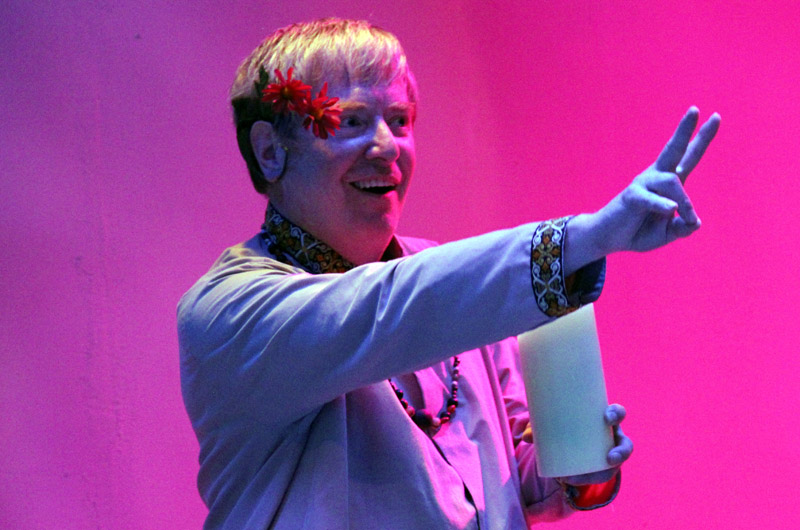
Allen Ginsberg (David Henry Gerson) is “secretary-general of all hip culture,” Mr. Leary explains; Alan Watts (David PB Stephens) is a leading voice in American Buddhism, capable of speaking to the spiritual aspects of the acid experience; Mary Meyer (Victoria Adams-Zischke), ex-wife of a CIA chief, has “class and breeding — key to the D.C. power structure.” (She is also the mistress of President John F. Kennedy, Jr., and evidently thinking about taking LSD with him in the near future.)

Rachel Claire and Victoria Adams-Zischke.

Rachel Claire and Victoria Adams-Zischke.
The fourth “intranaut,” (Mr. Leary’s term), is a lovely young dancer, Rosemary Woodruff (Rachel Claire), who’s not quite sure why she’s there in the first place. But by the end of the evening, it’s clear she will be back to stay.
Once the volunteers arrive, and after hearing by phone from Mr. Alpert that things are not going well with the Harvard administration, Mr. Leary impulsively decides to “dose” along with his subjects. Ms. Bieberman alone abstains as the other five characters toss back their acid-laced sugar cubes and begin the inner journeys that she, as a researcher, is there to observe and probe.
She’s also in charge of the mood. “I strongly urge you not to let the sexual cat out of the bag,” she tells Mr. Leary as the four volunteers begin necking on the couch. To distract them, she reads Boston Globe headlines and shows war-atrocity slides.
Directed by Randal Myler, the all-Equity cast delivers consistently believable and often moving performances as their characters encounter themselves, each other and their suddenly, molten condition.
A sullenly dignified and prickly Mr. Watts seeks comfort in alcohol, fending off Ms. Beiberman’s clinical interest with lines like “Trying to define yourself is like biting your own teeth.”

Mark Coffin and David Henry Gerson.
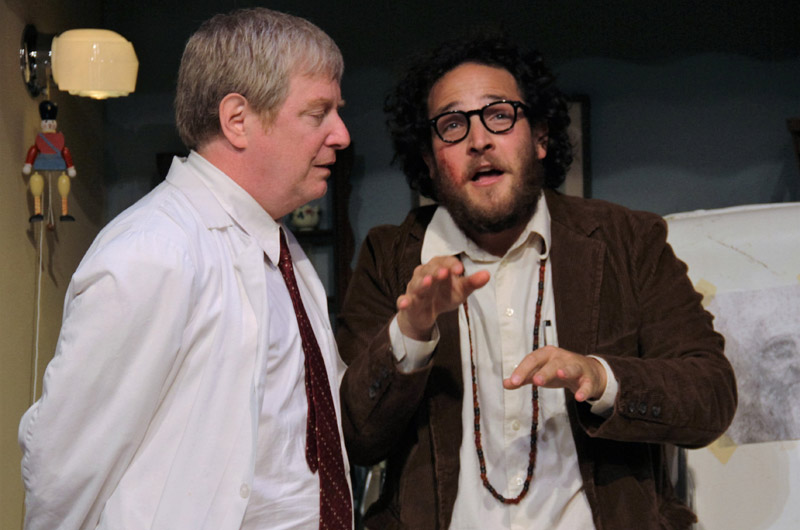
Mark Coffin and David Henry Gerson.
The wisecracking Mr. Ginsberg goes mute, then explodes into words, showering poetry from the stair landing. Mr. Gerson has mastered the incantatory cadences of the poet’s speaking voice, and it’s not hard to imagine that it really is a young Allen Ginsberg on the stage.
Ms. Woodruff dances. Ms. Meyer bakes cookies, then decides to eat some mayonnaise because it “goes with everything.” She also flirts on the phone with JFK and promises to “bring some back.”
After Mr. Alpert calls Mr. Leary again to say that Harvard has closed the research project and fired them both, the experiment begins to go haywire in both hilarious and heartbreaking ways. And, Mr. Mollin seems to suggest, so do the 1960s. Freed from what Mr. Leary calls “the chains of academia,” LSD has become what anyone wants it to be — aphrodisiac, spiritual guide or just trippy fun. Ms. Bieberman has harsh words for Mr. Leary over this.
“When you come down, you will see what damage you’ve done,” she says. “It’s going to become hip to take acid, but for all the wrong reasons... whatever its potential will be locked away forever.”
High Time concludes Mr. Mollin’s trilogy of plays about the 1960s. The other two are The Screenwriter’s Daughter and Search: Paul Clayton, both produced at the Playhouse in earlier seasons.
High Time plays Wednesdays through Saturdays at 7:30 p.m. until June 27. Tickets and information are online at mvplayhouse.org.
Comments
Wow! I'm coming to see this
Tom Notey Marina del Rey, CAWow! I'm coming to see this incredible story of my era! Can't wait to see it!
Given the current drug crisis
Shocked Islander OBGiven the current drug crisis on the Island, I am appalled by this manipulative and degrading show. There is no humor in addiction, and no mind expansion from big Pharma creations. This was true then with LSD as it is now with Opium derivatives. The producers should be run off the island along with all participants. There is no fun with these drugs. Making light of them only leads to pain and suffering. For shame!
To Shocked Islander,
Johnnie Mollin vineyard HavenTo Shocked Islander,
My heart is with you, and the addiction problem in this country is closer to home for this playwright then you might think. For 20 years I broke my father's heart leaving him sleepless, weary, and petrified over the safety of his eldest son (myself). He wrote my eulogy; I was not expected to survive. If anyone understands the pain and horrors of drug addiction it is Larry Mollin. Today through the grace of something beyond me I am a sober man. Not only that I am an addiction specialist a therapist with a masters degree in clinical psychology. I also am the owner and operator of an Addiction Recovery Community in Los Angeles. More than most this family is on the firing lines combating this horrible plight swallowing our country. I work feverishly with zeal, passion,and compassion to heal souls families and communities facing this insidious illness.
I understand your fear and pain, I have lived it first hand and live it night and day it is a nimbus looming over my sleeping and waking moments.
I have seen the play three times, and in the final say it is an anti-drug piece, a cautionary tale and a scathing review of what Tim Leary came to be. Simply put it is a historical piece giving a snapshot of the time.
I am sorry the play perpetuated this kind of fear in you. I know this was not my father's intention.
If you need anything, an understanding ear to talk to, a loving heart to hear you or actual assistance for a loved one please don't hesitate to call me.
With loving compassion and understanding,
Johnnie Mollin, MA, MFTI
Alchemy House Sober Living
Founder
(310)-403-1032
Dear shocked islander,
Discerning theatergoer BostonDear shocked islander,
Clearly you have been personally affected by the crisis on the island which extends well past its borders by the way. This has obviously made it impossible for you to see the forest for the trees with regard to this very entertaining and poignant play. Manipulative? How so? Run them off the island? I assume that you are not a fascist but that's a fascist statement. Art is meant to entertain and enlighten. High Time in no way advocates for the drug culture. It is in fact a cautionary tale which is very critical of Mr. Leary's personal misuse of LSD in the 60s. Happily the playwright doesn't beat the audience over the head with it and makes his point deftly and subtly while maintaining an entertaining and humorous tenor throughout. Look to yourself before you lash out. I hope that you and yours are alright.
Add new comment