


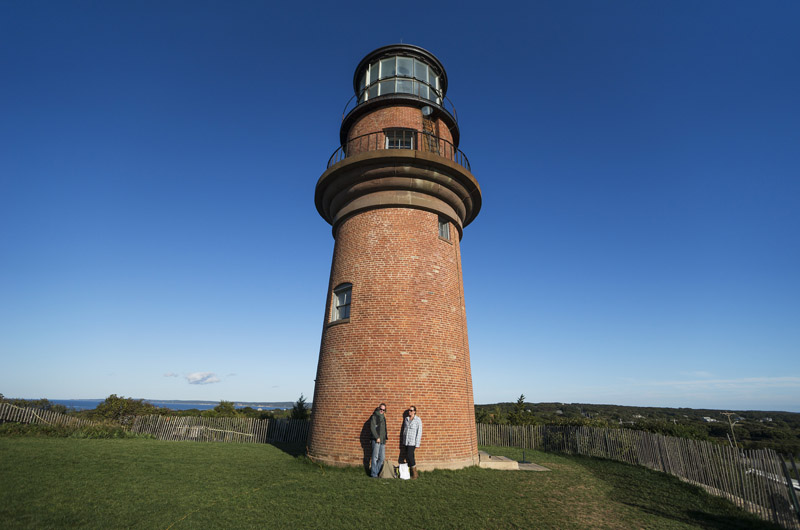
The Gay Head Light will close on Monday until next spring, marking the end of its first season in a new location and the beginning of a multi-year restoration project for the historic brick-and-masonry tower and its surroundings.
The Gay Head Light will close to the public on Monday until next spring, marking the end of its first season in a new location and the beginning of a multi-year restoration project, focusing on the historic brick-and-masonry tower and its immediate surroundings.
Between May 27 and May 30 this year, the lighthouse was moved 129 feet away from the eroding cliffs, buying at least 150 years before erosion may require another move inland. A stone wall similar to one that existed just east of the lighthouse in the 1880s now marks the boundary between town and Coast Guard properties, and a circular stone- and-brick bench marking the building’s original footprint is under construction. The area around the lighthouse has been covered in sod, with a split-rail fence along the cliff edge, and other landscaping features taking shape.
The 400-ton tower survived the move without a single crack, but decades of wind and rain have eroded some of its cast-iron features, including a railing surrounding the upper gallery, and an exterior ladder leading to the light room. During a severe storm in the 1800s, a portion of the brick wall below the light room shifted and cracked, and was replaced with a new brick wall that has also deteriorated over the years.

During relocation, an eight-inch cavity was discovered where trapped moisture likely contributed to deterioration.
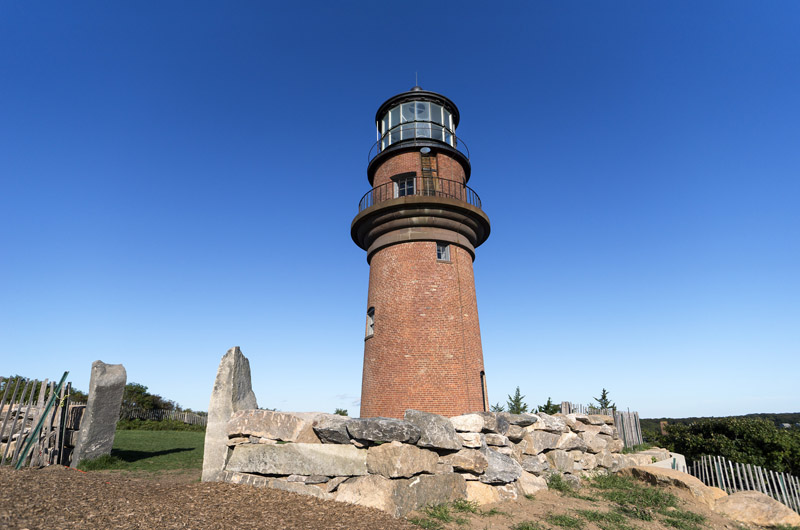
During relocation, an eight-inch cavity was discovered where trapped moisture likely contributed to deterioration.
First in line for the restoration is the old railing, which has been reinforced with fencing. “It’s still sound, but it’s not going to last much longer,” said Len Butler, who helped coordinate the move and is chairman of a new lighthouse advisory board that will oversee the restoration. He expected to issue a request for proposals for the railing and ladder portion of the work in the next few days.
The nine-member advisory board has met twice since September. Among other things, it is working to get a bet ter grasp on costs and available funds. A $3.4 million fundraising campaign is nearing its end, but several hundred thousand dollars were in the form of pledges that will arrive in installments over the next few years.
The $3 million relocation project has been mostly paid off, with only a couple of outstanding bills, Mr. Butler said. Pomroy Associates, which served as project manager during the move, will stay on in that capacity for the restoration.
Compared to the relocation project, restoring the 1856 tower will be relatively simple, and a fraction of the cost at about $300,000. But it will likely take years to develop recommendations, obtain approvals and carry out the work.
Replacing the interior brick wall will present the biggest challenge, Mr. Butler said. During the relocation, workers drilled through the wall and discovered an eight-inch cavity where trapped moisture has likely contributed to the deterioration of cast-iron straps embedded in the masonry.
As part of its application last year to take over the lighthouse property from the federal government, the town submitted a restoration plan that incorporated a set of recommendations from the early 1900s. The town plans to hire a restoration expert to come up with additional recommendations. But so far there are no photographs or building plans to indicate exactly how the lighthouse appeared in 1856.
Some of the work will be cosmetic, including repairs to windows and a wooden railing that follows the spiral staircase. The advisory board will also discuss rebuilding a portion of the lower wall where the entrance from a former lightkeeper’s quarters was filled in with bricks and cement.

Town is incorporating a set of recommendations from the 1900s in the plan.
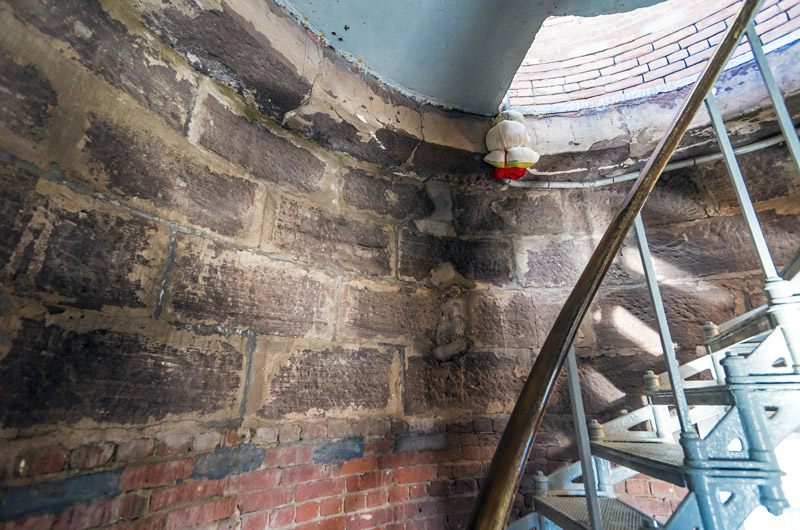
Town is incorporating a set of recommendations from the 1900s in the plan.
Granite blocks from the former lightkeeper’s quarters, along with portions of its brick foundation, will form the memorial bench where the lighthouse once stood. Some parts of the brick foundation had been whitewashed, while others kept their natural color. The brick parts will be positioned at intervals around the original center stone of the lighthouse, reflecting the light’s original signal pattern of three white flashes and one red.
The town also hopes to integrate the lighthouse property with the rest of Aquinnah Circle, although that work falls outside the purview of the advisory board. In response to public concerns, the selectmen have considered a parallel effort to address issues such as walkways and access to the Aquinnah shops.
To comply with state regulations this spring, the town set aside three parcels totaling 2.2 acres to mitigate the loss of habitat for the endangered broad tinker’s weed. Among its many responsibilities related to the lighthouse move, the town will need to maintain the conserved areas. In a report issued this week, Julie Russell of the Martha’s Vineyard Land Bank, which owns a nearby parcel with broad tinker’s weed habitat, recommended annual mowings, along with a management plan for invasive species, and partnering with Polly Hill Arboretum to propagate the endangered plant. A survey in early September did not reveal any broad tinker’s weed in the newly conserved areas.
“There is a bunch of different things that we’ve made agreements to, in order to not only obtain the lighthouse but relocate it,” town administrator Adam Wilson told the Gazette. Among other things, he said, the town will need to solicit bids for the continued operation of the lighthouse and formalize an agreement with the Coast Guard to monitor the site, where a large amount of lead-contaminated soil was removed this fall.
“Things didn’t stop when we finally moved it,” Mr. Wilson said of the lighthouse. “There is a lot more work that needs to be done.”
Comments
Wonderfully uplifting. Just
Denise Wells Queensbury, NYWonderfully uplifting. Just returned from Montauk, NY Lighthouse which was also saved, mostly through the efforts of one woman. There, the cliffs were stabilized by a system of terraces and vegetation. The erosion has been stopped and the lighthouse did not need to be moved. The PBS program featuring the Gay Head Light move was fascinating. So glad it turned out so well. Good luck with future efforts.
Thank you NOVA for bringing
Fay Moseley Ocean Springs, MsThank you NOVA for bringing this majestic lighthouse to our attention. We watched the move in wonder and whilst watching I could not help but think of all the ships it has deterred from the rocky shore and submerged rocks in the surrounding water. What a blessing to the ships and crew to know that Momma light is there watching and warning them. Thanks also to the many people who cared enough to get this task accomplished.
As the daughter of ferry
Nancy Richard Bristol RIAs the daughter of ferry captain I was a frequent visitor to Martha's Vineyard. I scrambled up and down those eroding cliffs (not allowed now) and admired that impressive, life saving structure. May she stand in imposing stature for many years! Her salvation is mind boggling.
Add new comment