

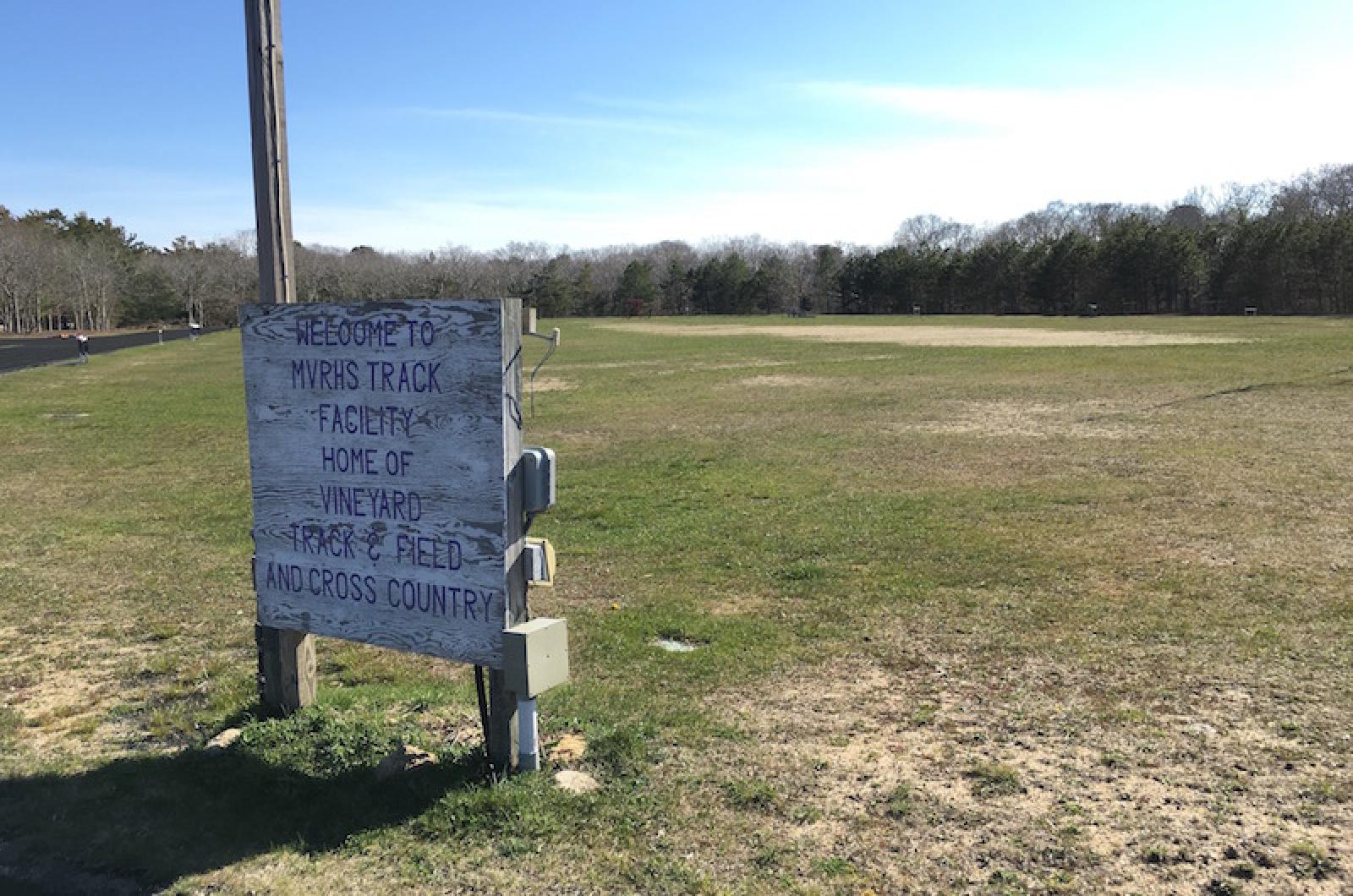
<p>About 100 people attended a public forum Wednesday to discuss a proposal to create a synthetic turf field as part of the high school's athletic facilities.</p>
A large crowd of about 100 people attended a public forum on Wednesday evening to discuss possible renovations to the Martha’s Vineyard Regional High School’s athletic facilities. At issue is the proposal by a nonprofit group made up of Vineyard parents called MV@Play to create a synthetic turf field with crumb rubber infill inside of the track. Concern from the community focused on potentially dangerous chemicals and carcinogens in the crumb rubber, which is made of recycled tires.
MV@Play was formed by David Wallis, Terry Donahue and Robert (Spike) Smith with the intent to create centralized, up-to-date sports fields on the Island. The group approached the high school committee early this month about forming a public-private partnership, and the school committee decided to take the proposal to the community first. No agreement has been signed yet and the final decision is at the discretion of the school committee.
Working with Gale Associates, MV@Play proposed a three-phase plan to address the fields at the high school, with the first phase focusing on the track and field. The proposal would widen the radius of the track from 104-foot radius to about a 120-foot radius which would allow a 210-foot field to be established in the middle. While all teams would be allowed to use the interior field, MV@Play hopes to dedicate it to women’s lacrosse and field hockey. Lighting would be added to increase the amount of time the field could be used for games and practice along with stadium seating for 500 people and storage facilities.
As planned, the first phase would cost $3.5 million, which MV@Play plans to fund through private donations. A synthetic turf field with crumb rubber infill inside of the track would increase usability and lower maintenance, organizers said.
“We don’t want to put anything out there that is going to harm our children, but what we do want to put out there is something that can sustain the amount of traffic that we’re going to get,” said MV@Play President David Wallis. “And I think that traffic is going to be good traffic. It’s not only the high school, it’s all the youth, all the adults, the tournaments and camps. It’s very hard to see natural grass being able to handle what it is we’re asking it to do.”
Vineyard community members came down on both sides of the discussion. Those attending included members of the MV United soccer team, the girls’ field hockey and lacrosse teams and school committee members.
Elissa Turnbull felt the possible danger of chemicals in the infill outweighed the benefit of increased usage.
“It seems slightly naive to me to think that we would chop up a tire into small pieces, roll around in it and then not have the health consequences that comes with that,” she said. “A tire is a tire, and it’s made out of the things it’s made out of, whether it’s in small pieces or big pieces.”
Ms. Turnbull said alternative infills to crumb rubber may be a good solution, but she had not researched them yet.
Molly Glasgow agreed, advocating for natural grass. “I believe the way forward is to create organically managed fields. . . Why would we install a giant layer of plastic and chemicals in a place where our children play?”
High school field hockey coach Lisa Knight countered by saying that turf fields are the standard at many of the places the students play.
“When your kids go off-Island and they go off-Island to play sports, do you know what they will be playing on? Turf. Fifty per cent of our field hockey games are played here on our fields, on grass, and 50 per cent of them [on turf], plus when you make tournament. And you’ll never go far in tournament if you don’t have turf because every game is played on turf.”
Senior student athlete Lee Hayman asked those weighing in to walk the current fields and see what student athletes currently practice and compete on.
“We played a game two weeks ago where four girls went down in two minutes and we had to call our game because we had a grass field and it was literally a mud puddle,” she said. “It’s become a matter of safety and it’s become a matter of school spirit. When teams come over here it’s just not the same as us going over to their school. The only thing this would do is improve our students.”
Ina Andre asked that another public meeting be held.
“I think we can do this, but we should probably look at the alternatives. I’m very concerned about crumb rubber,” she said, suggesting looking into what is done in Europe and by FIFA. “We can do this, it doesn’t have to be an either or.” Assistant superintendent Richard Smith directed those with more questions to contact himself or superintendent Dr. Matthew D’Andrea and said another public forum will most likely be held.
Comments
Please educate yourselves on
Dan ObPlease educate yourselves on this subject. Crumb rubber causes cancer. It is proven and more studies which prove it causes cancer are published every day. There have been a number of documentaries about the cancer causing agents in crumb rubber, and nbc news has even produced some great awareness and stories about cancer victims linked to crumb rubber.
Dan-The federal and state
Momof2onmv EdgartownDan-The federal and state governments including NY, CT and CA, just to name a few, have found after much research NO link of crumb rubber causing cancer.
I have found the exact
DanI have found the exact opposite. Look at the Norway studies. In America, the Epa is currently reassessing the studies you mention due to inconclusive data in the original reports (the studies only tested for cancer due to inhalation, not absorption) and now the epa plans to release new data in the fall of 2016. In addition to the 130 chemicals found in crumb rubber, many of which are cancer causing, they have now found high levels of lead. Would you want to eat a tire? And Why would we want to introduce these chemicals into our children and environment?
I agree that a new field is needed, but disagree that we should be using crumb rubber. It's very nasty stuff.
Municipalities all over the
George Stein EdgartownMunicipalities all over the world have made this cost effective choice. A consistence of safety is the primary achievement. I have a federal study that says people who can not post their actual name for postings have self esteem issues.
And when the field needs
Carol formerly ChilmarkAnd when the field needs replacing (as it will in 8 or 9 years - we've had this out here in CA), all that plastic covering the field? Goes into landfill. Great!
Carol,
Ken Esq EdgartownCarol,
It's very important to consider the cost of disposing of the material when it's worn out. Generally, that's about eight years (same as the warranty on most of these products). A lot of schools have found the savings weren't exactly there when disposal and replacement are added to the mix.
Anybody who wants to look
Jon Westport, CtAnybody who wants to look into this more should contact Greens Farms Academy in Ct.
The administration and Board there are as competent/enlightened as any in the country,and they decided against a rubber based field to be safe.
http://www.fairfield-sun.com/41941/letter-the-journey-toward-a-healthy-…
Our school district just put
Barbara Freda WhippanyOur school district just put down turf fields and used a"cork- fill" composite which has been tested and does not have the link.to carcinogenic that crumb rubber has. If the administration was further details we can provide it...
There is now a MoveOn
Vineyarders for Grass FieldsThere is now a MoveOn petition against the proposed artificial turf. If you wish to read and sign it, you can do so here: http://petitions.moveon.org/sign/no-artificial-turf-on?source=c.em.cp&r…
Add new comment