


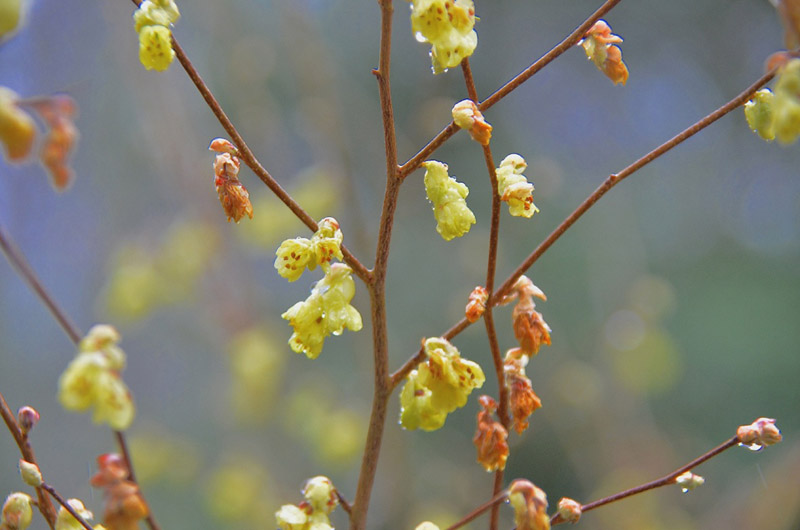
Variations in temperature can affect flowering and leaf-out around the Vineyard, with a distinct lag time up-Island, where colder temperatures usually mean a later spring.
The first buds of spring will soon give way to an avalanche of life and color around the Island. With the flowers and leaves come the insects and the birds, and of course the thousands of summer visitors for whom the Island is eternally in bloom.
Spring has been sounding its first notes: the warm haze of red maples, the glow of forsythia in yards and gardens, and the delicate trumpets of honeysuckle have appeared. Most of the early arrivals are non-natives, but blueberries, sassafras and other native plants are also beginning to emerge.
On a recent rain-soaked day at the Polly Hill Arboretum in West Tisbury, curator Tom Clark, pointed out some of the flowering magnolias, rhododendrons and stewartia that the arboretum has been tracking for the last few years. Plants here generally flower in the same sequence, he said, although the sequence itself may occur sooner or later depending on the weather.
As with the flowers, new leaves usually appear in late April, but that process, known as leaf-out, lasts only about four to six weeks before the season is in full swing. Both processes are triggered by warming temperatures and other factors. Some species respond only to lengthening days, and most temperate species require an adequately cold winter in order to emerge in the spring.
Variations in temperature can affect the timing of flowering and leaf-out around the Island. Many longtime Islanders report a distinct lag time up-Island, where colder temperatures usually mean a later spring.
Sophia Tewa
In addition, warming temperatures over time are likely pushing the entire process farther back, although the Vineyard lacks the hard data to verify the pattern.
Phenology, or the study of seasonal changes, has gained steam in recent years as attention grows around climate change. National efforts are underway to engage citizens to help track the emergence of flowers and leaves in the spring. But that approach is relatively new, and most of the evidence on the Vineyard is still anecdotal.
Mr. Clark said he would need at least 15 years of data at Polly Hill before he could say with authority that the local climate is changing. “I think we all agree that it is,” he said. “But I don’t think our data can substantiate that at this point.”
Many farmers and naturalists on the Island would agree, however, that spring has been arriving sooner. Tom Chase, director of conservation strategies for The Nature Conservancy, said the change is evident across the Island but doesn’t follow a uniform pattern.
“The patterns that we’re seeing on the Vineyard are really reflective of the erratic climate that we’re seeing worldwide,” he said.
Rebecca Miller of North Tabor Farm in Chilmark has noticed a distinct warming trend.
“I remember about 18 years ago, we tried to grow sweet potatoes, and it was a challenge,” she said this week. “And now we grow sweet potatoes with no challenges at all. It’s just hotter now. It stays warmer longer.”
She recalled many years ago being excited when the zinnias she sells were ready by the Fourth of July. “Now we have them in June,” she said.
At Morning Glory Farm in Edgartown, Jim Athearn has been tracking the emergence of wild pear, a Vineyard name for shadbush, whose white flowers are conspicuous in wooded areas, and usually appear in Edgartown around May 7. “It’s a reliable indicator because it doesn’t seem to vary very much,” he said.
More than a warming climate, though, Mr. Athearn said the flowering of the plant reveals natural temperature variation across the Island. He recalled seeing it in bloom much earlier than May 7 at Lambert’s Cove in West Tisbury, and even just up the road in Edgartown, where he goes for regular runs. “That will be out, and I’ll come back home and there are buds,” he said.

Sophia Tewa
Mr. Athearn said the prevailing southwest winds heat up as they pass over the Vineyard from Aquinnah to Oak Bluffs, delivering more balmy weather to the down-Island towns. “They are the beneficiary of all that passage overland,” he said. He also cited hearsay that Long Island and Falmouth have a similar phenomenon.
Mr. Chase agreed, adding that the shallower, warmer waters in Nantucket and Vineyard sounds contribute to the effect. Islanders generally report a two-week delay in leaf-out from Oak Bluffs and Vineyard Haven to Aquinnah.
Earlier flowering or leaf-out could benefit or harm a plant, depending on the weather. It allows the plant to photosynthesize for longer, but an early frost could also leave it crippled. “Goes both ways,” said Mr. Athearn.
Non-native species tend to emerge earlier and get a head start on their native competitors, said Suzan Bellincampi, director of the Felix Neck Wildlife Sanctuary in Edgartown.
“If you look around right now, you are seeing the honeysuckles popping, you are seeing some of the invasive rose popping,” she said. “The leaves are coming out, and that gives them a jump start. And that is one of the reasons these invasive species outcompete the natives. They are already starting to photosynthesize and get their energy.”
Gardens and developed areas down-Island may accentuate the difference in timing across the Island, Ms. Bellincampi said, since those areas often contain invasive species. “It doesn’t really have to do with temperature as much as the type of plants,” she said.
To further complicate things, down-Island towns appear to absorb and retain more heat as a result of its buildings and pavement, a process known as the heat-island effect. Even within a few blocks in Oak Bluffs, the variation can be dramatic. “I don’t think it’s enough to affect leaf-out and flowering times on the large scale,” said Mr. Chase, who lives in Oak Bluffs. “But certainly, in immediate neighborhoods it could probably exacerbate drought and increase heat.”
Another type of microclimate exists naturally along the south shore, where ancient riverbeds leading into the Great Ponds create a series of low-lying frost bottoms. Mr. Chase and others spent time in the 1980s measuring short-term temperature variation in those areas, where a lack of trees and wind creates stagnant air and extreme temperature variation. In one week in July, Mr. Chase said, the temperature in one frost bottom swung from 32 to 125 degrees.
“You can get freezing temperatures in every month of the year,” he said of the unusual natural areas. Cold nighttime air nips back the shrubby plants in frost bottoms and keeps them green throughout much of the summer, providing a valuable food source for many animals. But in some areas Mr. Chase has noticed a succession from scrub oaks to larger pine trees.
“There is a lot of biodiversity in those frost bottoms, and changing them from scrub oak to tree oak or tree anything is likely to change the flora and fauna that lives in them,” he said.
Some insects have internal clocks that tell them when to emerge, regardless of the temperature, said Jeremy Houser of the Vineyard Conservation Society who has studied changing climate patterns. “No external cue whatsoever, and they know it’s March 15 and that’s when they get up,” he said. As plants emerge earlier and earlier, those insects could fall out of sync with their environment. Some birds time their mating seasons so that their young will hatch when caterpillars are fattest and most valuable as a food source. “That’s getting a little bit mistimed,” Mr. Houser said, although the effects were still unclear.
“One really cataclysmic climate change impact could be what if you never get enough cold,” Mr. Houser said, noting the chilling requirement of many species. But he believed that was still a ways off. Mr. Clark pointed out that temperate plants generally accumulate their required cold days over time. “It would be an exceedingly abnormal winter for us to not get enough cold,” he said.
In general, scientists expect flowering and leaf-out periods to continue happening earlier across the continent, which may cause certain plant species to shift northward. Some have partly attributed the arrival of southern bird species on the Island to climate change, although Mr. Chase noted the difficulty in isolating the causes.
Sophia Tewa
“Everything in nature has got so many different influences and variables that it takes a long time to sort out what the root causes are of a lot of these big scale changes,” he said.
Even on a national scale, data related to leaf-out and flowering is still somewhat lacking.
Project BudBurst, based in Boulder, Colo., has been gathering data from communities across the country since 2007. Co-founder and director Sandra Henderson said that even nine years of data was inadequate for drawing conclusions. “It’s certainly a great start,” she said. “But we really need more time and more observation.”
“Each year it’s getting progressively earlier,” she said of the spring flowering and leaf-out. “But that doesn’t mean for the next five years it wouldn’t be progressively later.” She encouraged the Island community to consider taking part in the project.
Mr. Clark was unaware of any Island-based phenological studies apart from Polly Hill, and agreed that the topic was worthy of attention. “I think it would be a great thing for kids to get involved with,” he added. “It gets them involved with science and nature.” He agreed that leaf-out on the Vineyard has likely been slipping back over time, but that verifying the trend would take years of data. “The more the better,” he said.
Comments
What an interesting topic! I
Toni Kauffman Burlington, NJWhat an interesting topic! I too in NJ have noticed something a little different this year. First, the temperatures have vacillated from warm spring like temperature to freezing weekly, sometimes daily; causing quite a bit of confusion to the vegetation in our region. While many of my plants began coming up weeks ago when the calendar said Spring had begun, the Hostas decided to wait a bit longer.
I agree giving the school children a long range project would be GREAT idea! Compiling data each year would give them a wonderful goal, something to look forward to and a chance to collaborate with community partners! I would even suggest making it a curriculum addition with national recognition. I have read of gardening projects that already exist with the children on the Vineyard; how about giving it more emphasis, an objective with a studied result. LOVE IT!
My father, Albert Scott, kept
Katherine Scott TisburyMy father, Albert Scott, kept an eye on trees.
He also kept detailed records of just about everything.
There was a magnolia tree in the courtyard clearly visible from the window of his apartment in Berkeley, California. Each year, when spring came to Berkeley, in the fashion that it does in that climate, he noted when this magnolia tree came into bloom. In 1986, when he first moved there, it bloomed in mid-February. Each year the date moved back a bit, a fact that he made a point of relating to me whenever the topic of climate change or other earth-shaking issues came up. By last year, the magnolia was blooming in mid-January.
You can safely plant your
Marty Milner Flowery Branch, GaYou can safely plant your tomatoes when an oak tree's leaves are as big as a mouse's ear, unless you live in a hard frost bottom.
I can remember spring always
Larry King DuxburyI can remember spring always arriving later in West Tisbury when living there in the 1970s. The scrub oak was my indicator of its presence. The leaves on those trees seemed to "explode" to full bloom about three weeks later than the trees down Island in Tisbury. I am reminded that West Tisbury had no spring, just a transition week to summer. Now living in West Duxbury, I see the similarity to my days in West Tisbury. Happy spring to everyone, whenever it arrives!
Add new comment