



<p>Scientists at the University of Massachusetts are looking toward the future of the Massachusetts Estuaries Project, a 14-year study of saltwater ponds and embayments, including on the Vineyard.</p>
Scientists at the University of Massachusetts are looking toward the future of the Massachusetts Estuaries Project, a major study of saltwater ponds and embayments in Southeastern Massachusetts that has been under way for the past 14 years.
The study, which began in 2002 as a partnership between the University of Massachusetts at Dartmouth and the state Department of Environmental Protection, is expected to wind down over the next two years.
Estuaries project technical director Brian Howes and senior scientist Roland Samimy met last week with the Water Alliance, an Islandwide advocacy group, to discuss plans to help communities comply with the Clean Water Act and restore impaired saltwater estuaries.
Mr. Howes said funding from the DEP will end this year. Looking ahead, he expected the project to shift from monitoring to possible solutions. The partnership between the DEP and MEP will likely change as well, with the university playing more of a lead role as it continues working with towns and agencies, Mr. Howes said.
Nearly every coastal pond in the region is suffering from an overload of nitrogen, primarily from individual onsite septic systems, but also from fertilizers, road runoff and other sources. Too much nitrogen leads to algal blooms that deprive pond organisms of light and oxygen.
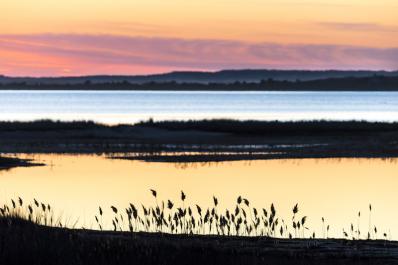
All Island saltwater ponds are impaired by nitrogen to some degree, most of it coming from development. The MEP has helped define the problem and now wants to help craft solutions.
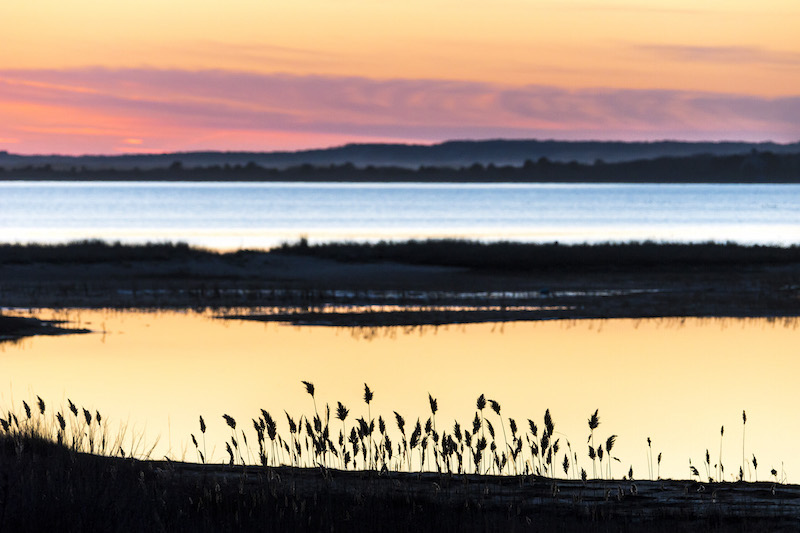
All Island saltwater ponds are impaired by nitrogen to some degree, most of it coming from development. The MEP has helped define the problem and now wants to help craft solutions.
The Island’s 24 major estuaries are in better shape than those on the Cape, but most are impaired to some degree. Since 2002, the MEP has issued reports for about 70 estuaries, including eight on the Vineyard (four others are underway or in planning).
The project has focused on developing nitrogen thresholds, which provide a basis for towns to seek permits and develop wastewater management plans. In the next phase, Mr. Howes said the MEP will help define strategies to meet nitrogen reduction goals and monitor results.
“We are recognized as being able to determine when those targets are hit,” he said. “That’s a big question regionally.”
Mr. Samimy said many of the tools that were developed under the MEP will be the same ones moving forward. “Everything that we do in the future is seamlessly connected to everything that we did in the past under the MEP,” he said.
“Phase two is all about the actual restoration,” Mr. Howes said. “Not about telling you how to do it, but getting down to the toolbox and building that toolbox to do the restorations. And that’s what we want to be doing for the next 10 or 15 years.”
He said the project aims to continuously adapt, eventually helping towns evaluate their management techniques.
Island towns will define their own strategies and funding sources, but the MEP can provide key data. Already the project has run scenarios for Lagoon Pond, Sengekontacket Pond and Farm Pond to help frame solutions to nitrogen overload.
A project to add culverts and increase circulation at Farm Pond won the support of Oak Bluffs voters last year and now is in the design and permitting stage. Mr. Howes said the culverts alone will achieve the nitrogen reduction goal for the small pond tucked off a north-facing stretch of Beach Road in Harthaven.
Strategies for the Lagoon and Sengekontacket will be more complicated.
Touching on a sore subject that has at times clouded the work of the MEP, Mr. Howes dismissed the idea that the project only advocates for sewering. “We’ve been working on alternatives from the beginning,” he said.
Water Alliance members who attended the meeting were generally receptive, but some wondered why the reports have taken so long to complete.The Lagoon Pond study began in the early 2000s but the report was not issued until 2010. The Lake Tashmoo study began in 2003; a report was finally issued last winter.
Mr. Howes said the structure of the project has been complicated, with each study involving a number of stakeholders and funding agencies. “If one person turns off the tap for that one source, then the whole thing grinds to a halt,” he said. The MEP also required several years of baseline data and with some ponds there were no monitoring programs already in place.
Martha’s Vineyard Commission executive director Adam Turner, who attended the meeting, offered strong support for the continued efforts. But he too puzzled over the slow pace of the project. Mr. Howes said the DEP was somewhat mired in a past era, when the federal government had a stronger hand in local funding. But he also saw a generational shift in store that he believed would create a more bottom-up approach.
Mr. Turner pointed to the efforts of the commonwealth in the 1980s to promote high-tech industry and wondered why nitrogen mitigation hasn’t gotten more attention.
But Mr. Samimy said Massachusetts is way ahead of Florida, for example, where nitrogen management for estuaries is just beginning to take root.
As for the Vineyard, Mr. Turner called the restoration of coastal ponds a priority. “We are looking at becoming known for restoring the Island,” he said. “Improving the environment . . . helps our economy and everything else.”
Mr. Howes agreed, but also stressed the importance of a partnership with the MEP.
“You are not going to win without data,” he said.
Comments
The bottom line is that
Richard Hall Vineyard HavenThe bottom line is that approved Title 5 septic systems are destroying the Eco system. They contain a given amount of solid and liquid waste (nitrogen), and over fill to a (nitogen) distribution box, and then go down a (nitogen) leaching field. Bring back the cess pool, and pump your systems in a timely basis (before when your toilets and showers back up) and Voila! Case cracked!
Sand trap septic systems are
BRUCE NEVIN Edgartown, MASand trap septic systems are a better alternative than cess pools. Maintenance is an issue with both--pumping out cess pool, replacing sand in the sand trap system after some years. Better yet are biological systems like those demonstrated across the Vineyard Sound at New Alchemy or right here by Anna Edey's Solviva. Even more local and lower maintenance, swap in composting toilets like that in the W.T. Library.
Note that objections to sewering also apply to these systems, because they make lots buildable that could not support a Title V septic system. We need tools other than limits on sewering to prevent maximum buildout.
In some parts of the
Charles Carlson Ocean HeightsIn some parts of the Sentekontacket watershed it may take up to 10 to 15 years for septic system nitrogen to reach the Pond. This means that the Pond requires a program of both prevention and mitigation. Although there has been some progress in mitigation efforts, very little is happening in reducing additional nitrogen entering the ground water. The new fertilizer regulations are a big plus. The Title 5 systems do nothing to eliminate nitrogen, but there are hundreds of these systems in the water shed. I urge the scientists involved in this effort to seek an affordable solution to update existing Title 5 systems. Although the new nitrogen reduction septic systems are presently being installed, they are not up to the mark. It may be difficult, but the towns should adopt a policy of a net zero tolerance of additional nitrogen entering the ponds. They can do it and still welcome development.
As a long time shellfish
Peter Becker Port Angeles WAAs a long time shellfish grower in South Puget Sound ( Little Skookum Shellfish Growers 500 Mt production of clams and 200 Mt of Pacific and other oysters for 35 years( up to 2010)) we we very sensitive to drainfield problems we had out own Mound System for 30 of the 35 years right on the shore line and monitor it regularly to make sure it worked ( "Caesars Wife problem")..They are well tested technology and you to can use them successfully. We were on glacial till over hardpan..any leakage went straight into the bay and we dye tested regularly. As Chairman of the Pacific Aquaculture Caucus Inc. we surveyed the whole Pacific coast for these problems and worked clossly with Eutro.org to measure, document and report on this program. "MacMansion's' were frequently, but not always the worse offenders as their systems were pulsed and not in continuous use. We also found long term residents with "Straight Pipes" ( no drain fields at all!) and agricultural and domestic animal waste problems ( including dogs and cats)! Get shore line fecal coliform surveys done by volunteers..monthly water samples for a year or so, identify the worse offenders, cite them. Simple. There is no "right to pollute".
Add new comment