


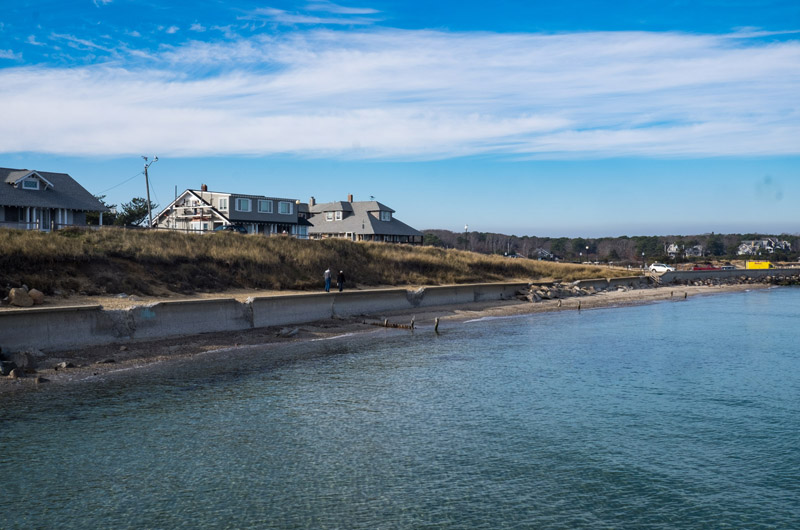
<p>A $5.6 million project to restore the crumbling North Bluff coastal bank is set to come before the Martha’s Vineyard Commission.</p>
A $5.6 million project to restore the crumbling North Bluff coastal bank is set to come before the Martha’s Vineyard Commission at a public hearing Thursday night. Oak Bluffs residents and elected officials have become sharply divided over the project .
Repairs to the stretch of north-facing coastline have been in various planning stages for more than five years. The Oak Bluffs selectmen recently awarded a bid for the project. On Nov. 17 the town planning board unanimously referred the project to the MVC, citing the need for regional review. Selectmen worry that the review process could delay construction, which was set to begin in early December.
The hearing begins Thursday at 7 p.m. in the Olde Stone Building in Oak Bluffs. It is the only item on the commission agenda.

Plan calls for raised steel piling wall secured in front of the deteriorating concrete wall.
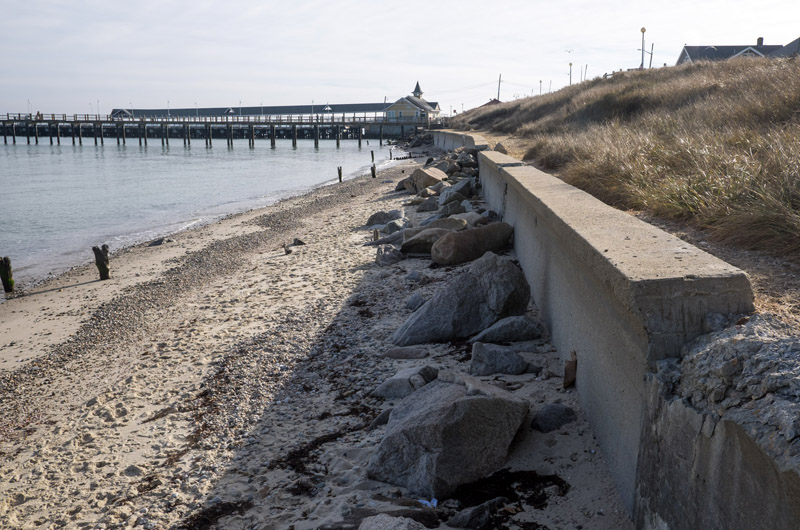
Plan calls for raised steel piling wall secured in front of the deteriorating concrete wall.
In its current iteration, the project would provide protection from storms and projected sea level rise with a raised steel piling wall, corrugated to break the impact of the waves. The sheet piling would be four feet higher than the current concrete sea wall, which is deteriorating. The old seawall would be buried as part of the restoration of the coastal bank.
A timber boardwalk would be constructed where the coastal bank meets the steel wall, providing a pedestrian path from the Oak Bluffs harbor to the new state fishing pier. From there the path would connect with the existing sidewalk to complete a walkway to the Steamship Authority summer terminal and wharf.
The Oak Bluffs conservation commission is working to obtain local, state and federal permits for a beach nourishment project that would restore a sandy beach along the North Bluff.
Funding sources for the project have changed along the way.
At the outset, in 2010 for more than a year town officials pursued funding from the Federal Emergency Management Agency to restore the coastal bank after it was damaged by Hurricane Sandy. FEMA eventually denied that request. The town then sought and received a $3.6 million from the state Dam and Seawall Repair or Removal Program, created in 2013. The Massachusetts Seaport Advisory Council also issued a grant for $2 million.
The original plan included rebuilding the concrete seawall from the harbor parking lot all the way to the Steamship Authority terminal. But when FEMA funding failed to materialize, engineers scaled the plans down, abandoning the idea of replacing the concrete seawall. Instead they envisioned a sheet piling barrier in front of the existing sea wall, from the parking lot to the new fishing pier. The work is expected to take about six months to complete.
Planning board chairman Brian Packish said Monday that the current plan has changed so much from the original project that people who live near the beach have had little chance to contribute to the planning and design process.
“It’s a massive project, one of the biggest undertakings in our town, dollars and cents wise,” he said. “There’s a lot of loose ends.”
He opposes some of the design elements in the latest version of the project and criticized town officials for the approach.
“We decided to design a project to chase funding. Anytime you do that, you’re going to find yourself in trouble,” Mr. Packish said. “When we discussed the DRI referral, that was the largest opportunity for discussion. For many of the abutters, that was the first time they had ever seen it.”
In a letter to the commission, Dr. Jason Lew registered concerns on behalf of the North Bluff Neighborhood Association.
“We are concerned with the process and the lack of transparency and public input,” Dr. Lew wrote. “The last we knew was the discussion of replacing/repairing the concrete wall and keeping the beach vital. Now we are faced with a metal wall and no beach.”
But town officials backing the project said there has been plenty of opportunity for public scrutiny and comment.
Conservation agent Liz Durkee said the conservation commission held four public hearings on the project. Notices were sent by certified mail to every resident within 300 feet of the project. Hearings were held in February and May of 2010, and twice in June of this year. The last hearing included a detailed presentation of the project changes, including the plans for steel sheet piling.
At a presentation before the Oak Bluffs finance committee Monday, Mrs. Durkee said the project is vital to preserve the town’s valuable natural resource.
“If this seawall fails, the bank is going to collapse, the road will collapse, it’s going to be a disaster,” she said.
She added that beach restoration is part of a broader town project to repair the coastline. “There’s no natural sand source washing along the shoreline to replenish that beach,” she said. “There will eventually be zero beach there if we do nothing.”
The project was originally scheduled for construction in the winter of last year. The town was granted a one-year extension on the state grants, and some are concerned that further delay could cause the state to withdraw the grants.
“We’re right at the point where we stand to not get this finished on time,” said selectman Walter Vail this week. “If we don’t get this finished, it’s going to start costing the town money.”
“I would hate to miss out on the opportunity for free money,” said Michael Santoro, chairman of the board of selectmen. “I just hate to squander money coming our way.”
But Oak Bluffs businessman Mark Wallace, who owns commercial properties and a residence near the North Bluff, said the project would eliminate what is left of the beach.
“You don’t give up a beach because you want money,” he said. “You don’t do that. It doesn’t happen anywhere in the world but it’s going to happen in Oak Bluffs if we don’t pay attention.”
Comments
There was once a beach in
Skip OBThere was once a beach in front of the Wesley House Hotel. In fact, on July 15, 1919 a seaplane tied up on it. Today, the Wesley House fronts on the harbor--whose sides sound remarkably like the plan for the North Bluff--and there is no longer a beach. Should global warming raise the sea level as predicted neither the existing or proposed "raised steel piling wall"s will suffice. So it might make sense to invest in the short term nature of the beach ie., live and be merry...
The steel sheet pile seawall
Charles Shabica Oak BluffsThe steel sheet pile seawall will give our waterfront an industrial look. There are better longer-lived solutions that are user-friendly like a stepped concrete seawall or a series of pocket beaches.
I'm probably a couple days
Steve Ewing EdgartownI'm probably a couple days late and a few dollars short with this comment. I was not aware, until today, that there was a project that involved installing steel sheeting outside OB harbor. A sloped,large stone, revetment with a few proper stone groins is a better way to go. It will look and work better.I know it is expensive but it will last longer than steel. I have a photo of my grandfather,as a boy, sitting on one of the old timber groins at this location in 1908. My mom's family, the Cargill's, owned property in OB from the mid 1800s until 2013 when they sold the Canonicus Ave, house. The old timers knew how to hold the shore. Mass Highway was allowed a few timber groins, to save Beach Road, between the bridges. With a proper beach nourishment schedule both that project and the proposed North Bluff project are viable from a cost benefit analysis and a coastal engineering perspective. Liz Durkee is correct; there is no sediment source for this location because the community decided, rightly so, the Highlands of East Chop were worth preserving, so they were armored. The new sediment source now becomes a dump truck or a dredge pipe. As the problem, lack of sand, is pushed down to this area and on to Farm Pond, Cow Bay, Eel Pond and Fuller Street Beach, my neck of the woods, comprehensive integrated solutions are needed. Also remember, it's easy to move sand but it's hard to keep it there. Nature doesn't care about property lines. Sloped stone replicates, more accurately than vertical walls, what the waves want the shore to look like. Vertical walls are most appropriate in harbors not in exposed areas.The existing (slightly sloped) concrete wall down the shore was originally buttressed with stone groins that were allowed to deteriorate. Those groins should have been maintained and also nourished. I want to say I have the greatest respect for all the folks that have most likely worked very hard on this project and there is a lot more to this discussion than my time today allows. I do understand the need to use the available funding that is on the table now. I suppose the town will defer to build the steel wall. I hope, even though the cart will be before the horse,OB realizes it is not the best approach and eventually, at least, sets stone in front of the steel.Even though we live on a sand bar and the sea level is, at the moment, slowly rising, there is no need to panic. Some of the solutions to erosion are right in front of us others are yet to be explored. It is going to take cooperation at the local, State and Federal levels to realize the solutions. Jumping on the cheapest, or easiest to permit is not always the best.
Add new comment