

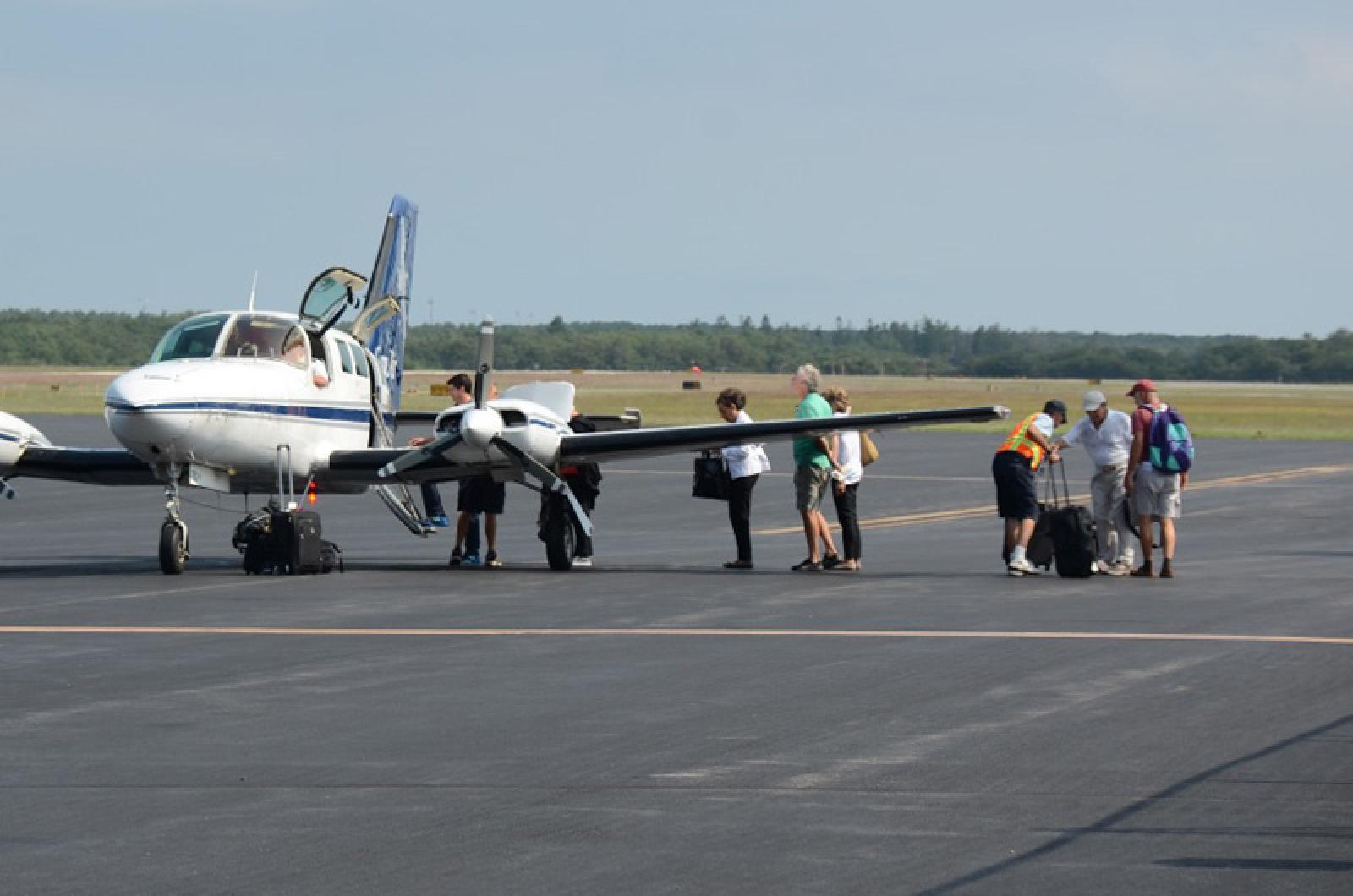
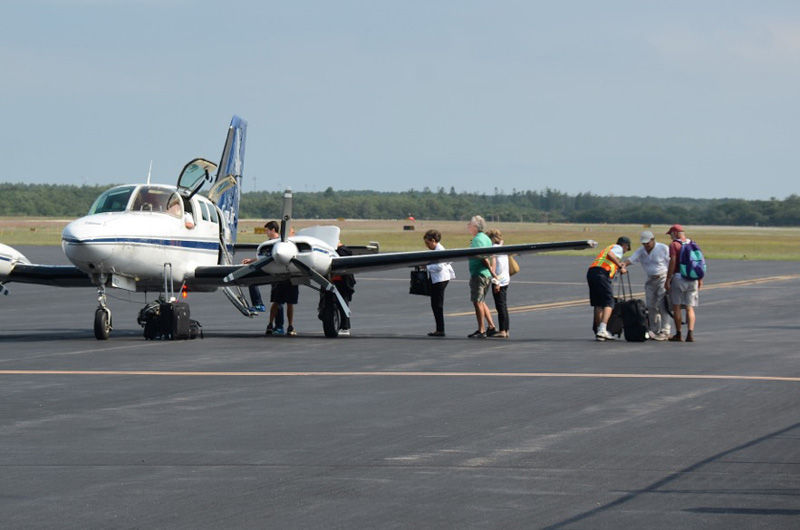
<p>Responding to recent complaints from West Tisbury residents about excessive noise from air traffic over the summer, the chief pilot for Cape Air said the airline follows voluntary noise abatement rules.</p>
Responding to recent complaints from West Tisbury residents about excessive noise from air traffic over the summer, the chief pilot for Cape Air said this week that the regional airline follows voluntary noise abatement rules whenever possible.
“We are well versed in noise abatement procedures,” David O’Connor told the Gazette in a telephone interview.
Three weeks ago two residents from Vineyard Meadow Farms brought their concerns about overhead noise from air traffic to the West Tisbury selectmen. David Stein and Harry Geller presented the board with a detailed report they said was based on data gathered from flights near their homes from early June to September.
According to Mr. Stein, 66 aircraft flew over the residential area. He estimated some flights went over his home at an altitude of 200 feet, climbing under full power. Most of the flights he recorded were Cape Air flights, and a few were private aircraft.
Both men told the board they believed that voluntary noise abatement procedures were not being followed. Since then, the chairman of the Martha’s Vineyard Airport Commission has scheduled time for airport neighbors to voice their concern at an upcoming commission meeting. Neighbors say they are encouraged by the effort of the airport commission and others to listen and work toward a solution.
Noise from overhead air traffic this summer has rankled some in West Tisbury.
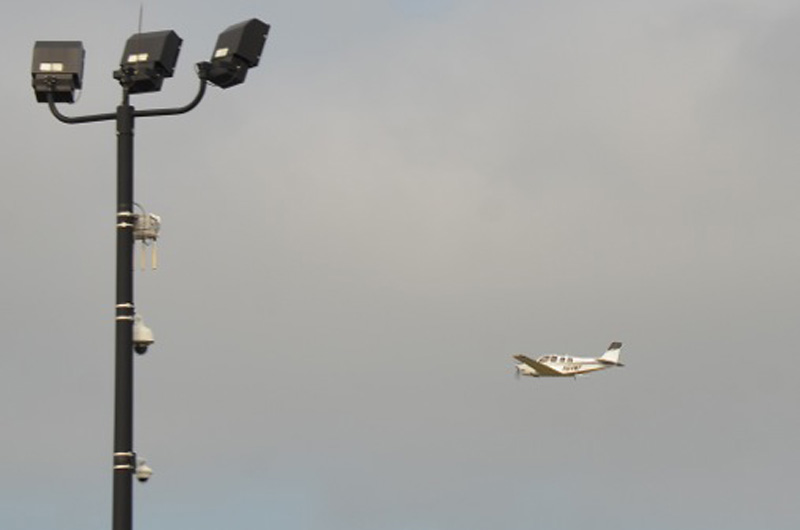
Noise from overhead air traffic this summer has rankled some in West Tisbury.
Meanwhile, this week Mr. O’Connor, the chief pilot for the Island’s only year-round airline, said the information
compiled by Mr. Stein is not completely accurate.
After checking electronic flight records, which document departure times and arrival times, but not the flight path of the aircraft, he said there is a discrepancy between the Cape Air data and the records Mr. Stein compiled.
“I concluded he was either mistaken in his count of planes, or his perception of where they were,” Mr. O’Connor said.
About 50 pilots fly Cape Air planes out of the Martha’s Vineyard Airport during the summer. Mr. O’Connor said after a conversation with Mr. Stein in August, he reminded the pilots of the noise abatement procedures.
“I like to think our pilots listen to me. I think periodic reminders help. I don’t know if there was less compliance before,” the chief pilot said.
He offered several scenarios where pilots would be required to fly over residential neighborhoods rather than observe voluntary noise abatement procedures, which route aircraft over sparsely populated areas as they climb to cruising altitude.
He said the most frequent scenario is when pilots are flying under Instrument Flight Rules (IFR), using electronic instruments to navigate. Low visibility in rain or fog, or a low cloud ceiling are the most common weather conditions that require instrument flight rules. Pilots must file a flight plan, and follow it, even if the weather clears. Also, it may be clear at departure, but stormy at the flight destination, which would require instrument flight rules along the entire air route. Under Visual Flight Rules (VFR), pilots navigate by sight, and have wide latitude to choose their own course. Pilots flying under instrument flight rules must follow assigned courses.
“When you’re flying under IFR, you’re required by law to fly the heading assigned by air traffic control,” Mr. O’Connor said. “You can’t decide on your own.”
Cape Air has the option of flying under visual flight rules in clear weather, but many commercial carriers and small jets, must fly under instrument flight rules at all times.
Another factor is President Obama’s Island visits. When the President is on the Island, almost all aircraft are required to operate under instrument flight rules, according to Mr. O’Connor. The Secret Service coordinates with air traffic controllers.
“I think those factors are very much in play,” Mr. O’Connor said. “The President might be on the move, and they tell you go this way, that way, or the other way.” Mr. Stein, also a pilot, said he understands aircraft flying under instrument flight rules may not follow noise abatement procedures.
“We may not get down to zero, but if we could get the number of playing not complying with noise abatement procedures down to three or four a day, rather than 15 a day, or 25 a day in the summer,” he said.
Mr. Stein said he is encouraged that airport management and the airport commission will take up the concerns.
“The airport is looking into a number of proactive steps and possible solutions to address the noise issues that face the airport,” said assistant general manager Deborah Potter in an email.
Airport commission chairman Myron Garfinkle said he has already discussed noise issues with he FAA, and will work with airport neighbors.
“No matter what the town or the city the airport is in says, the ultimate arbiter is the FAA,” Mr. Garfinkle said. “We have looked at the noise footprint. I don’t know what we can expect from the FAA, but I do know as a neighbor, we’re going to do everything we can. I can understand the frustration of the people involved, if they’ve been trying to get people and not had any response.”
Mr. Garfinkle, an experienced pilot, said he is aware of both sides of the noise abatement dilemma, including pilots who use full power soon after take off.
“An airport makes noise, airplanes make noise,” he said. “You want to get altitude so you’re safe, and you want to get altitude to be quiet.”
Mr. Stein contends that aircraft noise has increased dramatically in recent years. FAA data shows an increasing number of flights to and from the Martha’s Vineyard Airport over the past four years, but air traffic is still far below its peak more than five years ago.
In 2011, there were 39,860 operations, which the FAA defines as an aircraft taking off, landing, or crossing over the end of the runway. In 2012 the number of operations increased to 42,008; in 2013 it was 46,583, and last year it climbed to 47,360. In five of the seven years from 2004 to 2010, there were more than 50,000 operations at the Martha’s Vineyard Airport, peaking in 2010 with 59,087.
Comments
Yeah right!
Matthew Sudarsky West TisburyYeah right!
I owned a wonderful home on
GH Guy Gay HeadI owned a wonderful home on Skiffs Lane in West Tisbury and ended up selling it due to the noise from the low flying aircraft. From May thru October, our day started off at 7am with a Cape Air flight buzzing over our home at what sounded like full throttle. It got so bad that during the season, you'd rarely get 10 minutes of silence between all the planes flying into or out of the airport. It wasn't just Cape Air flights but the dozens of private planes each day that contributed to the daily barrage of aircraft noise. We were mostly effected by the shorter of the 2 runways at the airport which is primarily used for small aircraft and not the larger Jets.
There were also many days where you were subjected to the sound of aircraft running their engines while waiting for a slot to depart. I can understand how the residents feel and once you become sensitive to that noise, each and every plane that flies overhead makes your blood boil. Knowing that there wasn't much we could do to make less planes fly overhead, we finally decided the best thing to do was to sell the home and conduct our next search far away from airport noise….Gay Head was the answer!
I would assume that if one
DuhI would assume that if one built a house next to a train station, next to a highway, next door to a next to a Club (like the Old Hot Tin Roof) NEXT to a `Airport` one would expect noise especially in the summer in a tourist area! DUH!
I would agree with 'Duh'.
edwardI would agree with 'Duh'. Don't any of us want to take responsibility for our actions anymore.
How far down on Skiffs Ln
InterestedHow far down on Skiffs Ln were you?
I do understand the
Bob Zeltzer ChilmarkI do understand the frustration of abuters to the airport. However, I would guess that the airport was there when they bought and/or built.
I do think that safety is the overriding concern here.
Once the airport recognizes
Gail Rowe West TisburyOnce the airport recognizes that this is a serious problem, and finds solutions to address it, beyond simple "reminders" to pilots and the airlines, then we are making progress. I strongly urge them to work with the community to identify and implement viable solutions, and then to be proactive and precise in determining the success of these efforts.
There is no solution.
JaredN Wayland/ChappyThere is no solution.
Planes are noisy. The aircraft flown by Cape Air are relatively underpowered to begin with, and as a result don't climb all that quickly. They don't have a large reserve of power such that they can throttle back significantly and still climb.
The reality is that the airport has been there since WWII, long before you purchase your home.
How does Gay Head guy get to
Mel Satchcer The Big MHow does Gay Head guy get to the Island? Boats pollute and make noise. Geezz
Duh indeed! I would hope
John ChilmarkDuh indeed! I would hope pilots are at full power on take of! The idea is to get to sufficient altitude as quickly as possible in case there's an engine failure or other problem and you have to get the plane down someplace safe such as back to the runway.
Moreover, the airport has been there since WW II. I would think people buying in proximity would have figured out there would be airplanes taking off and landing.
Gail: Get real!
Thank you John. Someone
Concerned resident Martha's VineyardThank you John. Someone needs to brief residents regarding control of airspace - who can control it and who cannot (island residents.) The airspace is generally under the control of the FAA and they decide on routes for IFR flights. You may recall that the FAA was formed after a collision of 2 commercial aircraft over the Grand Canyon. Now, it's time for some aviation education!
Mr. Stein I will gladly
Very Annoyed Vineyard HavenMr. Stein I will gladly switch houses with you. I would prefer living on a dead end road with acres of conservation land instead of the a boat whistle and traffic. I accept that noise because it was there before me. You are a pilot, accept the noise! The airport was there before you, stop whining!
Following this story with
Charles H. NantucketFollowing this story with interest. Do any of those who want pilots/aircraft to cut back on power, upon takeoff, also want to be aboard these planes when they are not at full throttle? Since the mid-1950's, the FAA has made the rules for our skies, not people who have no clue about who controls the airways. This was after a mid-air collision of two aircraft on "sightseeing" flights. Don't understand who controls our skies? Read the FAA regulations and stop listening to a vocal, uneducated minority.
Instead of just talking
Concerned resident Martha's VineyardInstead of just talking without knowledge, here's the Airports Council International's new report on mitigating Airport noise for various stakeholders (60 pages, can be downloaded)- Try some of the ideas and solutions from experts:
https://www.canso.org/sites/default/files/Managing%20the%20Impacts%20of…
Add new comment