


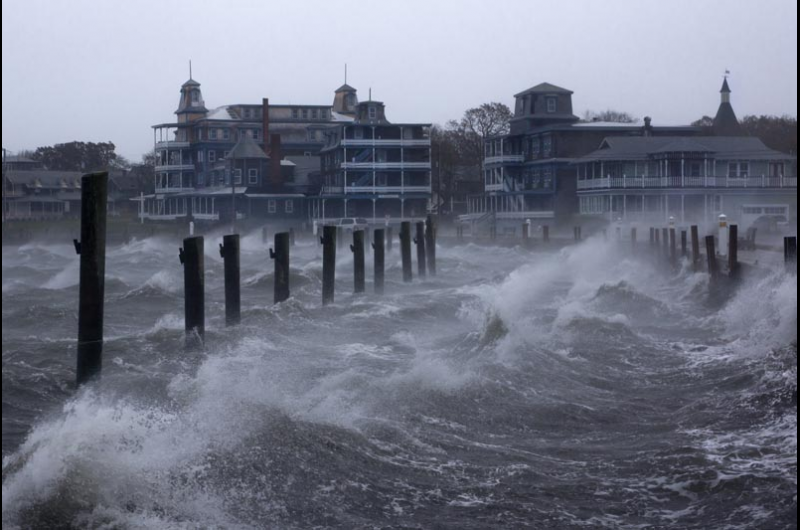
<p>An crowd of about 60 people turned out last week to hear preliminary results of a study predicting how climate change will affect the town of Oak Bluffs, which included precautionary measures that can be taken.</p>
An overflow crowd of about 60 people turned out Thursday evening in Oak Bluffs to hear the preliminary results of a study predicting how climate change will affect the town.
Funded by $50,000 in Community Preservation Act funds, the study will lay the foundation for future efforts in Oak Bluffs to respond to the rising sea level, and outlines the consequences the changing climate will have on coastal storms and hurricanes that batter Martha’s Vineyard.

Crowd of about 60 people listened to presentation on climate change study.
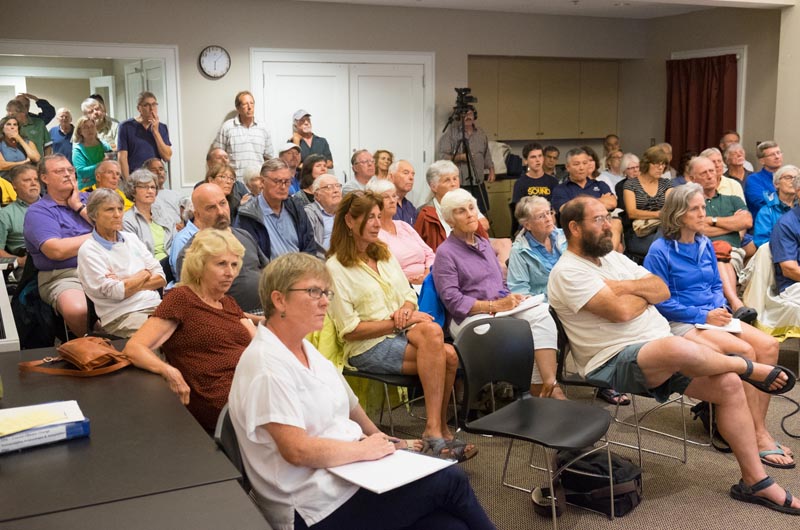
Crowd of about 60 people listened to presentation on climate change study.
The author of the study is Andre Martecchini, a civil and structural engineer with expertise in adaptation design and coastal engineering.
“We’re trying to understand how the community of Oak Bluffs is vulnerable in the future, to climate change, storm surge, and sea level rise,” Mr. Martecchini said.
With the help of two super-computers, he analyzed historical data from hundreds of storms. He applied the findings specifically to Oak Bluffs, predicting how rising sea levels will affect the town and its municipal infrastructure in the short term (the year 2030) and the long term (the year 2070).
Using predictions accepted in the scientific community for the rate of rising sea levels, Mr. Martecchini said climate change will cause the sea level to rise about eight inches by the year 2030, and about three feet, five inches by 2070.
Andre Martecchini, author of the study.
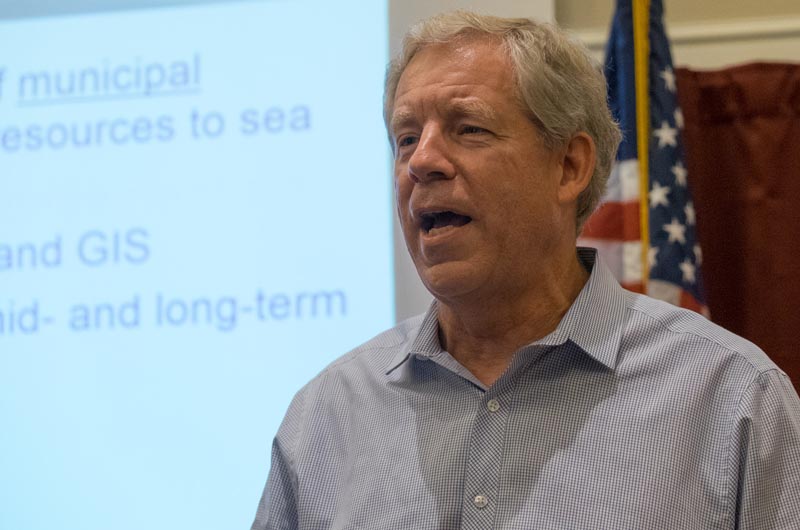
Andre Martecchini, author of the study.
He then analyzed how a “hundred year storm,” the strongest storm with a probability of striking the Island directly once in a century, would affect the town if those sea level predictions prove accurate.
According to his calculations, a hundred year storm in 2030 would push the sea level 9.7 feet above normal. He illustrated the calculation by estimating how familiar vulnerable locations might be affected.
A storm surge of 9.7 feet would come over the floor of the harbor master’s office on Oak Bluffs Harbor, well above the height of the current concrete bulkhead. A storm of that magnitude would cover the roadway across from Farm Pond to a depth of about 5.5 feet. It would flood the area around the Martha’s Vineyard Hospital, limiting access to a single road.
The hypothetical storm surge could be higher or lower by several feet, depending on the tides. The calculations to not take into effect how battering waves, or rain, might damage the town’s infrastructure.
Using his calculations, a hundred year storm in the year 2070 would push the ocean level 12.5 feet above normal.
Mr. Martecchini offered various solutions to protect the town from flooding in a storm.
“Some ideas are going to be, obviously, controversial,” Mr. Martecchini said. “Everything I’m going to talk about is costly.”
People in flood prone areas are already using natural and man-made solutions to protect property, he said. Among the man-made solutions are modular sea wall construction, a system that would allow the height of the barrier to increase in later years, as ocean storms pose a bigger threat.
Another suggestion was passive flood barriers, which lie flat on the ground as shore front walkways but can be raised upright to form a flood barrier. Glass walls surrounding the harbor, providing storm protection while not blocking the view, were also discussed.
A larger scale solution might be building a hurricane barrier at the harbor entrance. A large gate twould provide passage for boats, but could be closed to block a storm surge.
More natural solutions included building and maintaining massive sacrificial dunes that would wash away in a big storm, but would protect shoreline property from the brunt of a big storm.
He questioned whether that solution could work for Oak Bluffs. “If you don’t have sources of sand to work with, a community like you, it’s going to be really, really hard to do it,” he said.
In some vulnerable areas, such as East Chop Drive adjacent to Crystal Lake, there may be no way to control the ocean.
“To be honest, I don’t see a good solution there,” he said. “This may be a situation where the town looks to buy out properties, and let it go.”
He said federal and state regulators are beginning to see the value in loosening rules that currently would prevent some measures to protect property from constant flooding.
“The permitting agencies are starting to think a bit along those lines,” Mr. Martechhini said. “People are starting to be aware that some of these things have to be done.”
He said regulators will most likely favor green solutions for mitigating the effects of sea level rise, and will score grant applications higher for regional, rather than town by town, solutions.
The final version of the study will be complete in about a month, and available online at the town’s web site.
Comments
"The sky is falling. That
William Langley Charlestown, RI"The sky is falling. That will be $50,000.00 please."
Will climate science ever
mememine69 Martha's VinyardWill climate science ever finally say it's; "PROVEN" before it's too late to avoid their CO2 Armageddon?
It's been 34 years of debate and delay to save the planet.
Is this how you want your children remembering you?
CO2 death threats?
Who's the neocon in the coming history books?
Perhaps because it's not
William Langley Charlestown, RIPerhaps because it's not actually true.
PLEASE NOTE EDIT: Perhaps
William Langley Charlestown, RIPLEASE NOTE EDIT: Perhaps because anthropogenic climate change simply doesn't exist.
Prove the scientific
BrianProve the scientific community wrong, their almost universal consensus has to be a complete fabrication. I will be waiting for what will surely be a brilliant thesis....
Anthropocentric climate
NASA EverywhereAnthropocentric climate change is real. And luckily for us, you will be dead soon, but it is real, it is a threat, and we have the science to back it up.
"To be honest, I don’t see a
Dan Ob"To be honest, I don’t see a good solution there,” he said. “This may be a situation where the town looks to buy out properties, and let it go.”"
Why would the town waste tax payer dollars to buy properties and let them go?
Wouldn't it be a better idea to put the burden on the wealthy waterfront home owner? After the flood, allow the home owner to collect the insurance money and rebuild the house on stilts (if they want) like they do in most Norwegian communities.
Use the tax dollars for infanstructure improvements instead.
Dan: thank you for the voice
Steve FalmouthDan: thank you for the voice of reason! Why should society underwrite those who choose to live in harm's way? You have the right to do do but at least pick up your own tab!!
Water Front home owners
SplitRockRE WTWater Front home owners whether wealthy or not and home buyers need to be informed and accept the risks associated with living on the edge. Nothing lasts forever.
In the case of home owners many are trying to sell because of the new FEMA regulations and flood maps as well as astronomical increases in their flood insurance. In the case of home buyers the market has been narrowed to cash buyers or those willing to pay the high premiums associated with their loans. I don't think there is an easy answer for how to preserve our fragile water front but repeatedly relocating McMansions isn't the answer.
Add new comment