


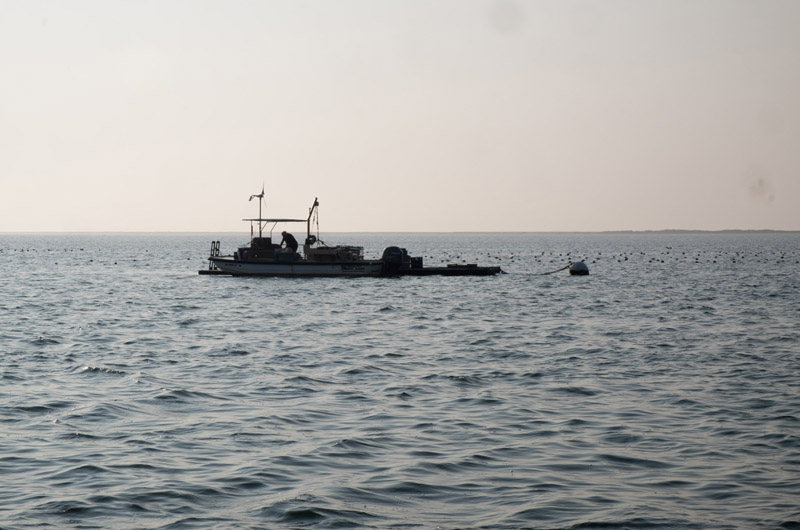
As Katama Bay oyster farms remain closed because of Vibrio illness tied to raw oysters, scientists are using the bay as a testing ground to understand more about the bacteria and how it interacts with oysters.
The sun was still low in the sky over Chappaquiddick early Thursday morning, but the work day was well underway on Katama Bay. Oyster farmer Scott Castro grabbed an orange plastic basket and hopped into a boat, motoring out to his shellfish farm on the bay as a cormorant dried its wings on a nearby dock. Ryan Smith loaded oyster grow-out bags into a boat with his father, Joe, while Sophie the dog ran up and down the dock. Jack Blake, known as an early riser, had been at work out on his raft since dawn.
Another day of work for the oyster farmers running 12 aquaculture operations on Katama Bay, except that business has come to a halt with a two-week closure of the oyster farms because of Vibrio illness tied to raw oysters consumed from the bay. A precautionary seven-day closure was announced last Wednesday; this Tuesday the state Department of Public Health and Department of Marine Fisheries announced the closure would be extended by another week because of three additional confirmed illnesses.
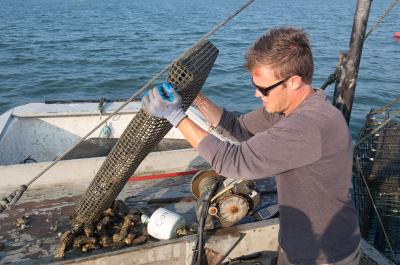
State biologist and Vibrio coordinator Chris Schillaci collects farmed oysters from Katama Bay Thursday morning.
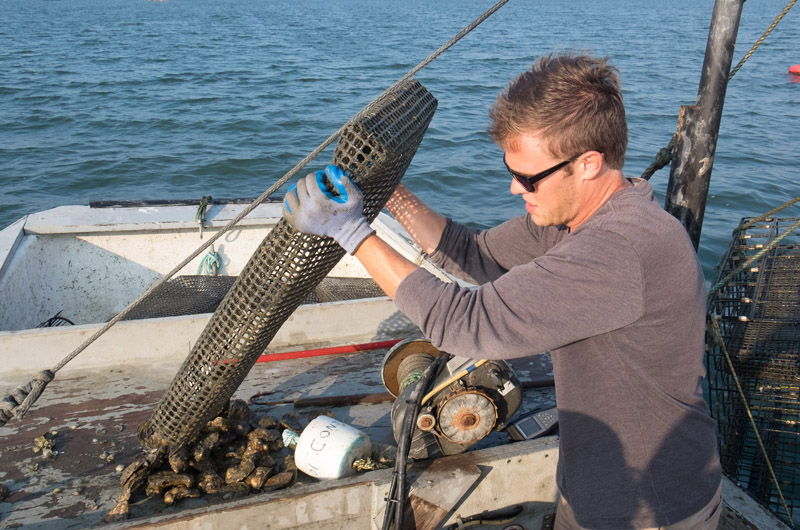
State biologist and Vibrio coordinator Chris Schillaci collects farmed oysters from Katama Bay Thursday morning.
The closure has put a wrinkle in an otherwise thriving Vineyard aquaculture industry, which is centered out on Katama Bay. This is the third closure of the area in as many years, and Vibrio cases continue despite new protocols for shellfish growers that by all accounts are being followed. Vibrio has been documented for the past three years, and scientists said this week the illnesses are tied to a virulent strain of the bacteria now found in East Coast waters.
As state health officials and oyster farmers work to balance business interests with public health concerns, scientists are using Katama Bay as a testing ground to understand more about the bacteria and how it interacts with oysters, with an eye toward measures to help reduce illnesses and prevent closures.
Biologist and state Vibrio coordinator Chris Schillaci emphasized this week that he did not think there was any fault in oyster handling, and the source of the problem might be in the water.
“It’s apparent there’s environmental conditions that promote the growth of pathogenic Vibrio in Katama Bay for a period during the summer,” he said Thursday.
Vibrio parahaemolyticus is a naturally-occurring bacteria that thrives in warmer waters, and with the Vineyard experiencing a prolonged heat wave in recent weeks, bay waters are warm. The water temperature in Katama Bay Thursday morning was almost 77 degrees.
Consuming a raw oyster with high levels of the bacteria can cause gastrointestinal illness with abdominal cramping, nausea, fever, vomiting, and chills. Severe illness is rare and most likely to occur in people with weakened immune systems.

Katama Bay aquaculture farms produced more than two million oysters last year valued at some $1.4 million.
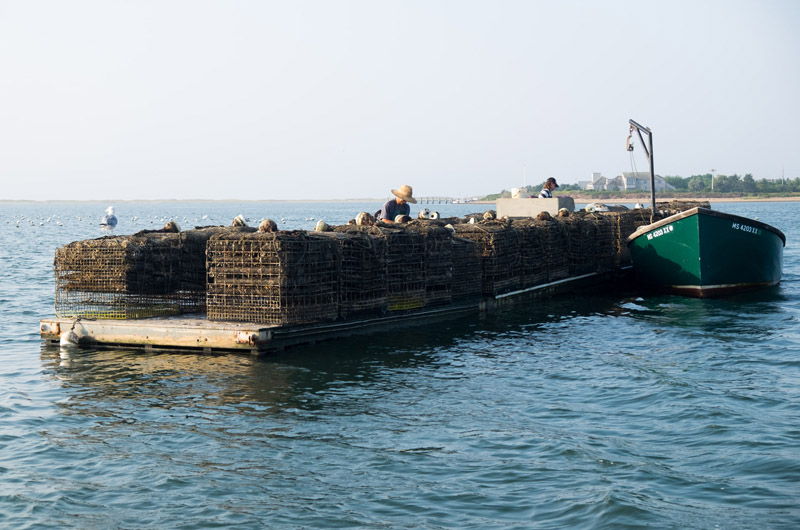
Katama Bay aquaculture farms produced more than two million oysters last year valued at some $1.4 million.
Mr. Schillaci said genetic testing shows that Vibrio cases from this year are caused by a particular pathogenic strain of the bacteria, the same strain that caused illnesses in previous years. The strain came to the area from the Pacific Northwest, he said — it’s unclear how — and has been found up and down the East Coast.
The strain is “incredibly virulent,” Mr. Schillaci said, and has been found to have a faster onset time.
Vibrio concerns began drawing attention in Massachusetts in 2013, when the state had 24 cases of the illness. It also happened at a time when the oyster industry is on the rise. Last year more than 2.3 million oysters were harvested from Katama Bay, valued at more than $1.4 million. In the state, harvesters are paid an average of 57 cents per oyster, Mr. Schillaci said; last year in Massachusetts wholesale dealers paid nearly $20 million to harvesters.
This represents significant growth. In 2007 seven million oysters were harvested in the state, Mr. Schillaci said. In 2014 the number had grown to 34 million. Oysters are the third most valuable fishery in the commonwealth.
So there was much at stake Tuesday afternoon when Mr. Schillaci announced the extended closure at a meeting of the Edgartown shellfish committee that was attended by several Katama Bay oyster farmers.
Under state guidelines, two to four illnesses tied to an area within a 30-day period would result in a seven-day closure, while four or more illness require a 14-day closure. More than 10 illnesses would require a 21-day closure and a product recall.
There have been six Vibrio cases reported from Katama Bay in the past 45 days, Edgartown shellfish constable Paul Bagnall said, and three in the last 30 days. Those oysters were eaten in early to mid August.
Based on the weather and the number of illnesses, plus the lag time in reporting illnesses, “it made more sense not to put more product on the market just to close again for one more illness,” Mr. Schillaci said. If the area had reopened on schedule and one more illness was reported, he added, an additional 14-day closure would have been mandated.
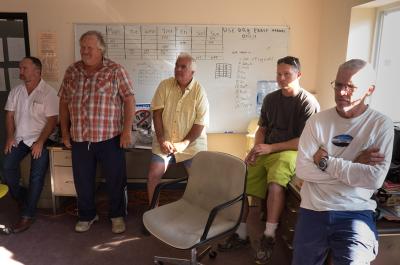
Oyster farmers gathered at shellfish committee meeting Tuesday.
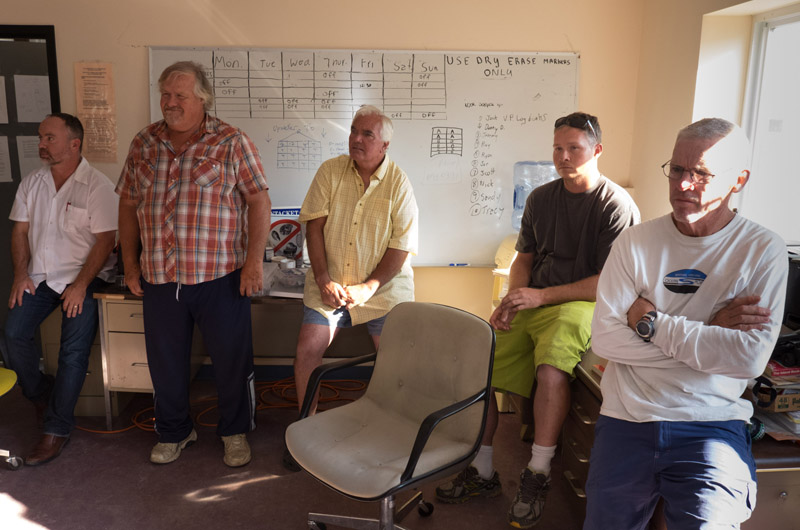
Oyster farmers gathered at shellfish committee meeting Tuesday.
“I know it’s not what you guys want to hear,” he told the group.
The oyster farmers in attendance peppered Mr. Schillaci with questions. One source of concern is information about the people getting sick: were they immune compromised, taking antacids, elderly, first-time oyster eaters? That information isn’t available, Mr. Schillaci said, but the state assumes for every case identified there are others that are unreported.
Other concerns include what happens to the oysters after they are handled by growers.
Mr. Bagnall and Mr. Schillaci said they are confident that the oyster harvesters are doing everything right, and following to the letter new state protocols instituted to reduce Vibrio illnesses, such as shorter lag times between harvest and chilling.
“It’s not handling that’s the problem here and I truly believe that,” Mr. Schillaci said. He also said the state looks for non-compliance in other areas and has not found abuse at retail establishments or wholesalers.
Scott Castro, one of the original oyster farmers on Katama Bay (he’s been in business since about 1997), said more attention should be paid to the rest of the production chain, and not just the growers.
“I think they need to look more at the restaurants and they’re not,” he said Thursday morning at the Katama town landing. He listed variables that aren’t known to the growers: details about the people getting sick, and where the oysters are consumed. In some cases, he said, the oysters are consumed several days after harvest.
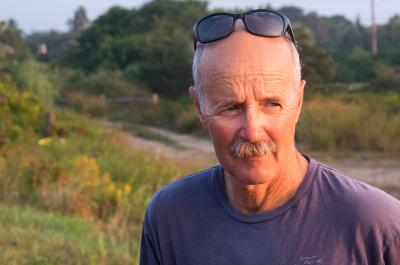
Longtime oyster farmer Scott Castro: "We're doing everything right."
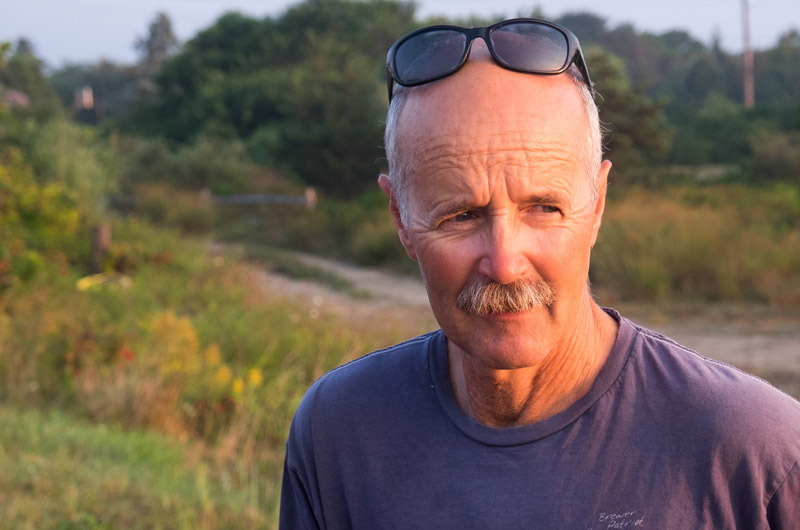
Longtime oyster farmer Scott Castro: "We're doing everything right."
“And it’s on the grower every year,” he said. “It’s an outrage, quite frankly.”
“We have to jump through a lot of hoops,” he added. “We’re doing everything right. But when they leave our hands . . . we can’t be held accountable for other people’s mistakes.”
Loss of income is a main concern, Mr. Castro said. By the time the oyster beds reopen it will be after Labor Day, and “the demand will also be down because nobody is going to want to touch Katama Bay oysters for awhile,” he said. “To not hold the other end of the chain accountable is outrageous.”
At Tuesday’s meeting, oyster farmer Ryan Smith aired the frustration felt by many.
“It seems like nobody really knows what going on,” he told the Gazette, adding that the closures started “out of nowhere” in 2013.
Lack of information is something Mr. Schillaci and others are making an effort to change.
Early Thursday, he and Mr. Bagnall joined a scattering of oyster farmers on the bay. As Mr. Bagnall steered the shellfish department boat, Mr. Schillaci made the rounds for scientific tests, which are examining a variety of things, including whether some methods commonly used by shellfishermen could be adjusted to reduce Vibrio. There also are tests for the levels of Vibrio in the water, bay sediment, and in oysters.
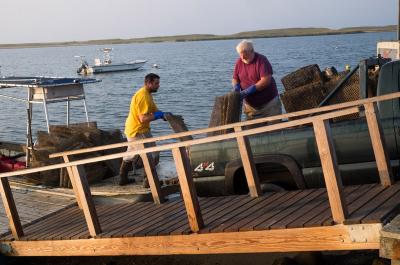
Ryan and Joe Smith at work Thursday morning.
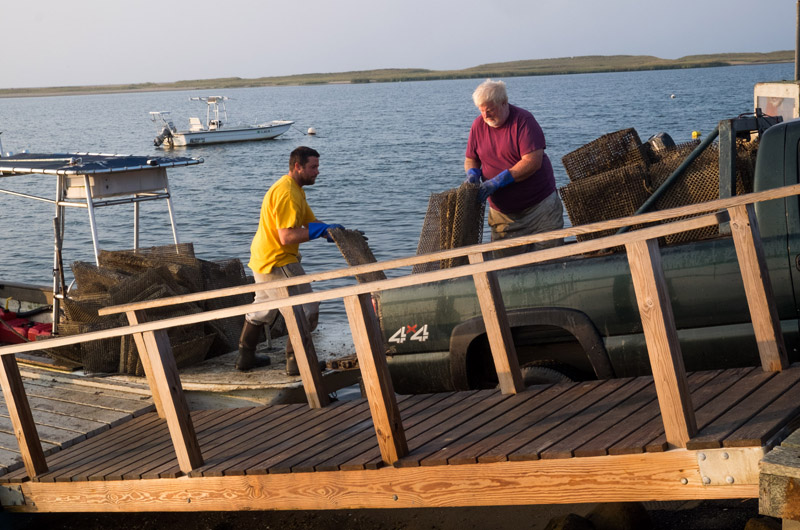
Ryan and Joe Smith at work Thursday morning.
“This is all an effort to lower the amount of Vibrio in oysters headed to the market,” Mr. Schillaci said. “That’s the thing we can control, how oysters are harvested and handled.” More information could open up options beyond seasonal closures that would reduce the risk of illness.
Scientific equipment placed on oyster cages and a buoy in the bay gather information including water acidity, salinity and temperature.
Oyster growers often air dry their farmed shellfish to remove fouling: barnacles, sponges, and jingle shells that accumulate on the shells fall off after being exposed to air. Using test oysters donated by several of the Katama farmers (most of the oysters are “ugly culls,” too unattractive to be sold), a test sample of oysters was left to air dry for 48 hours earlier in the week. On Thursday the test oysters, along with a control sample of shell-covered oysters, were pulled out of the water, packaged in plastic bags, and placed with ice packs in a cooler.
“We also want to know what conditions in the environment are conducive to pathogenic Vibrio growth,” Mr. Schillaci said.
A short time later Mr. Schillaci and the cooler of oysters arrived at the John T. Hughes State Lobster Hatchery on the shores of Lagoon Pond in Oak Bluffs. Diane Regan, a bacteriologist with the Department of Marine Fisheries lab in Newburyport, was waiting with trays of test tubes.
The Vibrio testing on the Vineyard is operating “on a shoestring,” the scientists said.
Ms. Regan is a seasonal resident of Oak Bluffs who is on the Island to help with the Vibrio study. Mr. Schillaci and his dog are staying with Ms. Regan, her husband and their dog at their home in the Camp Ground. The second floor of the hatchery has been turned into their laboratory.

State bacteriologist Diane Regan.
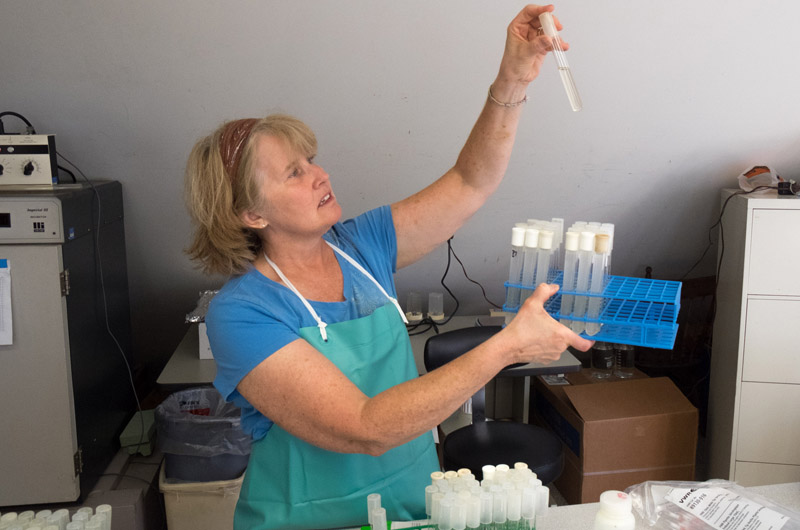
State bacteriologist Diane Regan.
The water samples from Katama Bay are put into test tubes, diluted in various amounts, to observe bacteria levels. About a week’s worth of water samples were stacked in a refrigerator. Ms. Regan will bring the samples back to Newburyport to actually look for Vibrio. The scientist said they are still working on the link between Vibrio levels in the water and illness from the oysters. And there’s a great deal of variability, she said: oysters grown right next to each other can have different levels of bacteria.
“We’re here,” Ms. Regan said as she processed a water sample taken about an hour earlier on Katama Bay. “Let’s test what we can. Give me mud, give me dirt, give me sediment.”
Meanwhile, Mr. Schillaci shucked the oysters, which were blended 12 at a time into an “oyster frappe” concoction to be tested by Ms. Regan. She can also test individual oysters with tiny blenders of her own making.
Ms. Regan and Mr. Schillaci were joined in the lab Thursday by Robert B. Rheault, executive director of East Coast Shellfish Growers Association. Mr. Rheault is also a seasonal Oak Bluffs resident.
“This new strain made us totally change the way the industry has operated,” he said. “With the new more virulent strain that came to New England, we had to change everything.”
The growers have made major investments, he said. And while they’ve risen to the challenge, “science is struggling to catch up.” He said he dreams of a day when water tests can show the presence of a virulent strain of Vibrio.
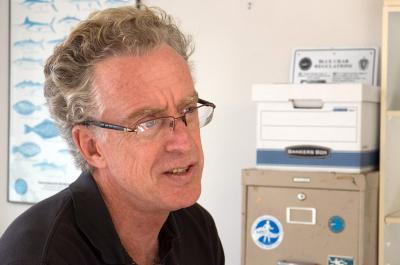
Robert Rheault, executive director of East Coast Shellfish Growers Association.
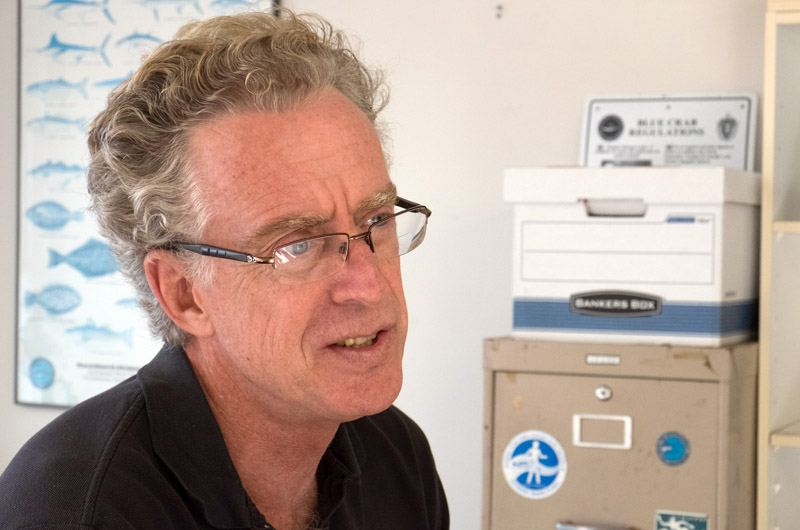
Robert Rheault, executive director of East Coast Shellfish Growers Association.
Mr. Rheault said he thinks oysters are relatively safe on balance — a lot of food carries a factor of risk to the consumer, he said — and there are have been great strides in understanding how to handle shellfish and avoiding introducing bacteria to oysters.
He believes extended closures aren’t justified given the number of illnesses reported. The numbers peaked in Massachusetts at the 24 cases in 2013. There were 11 cases last year in Massachusetts, and fewer than that so far this year.
The research taking place on the Vineyard will be used to help the aquaculture industry elsewhere in the state and beyond.
Meanwhile, the intricate Vibrio puzzle remains largely unsolved.
“That’s the problem with this whole thing is there’s more we don’t know than we know,” Mr. Bagnall said out on the water Thursday morning.
“I one hundred per cent agree with that,” Mr. Schillaci responded.
Comments
So let me get this straight -
JBM SengieSo let me get this straight - there have been six Vibrio cases reported from Katama Bay in the past 45 days and three in the last 30 days. No one knows anything about these folks and their medical condition, predisposition to illness or affinity (or lack thereof) to oysters. Apparently there is no test to confirm their sickness came from vibrio and the oyster. No one knows if they got sick from something else or if the link is to post-cull process and operations. The lab is working on a shoe string. Tests are done off island. Still working on a link between the vibrio and illness ... Great deal of variability... Science is catching up... Not one concrete link to Katama oysters or any test that can even prove vibrio is present in the water? And they shut one of our best industries/businesses down for 2 weeks at the end/height of final summer season. Blake, Castro, et al have every right to be outraged.
A detailed food history is
Bd of Health EdgA detailed food history is gathered from each ill individual by either an epidemiologist or registered nurse. Predisposition to illness is not measured...however the consumer is often an island visitor or short term summer resident. Vibrio illness is confirmed thru lab analysis of a stool sample when an individual seeks medical treatment. Suspect (unconfirmed) illness does not count against a harvest area. A case is not deemed confirmed without a positive stool test. Each illness links to consumption of oyster(s) thru the food history provided by the patient. Sometimes an individual with confirmed vibrio will also have eaten mainland oysters or Vineyard oysters from a different harvest area; this is all taken into account when the state determines whether to count an illness against a harvest area or not. Vibrio has been found in oysters when the water is very warm in many harvest areas along the entire eastern seaboard and on the west coast. Most oysters do not have enough vibrio organisms to cause illness. It appears the combination of high vibrio counts in a small percentage of oysters combined with a sensitive consumer conspire to cause the cases that have been documented. How much vibrio is contained in the stool of a year round resident who eats oysters frequently is an important question that hopefully will be answered. Hope this helps
Were the confirmed illnesses
An Oyster BuyerWere the confirmed illnesses tied to one farm, seafood wholesaler, or distributor? Did they occur in multiple restaurants in different cities? Why are the growers and those of us in the industry not getting more details on where and how the oysters were handled that caused the confirmed illnesses? Mishandling can happen throughout the supply chain, and we all should be in the know.
Much to my chagrin, I was
Oyster loverMuch to my chagrin, I was very sick twice in the spring and summer after consuming oysters that a dear friend brought to my table. I put it down to a late-in-life sudden appearance of an allergy. But the oysters came from Anthier's. Is there a way to monitor reports outside of restaurant consumption?
Does Anthiers meas
Charles Carlson EdgartownDoes Anthiers meas Sengekontacket?
I just spent 3 days in the
April CTI just spent 3 days in the hospital after having clams at Katama
I was VERY ill and bleeding.
Yes, this IS something that needs to be addressed before someone dies
Clams? Last I checked, they
Greg MVClams? Last I checked, they only grow oysters...
Add new comment