


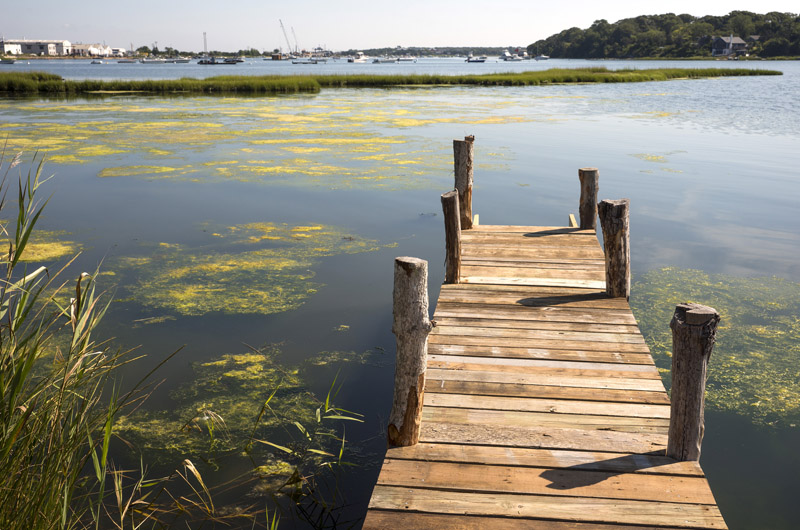
All the saltwater ponds on the Vineyard are impaired to some degree, and each one faces a unique set of conditions. Public interest has reached a tipping point.
Every year an explosion of algae — fueled mostly by nitrogen from septic tanks — turns the Lagoon Pond a shade of red or rusty brown, depending on the species. The “red tide” may only be visible in the wakes of boats stirring up the water, but it takes a toll on shellfish and other aquatic life.
Oak Bluffs shellfish constable David Grunden believed that this year’s algal bloom, in late spring, may have contributed to the death of several thousand cultured baby quahaugs by consuming oxygen in the already impaired estuary.

At Farm Pond in Oak Bluffs a $1 million-plus project is underway to install new culverts that connect with Nantucket Sound.
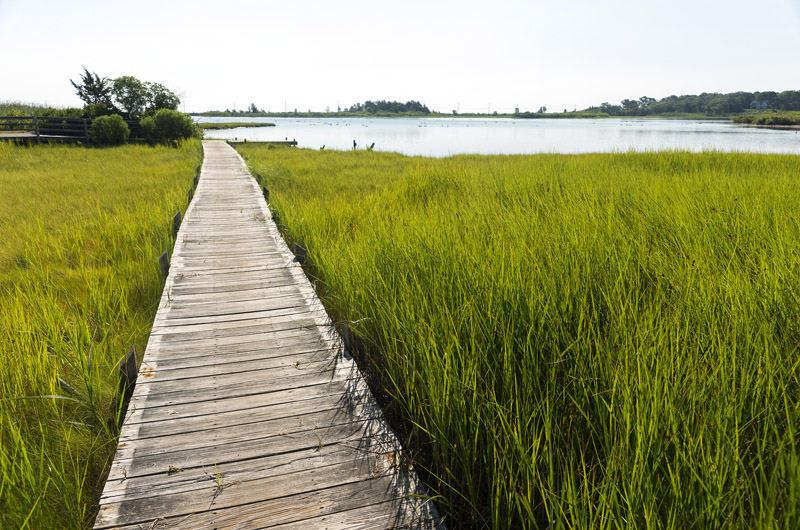
At Farm Pond in Oak Bluffs a $1 million-plus project is underway to install new culverts that connect with Nantucket Sound.
“We’ve had it for the last 10 years,” he said of the annual cycle, thinking back to the beginning of his time as shellfish constable. By then, the effects of nitrogen on the Island’s coastal ponds were well understood. But it had taken decades to arrive at that point. Scientific reports at least since the 1980s had called for better management techniques for the Lagoon and other Island ponds. According to some estimates, shellfish harvests have declined by more than half since the 1970s.
Public interest has finally reached a tipping point, largely in response to the Massachusetts Estuaries Project, a long-term partnership between the state Department of Environmental Protection and the University of Massachusetts at Dartmouth that began in 2002. Detailed reports by the MEP provide nitrogen reduction goals for most of the estuaries in the region.
“There is reason to be concerned,” said Brian Howes, the UMass Dartmouth marine biologist who has led the MEP study. “But there is not reason to be frightened that it’s all going to collapse tomorrow. But that doesn’t mean that you have 20 years either. So things really need to start moving.” In some cases, he said, even creating the needed plans can take five years, with implementation another five or 10 years down the line.
All the saltwater ponds on the Vineyard are impaired to some degree, and each one faces a unique set of conditions. Ponds along the south shore, for example, which are manually opened to the sea during the year, are more sensitive to nitrogen than the north shore ponds, most of which are permanently breached. But areas of dense development along the north shore produce the most nitrogen.

Crackatuxet Cove at Edgartown Great Pond. South shore ponds have less circulation than their north shore counterparts.
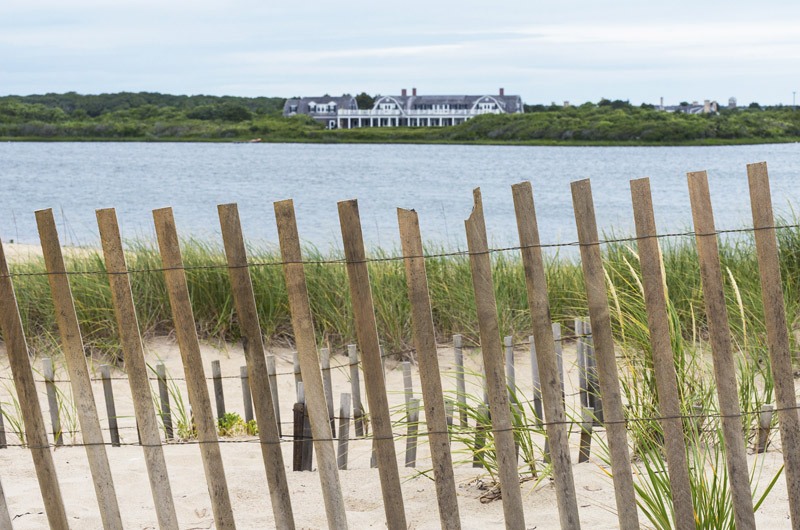
Crackatuxet Cove at Edgartown Great Pond. South shore ponds have less circulation than their north shore counterparts.
The resulting algal blooms can block out sunlight and consume oxygen, choking out the plants and animals that live in the pond.
“No system on the Island becomes impaired all at once,” Mr. Howes said, providing a quick evaluation of the problem. “You start to see the algal blooms, the loss of benthic communities, the loss of eelgrass. All of those things happen to the inland-most parts first.”
As nitrogen from groundwater and runoff continues to infiltrate the ponds, the impairment spreads toward the ocean. In the Lagoon, most of the remaining eelgrass beds are in the lower portion of the pond, closest to the inlet. Island ponds are in relatively good condition, Mr. Howes said, but will surely worsen over time if nothing is done to reduce the trend.
The rate of development on the Island will determine how much time is left for the ponds. Mr. Howes noted that the Lagoon has already lost significant resources, including bottom-dwelling organisms that support the food chain. According to the MEP, if development around the Lagoon reaches full buildout, nitrogen levels will increase by about 35 per cent, to about 27,000 kilograms per year.
About 18 per cent of the land around Island ponds could still be developed, according the Martha’s Vineyard Commission.
Lake Tashmoo. Restrictive zoning laws have helped protect Island estuaries.
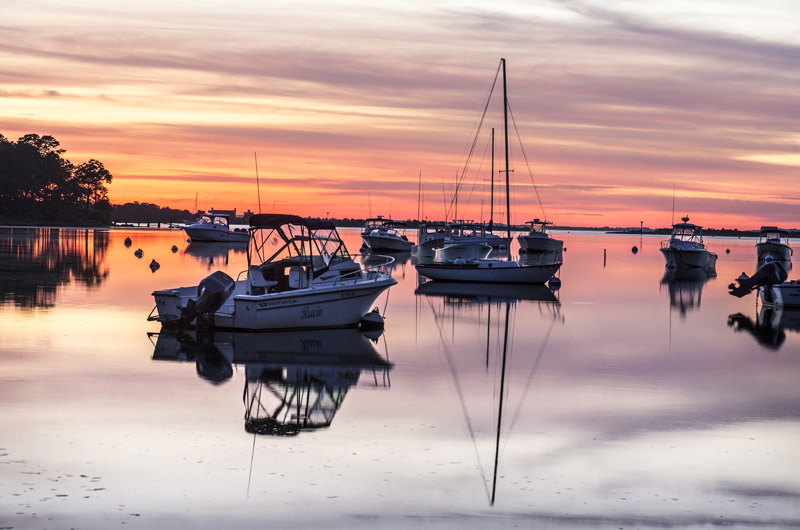
Lake Tashmoo. Restrictive zoning laws have helped protect Island estuaries.
But even if all development on the Island were to stop today, decades worth of nitrogen would still be inching its way through the ground and into the ponds. Groundwater travels at about one to three feet per day, Mr. Grunden said, so nitrogen loads may increase before the ponds get better.
In some respects, Islanders could consider themselves lucky. Widespread development has already devastated most of the 45 estuaries on Cape Cod, where fish kills are often reported during algal blooms in the summer. In some places, hundreds of dead fish have floated to the surface, unable to escape the oxygen-depleted waters.
More restrictive zoning laws and decades of land preservation have helped save the Island’s 15 major estuaries and a dozen or so smaller ponds from the same fate. But as nitrogen continues to seep into the groundwater and eventually into the ponds, several warning signs have emerged. Perhaps the clearest is the widespread loss of eelgrass, which provides food and habitat for pond organisms and helps maintain healthy ecosystems. Eelgrass has declined in many Island ponds, especially those on the south shore, which are closed for much of the year. As eelgrass disappears, so do the scallops and other animals it supports.
All of the eelgrass on the Cape has disappeared, Mr. Howes said.
Higher nitrogen levels have also opened the door to plants and animals often considered a nuisance. The invasive wetland grass phragmites, for example, is thought to thrive in nitrogen-rich environments, and like all plants and animals, consumes oxygen when it decomposes.
An overabundance of plants in general can alter the drainage capacity of wetlands, as it has around Sunset Lake in Oak Bluffs, another densely populated area on the north side of the Vineyard.

Nancy and Duncan Caldwell wade in waters of Menemsha Pond.
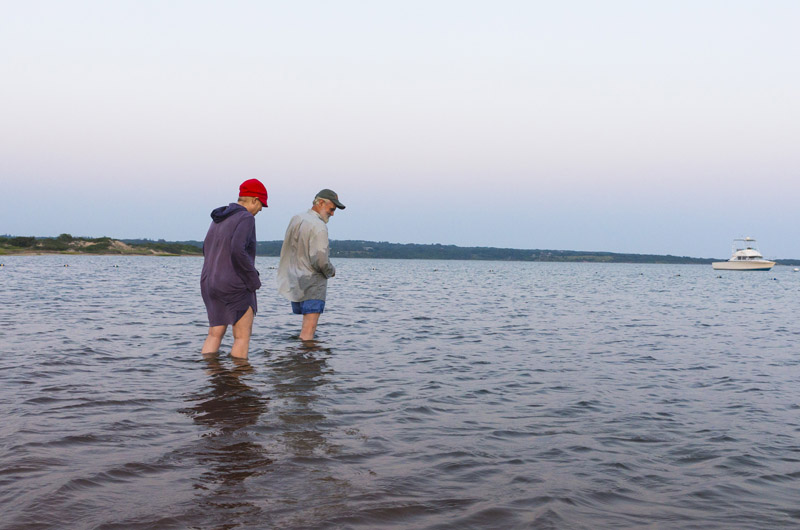
Nancy and Duncan Caldwell wade in waters of Menemsha Pond.
Meanwhile, algal blooms have forced smaller fish to retreat to areas with more oxygen, leaving more food for jellyfish, which can thrive in low-oxygen waters. One common species is the native lion’s mane, which can grow up to 100 feet long, and delivers a painful sting. “You see them all over the Island,” Mr. Grunden said.
Nitrogen is a growing concern everywhere, said Bret Stearns, director of natural resources for the Wampanoag Tribe of Gay Head (Aquinnah). But the concern is greatest for ponds that circulate more slowly. Menemsha Pond in Aquinnah is in relatively good condition, he said, since it is open to Vineyard Sound. But Squibnocket Pond, just to the south, has no direct inlet to the sea and is more vulnerable. “Is it ‘impacted?’ That’s a long discussion,” Mr. Stearns said. “It’s still doing what it needs to do, it’s just the nitrogen numbers are higher.”
He added that groundwater is just one source of nitrogen, albeit the largest. Other sources include fertilizer runoff, atmospheric deposition and to some degree the ocean itself. “As these numbers grow globally we are going to have problems that we really can’t control locally,” Mr. Stearns said. Nitrogen pollution has already spread to Nantucket Sound, which makes pond flushing in many of the Cape estuaries less effective.
“The biggest thing the Vineyard has going for it is that its estuaries, a lot of them are still in pretty good shape,” Mr. Howes said. “They are impaired, yes, but the offshore waters are very clean.”
He partly credited the Vineyard’s zoning laws, adopted in the 1970s, which have discouraged high-density development. “Those types of forward-thinking decisions that were put in place are very helpful for the Vineyard,” he said. “But it’s too late for other regions of the commonwealth to do that.”

Felix Neck summer camp children explore shoreline at Sengekontacket Pond.
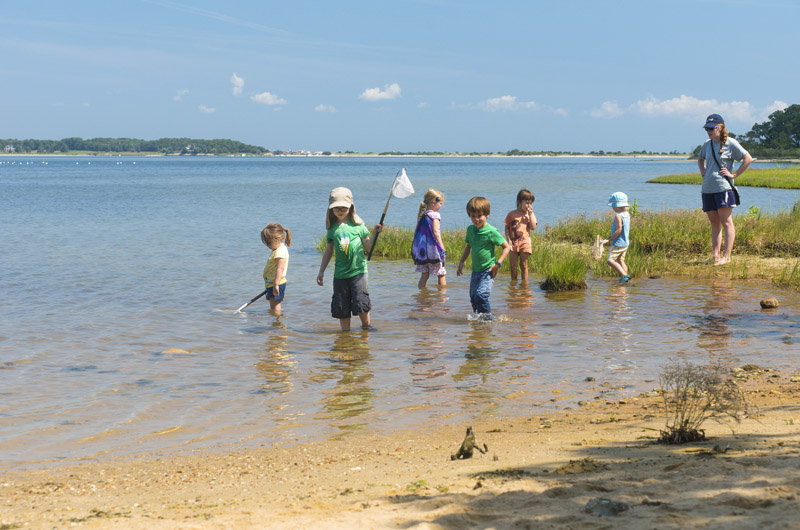
Felix Neck summer camp children explore shoreline at Sengekontacket Pond.
But while the Cape is suffering from the greater impacts of development, it is years ahead of the Vineyard in terms of addressing the problem. The Cape Cod Commission, a planning and regulatory body modeled after the MVC, has developed a regional watershed management plan with dozens of possible strategies for limiting nitrogen inputs and removing nitrogen from the estuaries.
“There are great things that we’re doing here on the Cape and mainland that are easily transferable to the Island,” said Tom Cambareri, the commission’s watershed management director.
While sewering will almost certainly be part of the mix, the Cape is also exploring alternatives such as aquaculture and floating constructed wetlands, which are known to attenuate nitrogen. Starting with those alternatives could lower the cost of sewering in the future, Mr. Cambareri said.
Mr. Howes estimated that meeting the nitrogen thresholds for all of the ponds on the Cape and Islands would cost between $4 billion and $8 billion, depending on the solutions. If sewering were the only solution, he said, the figure would be much higher.
The solutions for the Vineyard are still undefined, and several ponds have yet to be studied by the MEP. But the MVC’s comprehensive Island Plan in 2009 estimated that it would cost $142 million to deal with existing nitrogen in Island ponds, and $230 million to deal with possible additional development in the future.
Looking again toward the Cape, Mr. Howes stressed the importance of public support in the planning process. “You really have to get everybody on board first, and that takes a little bit of time,” he said. He believed that most towns on the Vineyard were on board, but were worried about the cost.
Each town will determine what solutions to pursue, he said. But collaboration will be key, since many watersheds cross town boundaries. A single sewer system in the Lagoon Pond watershed in Oak Bluffs and Tisbury, for example, could be cheaper and more efficient than two separate systems.
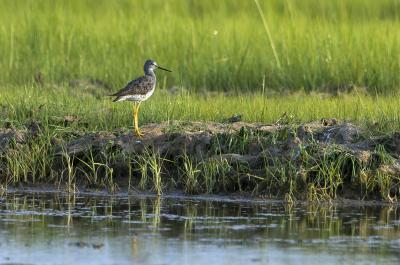
Ponds are home to many creatures — a greater yellowlegs enjoys the view.
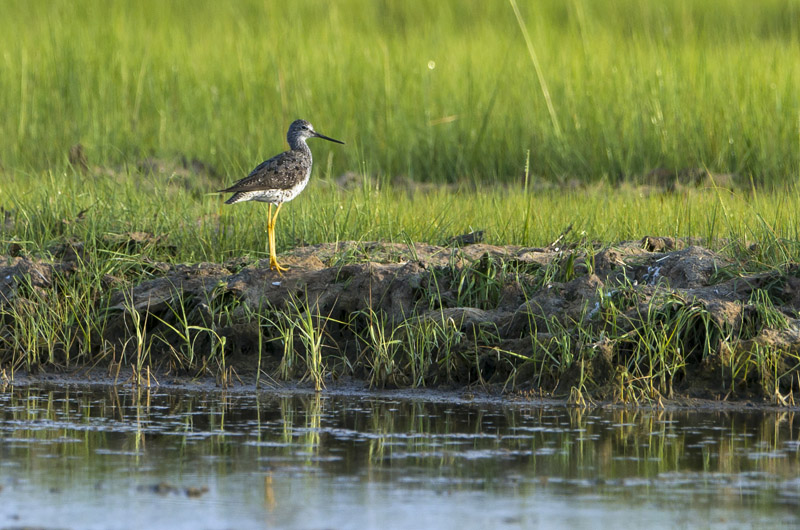
Ponds are home to many creatures — a greater yellowlegs enjoys the view.
As the alternatives become clearer, town officials on the Vineyard will likely focus more on public outreach and education. “It’s something that we are planning and talking about,” said Gail Barmakian, an Oak Bluffs selectman and member of both the Lagoon Pond Association and a new Tisbury-Oak Bluffs watershed planning committee. Some people may not be aware of the alternatives to sewering, she added, or that sewering in low-density areas could be cost-prohibitive.
“I think that people are aware that nitrogen is the issue,” Mr. Grunden said, noting a unanimous town meeting vote in Oak Bluffs this year to contribute $250,000 toward the installation of two culverts in Farm Pond. (The town has also received a $1 million federal grant for the project.) But sewering may be a more fraught proposal.
“Even myself, I’m reluctant to say: Let’s spend X-millions of dollars to do it,” Mr. Grunden said, “And it’s why we’ve been trying to look so hard at alternatives.”
This is the third in a series. See Coastal Ponds Under Pressure, a special report online at vineyardgazette.com.
Comments
Boy I don't know, I certainly
Mark Makuch ConnecticutBoy I don't know, I certainly wouldn't say I disagree with this science but there are some common sense problems with the whole narrative. At Senge, the same story is told - 10 new houses which are used for 8 weeks each are killing the entire pond, but when you kayak in it you see an entire island of what, two acres? made out of goose and brant dung. It's not hard to believe excrement is killing these bodies of water but I wonder if we're pointing fingers in the wrong place. It's a lot more popular (and financially rewarding) to blame the rich people than to point the finger for messing up nature at nature itself, especially on the Vineyard.
I saw FAR more goose and duck
Carol formerly ChilmarkI saw FAR more goose and duck dung around the shores of Chilmark Pond in the 1960s, and that pond was considerably - sadly - cleaner. Sorry, commenters, but humans mean excrement, and that means sewers. Pretending that sewers are more polluting than human excrement - despite evidence to the contrary, and just because they are costly - is simply dishonest. Either reduce population on the Island, or build a sewer system.
Carol is correct-the pond
Mit Gold EdgartownCarol is correct-the pond problems come from nitrogen in septic systems.
The watershed for sengi is
DanThe watershed for sengi is much larger than you give credit for. It consists of acres in edgartown, oak bluffs and west tisbury. It's not just the houses on the water that contribute to the problem, but it is also those developed areas more centralized, whose septics leach for miles underwater before reaching the ponds. Some septics can take 10-15 years before the groundwater reaches the pond. This is why solving these problems NOW is so paramount, because we have just begun to see the groundwater from the 90s housing boom enter the equation. This is a case where time is not on our side.
So why do some towns on the
Michael MV and FLSo why do some towns on the Vineyard shy away from proven alternative methods such as composting toilets?
Quite frustrating.
How do you mean "shy away"? I
Dan ObHow do you mean "shy away"? I'm not aware of any cases where a resident was denied the permit for an alternative septic system.
A good point made by one of
Drew Vineyard HavenA good point made by one of the water scientists who advises the Lagoon Pond association - birds are not "bringing in" nitrogen from elsewhere. They reprocess already existing nitrogen in the system. That's a good, common sense observation. Humans, on the other hand, are very efficient at taking nitrogen generated elsewhere (fertilizer, food, etc) and depositing net new nitrogen into the system. Humans (and their pets, and their livestock) introduce net new nitrogen - there's no way around that reality. The big challenge is what to do about it - there's no "simple" solution, nor is there a "cheap" solution.
I would hardly call that
Mark Makuch ConnecticutI would hardly call that common sense. Your water scientist should maybe talk with a biologist, these aren't penguins. Those things on the side of a goose are wings, they use them to leave the pond every morning. That's why you sometimes see birds at Ocean Park, sometimes at Sengi. Those are the same birds, they can fly. They eat all day in places which are not the pond (gobbling up all the fertilizers and toxins you're citing from the park - where the government, not the awful rich people put them) and carrying them back to the pond to introduce them there. The idea that birds, of all things, maintain the integrity of a closed system of a few acres is the opposite of true and a perfect example of the madness that infects these discussions. Now; sewers not septic tanks - I'm with you there. That makes sense.
Our ponds can be saved with a
Donald Muckerheide Oak BluffsOur ponds can be saved with a aeration program. A newly patented invention would make it more possible than ever, today. The path we are on will spend tens of billions and achieve nothing. For .001 the cost of the current path we can save the ponds. The MEP and DEP philosophy are biased by the waste water treatment industry as is their version of the science. We get 4 times the nitrate from rain than we do from septic systems. Septic systems account for about 200,000 lbs. nitrate per year, rain brings us 800,000 to 1,000,000 lbs per year plus all the agricultural and landscape nitrate. With that rain tons of nitrate are washed into the estuaries. Humans only contribute about 5 lbs per person per year according to MEP and DEP while one acre of agricultural use contributes 60 to 150 lbs per season. Only aeration can consume the bottom sediment and provide a base for seaweed and pond grasses to return. See Lake-savers.com, Varacorp.com, Aerationtech.com. The only thing required for nature to maintain a clean pond or estuary is a MIXED and OXYGENATED water column, 24/7 and 365. Nature will clean herself if we assist by providing the necessary Oxygen. Our ponds can be restored in 3-5 years with an intelligent aeration program.
We can also help by improving
Charles Shabica Oak BluffsWe can also help by improving the circulation in the ponds with targeted dredging of channels within the ponds and entrance channels to improve flushing. The Farm Pond project that Dave Grundy discussed; a good plan. Go Dave!
Thirty years ago, Chilmark
Dominique Callimanopulos ChilmarkThirty years ago, Chilmark Pond used to be chock full of blue crabs. Now you don't see a single one. That can't be a good thing.
Exactly.
Carol formerly ChilmarkExactly.
It's the poisons, the Roundup
David Custis Kimball Lagoon Edge 1950-61It's the poisons, the Roundup on lawns, the selecticides, herbicides and pesticides that last (Roundup residual lasts 20 yrs...no matter what they say.. and it just takes one molecule to kill a seagrass, reducing the oxygenation and balance. The algae on the top is actually helping, but then someone's (like the government) will kill it... and there you go again. If MV can ban McDonalds because it makes too much trash, then ban and PUNISH anyone not using a long list of toxins that are used on lawns, sidewalks. I was a Hazard Mitigation Specialist for FEMA, and the damage that stupid local governments do, and the stupid political bribery that the federal government engages in are killing us... while we blame CO2 or septic systems. Getting washing machines and showers and baths onto a grey water tank to irrigate with would be great... and new plumbing codes could get it done. That would reduce water demand as well. But people, read the f...ing labels on the lawn and farm chemicals. A class action lawsuit would be a start... Roundup and all the misinformation... Also only allow Organic Farming on the Vineyard.
I visited with my family in early fall 1999, and the Lagoon was filled with jellyfish. I remember having a bottle of ketchup on the beach, and we as kids would dive for scallops. There was a lobster hatchery on the lower part opposite the hospital... but that was gone in 1999. Poisons are cumulative and increasingly deadly.
I would love to come back to the Vineyard, my Pease, Mayhew, Norton, Daggett, Luce, and Chase heritage beckon.. but it's run by arrogant profiteers..so good luck...
Why don't we just call a
CAKonMVY Martha's Vineyard, MassachusettsWhy don't we just call a spade a spade. People with more money than brains are able to buy whatever land they want, build whatever building they want on it, and then they and their guests "dump" their nitrogen loads into the aquifer. Sooner or later all of the ponds on the Island will be overwhelmed by nitrogen and much of what made Martha's Vineyard special will be gone. I blame the developers, the builders and the arrogant and mind-numbed wealthy investors for the destruction of the Island.
I would blame the greedy law
Dee Ouchman Isles of LangerhansI would blame the greedy law makers who raised the taxes so high on farms and wood lots it forced the sale of thousands of acres. Loads got sold to developers,loads more went towards "conservation".
The most interesting thing I read here is the huge piles of bird "droppings" are nitrogen neutral. When the birds eat all the fish how does that effect the overall health of a pond? The science is all over the place with new theories developed practically monthly. From Edgartown to West Tisbury perch,pickerel and eels are almost nonexistent where they used to be a livelihood. Is it all nitrogen? I noticed a decline long before the building boom. It's most likely nonsense but the decline of fish in the south side ponds directly corresponds with the decline of duck blinds on their shores. That's my .o2
Add new comment