



<p>In just over half a year, the Vineyard Center for Clinical Research has completed its first trial and has begun working on three others that are aimed at improving the diagnosis of Lyme disease. The center operates out of the Vineyard Medical Care building in Vineyard Haven.
In just over half a year, the Vineyard Center for Clinical Research has completed its first trial and has begun working on three others that are aimed at improving the diagnosis of Lyme disease.
The center operates out of the Vineyard Medical Care building in Vineyard Haven, and relies mostly on center staff members. Lena Prisco, who co-founded the center last fall along with medical center director and owner Michael Loberg, said the idea was to focus on Lyme disease and other diseases that are common on the Vineyard.

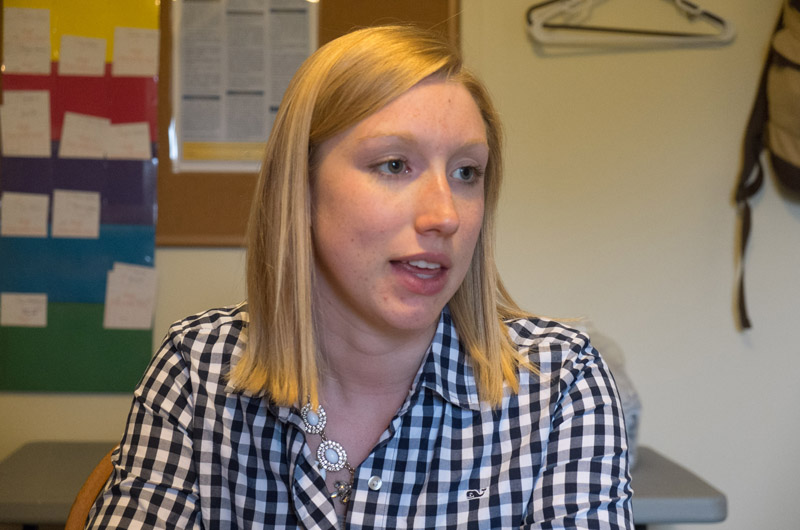
Lena Prisco leads clinical research.

Lena Prisco leads clinical research.
Ms. Prisco said cases of Lyme disease are vastly under reported, in large part because the only official diagnosis — a red bull’s eye rash at the point of infection — appears in fewer than half of all cases. Even people with a rash may not have produced enough antibodies for a positive diagnosis.
“The current methods, although they are very specific, they can tend to be insensitive because they depend on an immune response which is variable from person to person,” Ms. Prisco said in an interview this week. “Then it leads to either false negatives or false
positives. The danger obviously in this case is a false negative,” she added.
All three trials rely on volunteer patients who have been diagnosed with Lyme disease. More than 20 patients have signed up so far, and more are expected this summer as the number of cases on the Island increases. Most volunteers receive a stipend of $50 or $100 over the course of the trial.
An initial study using frozen samples to compare two diagnostic techniques has already been completed. Ms. Prisco will present the results at a national conference in Atlanta next month. The results may allow for faster diagnosis without having to send antibody samples to larger clinics for additional testing.
This winter, the center joined a trial by Oxford Immunotec, a global diagnostics company based in Marlborough. The study looks at the response of certain types of white blood cells known as T-cells, rather than antibodies, as an indicator of Lyme disease. Alix Emden, one of two interns working at the center this summer, said that approach “is go
ing to make it a more effective test, for faster results and less ambiguity.” One goal of the study is to develop an FDA-approved Lyme disease testing kit for hospitals. The trial will likely end this fall.
Anna McGlade, another intern working in the lab this summer, added that while antibodies can stay in the body for up to five years, T-cells have a more immediate response to the disease. “So you would be able to determine new infection versus the effects of long-term infection,” she said.
The trial itself required FDA approval and looks only at patients who exhibit the bull’s eye rash. Mr. Loberg, a Vineyard Haven resident who took ownership of the medical center last year, said he expects the trial to prove 100 per cent effective for diagnosing those patients. “Then the real question is, other people who we’ve diagnosed with Lyme disease — that they show positive too,” he said.

Intern Anna McGlade working in research lab this summer.
Intern Anna McGlade working in research lab this summer.
He said the Oxford Immunotec trial could revolutionize Lyme disease diagnosis. Vineyard Medical Center was eager to participate in the study, and Oxford Immunotec was drawn to the high incidence of Lyme disease on the Island and the center’s ability to run reliable tests, Mr. Loberg said. As of Tuesday, 11 patients were participating in the study.
In May the center began collecting samples for a Lyme disease repository funded in part by the Bay Area Lyme Foundation in Portola Valley, Calif. Repositories, or bio-banks, are common for many diseases, but not Lyme disease, Ms. Prisco said. She added that the bio-bank will likely be the center’s most expensive undertaking so far, since it is ongoing. Samples are sent to a certified specimen storage facility in Maryland for researchers to access after an application process.
A third trial that started last week will look at a range of cell types and responses that occur in an acute Lyme infection. That study, in conjunction with Stanford University, will likely continue for five years, in part because it also is limited to patients who present a rash.
All the clinics participating in the three trials will share their data and other results, Ms. Prisco said. She said she will be attempting to grow Lyme bacteria at the center this summer. “It’s notoriously hard to grow,” she said. “For whatever reason it doesn’t seem to survive well in culture methods.”
A small laboratory about the size of a kitchen pantry at the Vineyard Medical Center building houses the several machines that prepare the blood samples and run the tests. On Monday, a small machine hummed quietly as it rocked two vials of blood to prevent clotting.
“We are doing tons of stuff out of a very small space,” Mr. Loberg said, adding that eventually the space will need to expand. “Right now we can make it work by opening up [the clinic] on Saturdays and increasing our hours during the day.”
One goal of the center is to provide job experience for young people on the Island. Mr. Loberg said the medical center has begun training high school students in drawing blood and handling lab samples. With the right kind of fundraising, he said, the center could offer some year-round employment.
But Lyme disease research is mostly seasonal. Alzheimer’s or multiple sclerosis studies would be year-round, and would likely necessitate additional staff, said Ms. Prisco, who hopes to begin a trial looking at Alzheimer’s disease this year.
The center also aims to provide a new funding source for the Islandwide tick-borne illness reduction initiative, which began in 2000. A five-year grant administered by the Martha’s Vineyard Regional Hospital to fund the initiative ends this year. But the center plans to keep those efforts alive through grants and donations. Lyme disease is the most common tick-borne illness.
The initiative includes school programs, a web page and a series of educational videos, along with a free yard-assessment program in Chilmark and Chappaquiddick — two hot spots for ticks on the Island — to help people reduce tick habitat on their property.
Comments
The argument seems to be
Dolores Claesson FloridaThe argument seems to be whether Borrelia can set up a chronic infection. In addition, we have scant research that elucidates all the pathogens injected into us by various vectors and we do not know how these pathogens synergistically interact. For instance, since Borrelia does not require Iron for its dastardly deeds and instead utilizes Manganese, what role do other pathogens play in providing Manganese to Borrelia. If one studies many of the tick borne pathogens, you realize that quite a few can move from the acute to chronic phase. That is not being addressed either. We need next generation sequencing to ascertain all of the pathogens that are being transmitted and Coxiella burnetti, Mycoplasmas, Chlamydias and Brucella can also switch to a chronic phase as well as many others. Borrelia hermsii and burgdorferi can cripple the immune system, causing immune dysfunction and then we see most of the opportunistic infections that are in immune compromised people including those with AIDS. Auto antibodies seem to be produced in those with Borrelia and other co infecting agents.
http://www.jstor.org/discover/10.2307/3285004…
Pathway one is CCP or classical complement pathway which activates 4b2 and then Complement C5b9 also known as membrane attack complex.
Pathway two is antibody independent and requires the activation of C3bBb of the alternative complement pathway. The MAC or membrane attack complex has to disrupt the outer surface membrane of the spirochete in both cases.
…
Deer can kill off B garinii without any antibody production. Host response to these blasted spirochetes is varied. Article says that Borrelia is capable of activating both CCP and ACP.
Superevasion sites may occur on other powerful down regulators of host immunity, too. The concept of a microbial superevasion site is valid not only for down regulators of immunity, such as FH, but also for host immune activator molecules such as immunoglobulins.
http://journals.plos.org/plospathogens/article?id=10.1371%2Fjournal.ppa…
http://www.bmj.sk/2010/11103-09.pdf
Very interesting article that talks about immune compromisation of both cellular and humoral immunity and the auto antibodies that they found in lyme patients. People near me have autoantibodies to mitochondria and anti parietal cells of stomach, which produces intrinsic factor necessary for absorption of B 12. … Also interesting is that anti parietal cell antibodies and Hashi are mentioned elsewhere. Anti parietal cell antibodies are also discussed vis a vis infection with H. pylori. Atrophic gastritis and lyme too.
…I would get all these tests…Western Blot for Borrelia, also test for Borrelia hermsii, Borrelia recurrentis, and Babesia duncani and microti and Quest can test for duncani, Bartonella henselae and quintana, Brucella, Tularemia, Coxiella burnetti or Q fever, many rickettsias ie Rocky Mountain Spotted Fever, Typhus, Ehrlichia chaffeensis, Anaplasma phagocytophilum, EBV, CMV, all Coxsackie viruses, and now Powassan virus and its cousin Deer Tick Virus, HSV 1 and 2, HHV 1-8 if available. Parvovirus B -19, Papillomaviruses, Toxoplasmosis, Chlamydias and Mycoplasmas and get genetic tests for hypercoagulation like Mthfr and Factor V leiden, and test all your IgG subclasses 1-4, and CD 57 and C3a and C4a and CBS mutations and HPU/KPU and mold testing since so many of us have issues with mold. ECP or eisonophil cationic protein seems to suggest to docs that you have babesia. Also transfer growth factor b-1 and Beta Strep. High CD 57 counts may be associated with Beta Strep. Heavy metals have a part in this and we are low in Secosteroid D or vitamin D and some are low in Potassium and others iron. Many are deficient in all amino acids. Our hormones are a mess and the whole HPA Hypothalmic pituitary axis is the problem. We can have probs with our adrenals and thryoid…we do not convert T4 to T3 and in my case I have high reverse T3 or rT3. We are quite low in testosterone as well. Check out every hormone in your body, amino acids and vitamins and minerals. There are over 100 viruses we can get from a tick and also many parasites. The labs that insurance covers can’t find a parasite when we can see it under the microscope. Quest at Nichols Institute in Valencia California can culture samples and might even be able to distinguish Brucella suis from melitensis or arbortus. We also need an MRI of our brain with and without contrast. Many lymies are showing up with pituitary adenomas and pheomchromocytomas. Make sure that you do not have these. I have spent years trying to figure out what is in us and so far this is what I have seen. Unfortunately when your physician may take years to order all the necessary tests. Make sure you get tested sooner rather than later. One more thing …..you may get tested for Brucella today and 2 years from now may show up IgM positive. The immune system is overwhelmed with all these pathogens.
http://www.sophia.org/antidiuretic-hormone-adh-vasopressin-tutorial
Whole HPA is a mess. ADH is not normal in lyme patients. We also need to be tested for all the opportunistic fungal infections of AIDS patients.
How the immune system is crippled should be one aspect of research and then BosR and oxidative stress is another area to be researched and the fungal synergy needs to be explored.
We are discovering new pathogens all the time in people bitten by ticks. Powassan and Bourbon are two viruses now showing up. Candidatus neo ehrlichia mikurensis in Sweden is another new rickettsia. What role does Midichloria Mitochondrii or its Midichloria like organsism Montezuma play in human disease. We see antibodies being produced to Montezuma that is being injected from a variety of ticks as well. It is time to get busy researching this world wide epidemic and stop fighting and harming very ill people. People remain ill and a short course of any antibiotic is not going to eradicate all pathogens.
Thank you Dolores for your
Cameron Parry ChilmarkThank you Dolores for your comment. People can learn much more from your comment than any mainstream article. The insurance covered testing (if it exists) for the many diseases you mention, is garbage; they serve only to mask the problem by doling out false negatives. A false positive for lyme or any other of these infections is not something I have heard of. Even if you test positive for chronic lyme they will like to tell you it is just left over antibodies from an old infection. 'It is MS, it is fibromyalgia, it is ALS, it is dementia, it is depression' 'take this expensive toxic pill'. No, its chronic infections of tick borne illnesses. Meanwhile I go to the vet when my dog is sick with a TBI, gets a blood prick and two minutes later the vet comes out with what looks like a pregnancy test and tells me she is 'high in anaplasma', a disease most doctors have probably never heard of let alone tested for. What is going on? There are like 30 types of bartonella and they have these garbage tests for like 3 of them. Meanwhile you can pay a thousand dollars out of pocket send your own blood to a lab in Cali and get a proper 'DNA' test, which are pretty broad and accurate. Maybe they should try to improve on this type of test and get the cost down.
Another question, where are all these diseases coming from? Lyme popped up out of nowhere across the connecticut sound from plum island in the 1970s. They now want to say it has always been here, but if that were true how did it pop up out of nowhere in Lyme in the 1970's? it would have been famous, Lyme is not nothing. Now there are literally hundreds of debilitating potentially chronic infections coming from ticks; natures hypodermic needle.
Another issue, many of these TBIs are antibiotic resistant. I had normal chronic lyme for several years before getting to a 'Lyme specialist'. I took three three month courses of high dose antibiotics with adjuvants. Finally the infection came through the antibiotics while I was taking them. I got off them and within two weeks I was run over by the train of death. I was in terrible pain and weakness and completely unable to work for months, I was terrified I would remain an invalid. During that time I researched alternative medicine and found MMS among many other things. I have now fully cured myself and recently started Crossfit, which speaks to my excellent health. Now I have a one month old baby which was bit by a nymph brought in by the dog last week.
Sounds like more gravy train
Philosophy ScieneSounds like more gravy train funding to me. We need the prompt preparation using existing technologies of a single antigen panel test for all genera of infections harbored by ticks and all antigens of each genus.
Look very closely at
Martha FloridaLook very closely at serotonin.
Add new comment